
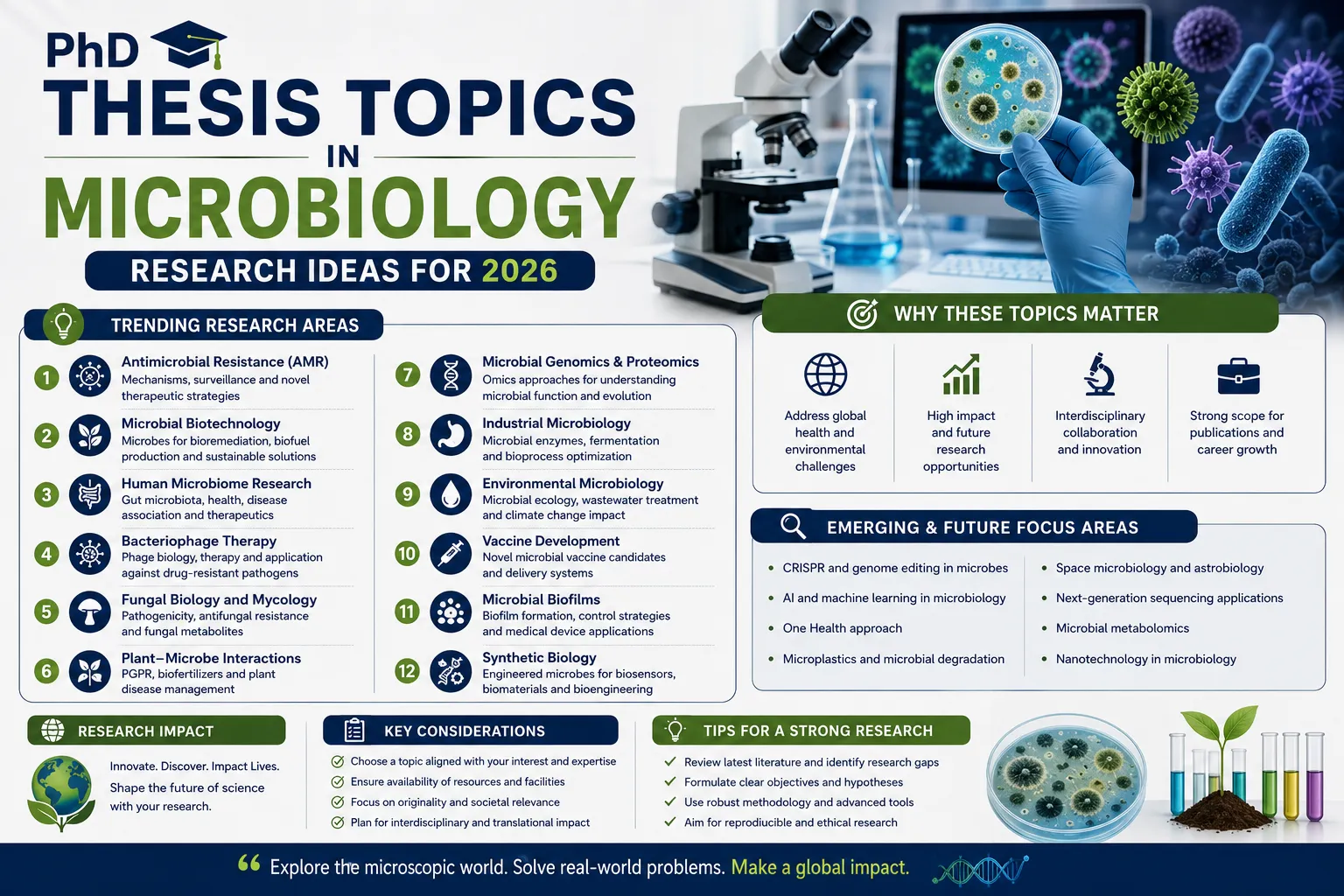
Microbiology is one of those PhD fields where the honest challenge isn't finding an interesting topic — it's narrowing down from genuinely too many good options. Antimicrobial resistance, the gut microbiome, CRISPR diagnostics, phage therapy, environmental microbiology: each of these is its own vast research territory. This guide walks through trending, genuinely research-ready PhD thesis topics in microbiology for 2026, along with how to narrow a broad theme into something your supervisor will actually approve.
What Makes a Microbiology Topic Genuinely Strong
Selecting a strong microbiology dissertation topic is not about finding the most impressive-sounding title. It's about identifying a question that can be meaningfully investigated, sits within an established body of literature, and contributes something of genuine academic value. This framing matters particularly in a field as broad as microbiology, spanning infectious disease, antimicrobial resistance, microbiome research, environmental microbiology, and biotechnology as genuinely distinct sub-areas — each with its own methods, literature, and expectations.
The 2026 Landscape in Brief
Antimicrobial resistance (AMR) continues to be a top global research priority, with the World Health Organization and national governments classifying it as a critical global threat — and research funding in this area remains strong, making AMR-focused topics both currently relevant and genuinely fundable. Microbiome science has expanded rapidly, with the gut bacteria-disease relationship now one of the most published areas in biomedical research — meaning genuinely narrow, well-differentiated framing matters more than ever in this specific space. Pathogen detection technology has also advanced significantly, with CRISPR-based diagnostics and AI-assisted microbial identification moving from research labs toward clinical application.
Trending PhD Thesis Areas in Microbiology for 2026
1. Antimicrobial Resistance Gene Profiling in Clinical Settings
Antibiotic resistance patterns in hospital-acquired infections remain one of the strongest, most fundable current research directions. A representative, well-scoped approach examines resistance gene profiles, current treatment protocol effectiveness, and the role of infection control practices in limiting resistance spread — combining molecular analysis with a genuine clinical/public health dimension.
Narrowed thesis example: "Molecular Characterization of ESBL Resistance Genes in Hospital-Acquired E. coli and Klebsiella Isolates: Prevalence and Treatment Protocol Implications"
2. Gut Microbiome and Antibiotic-Driven Resistance Spread
The gut microbiome's specific role in antibiotic-driven antimicrobial resistance is a currently active research frontier. Horizontal gene transfer (HGT) dynamics — the lateral spread of resistance genes across diverse bacteria via conjugation, transformation, and transduction — remains a fundamental biological challenge and a genuine open research area with real room for original contribution.
Narrowed thesis example: "Characterizing Horizontal Gene Transfer Dynamics Within the Gut Resistome Following Broad-Spectrum Antibiotic Exposure"
3. Bacteriophage Therapy for Resistant Infections
Bacteriophage (phage) therapy is an actively growing microbiome intervention research direction, particularly relevant given rising antimicrobial resistance. Phage host-specific lytic action enables precise elimination of pathogenic bacteria while avoiding antibiotic-induced dysbiosis — but the phage-host-microbiome interaction mechanisms remain unclear, representing a genuine, well-documented research gap.
Narrowed thesis example: "Investigating Phage-Host-Microbiome Interaction Mechanisms During Targeted Bacteriophage Therapy for Multidrug-Resistant Pseudomonas aeruginosa"
4. CRISPR-Based Rapid Diagnostics
CRISPR-based rapid diagnostic tools are a specifically current, technology-forward direction, with strong potential for direct comparison against standard PCR-based detection methods on both accuracy and speed.
Narrowed thesis example: "Development and Validation of a CRISPR-Based Diagnostic Assay for Rapid Detection of Respiratory Pathogens: A Comparative Study Against Standard PCR"
5. Gut Microbiome and Metabolic Disease
The gut microbiome's role in metabolic syndrome and obesity remains a strong, heavily published direction — genuine originality here requires a specifically narrow angle, such as a particular population, dietary intervention, or metabolic marker not yet extensively studied.
Narrowed thesis example: "Gut Microbiome Composition and Its Association With Blood Glucose Regulation in Adults With Newly Diagnosed Type 2 Diabetes"
6. The Gut-Liver Axis in Liver Disease
The gut-liver axis and its relationship with liver disease progression is a specifically differentiated microbiome sub-direction, connecting microbial ecology directly to a defined clinical outcome.
Narrowed thesis example: "Characterizing Gut Microbial Dysbiosis and Its Association With Disease Progression in Non-Alcoholic Fatty Liver Disease"
7. Probiotics and Fecal Microbiota Transplantation for IBD
Microbiome modulation strategies — including probiotics and fecal microbiota transplantation — for managing inflammatory bowel disease represent a well-established, clinically relevant research direction with a strong existing evidence base to build from.
Narrowed thesis example: "Evaluating Fecal Microbiota Transplantation as an Adjunct Therapy for Treatment-Resistant Ulcerative Colitis: A Microbial Composition Analysis"
8. Environmental Microbiology and Microplastic Contamination
Environmental microbiology has grown in importance as climate change, agricultural intensification, and plastic pollution raise new questions about microbial ecosystem function — a genuinely broadening area with strong current relevance.
Narrowed thesis example: "Assessing the Impact of Microplastic Contamination on Bacterial Community Structure in Freshwater Sediment Ecosystems"
9. Soil Microbial Communities and Agricultural Practice
The impact of agricultural practices — including pesticide use and land management — on soil microbial diversity and function is a specifically flagged, currently relevant environmental microbiology direction.
Narrowed thesis example: "Comparative Analysis of Soil Microbial Diversity in Rewilded vs. Conventionally Farmed Agricultural Land"
10. AI-Powered Microbial Diagnostics and Big Data
Emerging computational directions include microbiome big data analysis pipelines, AI-powered microbial diagnostic platforms, and bioinformatics tools specifically for AMR tracking — reflecting the field's ongoing shift toward data-intensive, technology-integrated research methods.
Narrowed thesis example: "Development of a Machine Learning Pipeline for Early Detection of Antimicrobial Resistance Patterns From Clinical Microbiome Sequencing Data"
11. Skin and Vaginal Microbiome in Clinical Contexts
Site-specific microbiome research — the skin microbiome in dermatological conditions, or the vaginal microbiome's relationship to pregnancy outcomes — represents a well-differentiated, clinically grounded direction distinct from the more heavily saturated gut microbiome space.
Narrowed thesis example: "Characterizing Skin Microbiome Composition in Atopic Dermatitis Patients and Its Response to Targeted Antimicrobial Therapy"
12. Quorum Sensing Inhibition as an Antibiofilm Strategy
Quorum sensing inhibition — blocking bacterial cell-to-cell communication to disrupt biofilm formation and disease progression — represents a mechanistically distinct alternative to traditional antibiotic approaches, particularly relevant given the biofilm-related treatment resistance seen in chronic infections.
Narrowed thesis example: "Evaluating Quorum Sensing Inhibitor Compounds as an Antibiofilm Strategy Against Catheter-Associated Urinary Tract Infections"
Practical Feasibility Considerations for Microbiology PhD Topics
Given how heavily microbiology depends on specific lab infrastructure and access, check these before finalizing a topic:
- Does your department have the specific molecular/sequencing infrastructure your topic requires (16S rRNA sequencing, whole-genome sequencing, qPCR, biosafety level requirements)?
- If your topic involves clinical samples, do you have the necessary ethics approval pathway and institutional collaboration (hospital, clinic) already accessible?
- Does your topic require specialized reagents, culture collections, or biosafety clearances you'd need to arrange well in advance?
- Does your supervisor's expertise genuinely align with your chosen sub-area (AMR, microbiome, environmental, computational)?
Step-by-Step: How to Narrow a Trending Theme Into a Defensible Thesis Topic
- Choose a broad trending area from the list above that genuinely interests you and fits your department's infrastructure
- Specify the exact organism, microbial community, or mechanism — not "AMR" but "ESBL resistance genes in E. coli"
- Name the specific clinical, environmental, or biotechnological application
- Define your measurable outcome — resistance gene prevalence, microbial diversity index, diagnostic accuracy, treatment response
- Confirm lab infrastructure, ethics pathway, and reagent access for your specific measurable outcome
- Check supervisor expertise alignment before finalizing
- Verify the specific narrow niche isn't already comprehensively covered by very recent (2025–2026) publications, particularly critical given how crowded gut microbiome research specifically has become
Practical Checklist: Is Your Microbiology Thesis Topic Ready?
- Topic specifies an exact organism, microbial community, or mechanism, not a broad category
- A specific clinical, environmental, or biotechnological application is named
- A measurable outcome or performance metric is defined
- Required lab infrastructure (sequencing, culture, biosafety level) is confirmed accessible
- Ethics approval pathway is identified if clinical samples are involved
- Supervisor's expertise genuinely aligns with the chosen sub-area
- Recent literature (2025–2026) has been checked to confirm the specific niche isn't already saturated
Two Practical Scenarios
Scenario 1 — Narrowing an Overly Broad Gut Microbiome Topic
A student initially proposed "Gut Microbiome and Human Health" — far too broad and heavily saturated to defend as a single PhD thesis. After applying the narrowing framework, the topic became "Gut Microbiome Composition and Its Association With Blood Glucose Regulation in Adults With Newly Diagnosed Type 2 Diabetes," specifying the exact population, the specific health outcome, and a measurable metric — resulting in a clear, feasible, and genuinely differentiated research plan.
Scenario 2 — Checking Infrastructure Before Committing
A student interested in both CRISPR-based diagnostics and phage therapy evaluated their department's actual resources: strong access to a molecular diagnostics lab with existing PCR and CRISPR-adjacent equipment, but no established biosafety-level infrastructure or hospital collaboration needed for phage isolation and clinical testing. Recognizing this constraint, the student chose the CRISPR diagnostics direction, which matched available infrastructure, over the phage therapy direction, which would have required clinical partnerships and biosafety clearances the department couldn't readily provide.
Common Mistakes PhD Microbiology Students Make When Choosing a Topic
- Proposing a broad research area as the topic itself, without narrowing to a specific organism, mechanism, and application.
- Choosing a topic in an oversaturated space (broad gut microbiome research) without a genuinely differentiated angle.
- Underestimating ethics approval and clinical collaboration requirements for topics involving human samples.
- Not confirming lab infrastructure and reagent access before committing to a molecular or sequencing-heavy topic.
- Choosing a sub-area outside the supervisor's genuine expertise, risking limited guidance through technically demanding methodology.
Frequently Asked Questions
What are trending PhD thesis topics in microbiology for 2026?
Leading areas include antimicrobial resistance gene profiling, gut microbiome and resistance gene transfer, bacteriophage therapy, CRISPR-based diagnostics, gut microbiome and metabolic disease, the gut-liver axis, probiotics/fecal microbiota transplantation for IBD, environmental microbiology (microplastics, soil health), AI-powered microbial diagnostics, site-specific microbiome research, and quorum sensing inhibition.
Why does topic selection matter for a PhD thesis in microbiology?
Microbiology spans genuinely distinct sub-fields (AMR, microbiome, environmental, computational) each with different infrastructure and ethics requirements, and a topic that isn't narrowed and checked against these practical constraints can become difficult to execute within a standard PhD timeline, regardless of scientific interest.
How does trending research area selection affect a thesis's outcomes?
Aligning with an active 2026 direction — AMR, CRISPR diagnostics, phage therapy — increases both publication potential and funding relevance, but only if the specific niche within that direction is narrowed enough to remain original, particularly in heavily saturated spaces like gut microbiome research.
How long does it take to complete a PhD thesis using this approach?
Timelines vary significantly based on methodology — sequencing-heavy or clinical-sample-based topics generally take longer due to ethics approval and data collection timelines, while computational or bioinformatics-focused topics may proceed faster given existing public datasets.
Is professional help available for PhD thesis topics in microbiology?
Yes. ThesisLikho's PhD-qualified experts have guided 10,000+ scholars through topic selection, research methodology, and complete PhD thesis writing assistance tailored to microbiology and other life science disciplines.
Get Expert Guidance on Your PhD Microbiology Thesis Topic
Choosing a microbiology PhD topic that's simultaneously novel, feasible, and well-matched to your department's infrastructure takes careful evaluation across several practical dimensions at once. If you'd like expert input on refining your microbiology thesis topic or checking its feasibility, ThesisLikho's PhD-qualified team offers topic selection support, research methodology guidance, and complete PhD thesis writing assistance. If you need expert guidance with your thesis topic, research design, or overall project structure, you can explore our PhD Thesis Assistance service.
Book a PhD Research Consultation → https://thesislikho.com/writing-services/thesis-assistance-phd
Email: support@thesislikho.com
Mobile No.: +91-9289068414 , +91-9643802216