
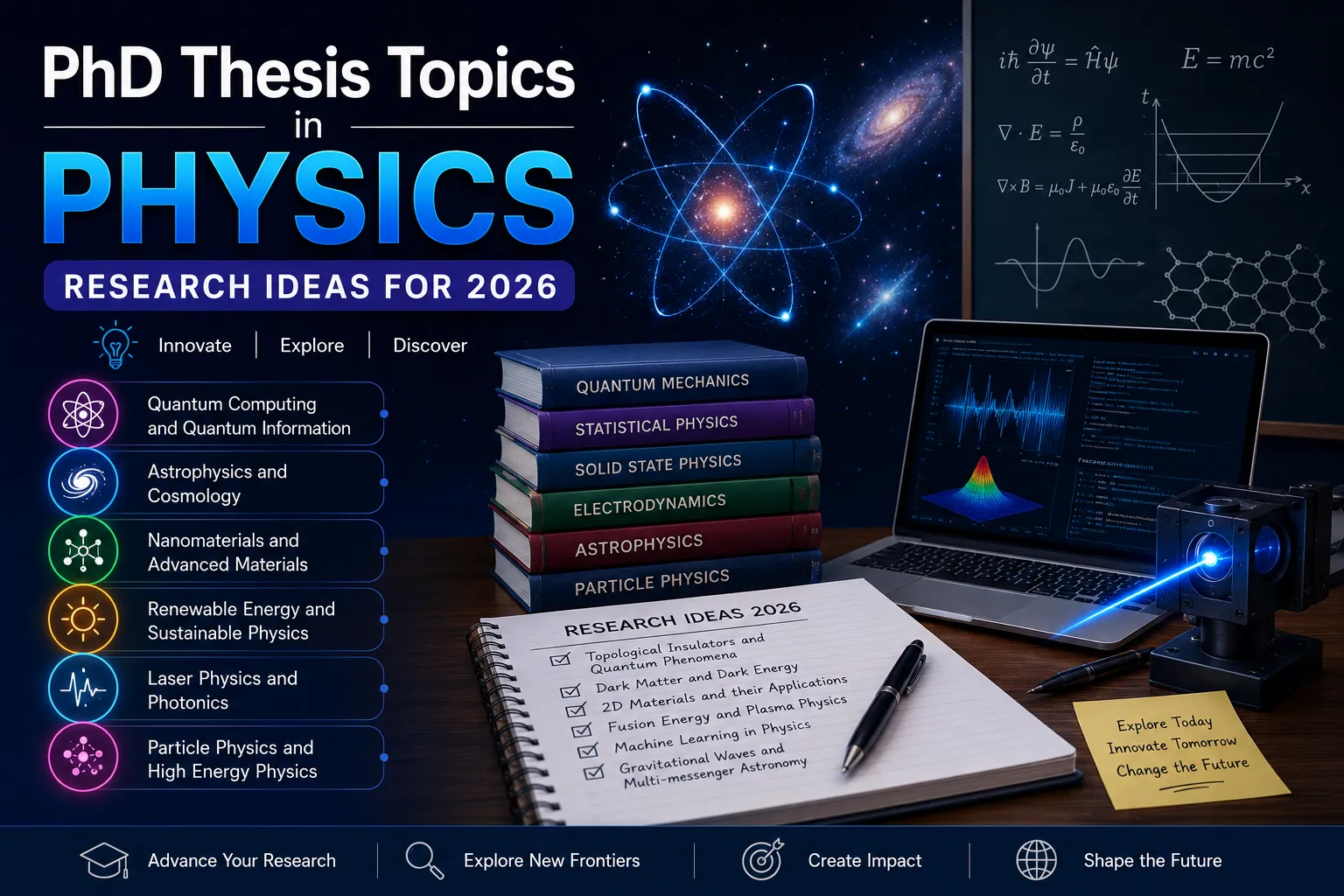
If you're a PhD Physics scholar trying to lock down a thesis topic, you're working in a field with genuinely significant momentum behind it right now in India specifically — the National Quantum Mission is funding quantum research at a scale the country hasn't seen before, LIGO-India is actively under construction as a major gravitational wave observatory, and Indian institutions are directly involved in some of the world's largest international astrophysics collaborations. This guide walks through PhD thesis topics in physics research ideas for 2026, organized by category, along with the framework you need to choose a topic that's both scientifically current and realistically feasible.
This guide is written specifically for first-time PhD thesis writers in India who want topics grounded in real, current research infrastructure and funding — not generic physics themes disconnected from what's actually researchable right now.
Why Physics Topic Selection Needs Extra Care
Physics research spans an enormous range — from how particles behave at the smallest quantum scale to how the universe expands at a cosmic one — and this breadth is exactly why topic selection needs more deliberate narrowing here than in many other disciplines. "Quantum physics" or "condensed matter physics" aren't topics; they're entire continents of research, each containing dozens of genuinely distinct, specific research directions. Choosing among PhD thesis topics in physics research ideas for 2026 means narrowing from one of these broad areas down to a specific system, technique, or application — and doing so in a way that's grounded in what your specific department can actually support.
ThesisLikho's PhD-qualified experts, who've guided over 10,000 scholars through topic selection and thesis development, consistently see the same pattern trip up first-time physics scholars: choosing a broad area based on general interest without checking whether their specific department has the laboratory equipment, computational resources, or theoretical expertise the resulting topic would actually require.
India's Current Physics Research Infrastructure and Funding
Understanding where India's physics research investment and infrastructure currently stands is genuinely useful before finalizing a topic, since several current developments create real, concrete research opportunities. India's National Quantum Mission is a government-approved program funded at roughly ₹6,000 crore, running from 2023-24 through 2030-31, supporting research across quantum computing, quantum communication, quantum sensing and metrology, and quantum materials and devices. As part of this mission, ISRO is developing quantum key distribution satellites for secure communication, and institutes including IISc Bangalore and IISER Pune are actively building quantum sensing hardware — nitrogen-vacancy diamond sensors and cold-atom gravimeters among them — creating genuinely current, well-funded infrastructure for quantum-focused thesis topics.
On the astrophysics side, LIGO-India is a concrete, currently-developing mega-science project — an Indo-US collaboration between India's Department of Atomic Energy and Department of Science and Technology, partly supported by the US National Science Foundation, building an advanced gravitational-wave observatory on Indian soil. The Inter-University Centre for Astronomy and Astrophysics in Pune, set up by the UGC specifically to promote astronomy and astrophysics research at Indian universities, is directly involved in this project alongside several other major international collaborations, including AstroSat, the Thirty Meter Telescope, the Square Kilometre Array, and the Legacy Survey of Space and Time — meaning gravitational wave and multi-messenger astrophysics research has genuine, current, India-linked infrastructure behind it, not just international opportunity.
Beyond these two flagship developments, India's broader physics research landscape includes the Tata Institute of Fundamental Research, conducting research across astronomy and astrophysics, condensed matter physics and materials science, high energy physics, nuclear and atomic physics, and theoretical physics, with specialized centres in Bengaluru and Pune. Department of Atomic Energy-funded institutes — the Bhabha Atomic Research Centre, the Raja Ramanna Centre for Advanced Technology in Indore, the Indira Gandhi Centre for Atomic Research in Kalpakkam, the Variable Energy Cyclotron Centre in Kolkata, and the India-based Neutrino Observatory — offer additional specialized infrastructure depending on your specific sub-field.
Latest Trends Shaping 2026 Physics PhD Research
Globally, the most actively funded and researched physics areas right now include quantum computing and quantum technology, condensed matter physics (closely linked to quantum computing progress, since many quantum computing breakthroughs emerge directly from condensed matter research), theoretical and observational astrophysics (gravitational waves, the cosmic microwave background, dark matter and dark energy), and increasingly, interdisciplinary research combining physics with biology or materials science.
Materials science specifically is seeing genuinely active research into two-dimensional materials, topological quantum matter, and perovskite materials for photovoltaic applications, alongside continued work on high-temperature superconductivity in layered materials. Plasma physics and fusion energy research remains a consistently active, well-funded area globally, tied to ongoing efforts toward viable fusion power. Photonics and nonlinear optics research is expanding, particularly around integrated photonic circuits and quantum optomechanics. And computational physics — AI-assisted physical modeling, machine learning applied to gravitational wave data analysis, and AI-assisted analysis of large astronomical datasets — is becoming a genuinely mainstream research approach across nearly every physics sub-field, not a niche computational specialty.
Quantum sensing deserves particular mention as a rapidly growing area combining quantum technology with precision measurement, with applications spanning gravitational wave detection, magnetic field mapping for both fundamental science and biomedical applications, and fundamental tests of physical laws using entangled particles and atomic clocks.
Topic Selection Framework for Physics PhD Scholars
Run any shortlisted topic through these five checks before finalizing it. First, currency: is this genuinely tied to an active 2025–2026 research direction or a live funding initiative, not something that peaked years ago? Second, specificity: can you state your exact research question, system, and approach in one sentence, narrowed well past a broad area name like "condensed matter physics" or "astrophysics"? Third, feasibility: do you have realistic access to the laboratory equipment, computational resources, telescope or detector time, or theoretical expertise your topic requires within your program's timeline? Fourth, originality: has this exact angle, in this exact system or context, already been extensively studied? Fifth, supervisor and infrastructure fit: does your department or a collaborating institution genuinely have the specific capability your topic depends on?
A topic that fails the feasibility check — for instance, requiring access to a specific detector, telescope facility, or specialized fabrication equipment your department doesn't have — is one of the most common reasons physics PhD timelines run into difficulty, so confirm this before finalizing, not after.
What Is a Research Gap in Physics Research?
A research gap in physics research typically falls into a few recognizable categories. A theoretical gap exists where an established physical model or theory hasn't yet been extended to account for a newly observed phenomenon or a previously unexamined regime. An experimental gap exists where a theoretical prediction hasn't yet been tested experimentally, often because the required precision or instrumentation has only recently become available — quantum sensing's rapid improvement is opening up several such gaps right now. A computational gap exists where a physical system is too complex to solve analytically and a specific computational or machine-learning approach hasn't yet been applied to it. And a materials-specific gap exists where a newly synthesized or newly characterized material's properties haven't yet been fully explored for a specific application.
For most first-time Indian physics PhD scholars, gaps tied to newly available instrumentation or newly funded infrastructure — quantum sensing hardware becoming available through the National Quantum Mission, or gravitational wave data becoming available as LIGO-India's capabilities develop — are often the most concretely current and defensible starting points.
100+ PhD Physics Thesis Topics by Category
Quantum Computing and Quantum Information
- Error correction strategies for topological qubits in fault-tolerant quantum computing
- Comparative performance analysis of superconducting versus trapped-ion qubit architectures
- Quantum algorithm development for simulating strongly correlated electron systems
- Decoherence mitigation techniques in solid-state qubit systems
- Quantum entanglement measures in many-body quantum systems
- Hybrid classical-quantum algorithms for optimization problems
- Scalability challenges in superconducting quantum processor architectures
- Quantum error mitigation techniques for near-term noisy quantum devices
- Quantum simulation of condensed matter phase transitions
- Benchmarking quantum advantage claims through classical simulation comparison
Quantum Sensing and Metrology
- Nitrogen-vacancy diamond sensor optimization for biomedical magnetic field mapping
- Cold-atom interferometry-based gravimeter design for precision gravity measurement
- Quantum-enhanced sensors for gravitational wave detection sensitivity improvement
- Entangled photon-based strain sensing for material deformation detection
- Quantum metrology techniques for atomic clock precision improvement
- SQUID magnetometer arrays for local gravitational wave detection complementing large interferometers
- Quantum sensing applications for early-stage disease biomarker detection
- Precision measurement techniques using entangled particle states for fundamental physics tests
- Quantum LiDAR system development using entangled photon pairs
Condensed Matter Physics
- Spin-orbit coupling effects in topological insulator systems
- Quantum phase transitions in ultra-cold atomic gas systems
- High-temperature superconductivity mechanisms in layered materials
- Spintronics-based device design for low-power computing applications
- Topological quantum matter characterization in van der Waals heterostructures
- Quantum criticality and universality classes in strongly correlated systems
- Moiré material electronic property investigation in twisted bilayer systems
- Floquet time crystal realization in periodically driven quantum systems
- Majorana fermion detection in topological superconductor systems
- Quantum optomechanics applications in mechanical resonator cooling and manipulation
Astrophysics and Gravitational Wave Research
- Machine learning-based gravitational wave signal detection and classification
- Multi-messenger astronomy approaches combining gravitational wave and electromagnetic data
- Continuous gravitational wave detectability from rotating neutron star systems
- Primordial black hole detection through gravitational wave signal analysis
- Cosmic microwave background analysis for early universe structure formation studies
- Exoplanet atmosphere characterization using spectroscopic observation data
- Dark matter detection model development using astrophysical observational constraints
- Black hole information paradox investigation through quantum entanglement frameworks
- Neutron star equation of state constraints from gravitational wave observations
- AI-assisted analysis of large-scale astronomical imaging datasets
- Galactic magnetic field origin investigation using radio astronomy observations
Particle Physics and High Energy Physics
- Beyond Standard Model particle search strategies at current collider energies
- Neutrino oscillation parameter measurement using long-baseline experimental data
- Dark matter candidate particle detection through direct detection experiments
- Cosmic ray acceleration mechanism investigation using high-energy observational data
- Precision measurement of fundamental particle properties for Standard Model tests
- Quark-gluon plasma characterization in heavy-ion collision experiments
- Neutrinoless double beta decay search methodology for neutrino mass hierarchy determination
- Dark energy equation of state constraints from cosmological observation data
Materials Science and Nanomaterials
- Nanostructured material design for high-efficiency solar cell applications
- Perovskite material optical property optimization for photovoltaic performance
- Two-dimensional material heterostructure fabrication for optoelectronic applications
- Thermoelectric material development for waste heat recovery applications
- Semiconductor nanowire fabrication for optoelectronic device applications
- Graphene-based composite material characterization for electronic applications
- Programmable thermal metamaterial design for infrared sensing applications
- Self-healing material development for extended device lifetime applications
- Nanomaterial toxicity and biocompatibility assessment for biomedical applications
Photonics and Optics
- Nonlinear optical property characterization in integrated photonic circuit materials
- Silicon photonics-based optical computing architecture development
- Metasurface design for wavefront manipulation in optical applications
- Quantum optomechanics-based precision sensing device development
- Optical fiber sensor design for structural health monitoring applications
- Photonic crystal fabrication for light manipulation applications
- Ultrafast laser-matter interaction investigation for material processing applications
Plasma Physics and Fusion Energy
- Plasma turbulence simulation in magnetic confinement fusion devices
- Plasma surface modification techniques for biomedical material applications
- Magnetic confinement stability analysis for fusion reactor design optimization
- Laser-driven plasma acceleration mechanism investigation for particle physics applications
- Plasma diagnostic technique development for fusion device performance monitoring
- Low-temperature plasma applications in materials processing and surface treatment
Computational and Theoretical Physics
- Machine learning-based prediction of material properties from structural data
- Computational modeling of strongly correlated electron system behavior
- Numerical relativity simulation techniques for black hole merger event modeling
- AI-assisted physical model development for complex system behavior prediction
- Monte Carlo simulation methods for statistical mechanics system investigation
- Density functional theory application for novel material property prediction
- Machine learning-accelerated molecular dynamics simulation development
- Quantum chaos investigation in classically chaotic system quantum analogues
Nuclear and Atomic Physics
- Nuclear structure investigation using advanced spectroscopic techniques
- Radioactive isotope production optimization for medical imaging applications
- Nuclear reaction cross-section measurement for astrophysical nucleosynthesis modeling
- Atomic clock precision improvement using advanced laser cooling techniques
- Nuclear fission product characterization for waste management applications
- Cold atom trapping technique optimization for precision measurement applications
Applied Physics and Interdisciplinary Research
- Biophysical modeling of protein folding dynamics using computational approaches
- Physics-based modeling of climate system feedback mechanisms
- Medical physics applications of radiation dosimetry for cancer treatment optimization
- Renewable energy material physics for improved solar cell efficiency
- Physics-informed machine learning models for complex system prediction
- Acoustic metamaterial design for noise reduction applications
- Biomechanics investigation using physics-based modeling approaches
- Physics of granular material flow for industrial process optimization
Renewable Energy and Sustainable Physics
- Solar cell efficiency optimization through novel semiconductor material research
- Energy storage material physics for improved battery performance
- Piezoelectric material development for energy harvesting applications
- Thermoelectric generator optimization for waste heat energy recovery
- Wind turbine aerodynamics optimization through computational fluid dynamics modeling
- Hydrogen storage material physics for clean energy applications
- Photocatalytic material development for solar-driven water splitting applications
- Grid-scale energy storage physics for renewable energy integration
Theoretical, Experimental, or Computational: Matching Your Topic to Your Approach
Physics PhD topics generally fall into one of three broad methodological categories, and being honest about which one genuinely fits your strengths, interests, and department's capabilities matters as much as the topic itself. Theoretical physics topics rely on mathematical modeling and analytical derivation, requiring strong mathematical preparation and typically minimal laboratory infrastructure, but demanding genuine comfort with abstract, often highly technical formalism over an extended period. Experimental physics topics require hands-on laboratory work, and their feasibility depends heavily on your department's specific equipment and instrumentation — a topic requiring a facility your department doesn't have access to, even if scientifically exciting, isn't a realistic choice without a confirmed external collaboration. Computational physics topics rely on simulation, numerical methods, or machine learning applied to physical systems, requiring strong programming skills and adequate computational resources, and have become an increasingly common and accessible entry point given how central AI-assisted modeling has become across nearly every physics sub-field.
Many current, strong physics topics genuinely blend two of these approaches — a computational study validated against experimental data, or a theoretical model tested through simulation — and being clear about which combination your specific topic requires, and confirming your department can support it, is essential before finalizing.
Two Practical Examples, Explained in Depth
A strong version of a quantum sensing topic isn't simply "quantum sensors" but something like the development and characterization of a nitrogen-vacancy diamond sensor optimized specifically for detecting weak magnetic field signatures relevant to early-stage biomedical diagnostics, building on ongoing work at institutes like IISc under India's National Quantum Mission. This works well because it's anchored to genuinely current, well-funded national infrastructure, addresses a specific, checkable application (biomedical magnetic field detection) rather than a vague sensing goal, and connects to an active Indian research program a scholar could realistically seek collaboration or mentorship through.
A strong version of a gravitational wave topic, similarly, isn't just "gravitational wave astronomy" but something like developing a machine learning-based classification method for distinguishing genuine continuous gravitational wave signals from noise in preparation for LIGO-India's eventual data stream, potentially in collaboration with or informed by IUCAA's involvement in the broader LIGO collaboration. This ties directly to a concrete, currently-developing piece of Indian scientific infrastructure, gives a computational physics scholar a genuinely current and originality-rich angle even without direct experimental access to a gravitational wave detector, and positions the resulting thesis to remain relevant as LIGO-India's capabilities continue to develop.
Both examples illustrate the same principle: the strongest physics thesis topics combine a genuinely current scientific direction with a specific, checkable system or application — and, where possible, a connection to real, current Indian research infrastructure and funding, not just international literature alone.
Getting Supervisor Approval
Supervisors approve physics thesis topics faster when scholars demonstrate they've already confirmed feasibility, not just scientific interest. Bring two or three shortlisted topics, each with the specific equipment, computational resources, or theoretical expertise it requires already identified. Reference a specific, current development — India's National Quantum Mission funding calls, LIGO-India's ongoing construction, or a recent published result in your specific sub-field — to show real groundwork rather than a general area of interest. Be upfront about whether your topic is theoretical, experimental, or computational, and confirm your department can genuinely support that specific approach. If your topic depends on external collaboration or facility access beyond your own department, have a realistic plan for securing it ready to discuss.
For a deeper framework on this exact step, our related guides on [Link: How to Choose a Strong Thesis Topic Your Supervisor Will Approve] and [Link: What Is a Research Gap and How to Identify One for Your Thesis] walk through this process in more depth.
Common Mistakes When Choosing a Physics Thesis Topic
- Choosing a topic based on a broad area name — "quantum computing" or "astrophysics" — without narrowing it to a specific system, technique, or application
- Ignoring equipment or computational feasibility, picking an experimental or computational topic your department genuinely can't support
- Underestimating how mathematically or computationally demanding a theoretical or computational topic will be relative to your current preparation
- Overlooking genuinely current Indian research infrastructure and funding opportunities, defaulting only to international literature for topic inspiration
- Skipping the literature scan before finalizing, leading to a topic that turns out to already be extensively covered
- Choosing a topic that blends approaches (theoretical plus experimental, or computational plus experimental) without confirming your department can genuinely support both halves
Topic Validation Checklist
Before finalizing any topic, confirm the following:
- It's narrowed well past a broad area name to a specific system, technique, or application
- Your intended approach (theoretical, experimental, or computational) is clearly identified and matches your actual skills and preparation
- Your required equipment, computational resources, or facility access is confirmed genuinely available
- A preliminary literature scan confirms a genuine gap rather than an oversaturated area
- The topic connects, where possible, to current, active research infrastructure or funding you could realistically draw on
- Your supervisor has reviewed and approved the direction, including its feasibility within your department
- You can write a clear two-to-three sentence problem statement directly from the topic as stated
How Long Does a PhD Thesis Take Using This Approach?
Topic finalization for a physics PhD, including confirming genuine feasibility around equipment, computation, or theoretical scope, typically takes four to six weeks when approached systematically. From there, most Indian physics PhD programs run four to six years overall, with experimental topics generally taking longer than theoretical or computational ones given equipment setup, calibration, and data collection timelines — though this varies considerably depending on your specific sub-field and facility access.
If you need expert guidance with topic selection, research methodology, or thesis development, you can explore our PhD Thesis Assistance service, where our PhD-qualified experts help physics scholars validate topics, confirm feasibility, and stay on track from proposal to final submission.
FAQs
What is phd thesis topics in physics research ideas for 2026?
It refers to current, researchable PhD topic ideas across physics sub-fields — including quantum computing and sensing, condensed matter physics, astrophysics and gravitational waves, materials science, plasma physics, and computational physics — that reflect genuinely active 2025–2026 scientific developments and, in India specifically, current national funding initiatives like the National Quantum Mission and infrastructure projects like LIGO-India.
Why does choosing the right physics PhD thesis topic matter?
Physics spans an enormous range of sub-fields with genuinely different equipment, computational, and mathematical requirements. A topic chosen without confirming feasibility against your department's actual capabilities is one of the most common reasons physics PhD timelines run into significant, avoidable difficulty.
How does topic choice affect a physics PhD thesis?
Your topic determines whether you need laboratory equipment, computational resources, or purely theoretical expertise, and how original your research can genuinely be — a topic chosen without confirming realistic feasibility often forces a difficult, time-costly pivot partway through your research.
How long does it take to complete a PhD thesis using this approach? T
opic finalization with feasibility confirmation typically takes four to six weeks. Overall physics PhD completion in India commonly runs four to six years, with experimental topics generally taking longer than theoretical or computational ones.
Is professional help available for phd thesis topics in physics research ideas for 2026?
Yes. Many physics PhD scholars work with experienced research mentors to validate topic feasibility, confirm realistic access to required equipment or computational resources, and align their chosen topic with current scientific developments — this is exactly the kind of support ThesisLikho's PhD-qualified experts provide.
Book a PhD Research Consultation: If you're weighing a few physics topic ideas or want expert input on feasibility before committing years of work to one direction, ThesisLikho's PhD-qualified experts can help you validate your topic and plan your path forward. Book Your Consultation →