
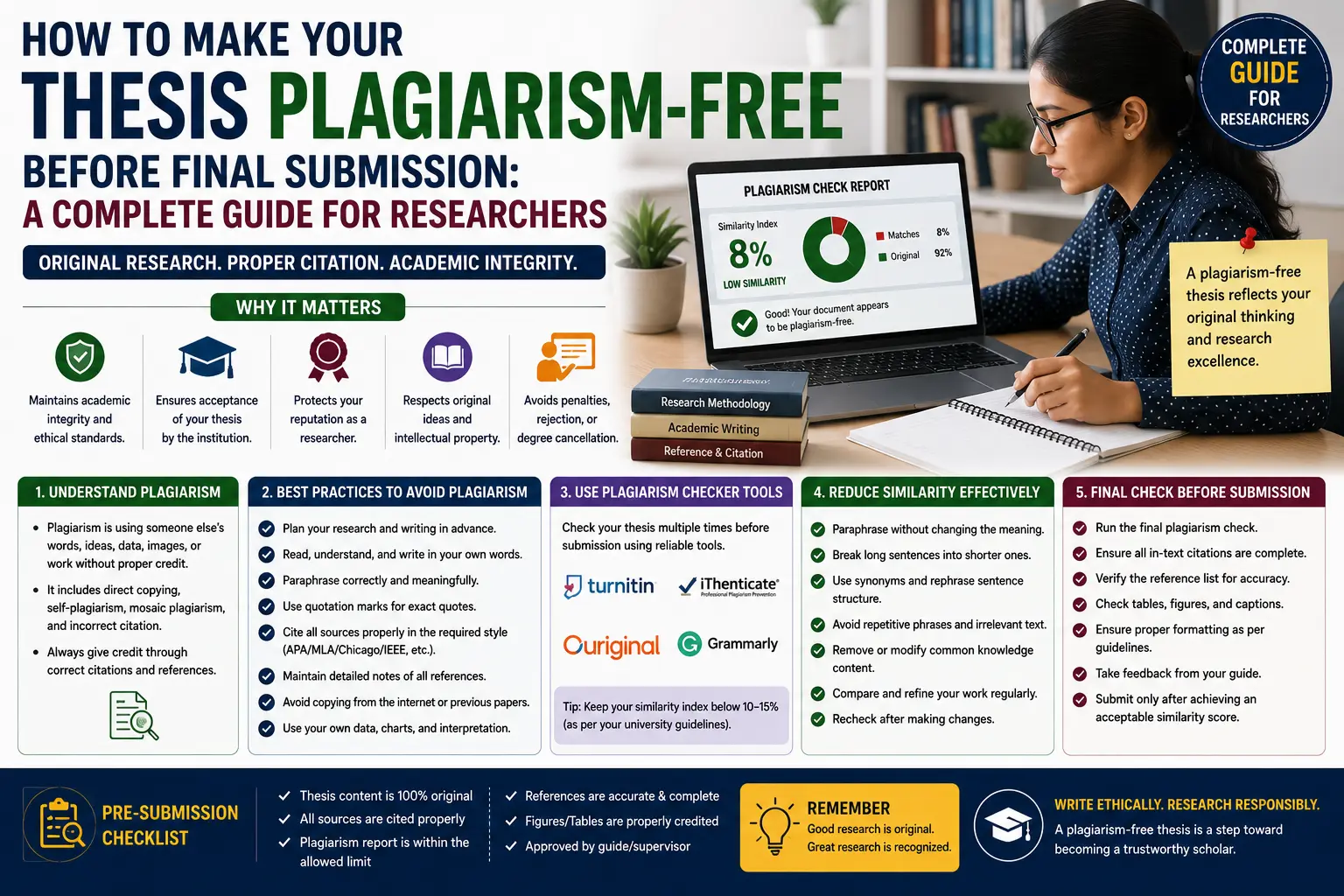
Submitting a thesis is one of the most significant milestones in a student's academic journey. Whether you are pursuing a Master's degree, MPhil, or PhD, your thesis represents years of research, analysis, and hard work. However, before final submission, there is one critical requirement that every researcher must fulfill: ensuring the thesis is plagiarism-free.
Universities across India and worldwide have adopted strict plagiarism policies. According to the University Grants Commission (UGC) guidelines, excessive plagiarism can lead to thesis rejection, delayed degree completion, revision requirements, or even disciplinary action. As a result, scholars must carefully review their work and reduce plagiarism levels before submitting their dissertation or thesis.
Many students mistakenly believe that plagiarism only refers to copying someone else's work word-for-word. In reality, plagiarism can occur in various forms, including improper citation, self-plagiarism, patchwriting, and inadequate paraphrasing. Even unintentional plagiarism can negatively affect your academic credibility.
This comprehensive guide explains how to make your thesis plagiarism-free before final submission, common causes of plagiarism, effective plagiarism reduction techniques, recommended tools, and best practices for maintaining academic integrity.
What is Plagiarism in Academic Research?
Plagiarism occurs when someone presents another person's ideas, words, research findings, or intellectual work as their own without proper acknowledgment.
In academic writing, plagiarism can include:
- Copying text without citation
- Using ideas without attribution
- Improper paraphrasing
- Reusing your own published content without acknowledgment
- Copying tables, figures, or images without permission
Universities take plagiarism seriously because research is expected to contribute original knowledge and maintain academic honesty.
Why Is a Plagiarism-Free Thesis Important?
A plagiarism-free thesis demonstrates:
Academic Integrity
It shows respect for other researchers' contributions.
Research Credibility
Original work enhances the value of your research findings.
University Compliance
Most universities have strict plagiarism limits.
Publication Opportunities
Journals prefer manuscripts with low similarity scores.
Professional Reputation
Maintaining ethical standards strengthens your academic profile.
Understanding Similarity Index vs Plagiarism
Many students confuse similarity scores with plagiarism.
A plagiarism detection software generates a similarity index, which measures how much text matches existing sources.
However:
- A high similarity score does not always mean plagiarism.
- A low similarity score does not always guarantee originality.
For example:
- Properly cited quotations may appear in similarity reports.
- Common technical phrases often generate matches.
Therefore, researchers should focus on reducing problematic similarities rather than merely lowering percentages.
UGC Guidelines on Plagiarism
Indian universities generally follow UGC regulations regarding academic integrity.
While exact requirements vary, many institutions prefer thesis similarity levels within acceptable limits before submission.
Universities typically evaluate:
- Overall similarity percentage
- Chapter-wise similarity
- Proper citations
- Research originality
Always check your university's latest plagiarism policy before submission.
Common Types of Plagiarism in Theses
Understanding plagiarism types helps prevent them effectively.
1. Direct Plagiarism
This occurs when text is copied word-for-word without quotation marks or citations.
Example:
Copying a paragraph from a journal article directly into your thesis.
This is considered a serious academic offense.
2. Mosaic or Patchwork Plagiarism
Patchwork plagiarism occurs when text is slightly modified but retains the original structure and wording.
Many students unintentionally commit this form of plagiarism.
Simply replacing a few words with synonyms is not sufficient.
3. Self-Plagiarism
Self-plagiarism occurs when authors reuse their own previously published work without acknowledgment.
Examples:
- Reusing journal articles
- Reusing conference papers
- Copying dissertation sections
Proper citation is still required.
4. Idea Plagiarism
Using someone else's concepts, theories, or interpretations without credit can also constitute plagiarism.
Even if wording is changed, the original source should be cited.
5. Improper Citation
Incorrect referencing often results in accidental plagiarism.
Examples include:
- Missing citations
- Incomplete references
- Incorrect citation formats
Step 1: Start Writing in Your Own Words
The best way to reduce plagiarism is to avoid copying from the beginning.
Instead of copying content:
Read
Understand the source material thoroughly.
Close the Source
Write the concept from memory.
Compare
Check whether your explanation differs sufficiently from the original text.
This technique naturally improves originality.
Step 2: Master the Art of Paraphrasing
Paraphrasing is one of the most important academic writing skills.
Good paraphrasing means:
- Understanding the original idea
- Rewriting using your own sentence structure
- Maintaining the original meaning
- Providing proper citation
Poor Paraphrasing Example
Original:
"Artificial intelligence is transforming healthcare through predictive analytics."
Poor paraphrasing:
"AI is changing healthcare through predictive analysis."
This remains too similar.
Effective Paraphrasing Example
"Healthcare organizations increasingly utilize advanced computational technologies to forecast patient outcomes and improve clinical decision-making."
The idea remains intact while the structure is significantly different.
Step 3: Use Proper Citations Consistently
Citations acknowledge the original source of information.
Common citation styles include:
- APA
- MLA
- Chicago
- Harvard
- IEEE
Follow the style prescribed by your university.
Cite:
- Direct quotations
- Paraphrased information
- Statistics
- Theories
- Research findings
When in doubt, cite the source.
Step 4: Avoid Excessive Direct Quotations
Although quotations are acceptable in moderation, excessive use may increase similarity scores.
Instead:
Summarize
Condense lengthy discussions into concise explanations.
Paraphrase
Explain concepts in your own words.
Reserve direct quotations for:
- Definitions
- Historical statements
- Critical original wording
Step 5: Review Literature Carefully
The literature review chapter often generates the highest similarity scores.
Many students unintentionally copy:
- Definitions
- Theoretical frameworks
- Research findings
To reduce plagiarism:
Synthesize Multiple Sources
Rather than discussing studies individually, combine findings from several papers.
Compare Studies
Analyze similarities and differences among researchers.
Add Critical Insights
Include your interpretation wherever possible.
Step 6: Use Plagiarism Detection Software
Before submission, every researcher should perform plagiarism checks.
Popular tools include:
Turnitin
Widely used by universities.
iThenticate
Preferred by researchers and publishers.
Ouriginal (Urkund)
Commonly used in academic institutions.
PlagScan
Provides detailed similarity reports.
These tools identify matching text and highlight problematic sections.
Step 7: Analyze the Similarity Report Carefully
Do not focus only on the percentage.
Instead examine:
- Source matches
- Repeated phrases
- Improper citations
- Unnecessary quotations
Some matches may be harmless, while others require revision.
Step 8: Rewrite High-Similarity Sections
After identifying problematic areas:
Rephrase Content
Use different sentence structures.
Add Analysis
Include original interpretation.
Merge Sources
Synthesize information from multiple references.
Reduce Long Quotations
Replace them with paraphrased summaries.
Step 9: Check References Thoroughly
Many plagiarism issues result from incomplete references.
Verify:
- Author names
- Publication years
- Journal titles
- Page numbers
- DOI information
Reference management software can help.
Popular tools include:
- Zotero
- Mendeley
- EndNote
Step 10: Avoid Copying from Previous Assignments
Many students reuse:
- Coursework assignments
- Published papers
- Project reports
Without proper citation, this may be considered self-plagiarism.
Always acknowledge previously used material.
How to Reduce Plagiarism in Tables and Figures
Plagiarism is not limited to text.
Tables, charts, and figures also require proper attribution.
When using visuals:
Cite the Source
Mention the original source below the figure.
Obtain Permission
When required by copyright policies.
Create Original Graphics
Whenever possible, generate your own visual representations.
Best Practices for Writing an Original Thesis
Maintain Research Notes
Keep detailed records of all sources consulted.
Write Regularly
Last-minute writing often increases plagiarism risk.
Read Widely
Broader reading improves understanding and originality.
Develop Critical Thinking
Interpret findings instead of merely describing them.
Maintain Citation Discipline
Cite sources immediately while writing.
Common Mistakes Researchers Make
Copying Literature Review Content
One of the most frequent causes of plagiarism.
Overusing Internet Sources
Blogs and websites often encourage superficial copying.
Ignoring Citation Requirements
Missing references increase plagiarism risk.
Depending Entirely on Plagiarism Software
Software assists but cannot replace careful academic writing.
Poor Paraphrasing
Simply replacing words with synonyms is insufficient.
How Supervisors Can Help Reduce Plagiarism
Research supervisors can assist by:
- Reviewing drafts
- Identifying problematic sections
- Suggesting improvements
- Guiding citation practices
Seek feedback regularly rather than waiting until the final submission stage.
Final Pre-Submission Checklist
Before submitting your thesis, ensure:
✔ All sources cited properly
✔ Reference list complete
✔ Similarity report reviewed
✔ High-similarity sections revised
✔ Figures and tables acknowledged
✔ Quotations used appropriately
✔ Paraphrasing checked carefully
✔ Grammar and language edited
✔ University guidelines followed
✔ Final plagiarism check completed
Benefits of Submitting a Plagiarism-Free Thesis
A plagiarism-free thesis offers numerous advantages:
- Faster approval process
- Higher academic credibility
- Better publication opportunities
- Increased confidence during viva voce
- Stronger professional reputation
Most importantly, it reflects genuine scholarly contribution.
Conclusion
Ensuring that your thesis is plagiarism-free before final submission is not merely a technical requirement—it is a fundamental aspect of academic integrity and research excellence. Universities, publishers, and research institutions expect scholars to produce original work that appropriately acknowledges existing knowledge while contributing new insights to their field.
By developing strong paraphrasing skills, maintaining accurate citations, using plagiarism detection software responsibly, and revising high-similarity sections carefully, researchers can significantly reduce plagiarism risks. More importantly, focusing on critical thinking and original analysis throughout the writing process naturally enhances the quality and authenticity of the thesis.
Remember that plagiarism prevention should begin from the first day of research rather than becoming a last-minute concern. A well-written, properly cited, and plagiarism-free thesis not only improves your chances of successful degree completion but also establishes a strong foundation for a credible and ethical academic career.
Frequently Asked Questions (FAQs)
1. What is considered plagiarism in a thesis?
Plagiarism includes copying text, ideas, figures, tables, or research findings without proper citation and acknowledgment.
2. What is a similarity index?
A similarity index is the percentage of text in a document that matches content from existing sources identified by plagiarism detection software.
3. Is a high similarity score always plagiarism?
No. Properly cited quotations, references, and commonly used phrases may increase similarity scores without constituting plagiarism.
4. Which plagiarism checker is most commonly used by universities?
Turnitin is one of the most widely used plagiarism detection tools in universities worldwide.
5. How can I reduce plagiarism in my literature review?
Synthesize multiple studies, paraphrase effectively, add critical analysis, and cite all sources appropriately.
6. What is self-plagiarism?
Self-plagiarism occurs when an author reuses their own previously published work without proper acknowledgment.
7. Can paraphrased content still be considered plagiarism?
Yes. If the original source is not cited, even paraphrased content may be considered plagiarism.
8. How many times should I check plagiarism before submission?
Ideally, conduct plagiarism checks during drafting, after revisions, and before final submission.
9. Are figures and tables subject to plagiarism rules?
Yes. Figures, charts, images, and tables must be properly cited and may require permission depending on copyright restrictions.
10. Why is a plagiarism-free thesis important?
A plagiarism-free thesis demonstrates academic integrity, improves credibility, supports successful degree completion, and enhances future publication opportunities.
Contact ThesisLikho Today
Call / WhatsApp: +91 96438 02216
Visit: ThesisLikho.com