
Introduction
Every successful research project begins with one essential element—a well-designed research instrument. Whether you are conducting a PhD thesis, master's dissertation, academic survey, or institutional research project, the quality of your findings depends heavily on the quality of the data you collect. Even the most sophisticated statistical techniques cannot compensate for poor-quality data gathered using unreliable or invalid research instruments.
A research instrument is any tool used to collect, measure, and record data. These include questionnaires, surveys, interview schedules, observation checklists, psychological scales, assessment tests, and measurement forms. Designing these instruments requires more than simply writing a list of questions. Researchers must ensure that every item accurately measures what it is intended to measure while producing consistent and dependable results.
For researchers in universities across India and around the world, understanding concepts such as validity, reliability, pilot testing, and instrument development is essential for producing credible academic work. Supervisors, ethics committees, and journal reviewers often evaluate research quality based on how carefully the research instruments have been designed and validated.
This comprehensive guide explains the complete process of designing reliable and valid research instruments, helping you collect high-quality data that strengthens the credibility of your academic research.
What Is a Research Instrument?
A research instrument is a structured tool used to collect information from participants or other sources in a systematic manner.
Common examples include:
- Questionnaires
- Online surveys
- Interview guides
- Observation schedules
- Rating scales
- Psychological inventories
- Knowledge assessment tests
- Performance evaluation forms
- Experimental measurement tools
The primary purpose of a research instrument is to gather accurate, relevant, and measurable information that addresses the research objectives.
Why High-Quality Research Instruments Matter
A poorly designed instrument can introduce errors that affect every stage of research.
Well-designed instruments help researchers:
- Collect accurate and consistent data
- Reduce measurement errors
- Improve research credibility
- Increase confidence in research findings
- Produce reliable statistical analyses
- Support publication in high-quality journals
- Meet university thesis standards
Simply put, the strength of your conclusions depends on the quality of the information you collect.
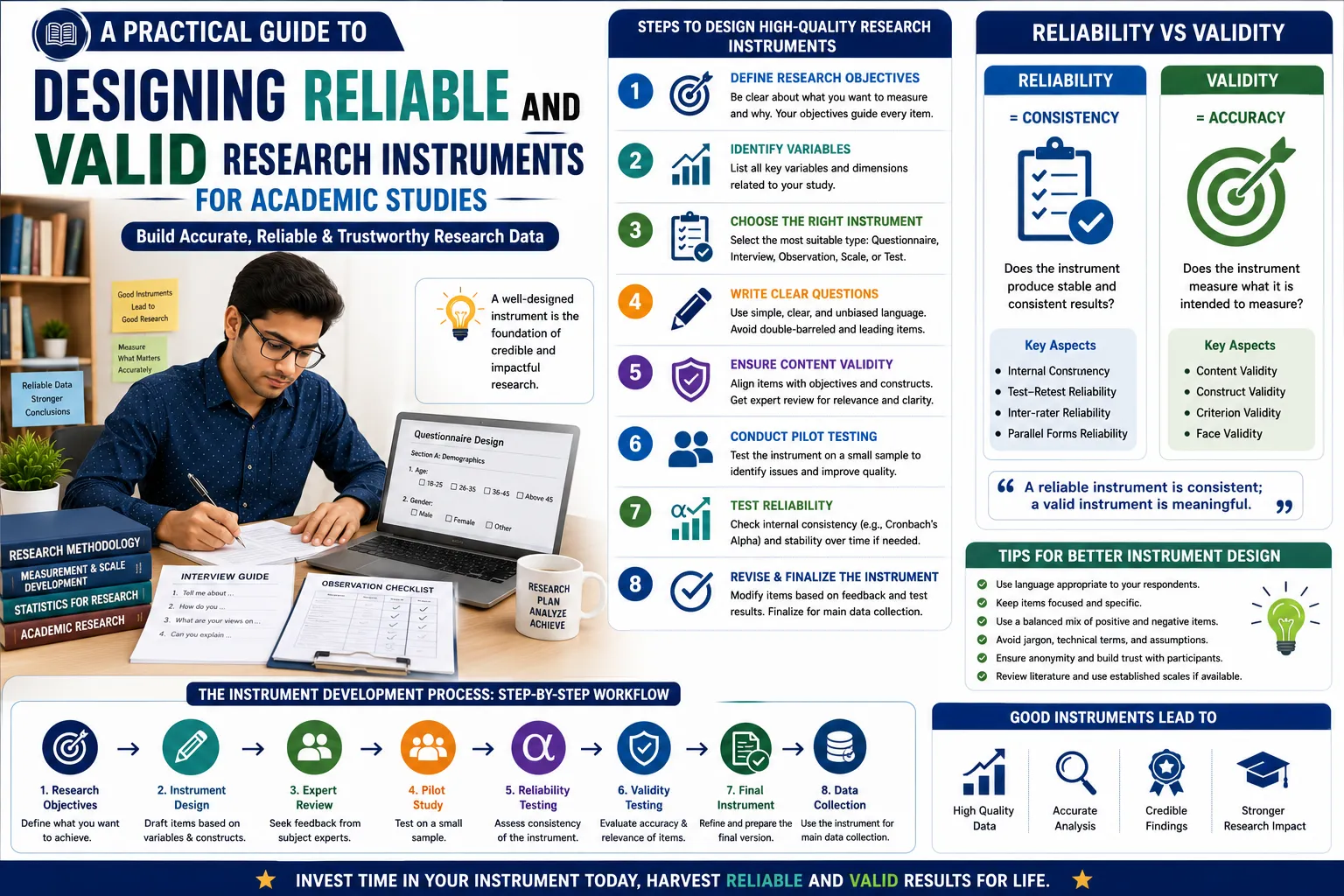
Understanding Reliability and Validity
Reliability and validity are two fundamental characteristics of every research instrument.
Although they are related, they measure different aspects of quality.
Reliability
Reliability refers to consistency.
A reliable instrument produces similar results when used repeatedly under similar conditions.
For example, if a student's stress level remains unchanged, a reliable stress questionnaire should produce approximately the same score every time it is administered.
Reliable instruments minimize random errors.
Validity
Validity refers to accuracy.
A valid instrument measures exactly what it is intended to measure.
For example:
If a questionnaire claims to measure research anxiety but actually measures general academic stress, it lacks validity.
An instrument cannot be considered useful unless it is both reliable and valid.
Steps to Design a Reliable and Valid Research Instrument
Step 1: Clearly Define Your Research Objectives
Before writing a single question, identify exactly what information you need.
Ask yourself:
- What is my research problem?
- What variables am I measuring?
- What hypotheses am I testing?
- Who is my target population?
Clear objectives prevent unnecessary questions and improve instrument quality.
Step 2: Identify Variables
Every research instrument measures one or more variables.
Examples include:
Independent Variables
- Teaching methods
- Technology adoption
- Employee training
Dependent Variables
- Student performance
- Customer satisfaction
- Employee productivity
Control Variables
- Age
- Gender
- Income
- Educational qualification
Each variable should have clearly defined indicators before questions are developed.
Step 3: Review Existing Literature
Avoid creating an entirely new instrument unless necessary.
Many established scales already exist.
Examples include:
- Technology Acceptance Model (TAM)
- SERVQUAL
- Perceived Stress Scale (PSS)
- Organizational Commitment Scale
- Job Satisfaction Survey
- Big Five Personality Inventory
Using validated instruments improves research quality and allows comparisons with previous studies.
If modifications are made, clearly justify them.
Step 4: Select the Appropriate Instrument Type
Different research objectives require different instruments.
Questionnaire
Best for:
- Large populations
- Quantitative studies
- Statistical analysis
Interview Schedule
Suitable for:
- Qualitative research
- Exploratory studies
- In-depth understanding
Observation Checklist
Useful when studying:
- Classroom behavior
- Workplace practices
- Clinical procedures
Rating Scale
Ideal for measuring:
- Opinions
- Attitudes
- Perceptions
- Satisfaction
Writing Effective Questionnaire Items
Good questions are:
Simple
Avoid technical language.
Specific
Each question should address only one issue.
Objective
Avoid leading respondents toward a particular answer.
Relevant
Every question should directly support a research objective.
Brief
Long questions increase respondent fatigue.
Poor Question Example
Do you think your university provides excellent academic facilities and effective career support?
This asks two questions simultaneously.
Better Version
How satisfied are you with your university's academic facilities?
How satisfied are you with your university's career support services?
Each question measures only one concept.
Choosing Response Scales
Different scales serve different purposes.
Likert Scale
Most common.
Example:
- Strongly Disagree
- Disagree
- Neutral
- Agree
- Strongly Agree
Suitable for:
- Attitudes
- Opinions
- Satisfaction
Semantic Differential Scale
Example:
Poor Quality —— Excellent Quality
Useful for perception studies.
Frequency Scale
Example:
- Never
- Rarely
- Sometimes
- Often
- Always
Useful for behavioral research.
Numerical Rating Scale
Example:
Rate your satisfaction from 1 to 10.
Often used in healthcare and service quality research.
Types of Validity
Face Validity
Does the instrument appear appropriate?
Usually assessed by experts or supervisors.
Content Validity
Does the instrument cover every important aspect of the construct?
Experts review whether important dimensions are missing.
Example:
A teaching effectiveness questionnaire should include:
- Subject knowledge
- Communication
- Classroom management
- Assessment methods
- Student interaction
Construct Validity
Determines whether the instrument actually measures the theoretical concept.
Commonly assessed using:
- Factor Analysis
- Confirmatory Factor Analysis (CFA)
Criterion Validity
Compares the instrument with an established standard.
Example:
A new depression scale may be compared with an internationally accepted psychological assessment.
Types of Reliability
Internal Consistency
Measures whether all questions assess the same construct.
Common statistic:
Cronbach's Alpha
Interpretation:
- Above 0.90 = Excellent
- 0.80–0.89 = Good
- 0.70–0.79 = Acceptable
- Below 0.70 = Needs improvement
Test-Retest Reliability
Administer the instrument twice to the same participants.
Consistent scores indicate stability.
Inter-Rater Reliability
Important in observational studies.
Measures agreement between different observers.
Parallel Forms Reliability
Two equivalent versions of the instrument are administered.
Results should be similar.
Conducting a Pilot Study
A pilot study is a small-scale trial conducted before the main research.
Benefits include:
- Identifying confusing questions
- Measuring completion time
- Detecting technical problems
- Testing reliability
- Improving validity
- Reducing respondent burden
A pilot sample usually includes 20–50 participants, depending on the study design.
Expert Review
Before finalizing your instrument, seek feedback from:
- Research supervisors
- Subject experts
- Methodologists
- Statisticians
- Language experts
Experts may recommend:
- Removing redundant questions
- Improving wording
- Adding missing dimensions
- Correcting sequencing
Common Errors in Instrument Design
Researchers often make avoidable mistakes.
Examples include:
Leading questions
Example:
Do you agree that online education is better than classroom learning?
Double-barreled questions
Example:
Are you satisfied with your salary and promotion opportunities?
Ambiguous wording
Example:
Do you exercise regularly?
Regularly means different things to different respondents.
Negative wording
Complex negative statements confuse participants.
Long questionnaires
Lengthy surveys reduce response quality and increase dropouts.
Ethical Considerations
Every research instrument should respect participants' rights.
Include:
- Informed consent
- Confidentiality statement
- Voluntary participation
- Withdrawal rights
- Data protection information
- Contact details for researcher
Ethical research improves participant trust and response quality.
Digital Tools for Designing Research Instruments
Several platforms simplify instrument development.
Popular options include:
- Google Forms
- Microsoft Forms
- Qualtrics
- SurveyMonkey
- KoboToolbox
- REDCap
- Jotform
For interviews and qualitative studies:
- NVivo
- MAXQDA
- ATLAS.ti
These tools support secure data collection, skip logic, automated coding, and export to statistical software.
Best Practices for Designing Research Instruments
To maximize data quality:
- Align every question with a research objective.
- Use simple, unbiased language.
- Avoid unnecessary or repetitive items.
- Select appropriate response scales.
- Use previously validated scales where possible.
- Conduct expert review and pilot testing.
- Test reliability and validity statistically.
- Revise the instrument before the main study.
- Ensure ethical compliance and participant confidentiality.
- Document the entire development process in your methodology chapter.
Following these practices enhances the credibility of your research and increases the likelihood of producing meaningful, reproducible findings.
Conclusion
Designing reliable and valid research instruments is one of the most important steps in academic research. A carefully developed questionnaire, interview guide, or observation checklist enables researchers to collect trustworthy data, reduce measurement errors, and produce findings that withstand academic scrutiny.
By clearly defining research objectives, selecting appropriate measurement tools, writing unbiased questions, validating the instrument through expert review, conducting pilot studies, and testing reliability statistically, researchers can significantly improve the quality of their work. Whether you are preparing a PhD thesis, dissertation, or journal publication, investing time in instrument design lays the foundation for credible and impactful research.
Remember that a research instrument is not merely a collection of questions—it is the bridge between your research objectives and the evidence needed to answer them. Building that bridge with rigor and care ensures that your study contributes meaningful knowledge to your field and meets the highest standards of academic excellence.
Call / WhatsApp: +91 96438 02216
Website:www.ThesisLikho.com