
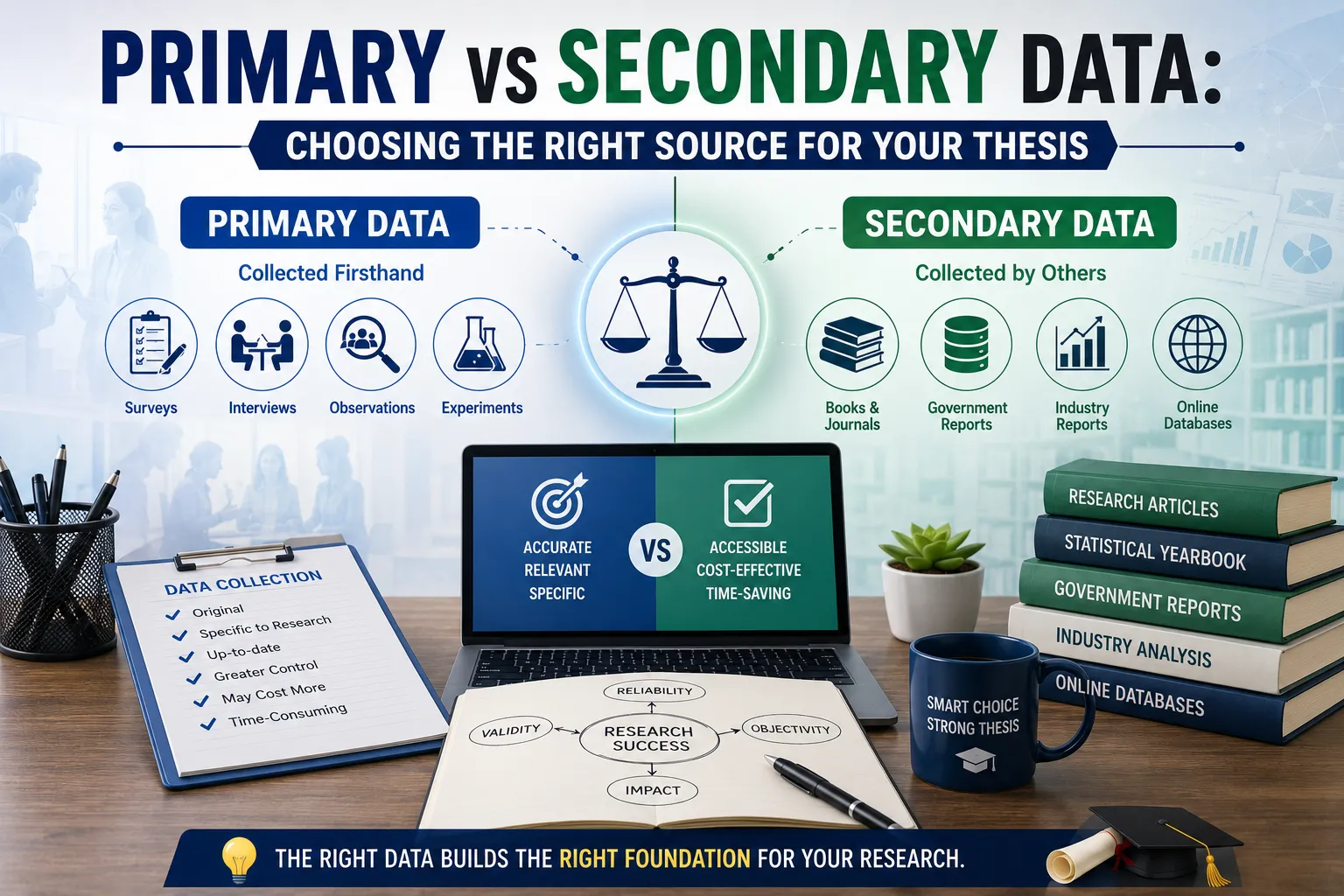
One of the earliest and most consequential decisions in your thesis methodology chapter is deceptively simple to state and genuinely hard to get right: will you collect your own data, or work with data that already exists? Primary vs secondary data: choosing the right source for your thesis isn't a question with a universally correct answer — it depends entirely on your research question, your access, your timeline, and what kind of claim you're trying to make. Get it wrong, and you'll either spend months collecting data you didn't strictly need, or discover too late that existing datasets can't actually answer what you're asking.
This guide walks through exactly what separates primary from secondary data, when each is the right choice, the specific Indian data sources worth knowing about, and how to justify your choice clearly to a supervisor or committee. We've grounded this in current research methodology guidance and the patterns we see across scholars ThesisLikho supports through the data source decision.
What's the Actual Difference?
Primary data is information you collect yourself, directly, specifically for your own research question — interviews you conduct, surveys you distribute, experiments you run, or observations you personally record. Secondary data is information that already exists, originally collected by someone else for a different purpose — government statistics, published research datasets, company records, industry reports, or prior academic studies whose raw data you're re-analyzing.
The distinction isn't about how "official" or credible the data is — a national census is highly credible secondary data, and a poorly designed survey can be low-quality primary data. The distinction is entirely about who collected it and why: primary data is gathered specifically to answer your research question; secondary data was gathered for someone else's purpose and you're applying it to yours.
Why This Choice Matters Early
Deciding between primary and secondary data — or some combination of both — shapes nearly everything that follows in your methodology: your timeline, your budget, whether you need institutional ethics approval, what analytical techniques are available to you, and how strong a claim you can ultimately make about your findings. Making this decision late, after your research questions and objectives are already locked in, often means discovering a mismatch — a research question that assumes data you can't realistically collect in your remaining timeline, or a secondary dataset that turns out not to measure quite what your question needs.
Deciding early, and deciding deliberately with a clear justification, is what lets every later methodology decision — sampling, instrument design, analysis technique — build on solid ground rather than being retrofitted around a data source chosen by default.
The Case for Primary Data
Primary data offers three things secondary data structurally cannot: precise fit to your specific research question, since you control exactly what's measured and how; currency, since the data reflects the present moment rather than whenever someone else happened to collect it; and originality, since primary data collection is often what gives a thesis its clearest claim to a genuinely new contribution rather than a re-analysis of existing information.
Examiners generally expect primary data when your research aims to explore experiences, perceptions, behaviours, or outcomes that existing literature and datasets simply can't answer — questions about how people make sense of a specific situation, or measurements of a construct no prior survey has captured in your specific population, almost always require you to go and collect the data yourself.
The Case for Secondary Data
Secondary data's advantages are essentially the mirror image of primary data's costs: it's dramatically faster and cheaper to work with, since the laborious work of designing instruments, obtaining ethics approval, recruiting participants, and running data collection is already done. It often gives you access to datasets — national censuses, large-scale longitudinal surveys, multi-country comparative data — at a scale and scope no individual researcher could realistically gather alone. And because it typically uses already-anonymized, publicly available information, the ethics-approval burden is usually lighter, which matters if your thesis timeline is tight.
Secondary data is also often the only realistic way to study long-term trends or rare phenomena, since it can draw on data collected repeatedly over years or decades — something a single thesis's data collection window could never replicate on its own.
Where Secondary Data Falls Short
The core limitation of secondary data is that you have no control over how it was originally collected — it was gathered for someone else's purpose, which means it may not measure exactly what your research question needs, may use variable definitions that don't quite match your conceptual framework, and may simply be missing a key variable your study depends on. You also inherit any errors, biases, or quality issues present in the original data collection, without the ability to go back and correct them. And depending on how recently the data was collected, it may be outdated for a question that specifically concerns current conditions.
Before committing to a secondary dataset, it's worth explicitly checking whether it actually contains what your research question requires — a surprising number of scholars discover this mismatch only after significant time has already been invested in a specific dataset.
Where Primary Data Falls Short
Primary data's core limitation is cost, in every sense of the word: it takes considerably more time to design instruments, secure ethics approval, recruit participants, and collect data than working with an existing dataset does, and this can be a serious constraint within a fixed thesis timeline, particularly for MBA or master's-level research with only a few months to complete the entire study. It's also more resource-intensive in practical terms — interviews require scheduling and often transcription, surveys require distribution and follow-up, and both require your own quality control since there's no established track record for a newly designed instrument the way there is for an established government dataset.
Primary data collection also introduces its own risk of error at every stage — sampling bias, poorly worded questions, low response rates — that a well-established secondary dataset, refined and validated by an experienced statistical agency over years, is less likely to carry.
Key Secondary Data Sources for Indian Research
For Indian management and social science research specifically, several government and institutional sources are worth knowing well:
The Ministry of Statistics and Programme Implementation (MoSPI) is the nodal agency for official Indian statistics, publishing National Accounts Statistics, the Annual Survey of Industries, the Periodic Labour Force Survey, the Consumer Price Index, and the Index of Industrial Production — genuinely valuable for research touching consumption patterns, labour markets, or industrial trends.
The National Sample Survey Office (NSSO), operating under MoSPI, conducts large-scale household surveys on consumption, employment, and unemployment, with unit-level data available through the ICSSR Data Service for academic use (with proper citation required).
The Reserve Bank of India (RBI) publishes extensive banking, financial, and monetary statistics through its website, relevant for finance-focused theses.
The Census of India, conducted by the Registrar General, provides demographic data down to the village level, useful for studies requiring detailed population or household characteristics.
The ICSSR Data Service specifically hosts unit-level National Sample Survey and Annual Survey of Industries datasets for academic researchers, along with supporting documentation like questionnaires and codebooks, making it a genuinely useful starting point for Indian social science secondary data work.
These sources are generally credible, well-documented, and free or low-cost to access — a strong starting point before considering less formally vetted secondary sources like industry reports or news coverage.
Deciding Which Fits Your Research Question
A practical way to decide: if your research question asks about people's experiences, perceptions, opinions, or behaviours in a specific context that hasn't already been studied in exactly this way, you likely need primary data. If your research question can be answered by analyzing existing patterns, trends, or relationships in data that's already been collected at scale — economic indicators, published financial statements, existing survey datasets — secondary data is likely sufficient and considerably more efficient. If your question genuinely needs both a broad, established pattern and a specific, contextual explanation of that pattern, a combination is often the strongest choice.
It's also worth being honest about resource constraints: a research question that theoretically calls for primary data but that you cannot realistically execute within your timeline or budget may need to be reframed around available secondary sources instead, rather than forcing a data collection plan that isn't feasible.
Combining Primary and Secondary Data
Many strong theses use both, and doing so deliberately is often the strongest choice rather than a compromise. A common pattern: primary data (interviews, surveys) provides original, firsthand evidence directly addressing your core research question, while secondary data (government statistics, industry reports, prior published studies) provides context, background, and a broader frame for interpreting what your primary data shows. For example, interviewing postgraduate students about their adaptation experiences is primary data, while analyzing government enrolment statistics to contextualize how representative or unusual their experiences are is secondary data — together, the combination is considerably stronger than either alone.
This combined approach connects directly to mixed methods research design, where primary qualitative or quantitative data collection is deliberately paired with secondary sources for context or validation. If you're considering this kind of combination, our related guide, [mixed methods research: when and how to use it in a thesis], covers how to structure that integration properly.
Ethical and Practical Considerations
Primary data collection involving human participants requires institutional ethics approval in most Indian universities, even for seemingly low-risk survey research — informed consent, confidentiality protections, and data storage procedures all need to be explicitly planned and documented before data collection begins. Secondary data generally carries a lighter ethical burden, since it typically uses already-anonymized, publicly available information — though you still need to respect the data's original licensing terms, cite it properly, and never attempt to re-identify individuals from anonymized datasets.
Practically, budget realistic time for each: primary data collection needs time for ethics approval, instrument piloting, recruitment, and the collection process itself, often extending over several months; secondary data needs time for locating, accessing, cleaning, and understanding a dataset's original collection methodology well enough to use it credibly — a step scholars sometimes underestimate, assuming secondary data is simply ready to use the moment it's downloaded.
Evaluating Secondary Source Quality
Not all secondary data is equally trustworthy, and evaluating it carefully before committing to a source matters as much as evaluating any other literature. Check when and under what conditions the data was originally collected, since data collected during unusual circumstances (an economic shock, a pandemic-affected year) may not represent typical conditions relevant to your research question. Check whether the source's methodology and variable definitions are clearly documented, since undocumented or vaguely described secondary data is much harder to defend credibly in your methodology chapter. And check whether the source is genuinely authoritative — government statistical agencies, established research institutions, and peer-reviewed academic datasets carry far more credibility than informal industry reports or unverified online sources.
Justifying Your Choice to a Committee
Whatever you choose, your methodology chapter needs to explicitly justify why that specific data source fits your specific research question — not just describe what the data is. If you're using primary data, explain why existing secondary sources couldn't adequately answer your question. If you're using secondary data, explain why the specific dataset you chose is credible, sufficiently current, and actually measures what your research question needs. If you're combining both, explain specifically what each contributes that the other couldn't provide alone.
This connects directly to the broader principle of defending your overall research design, covered in more depth in our related guide, [how to justify your research design to a thesis committee] — the same standard of explicit, alternative-aware justification applies just as much to your data source decision as it does to your broader methodological choices.
Real Thesis Examples
Example 1 — Primary data justified. A scholar studying how employees experience algorithmic performance monitoring in Indian IT firms needed primary data because no existing dataset captured employee perceptions of this specific, relatively new management practice — she conducted semi-structured interviews with employees across three firms, explicitly justifying in her methodology chapter that this contemporary, firm-specific phenomenon simply wasn't represented in any available secondary source.
Example 2 — Secondary data justified, with primary data ruled out. A scholar studying long-term trends in Indian manufacturing employment initially considered a primary survey but recognized that MoSPI's Periodic Labour Force Survey and Annual Survey of Industries data already provided exactly the multi-year, large-sample data her research question needed — far beyond what a single thesis's primary data collection could realistically achieve. Her methodology chapter explicitly explained why primary data collection would have been both unnecessary and inferior to the existing, methodologically robust government datasets already available.
Common Mistakes When Choosing a Data Source
- Choosing primary data by default without seriously checking whether adequate secondary data already exists and could save months of unnecessary data collection.
- Choosing secondary data without verifying it actually measures what the research question needs, discovering the mismatch only after significant time has been invested.
- Failing to explicitly justify the choice, describing the data source without explaining why it was the right fit for the specific research question.
- Underestimating the ethics-approval timeline for primary data collection, particularly for sensitive topics or vulnerable populations.
- Using secondary data without checking its original collection methodology, quality, or the conditions under which it was gathered.
- Combining primary and secondary data without a clear integration plan, resulting in two loosely related data sources rather than a genuinely combined analysis.
- Overlooking well-established Indian government data sources (MoSPI, NSSO, RBI, Census of India) in favor of less rigorous secondary sources that are easier to find but less credible.
- Citing secondary data improperly, failing to give appropriate attribution to the original data source and collecting agency.
Data Source Decision Checklist
Before finalizing your data source in your methodology chapter, confirm you have:
- Clearly identified whether your research question requires primary data, secondary data, or a combination
- Checked whether adequate secondary data already exists before committing to primary data collection
- Verified that any secondary dataset actually measures what your research question needs
- Evaluated your secondary source's credibility, currency, and documented methodology
- Planned a realistic timeline accounting for ethics approval if primary data is involved
- Explicitly justified your choice in writing, not just described the data source
- Considered how primary and secondary data might combine to strengthen your study, if applicable
- Properly cited any secondary data source according to its required attribution format
How Long Does It Take to Complete a Thesis Using This Approach?
Working primarily with secondary data can shorten your data phase considerably — often just a few weeks for locating, accessing, and cleaning a dataset once you've identified the right source — compared to primary data collection, which typically takes two to six months once ethics approval, instrument piloting, recruitment, and actual data collection are all accounted for. Theses combining both generally fall somewhere between these timelines, depending on how the two components are sequenced and integrated.
Is Professional Help Available for Primary vs Secondary Data: Choosing the Right Source for Your Thesis?
Yes — many scholars work with academic mentors or research consultancies to evaluate whether existing secondary data can answer their research question, identify credible Indian data sources relevant to their topic, and design primary data collection instruments when original data is genuinely needed. ThesisLikho's PhD-qualified research experts have supported thesis writers through exactly this decision, helping ensure the chosen data source is both feasible within the available timeline and genuinely capable of answering the stated research question — all while keeping the underlying research entirely your own. Explore ThesisLikho's thesis writing services for one-on-one guidance.
FAQs
What is primary vs secondary data: choosing the right source for your thesis?
Primary data is information you collect yourself specifically for your research question, while secondary data already exists, collected by someone else for a different purpose — choosing between them (or combining both) is one of the earliest and most consequential decisions in your thesis methodology.
How long does it take to complete a thesis using this approach?
Working with secondary data can take just a few weeks for sourcing and cleaning, while primary data collection typically takes two to six months once ethics approval, instrument design, and actual collection are accounted for.
Is professional help available for primary vs secondary data: choosing the right source for your thesis?
Yes. Research consultancies and academic mentors, including ThesisLikho's PhD-qualified experts, help scholars evaluate secondary data availability and design primary data collection when needed, while preserving full research originality.
Why does primary vs secondary data: choosing the right source for your thesis matter?
Because this choice shapes your entire timeline, budget, ethics requirements, and the kind of claims your findings can support — choosing the wrong source can mean months of unnecessary data collection or, conversely, a dataset that can't actually answer your research question.
How does primary vs secondary data: choosing the right source for your thesis affect a thesis?
It determines your research feasibility, your methodology chapter's structure, and how convincingly you can defend your findings — a well-justified data source choice, whether primary, secondary, or combined, gives every later chapter a solid foundation to build on.
Related reading: Mixed Methods Research: When and How to Use It in a Thesis and How to Design a Reliable Questionnaire for Thesis Research].
Ready to choose the right data source for your specific research question?
Talk to a Thesis Expert → https://thesislikho.com/writing-services/thesis-writing