
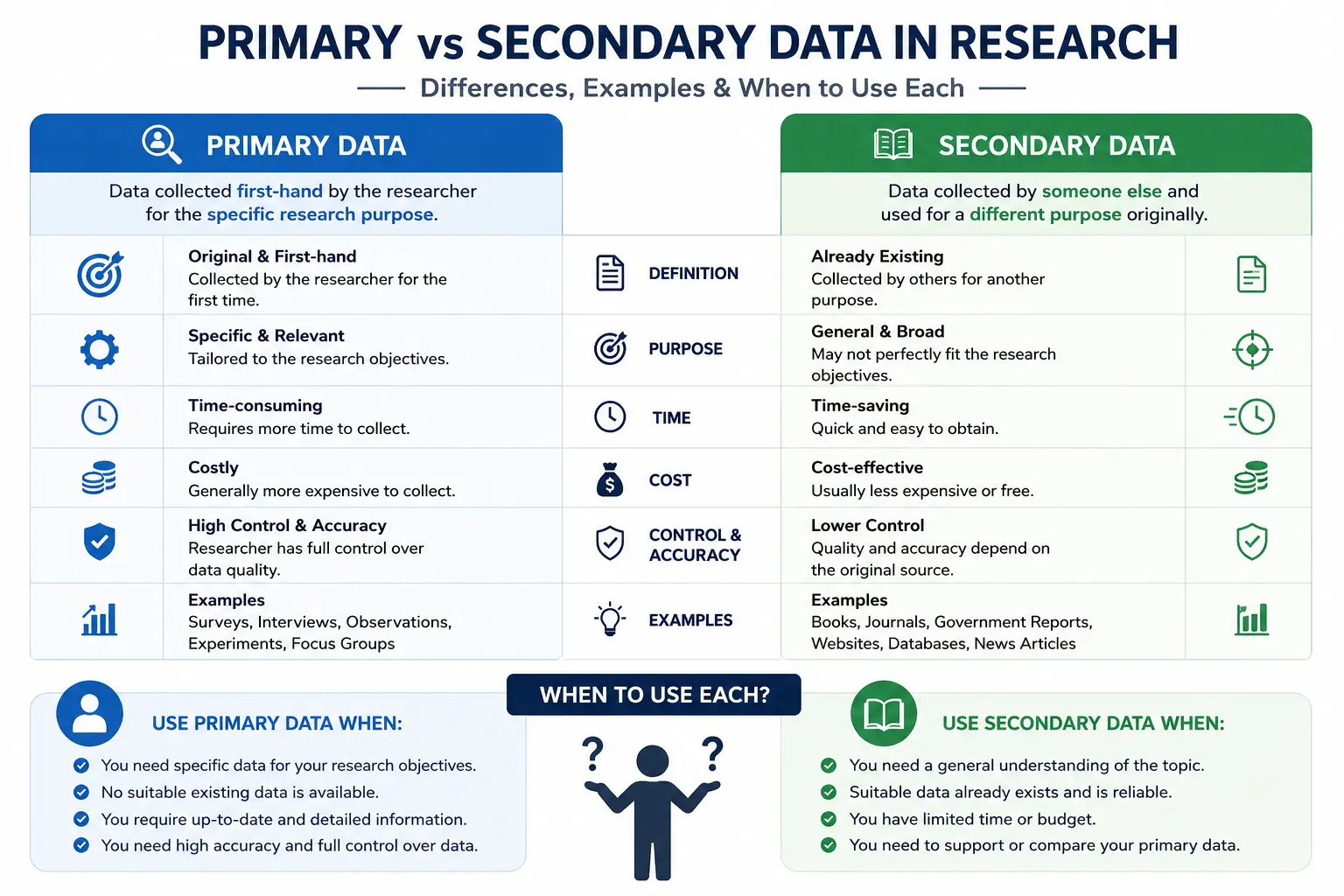
Data is the foundation of every research study. Whether you are pursuing a PhD, MPhil, MBA, or Master's degree, the quality of your research largely depends on the quality of the data you collect and analyze. Before beginning a thesis or dissertation, one of the most important decisions researchers must make is choosing between primary data and secondary data.
Both primary and secondary data play crucial roles in academic research. However, they differ significantly in terms of collection methods, purpose, cost, reliability, accessibility, and applicability. Understanding these differences helps researchers select the most appropriate data source for their research objectives and methodology.
Many PhD scholars struggle with questions such as:
- Should I collect my own data or use existing datasets?
- Is primary data always better than secondary data?
- Can I combine both data types in one study?
- Which approach is more suitable for my thesis?
The answers depend on your research questions, available resources, timeline, and the nature of your study.
In this comprehensive guide, we will explore the meaning of primary and secondary data, their characteristics, differences, advantages, limitations, examples, and practical guidance on when to use each in doctoral research.
What Is Data in Research?
Data refers to information collected, observed, measured, or recorded for analysis and interpretation.
Researchers use data to:
- Answer research questions
- Test hypotheses
- Develop theories
- Evaluate relationships
- Support conclusions
Data can be broadly categorized into two major types:
- Primary Data
- Secondary Data
Understanding these categories is essential for designing an effective research study.
What Is Primary Data?
Primary data is original information collected directly by the researcher for a specific research purpose.
In other words, the researcher gathers the data firsthand rather than relying on information collected by someone else.
The data is collected specifically to address the objectives of the current study.
Definition of Primary Data
Primary data is data obtained directly from original sources through various research methods such as surveys, interviews, observations, experiments, and focus groups.
Since the data is collected specifically for the research project, it is often highly relevant to the study objectives.
Examples of Primary Data
Examples include:
- Survey responses collected from participants
- Interview transcripts
- Focus group discussions
- Experimental results
- Observation notes
- Fieldwork data
- Questionnaires completed by respondents
Example
A PhD scholar studying employee engagement conducts interviews with 100 employees from Indian IT companies.
The interview responses represent primary data because they were collected directly from participants for the specific research project.
Characteristics of Primary Data
Primary data has several unique features.
Original
Collected directly by the researcher.
Specific
Designed to address a particular research question.
Current
Reflects recent information collected for the study.
Customized
Can be tailored to the research objectives.
Researcher-Controlled
The researcher determines how data is collected and managed.
Methods of Collecting Primary Data
Researchers use various techniques to gather primary data.
Surveys
One of the most widely used methods.
Examples:
- Online questionnaires
- Paper-based surveys
- Mobile surveys
Benefits:
- Large sample sizes
- Statistical analysis opportunities
Interviews
Researchers directly interact with participants.
Types:
- Structured interviews
- Semi-structured interviews
- Unstructured interviews
Benefits:
- Rich and detailed insights
Observations
Researchers observe behaviors, events, or activities.
Examples:
- Workplace observations
- Classroom observations
- Consumer behavior studies
Benefits:
- Real-life understanding
Focus Groups
Small group discussions led by a moderator.
Benefits:
- Diverse perspectives
- Interactive discussions
Experiments
Researchers manipulate variables and measure outcomes.
Common in:
- Healthcare
- Psychology
- Engineering
Benefits:
- Strong control over variables
Advantages of Primary Data
High Relevance
Data is collected specifically for the study.
Greater Accuracy
Researchers control data collection procedures.
Current Information
Data reflects recent circumstances.
Flexibility
Researchers can modify instruments as needed.
Better Alignment with Objectives
Questions can be designed to match research goals precisely.
Limitations of Primary Data
Time-Consuming
Data collection often requires months of effort.
Expensive
Costs may include:
- Travel
- Software
- Survey tools
- Research assistants
Access Challenges
Obtaining participants may be difficult.
Ethical Requirements
Researchers often require consent and ethical approval.
Data Collection Risks
Low response rates can affect research quality.
What Is Secondary Data?
Secondary data refers to information that has already been collected, analyzed, or published by another individual, organization, or institution.
Researchers use existing data rather than collecting new information.
Definition of Secondary Data
Secondary data is previously collected information that researchers utilize to address new research questions or support current investigations.
The original purpose of data collection may differ from the present research objectives.
Examples of Secondary Data
Examples include:
- Government reports
- Census data
- Academic journals
- Published research studies
- Company annual reports
- Industry databases
- International organization reports
- Historical records
Example
A researcher analyzes employment statistics published by the Government of India to study labor market trends.
This information represents secondary data because it was originally collected by another organization.
Characteristics of Secondary Data
Already Available
Data exists before the current research begins.
Cost-Effective
Generally less expensive than collecting primary data.
Broad Coverage
May cover large populations and geographic areas.
Historical Value
Provides access to past information.
Limited Control
Researchers cannot influence how the data was originally collected.
Sources of Secondary Data
Secondary data can originate from multiple sources.
Academic Sources
Examples:
- Journal articles
- Theses
- Conference papers
Government Sources
Examples:
- Census reports
- National surveys
- Economic statistics
International Organizations
Examples:
- World Bank reports
- United Nations databases
- UNESCO publications
Business Sources
Examples:
- Annual reports
- Market research reports
- Industry publications
Online Databases
Examples:
- Scopus
- Web of Science
- Google Scholar
- Statista
Advantages of Secondary Data
Cost-Effective
Researchers save money by using existing information.
Time-Saving
Data collection is already completed.
Large Datasets
Many secondary datasets include thousands of observations.
Historical Analysis
Researchers can examine trends over time.
Easy Accessibility
Many sources are publicly available.
Limitations of Secondary Data
May Not Match Research Needs
Data was collected for a different purpose.
Unknown Data Quality
Researchers may not know how data was collected.
Outdated Information
Older datasets may not reflect current conditions.
Missing Variables
Required variables may not be available.
Limited Flexibility
Researchers cannot modify collection methods.
When Should PhD Students Use Primary Data?
Primary data is appropriate when:
Specific Information Is Needed
Existing sources cannot answer the research question.
Research Involves New Phenomena
Examples:
- AI adoption in organizations
- Emerging technologies
- New consumer behaviors
Direct Participant Perspectives Are Required
Examples:
- Employee experiences
- Customer satisfaction
- Leadership perceptions
Experimental Research Is Conducted
Experiments require original data collection.
Theory Development Is the Goal
Qualitative studies often rely heavily on primary data.
When Should PhD Students Use Secondary Data?
Secondary data is appropriate when:
Existing Data Is Sufficient
Reliable datasets already address the research objectives.
Historical Analysis Is Needed
Examples:
- Economic trends
- Population changes
- Industry evolution
Budget Is Limited
Secondary data reduces research costs.
Large Samples Are Required
Government datasets often provide extensive coverage.
Time Constraints Exist
Data collection can be bypassed.
Can Researchers Combine Primary and Secondary Data?
Yes.
Many doctoral studies use both data types through a mixed-methods approach.
Example
Secondary Data
Analyze company annual reports.
Primary Data
Conduct interviews with managers.
Combining both sources often improves research quality and validity.
Primary and Secondary Data in Quantitative Research
Primary Quantitative Data
Examples:
- Surveys
- Experiments
- Structured questionnaires
Secondary Quantitative Data
Examples:
- Census statistics
- Government surveys
- Public databases
Primary and Secondary Data in Qualitative Research
Primary Qualitative Data
Examples:
- Interviews
- Observations
- Focus groups
Secondary Qualitative Data
Examples:
- Historical documents
- Diaries
- Organizational records
- Published narratives
Practical Examples for PhD Students
Management Research
Primary Data
Employee engagement surveys.
Secondary Data
Company performance reports.
Education Research
Primary Data
Teacher interviews.
Secondary Data
School performance statistics.
Healthcare Research
Primary Data
Patient surveys.
Secondary Data
Hospital records.
Economics Research
Primary Data
Consumer expenditure surveys.
Secondary Data
Government economic indicators.
Common Mistakes to Avoid
Assuming Primary Data Is Always Better
The best choice depends on research objectives.
Using Unreliable Secondary Sources
Verify data quality and credibility.
Ignoring Ethical Requirements
Primary data collection often requires informed consent and institutional approval.
Collecting Unnecessary Primary Data
Use existing data when appropriate.
Failing to Evaluate Data Suitability
Ensure data aligns with research questions.
Tips for PhD Scholars
Start with Research Objectives
Your objectives should determine data needs.
Evaluate Existing Sources First
Reliable secondary data may already exist.
Consider Time and Budget
Primary data requires substantial resources.
Ensure Data Quality
Assess validity and reliability.
Use Mixed Approaches When Appropriate
Combining data sources often strengthens findings.
Conclusion
Understanding the difference between primary and secondary data is fundamental for successful academic research. Primary data provides original, highly relevant information collected directly by the researcher, making it ideal for studies requiring specific insights, participant perspectives, and customized data collection. Secondary data, on the other hand, offers cost-effective and readily available information collected by others, making it valuable for historical analysis, large-scale studies, and research conducted under time or budget constraints.
Neither type of data is inherently superior. The best choice depends on your research objectives, available resources, methodology, and the nature of the research problem. In many PhD studies, combining primary and secondary data can provide a more comprehensive understanding of the research topic while improving validity and depth.
By carefully evaluating the advantages, limitations, and suitability of each data source, doctoral scholars can make informed decisions that strengthen the quality, credibility, and impact of their thesis or dissertation.
Contact ThesisLikho Today
Call / WhatsApp: +91 96438 02216
Visit: ThesisLikho.com