
When you sit down to plan your research — whether it is a PhD dissertation, a master's thesis, or an academic paper — one of the earliest and most important decisions you will face is this: Where will your data come from?
This is not a small question. The type of data you collect shapes your entire methodology, influences the credibility of your findings, and determines how much time, effort, and resources your study will demand.
Two broad categories sit at the center of this decision — primary data and secondary data. Understanding the difference between primary and secondary data in research, and knowing when to use each, can save you months of confusion and keep your study on solid methodological ground.
Let us break it all down.
What Is Primary Data in Research?
Primary data is original data collected directly by the researcher for the specific purpose of the current study. It does not exist anywhere before you go out and gather it. You design the tools, recruit the participants, run the process, and end up with data that is entirely yours.
Think of it this way — if you are the one asking the questions, observing the behavior, or running the experiment, you are collecting primary data.
Common primary data collection methods include:
- Surveys and questionnaires (online or paper-based)
- In-depth interviews (structured, semi-structured, or unstructured)
- Focus group discussions
- Direct observation (participant or non-participant)
- Experiments and laboratory studies
- Case studies with original fieldwork
- Oral histories and ethnographic field notes
Primary data is raw, unfiltered, and highly specific to your research objectives. Because you control every step of the collection process, you can tailor it precisely to answer your research questions.
What Is Secondary Data in Research?
Secondary data is information that was originally collected by someone else for a different purpose — and you are now using it for your own research. It already exists in some form before your study begins.
This data can come from a wide range of sources. Published academic journals, government databases, census records, historical archives, company reports, and previous research studies all fall under the umbrella of secondary data.
Common sources of secondary data include:
- Government publications and national statistics (e.g., census data, public health records)
- Academic journals and peer-reviewed articles
- Books, reports, and grey literature
- NGO and institutional research reports
- Media archives and news databases
- Social media data and web analytics
- Historical records and official documents
- Previously conducted surveys or datasets made publicly available
Secondary data is pre-existing, so you are not collecting it yourself — you are locating, evaluating, and analyzing what others have already gathered.
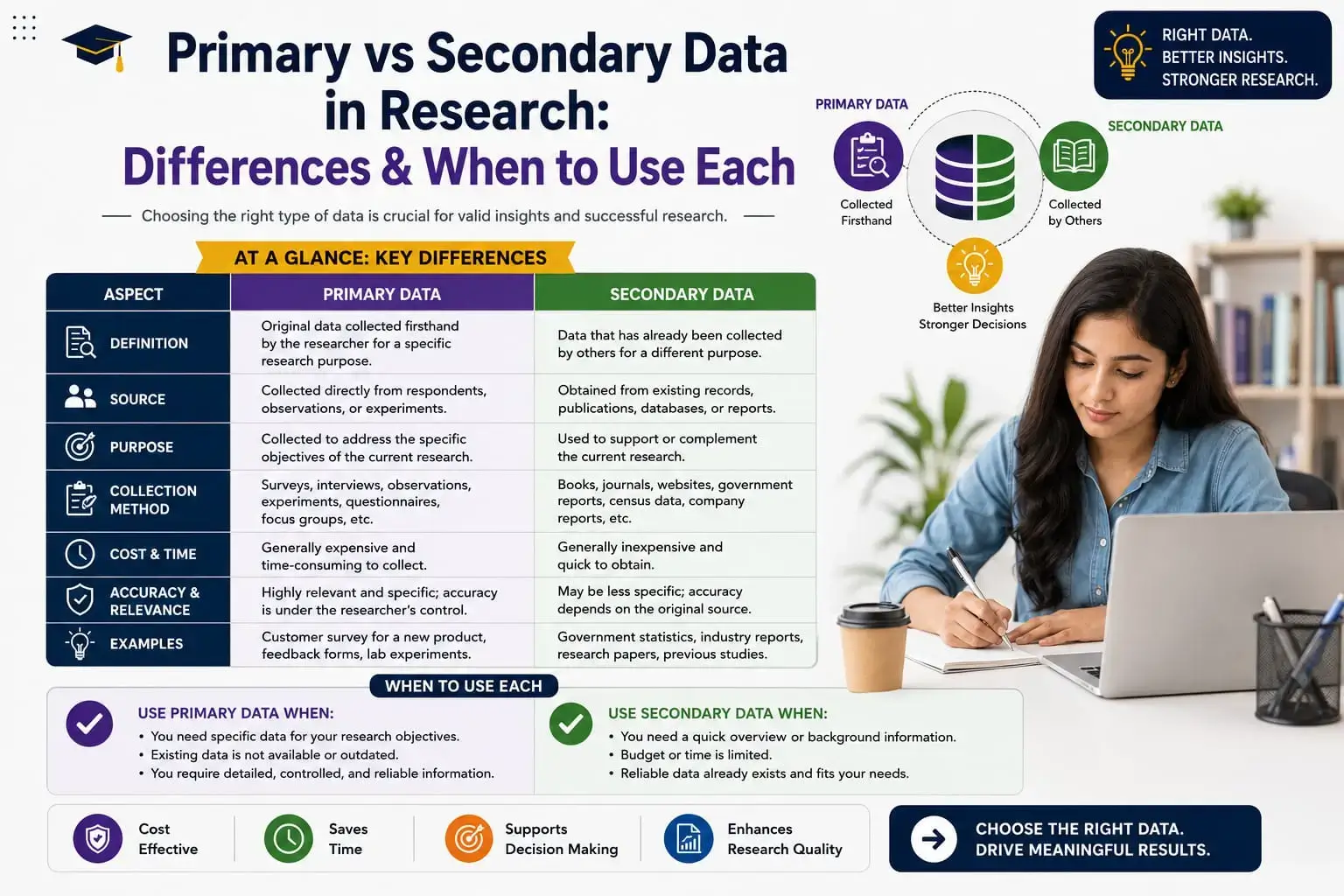
Primary vs Secondary Data: Key Differences at a Glance
Understanding how primary and secondary data differ helps you make a more informed methodological decision. Here is a direct comparison across the factors that matter most for researchers:
1. Origin Primary data originates with you — the current researcher. Secondary data originates with a previous researcher, institution, or organization.
2. Purpose Primary data is collected specifically for your study. Secondary data was collected for a different original purpose and is being repurposed for yours.
3. Cost and Time Primary data collection is typically time-consuming and expensive. It requires designing instruments, recruiting participants, conducting fieldwork, and transcribing or processing results. Secondary data is generally faster and cheaper to access, since the collection has already been done.
4. Relevance Primary data is highly relevant to your exact research questions because you designed it that way. Secondary data may or may not perfectly fit your needs — you work with what is available.
5. Control and Accuracy With primary data, you control quality at every step. With secondary data, you depend on the rigor of whoever collected it originally, which means potential issues with accuracy, bias, or outdated information.
6. Availability Primary data does not exist until you create it. Secondary data is already out there — the challenge is finding, accessing, and critically evaluating it.
7. Confidentiality Primary data collection involves ethical responsibilities like informed consent and participant anonymity. Secondary data, especially from public databases, usually bypasses these concerns — though ethical considerations around data use still apply.
Advantages and Disadvantages of Primary Data
Advantages
Specificity. Primary data answers your exact research questions. You design every element — the questions, the sample, the timing — around what you need to know.
Originality. Because no one has collected this data before, your contribution to the literature is genuinely new. This is particularly valuable in PhD research, where original contribution is a core requirement.
Control over quality. You manage the process end to end, which means you can catch errors, ensure consistency, and maintain ethical standards throughout.
Up-to-date information. You are collecting data in real time, so it reflects the current state of whatever you are studying.
Disadvantages
Time-intensive. Designing instruments, gaining ethical approval, recruiting participants, collecting and processing data — all of this takes significant time, which can be a real constraint in doctoral or postgraduate research.
Expensive. Travel, software, transcription services, participant incentives — primary data collection adds up financially.
Limited scope. You can only collect so much data on your own. Large-scale trends or historical patterns are difficult to capture through primary means alone.
Risk of bias. Researcher bias can creep into survey design, interview conduct, or observation — especially if not carefully managed.
Advantages and Disadvantages of Secondary Data
Advantages
Speed and efficiency. Since the data already exists, you can move quickly from research question to analysis. This is a significant advantage when time is limited.
Cost-effective. Most secondary data sources are free or low-cost. Government databases, academic repositories, and open-access journals are widely available.
Large datasets. Secondary data often gives you access to massive samples — national census data, for example — that would be impossible to replicate through primary research alone.
Historical depth. Want to analyze trends over the last 30 years? Secondary data makes longitudinal analysis feasible when primary collection would be impossibly slow.
Disadvantages
Lack of control. You did not collect this data, so you cannot vouch for exactly how it was gathered, whether instruments were validated, or how missing data was handled.
Potential irrelevance. The data may not align perfectly with your research questions. Variables may be defined differently, populations may not match, or the scope may be too broad or too narrow.
Outdated information. Depending on when the original study was conducted, the data may no longer reflect current realities.
Access restrictions. Not all secondary data is publicly available. Some datasets require formal data sharing agreements, institutional access, or fees.
When Should You Use Primary Data?
Primary data collection is the right choice when:
- Your research question is highly specific and no existing dataset addresses it directly
- You are studying a population or phenomenon that has not been researched before
- You need original, first-hand accounts — lived experiences, opinions, or behaviors
- Your PhD requires a demonstrable original contribution to knowledge
- You need full control over how variables are defined and measured
- The available secondary data is outdated, incomplete, or methodologically weak
Primary data is particularly common in qualitative PhD research — phenomenological studies, grounded theory work, ethnographies, and participatory action research all depend on original data collection. It is also the backbone of experimental and quasi-experimental quantitative studies.
When Should You Use Secondary Data?
Secondary data is the smarter choice when:
- Your research focuses on historical analysis, policy review, or large-scale trend analysis
- You are working within tight time or budget constraints
- A high-quality, relevant dataset already exists and fits your research objectives
- You want to replicate or extend a previous study using the same dataset
- Your research design involves systematic literature review or meta-analysis
- You are in the exploratory phase of your research and need to understand the existing landscape before deciding on primary collection
Secondary data analysis is increasingly recognized as a legitimate and rigorous research approach in its own right — not just a shortcut. Many high-impact studies are built entirely on existing datasets from sources like the World Bank, OECD, NHS Digital, or national census bureaus.
Can You Use Both? Mixed Data Approaches in Research
Absolutely — and in many PhD studies, using both primary and secondary data is not just acceptable, it is actually methodologically stronger.
This is common in mixed methods research, where secondary data provides context, historical depth, or quantitative baselines, while primary data captures current experiences, perspectives, or phenomena that existing sources cannot cover.
For example, a researcher studying graduate employability might analyze national labor market statistics (secondary) alongside conducting interviews with recent PhD graduates (primary). Each data type answers a different layer of the research question — together, they build a far more complete picture.
The key is to be explicit about which data answers which part of your research question and to justify why each type was the most appropriate choice for that component.
Primary vs Secondary Data: Which Is Better for a PhD?
There is no universal answer. The better choice is always the one that most directly and rigorously addresses your research questions — within the constraints of your discipline, your timeline, and your available resources.
That said, here is a practical rule of thumb: if your research question demands originality, depth, or context-specific insight, lean toward primary data. If your question involves scale, historical analysis, or existing phenomena well-documented in the literature, secondary data may serve you better — or supplement your primary work powerfully.
What matters most is that your choice is deliberate, clearly justified in your methodology chapter, and consistently applied throughout your study.
Frequently Asked Questions (FAQs)
Q1: What is the main difference between primary and secondary data? Primary data is collected directly by the researcher for the current study. Secondary data was collected by someone else for a different purpose and is being reused. The core difference lies in origin, control, and specificity.
Q2: Which is more reliable — primary or secondary data? Primary data is generally considered more reliable for your specific study because you control the collection process. However, secondary data from reputable sources like government agencies or peer-reviewed studies can be equally rigorous when critically evaluated.
Q3: Can a PhD thesis use only secondary data? Yes. Many PhD theses — especially in history, policy studies, economics, and systematic review-based disciplines — are built entirely on secondary data. What matters is that the data is critically analyzed and the methodology is well justified.
Q4: What are examples of primary data collection methods? Common examples include surveys, interviews, focus groups, direct observations, experiments, and ethnographic fieldwork. Each method suits different types of research questions and contexts.
Q5: What are good sources of secondary data for academic research? Strong secondary data sources include government statistical databases (ONS, Census Bureau, WHO), academic repositories, JSTOR, Google Scholar, the World Bank Open Data portal, national health records, and institutional research archives.
Q6: How do I decide between primary and secondary data for my research? Start with your research question. Ask yourself: Does existing data already address this question adequately? If yes, consider secondary data. If your question demands original, context-specific, or current insights that no existing dataset provides, go for primary data collection.
Q7: What is the difference between primary and secondary data in qualitative research? In qualitative research, primary data typically involves original interviews, focus groups, or observations. Secondary data in qualitative research includes previously transcribed interviews, historical documents, media content, or published case studies used for analysis.
Wrapping Up: Make a Data Decision You Can Defend
The distinction between primary and secondary data in research is not just academic terminology — it is a decision that shapes the entire credibility and direction of your study. Every choice you make about data has consequences for your methodology, your findings, and ultimately your contribution to knowledge.
Whether you go primary, secondary, or a thoughtful combination of both, the goal is the same: collect or source data that gives you the most accurate, relevant, and defensible answers to your research questions.
Take the time to think this through before you start. Your dissertation committee will be asking about it — and you want a clear, confident answer ready.
Ready to build a stronger research methodology — but not sure where to start? Whether you are stuck on your data collection strategy, struggling to justify your methodological choices, or need expert eyes on your dissertation draft, professional academic guidance can make all the difference. Get tailored support from subject-matter experts who understand exactly what doctoral-level research demands.
Because the right data strategy does not just improve your thesis — it defines it.
Tags: primary vs secondary data, primary data collection methods, secondary data sources for research, difference between primary and secondary data, when to use primary data, when to use secondary data in research, primary and secondary data examples, PhD data collection strategy, mixed data research, research methodology PhD
Website: www.thesislikho.com
Call/WhatsApp: +91 96438 02216