
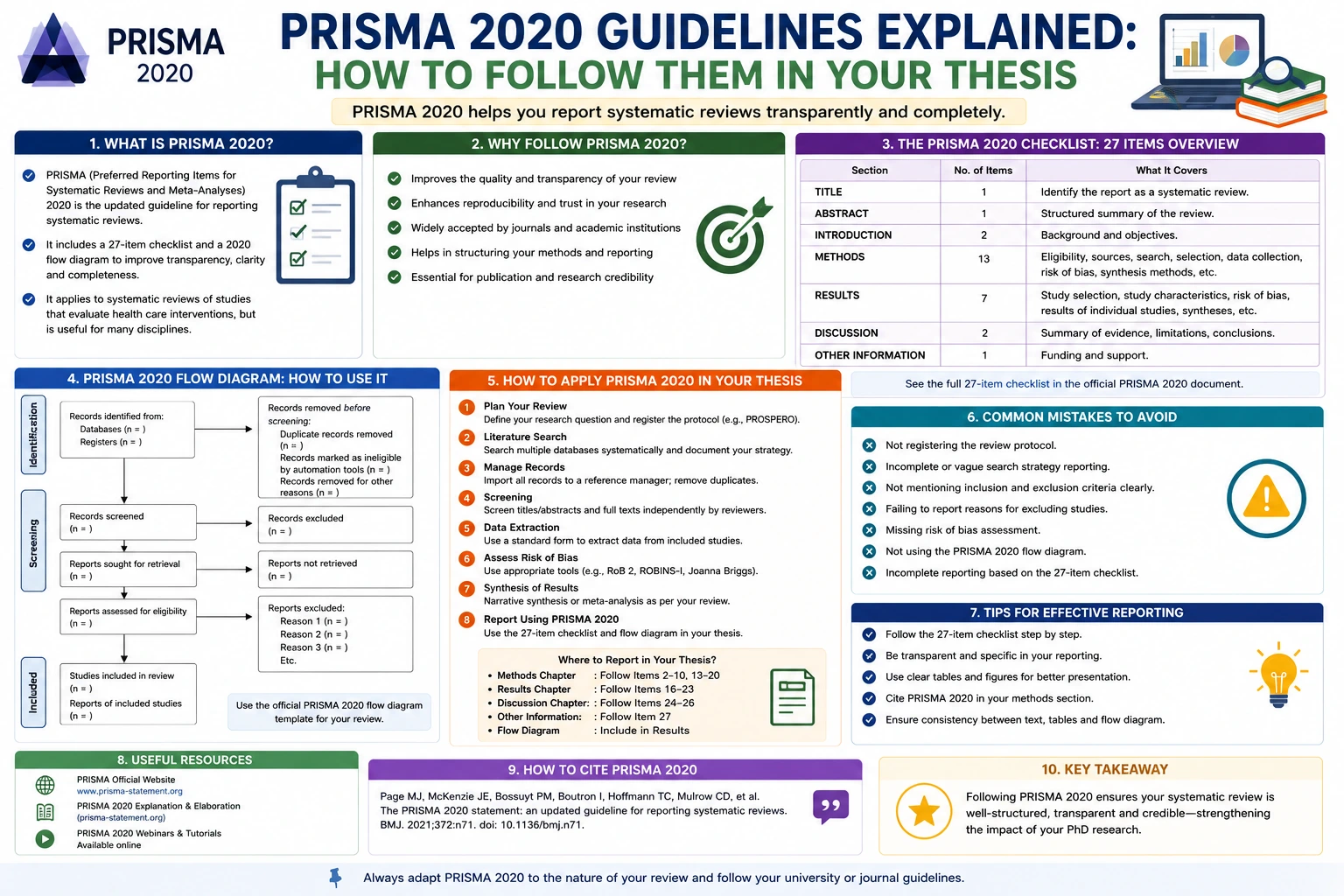
Writing a systematic review as part of your PhD thesis requires more than collecting and summarizing research papers. It demands transparency, reproducibility, and a structured reporting process. This is where the PRISMA 2020 Guidelines become essential.
Whether you are pursuing a PhD in medicine, engineering, management, education, social sciences, nursing, pharmacy, psychology, or any other discipline, understanding PRISMA 2020 can significantly improve the quality and credibility of your research.
In this comprehensive guide, you'll learn what PRISMA 2020 is, why it matters, how to follow it step by step, and common mistakes to avoid.
What Is PRISMA 2020?
PRISMA stands for Preferred Reporting Items for Systematic Reviews and Meta-Analyses.
It is an internationally accepted reporting guideline that helps researchers present systematic reviews in a clear, transparent, and reproducible manner.
The latest version, PRISMA 2020, replaces the original 2009 guideline and reflects modern research practices, digital databases, and advances in evidence synthesis.
Rather than telling researchers how to conduct a systematic review, PRISMA explains how to report it comprehensively so readers can evaluate and reproduce the review process.
Why Are PRISMA 2020 Guidelines Important?
Following PRISMA offers several benefits:
- Improves transparency in research.
- Reduces reporting bias.
- Makes literature reviews reproducible.
- Enhances publication acceptance chances.
- Increases research credibility.
- Meets journal submission requirements.
- Helps supervisors and reviewers assess research quality.
Many Scopus-indexed and Web of Science journals now expect systematic reviews to comply with PRISMA reporting standards.
Who Should Use PRISMA?
PRISMA is useful for:
- PhD scholars
- MPhil students
- Master's researchers
- Medical researchers
- Engineering researchers
- Education scholars
- Nursing researchers
- Psychology researchers
- Management researchers
- Public health professionals
If your thesis includes a systematic review or meta-analysis, PRISMA should be part of your methodology.
What Changed in PRISMA 2020?
Compared to the 2009 version, PRISMA 2020 includes several important updates.
Expanded Reporting Checklist
The checklist now contains 27 reporting items with additional guidance and explanations.
Improved Flow Diagram
The updated flowchart accommodates:
- Database searching
- Register searching
- Citation searching
- Duplicate removal
- Updated reviews
Better Reporting of Search Strategies
Researchers are encouraged to provide detailed search strategies, including:
- Database names
- Search strings
- Search dates
- Filters applied
More Transparent Selection Process
Authors should clearly explain:
- Inclusion criteria
- Exclusion criteria
- Screening procedures
- Reviewer disagreements
- Data extraction methods
The Four Stages of PRISMA 2020
PRISMA organizes the literature selection process into four stages.
1. Identification
Researchers search multiple databases.
Examples include:
- Scopus
- Web of Science
- PubMed
- IEEE Xplore
- ScienceDirect
- Google Scholar
Every retrieved record is documented.
2. Screening
Researchers remove duplicate studies.
Next, titles and abstracts are reviewed to eliminate irrelevant papers.
Only potentially eligible studies move forward.
3. Eligibility
The remaining articles undergo full-text review.
Researchers determine whether each study satisfies the inclusion and exclusion criteria.
Reasons for exclusion should be recorded.
Examples:
- Wrong population
- Wrong intervention
- Incomplete data
- Not peer-reviewed
- Duplicate publication
4. Included Studies
Only studies meeting all eligibility criteria are included in the final systematic review.
The number of included studies is reported in the PRISMA flow diagram.
Understanding the PRISMA 2020 Checklist
The PRISMA checklist contains 27 reporting items organized into several sections.
Title
Clearly identify the paper as a systematic review.
Example:
"Systematic Review of Artificial Intelligence Applications in Healthcare."
Abstract
Provide a structured abstract covering:
- Objectives
- Methods
- Results
- Conclusions
Introduction
Include:
- Background
- Research problem
- Research objectives
- Review questions
Methods
This is the most detailed section.
Describe:
- Eligibility criteria
- Information sources
- Search strategy
- Selection process
- Data extraction
- Risk of bias assessment
- Data synthesis methods
Results
Present:
- Number of studies found
- Screening process
- Characteristics of included studies
- Risk of bias
- Main findings
Discussion
Discuss:
- Interpretation
- Limitations
- Strengths
- Practical implications
- Future research
Other Information
Include:
- Funding
- Registration details
- Conflict of interest
- Data availability
How to Create a PRISMA Flow Diagram
The PRISMA flow diagram visually represents the study selection process.
A typical example might look like this:
- Records identified through databases: 2,500
- Duplicates removed: 450
- Records screened: 2,050
- Records excluded: 1,700
- Full-text articles assessed: 350
- Full-text articles excluded: 250
- Studies included: 100
This diagram allows readers to understand exactly how the final studies were selected.
Step-by-Step Guide to Following PRISMA in Your Thesis
Step 1: Define Your Research Question
Use frameworks such as:
- PICO
- SPIDER
- PICo
A well-defined question guides the entire review process.
Step 2: Develop Inclusion and Exclusion Criteria
Specify:
- Publication years
- Language
- Study design
- Population
- Outcomes
- Document type
Clearly documenting these criteria helps reduce selection bias.
Step 3: Search Multiple Databases
Avoid relying on a single source.
Search across several relevant databases to capture a comprehensive body of literature.
Record:
- Database name
- Date searched
- Search terms
- Number of results
Step 4: Remove Duplicate Records
Reference management software such as Zotero, Mendeley, or EndNote can simplify duplicate removal before screening begins.
Step 5: Screen Titles and Abstracts
Review titles and abstracts against your eligibility criteria.
This step quickly filters out irrelevant studies while keeping potentially useful ones for full-text review.
Step 6: Review Full-Text Articles
Read the remaining studies in full.
Exclude articles that do not meet your predefined criteria, and document the reasons for exclusion to maintain transparency.
Step 7: Extract Data Systematically
Create a standardized data extraction table that includes information such as:
- Author
- Publication year
- Country
- Research design
- Sample size
- Variables studied
- Key findings
Consistency at this stage makes synthesis easier and more reliable.
Step 8: Assess Study Quality
Evaluate the methodological quality or risk of bias using an appropriate appraisal tool, depending on the study design.
Examples include the CASP checklists, JBI critical appraisal tools, or the Cochrane Risk of Bias tool.
Step 9: Synthesize the Evidence
Choose the synthesis approach that matches your review:
- Narrative synthesis for qualitative or diverse studies.
- Meta-analysis when quantitative studies are sufficiently comparable.
Explain how you combined and interpreted the evidence.
Step 10: Report Using the PRISMA Checklist
Before finalizing your thesis, compare each section with the PRISMA 2020 checklist to ensure every required reporting item has been addressed.
Common Mistakes to Avoid
Researchers often weaken their systematic reviews by making avoidable errors.
Common mistakes include:
- Searching only one database.
- Not documenting the search strategy.
- Omitting reasons for excluding studies.
- Ignoring duplicate records.
- Using unclear inclusion or exclusion criteria.
- Failing to assess study quality.
- Leaving out the PRISMA flow diagram.
- Reporting methods inconsistently.
Avoiding these issues improves both the transparency and credibility of your work.
Tips for Indian PhD Scholars
If you're preparing a thesis in India:
- Confirm your university's formatting guidelines.
- Follow PRISMA if your research includes a systematic review.
- Use citation management software to organize references efficiently.
- Keep detailed records of search dates, databases, and search strings.
- Save exported search results for reproducibility.
- Discuss your review protocol with your supervisor before beginning the search process.
These practices can save significant time during thesis review and journal submission.
Frequently Asked Questions (FAQs)
Is PRISMA mandatory for every thesis?
No. PRISMA is specifically intended for systematic reviews and meta-analyses. Narrative reviews and other research designs generally follow different reporting standards.
Can PRISMA be used without a meta-analysis?
Yes. PRISMA applies to systematic reviews regardless of whether a meta-analysis is performed.
Does PRISMA tell me how to conduct research?
No. PRISMA is a reporting guideline. It helps you explain your review process clearly and transparently rather than prescribing the research methodology itself.
How many items are in the PRISMA 2020 checklist?
The PRISMA 2020 checklist contains 27 reporting items covering the title, abstract, introduction, methods, results, discussion, and other important information.
Which software can help with a PRISMA review?
Commonly used tools include Zotero, Mendeley, EndNote, Rayyan, and spreadsheet software such as Microsoft Excel for tracking screening decisions and extracted data.
Conclusion
The PRISMA 2020 Guidelines have become the global benchmark for reporting systematic reviews with clarity and transparency. By documenting every stage—from database searching and study screening to evidence synthesis—you make your research easier to understand, evaluate, and reproduce.
For PhD scholars, especially those planning to publish in reputable journals, following PRISMA is more than a recommendation; it is a best practice that strengthens the credibility of your thesis and increases the likelihood of successful publication.
If your research includes a systematic review, integrating the PRISMA 2020 checklist and flow diagram from the beginning of your project will help you produce a rigorous, well-organized, and publication-ready thesis.
Website: www.thesislikho.com
Call/WhatsApp: +91 96438 02216