
If you're working on a systematic review or meta-analysis as part of your thesis, you've probably been told to follow PRISMA guidelines. But here's the thing — most guides online still talk about the 2020 version, and with the updated PRISMA 2026 framework now being discussed and adopted across academic institutions, students are genuinely confused about what changed, what stayed the same, and how to actually apply it without getting stuck.
This guide breaks it all down in plain language. Whether you're at the proposal stage or already knee-deep in your literature screening process, you'll walk away knowing exactly how to align your thesis with PRISMA 2026 — and why doing it right can significantly strengthen your research credibility.
What Is PRISMA and Why Does It Keep Updating?
PRISMA stands for Preferred Reporting Items for Systematic Reviews and Meta-Analyses. It's essentially a checklist and flow diagram framework that helps researchers report their review process in a transparent, reproducible way.
Think of it like this: if you and I both searched PubMed for the same topic using the same keywords, would we arrive at the same studies? PRISMA exists to make sure whoever reads your thesis can answer that question confidently.
The guidelines were first formally published in 2009, revised significantly in 2020, and now the 2026 iteration addresses reporting gaps that researchers and journal editors have flagged over the past few years — especially around automation tools, AI-assisted screening, and equity considerations in evidence synthesis.
It keeps updating because research methods keep evolving. That's not a bug; that's science working as intended.
What's New in PRISMA 2026 Compared to PRISMA 2020?
Before you panic about having to redo everything, let's be clear: PRISMA 2026 builds on 2020, not replaces it wholesale. Most core elements remain intact. However, there are meaningful refinements you need to know about.
1. Explicit Reporting on AI-Assisted Screening
This is the biggest change most thesis students will feel directly. If you used any tool — Rayyan, Covidence, ASReview, or even a custom script — to assist in title/abstract screening, PRISMA 2026 expects you to explicitly state this in your methods and in the flow diagram.
You don't have to avoid these tools. You just have to be honest about them. Specifically:
- Name the tool used
- Describe what role it played (prioritization vs. full automation)
- State how human oversight was maintained
2. Updated Equity and Inclusion Lens
PRISMA 2026 now encourages reviewers to consider health equity in how they define eligibility criteria and interpret results. This doesn't mean every thesis needs a social justice angle — but if your topic involves populations, interventions, or outcomes where equity matters (which, honestly, is most health-related topics), you should address this in your eligibility criteria section.
3. Clearer Guidance on Grey Literature
The updated framework gives more structured direction on how to report searches beyond traditional databases — think dissertations, clinical trial registries, preprint servers, and conference proceedings. If you searched sources like OpenGrey, ProQuest, or ClinicalTrials.gov, you now have clearer reporting language to follow.
4. Refined Flow Diagram Labels
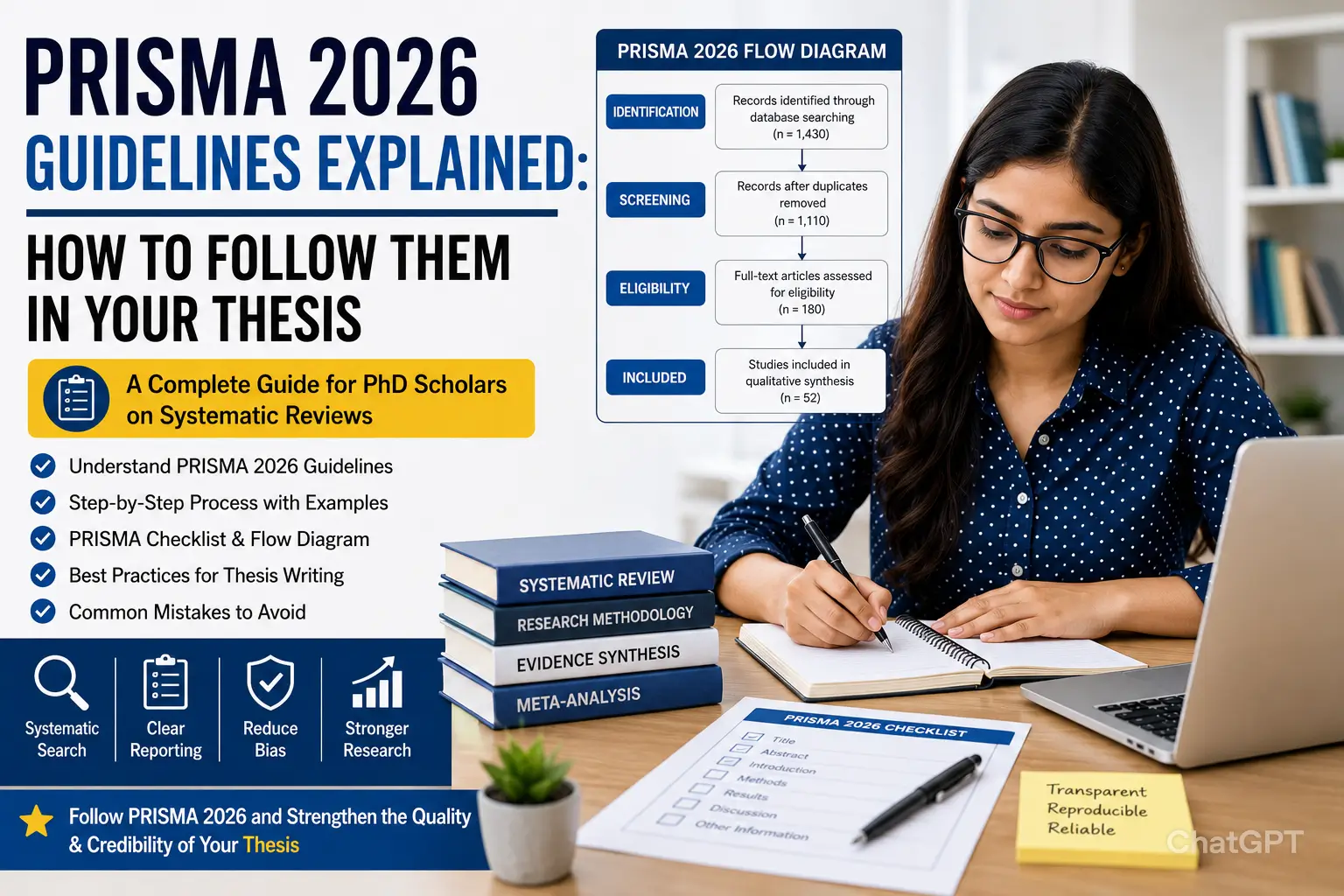
The classic four-box PRISMA flow diagram (Identification → Screening → Eligibility → Included) gets a slight structural refinement. Specifically, the 2026 guidance recommends clearer differentiation between records identified through database searching versus other methods, which actually aligns with what good systematic reviewers were already doing.
How to Apply PRISMA 2026 in Your Thesis: A Step-by-Step Breakdown
Step 1: Plan Your Protocol First (and Register It)
This sounds basic, but many students skip it and pay the price later. Before you begin searching, write out your review protocol. This includes your:
- Research question (ideally using PICO or a similar framework)
- Inclusion and exclusion criteria
- Planned databases and search terms
- How you'll manage duplicates
- How you'll handle disagreements between reviewers
Register this protocol on PROSPERO (for health-related reviews) or OSF (for other fields). PRISMA 2026 recommends — and many supervisors now require — that you include the registration number in your thesis. It signals that you didn't change your criteria after seeing results.
Step 2: Build a Comprehensive, Documented Search Strategy
Your search strategy needs to be reproducible. That means someone else could copy your exact search strings, run them in the same databases on the same date, and retrieve the same records.
For your thesis, this means:
- Documenting the exact Boolean strings used
- Noting the date each database was searched
- Listing all databases searched (e.g., MEDLINE via PubMed, Embase, CINAHL, Cochrane Library)
- Reporting any filters applied (date limits, language restrictions, study design filters)
A pro tip most students miss: ask a medical librarian or information specialist to peer review your search strategy. This is a PRISMA 2026-recommended step and it meaningfully improves the quality signal of your review.
Step 3: Use and Report Your Screening Process Correctly
Here's where the PRISMA 2026 AI update kicks in practically. After removing duplicates, you'll screen titles and abstracts, then move to full-text review.
Whether you screen manually in Excel, use a dedicated tool like Rayyan, or let an AI prioritization algorithm sort your records — your thesis needs to explain:
- How many reviewers screened each record
- What the protocol was for disagreements
- If any automated tool was used, what it did and how you validated its decisions
Create a clear decision log as you screen. This makes writing your methods chapter dramatically easier, and it protects you if your supervisor asks why a particular study was excluded.
Step 4: Extract Data Consistently
Data extraction is where systematic reviews often become unsystematic. Design your extraction form before you start — not as you go. Your form should capture:
- Study characteristics (author, year, country, design)
- Population details
- Intervention/exposure details
- Outcome measures and results
- Risk of bias indicators
If two reviewers are extracting independently (recommended for a robust review), plan how you'll reconcile differences before you start.
Step 5: Complete the PRISMA 2026 Flow Diagram
The flow diagram is often the first thing an examiner or reviewer looks at. It needs to show, at each stage, exactly how many records were:
- Identified (split by source type — databases vs. other methods)
- Screened
- Assessed for eligibility
- Included in final synthesis
Don't leave out the exclusion reasons. Under PRISMA 2026, at the full-text stage, you must list the reasons studies were excluded — with numbers. Vague statements like "did not meet inclusion criteria" without specifics are a red flag to examiners.
Step 6: Complete the PRISMA 2026 Checklist
The official PRISMA 2026 checklist has items across several sections: Title, Abstract, Introduction, Methods, Results, Discussion, and Other. For your thesis, go through each item and note which section and page number of your thesis addresses it.
Supervisors increasingly ask students to submit this completed checklist as an appendix. Even if yours doesn't require it, doing this exercise yourself will reveal gaps before your viva.
Common Mistakes Thesis Students Make with PRISMA Reporting
Let's be direct about what tends to go wrong:
Forgetting to update the flow diagram after adding studies. Many students create their PRISMA diagram early and forget to revise it when they add or remove studies later. Treat your diagram as a living document until your thesis is final.
Incomplete exclusion reasons. Listing reasons for full-text exclusions is non-negotiable under any version of PRISMA. If you excluded 47 studies, your reader needs to know why — even if it's just a summary table.
Not reporting the date of searches. The date matters because databases update constantly. An undated search is an unreproducible search.
Confusing systematic review reporting with systematic review conduct. PRISMA tells you how to report what you did, not how to do the review itself. You still need to understand methodology (like GRADE for certainty of evidence, or risk of bias tools like RoB 2 or ROBINS-I) separately.
Skipping the protocol registration. Even if your institution doesn't require it, registering your protocol is increasingly a marker of rigorous academic work.
LSI Keywords You'll Encounter in PRISMA-Related Research
If you're doing a literature review on systematic review methodology itself, you'll come across these related terms regularly:
- PRISMA-P (the protocol extension)
- PICO framework (Population, Intervention, Comparison, Outcome)
- Evidence synthesis methods
- Systematic review reporting standards
- Meta-analysis flow diagram
- Risk of bias assessment
- GRADE approach (Grading of Recommendations Assessment)
- Scoping review vs systematic review
- Citation screening tools for thesis
- Cochrane review methods
Understanding these terms helps you place your thesis in the broader methodological conversation — which examiners appreciate.
Frequently Asked Questions (FAQs)
Q1: Is PRISMA 2026 mandatory for my thesis? It depends on your institution and supervisor. However, it is increasingly expected for any thesis that includes a systematic review or structured literature review. Journals now routinely require PRISMA adherence, and thesis examiners are familiar with the standards. Following it signals methodological rigor.
Q2: Can I still follow PRISMA 2020 if my university hasn't updated its guidelines? Yes, and in many cases that's still acceptable. The key difference is that if you use AI-assisted screening tools, you should disclose and describe this regardless of which version you follow — it's a transparency issue.
Q3: Do I need PRISMA if I'm doing a scoping review, not a systematic review? There's a separate framework for scoping reviews called PRISMA-ScR (the Scoping Review extension). If your review follows scoping review methodology, use that instead.
Q4: Where can I find the official PRISMA 2026 checklist? The official PRISMA resources are hosted at prisma-statement.org. Always download directly from the source — many circulating versions online are outdated.
Q5: My systematic review only has one reviewer (me). Does PRISMA still apply? Yes, but you need to be transparent about this limitation. Single-reviewer screening is a methodological limitation, not a disqualifying factor. Acknowledge it in your methods and limitations sections.
Q6: How long should the PRISMA flow diagram section take in my thesis? The diagram itself is a single figure, but the associated methods section explaining your search, screening, and inclusion process typically runs 400–800 words for a thesis. Don't underwrite it — this is where examiners check your rigor.
Q7: What's the difference between PRISMA and PROSPERO? PRISMA is a reporting guideline (how you describe what you did). PROSPERO is a protocol registry (where you register what you plan to do before starting). They serve different purposes and are often used together.
Final Thoughts
Getting PRISMA 2026 right in your thesis isn't about box-ticking. It's about building a piece of research that another scholar could genuinely replicate, critique, and build upon. That's the point of a systematic review — and honestly, that's what a thesis is trying to demonstrate: that you can conduct and report rigorous research.
The 2026 updates aren't dramatic overhauls. They're refinements that reflect how research practices have evolved — particularly around technology use and equity considerations. If you already understand PRISMA 2020, you're most of the way there.
Start early, document obsessively, register your protocol, and treat the PRISMA checklist not as a burden but as your quality assurance tool.
Ready to Take Your Thesis Systematic Review to the Next Level?
If you're finding PRISMA compliance challenging — whether it's designing your search strategy, managing your screening process, or structuring your methods chapter — don't leave it to guesswork.
Our academic writing consultation service helps postgraduate students at every stage of the systematic review process: from protocol development and database search design through to PRISMA-compliant reporting and thesis submission. We've helped students across disciplines — health sciences, education, psychology, social policy — produce rigorous, examiner-ready systematic reviews.
Website: www.thesislikho.com
Call/WhatsApp: +91 96438 02216