
Introduction
SPSS is a trusted tool for analyzing data in academic research. Universities worldwide like SPSS because it is easy to use has statistical capabilities and gives accurate results for dissertations, theses, journal publications and research projects.
Many researchers collect data but struggle with choosing the right statistical tests checking assumptions interpreting results and presenting findings as per university guidelines. Without analysis even well-designed research may not produce reliable conclusions.
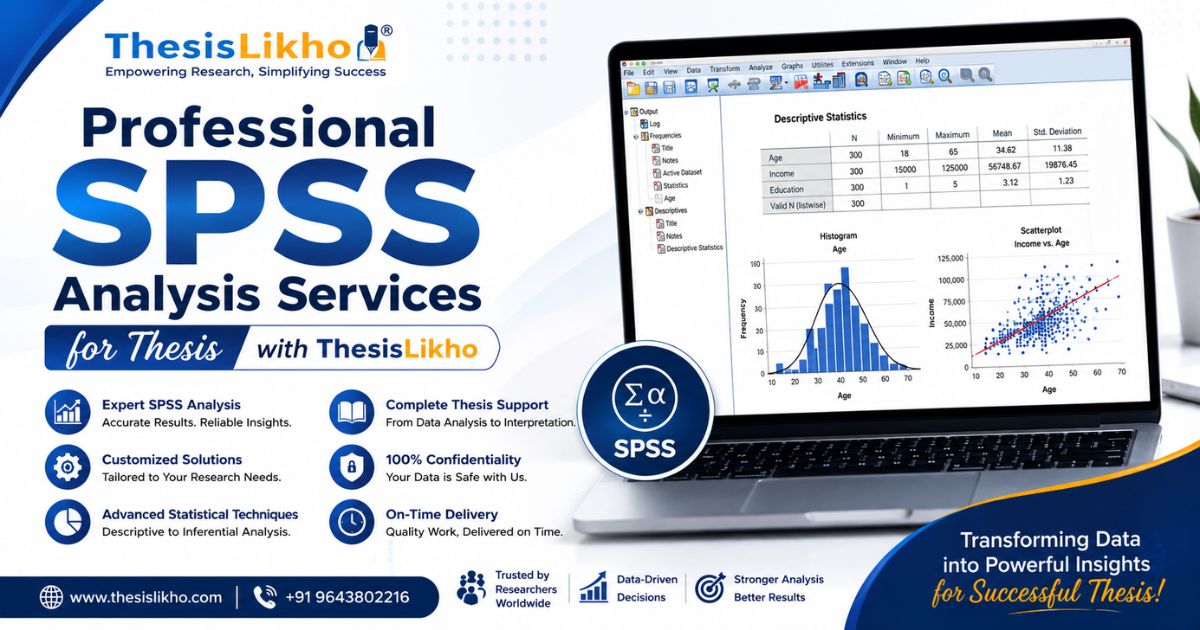
ThesisLikhos professional SPSS Analysis Services make this process easier by helping scholars datasets do statistical tests interpret results prepare tables and explain findings in relation to research objectives and hypotheses.
Their experienced statisticians provide SPSS Data Analysis support for scholars from various disciplines like Management, Commerce, Economics, Education, Psychology, Medical Sciences and more.
From coding questionnaires and doing descriptive statistics to advanced regression models and reliability testing they ensure that every stage of SPSS Analysis is accurate, transparent and follows international research standards.
Quick Definition
SPSS Analysis is using IBM SPSS Statistics software to organize, analyze and interpret research data. It helps researchers do statistics inferential statistics, test hypotheses do regression analysis, test reliability and visualize data for good thesis and dissertation research.
Why Is SPSS Important for Thesis Research?
SPSS helps researchers turn data into meaningful statistics. It supports decision-making validates hypotheses measures relationships between variables and makes academic research more credible.
Because SPSS is recognized by universities and research institutions worldwide it is a tool for thesis and dissertation research.
Major Advantages of SPSS
It is easy to use.
It has statistical techniques.
It does hypothesis testing.
It manages data reliably.
It creates publication tables and charts.
It is suitable for research.
1. Preparing Data for SPSS Analysis
Before doing tests researchers must prepare their datasets carefully. Preparing data improves accuracy. Prevents errors during analysis.
Proper preprocessing ensures that statistical assumptions are met and research findings remain reliable.
Major Steps in Data Preparation
Coding questionnaires.
Defining variables.
Entering data.
Identifying missing values.
Detecting outliers.
Cleaning data.
Transforming variables.
Validating data.
2. Statistical Tests Available in SPSS
One of the strengths of SPSS Analysis is the statistical procedures it offers. Choosing the test depends on the type of variables sample size, research questions and hypotheses.
Common SPSS Statistical Tests
Descriptive Statistics.
Frequency Distribution.
Crosstab Analysis.
Independent t-test.
Paired t-test.
One-way ANOVA.
Two-way ANOVA.
Correlation Analysis.
Linear Regression.
Multiple Regression.
Chi-Square Test.
Factor Analysis.
Comparison Table
Parametric vs Non-Parametric Tests
Parametric Tests
Non-Parametric Tests
Independent t-test
Mann Whitney U Test
Paired t-test
Wilcoxon Signed Rank Test
ANOVA
Kruskal Wallis Test
Pearson Correlation
Spearman Correlation
Linear Regression
Logistic Regression
Assumes distribution
Suitable for non normal data
3. Reliability and Validity Testing in SPSS
valid research instruments are essential for producing trustworthy research findings. SPSS provides techniques to evaluate measurement quality before doing statistical analysis.
Major Reliability and Validity Tests
Cronbachs Alpha.
Split-half reliability.
Item-total correlation.
Exploratory Factor Analysis.
KMO Measure.
Bartletts Test of Sphericity.
Communality Analysis.
Construct validity assessment.
4. Regression Analysis in SPSS
Regression Analysis is an used statistical technique in SPSS Analysis. It helps researchers examine the relationship between variables measure the influence of predictors and develop evidence-based conclusions.
Regression models are applied in fields like Management, Commerce, Economics, Medical Sciences and more.
Types of Regression Analysis
Simple Linear Regression.
Multiple Linear Regression.
Logistic Regression.
Hierarchical Regression.
Stepwise Regression.
Binary Logistic Regression.
Benefits of Regression Analysis
It predicts outcomes.
It identifies variables.
It tests research hypotheses.
It supports decision-making.
It quantifies relationships.
It strengthens research findings.
5. Correlation and ANOVA in SPSS
Correlation and ANOVA are statistical techniques used to examine relationships and compare group differences.
Correlation Analysis measures the strength and direction of relationships between variables whereas ANOVA determines whether significant differences exist among groups.
Applications of Correlation Analysis
Pearson Correlation.
Spearman Rank Correlation.
Relationship between research variables.
Preliminary analysis before regression.
Applications of ANOVA
One-Way ANOVA.
Two-Way ANOVA.
Post Hoc Tests.
Group comparison studies.
Experimental research.
Comparison Table
Correlation vs Regression vs ANOVA
Technique
Purpose
Common Applications
Correlation Analysis
Measures relationships
Association between variables
Regression Analysis
Predicts outcomes
Hypothesis testing forecasting
ANOVA
Compares group means
comparative studies
6. Data Interpretation and Report Writing
Doing tests is only part of research. The next step is converting outputs into meaningful academic interpretations. Proper Data Interpretation explains what the findings indicate and how they contribute to existing knowledge.
An effective Results Discussion should always connect findings with the Research Objectives and previous literature.
Best Practices for Interpretation
Explain findings in language.
Link every result to research objectives.
Compare outcomes with studies.
Discuss practical implications.
Report significance levels accurately.
Present Figures clearly.
Highlight limitations where appropriate.
7. Common Mistakes in SPSS Analysis
Many scholars make mistakes that reduce the quality of their research. Professional SPSS Analysis Services help. Correct these issues before submission.
Common Errors
Selecting inappropriate statistical tests.
Ignoring assumptions of normality.
Incorrect coding of variables.
Failure to check reliability and validity.
Misinterpreting p-values.
Reporting statistical results.
Weak linkage between analysis and research objectives.
Poor formatting of tables.
Inadequate explanation of findings.
Ignoring supervisor or reviewer comments.
8. Latest Trends in SPSS Analysis from 2026 to 2030
The way we do analysis is changing really fast because of artificial intelligence, automation and data science. These days researchers are combining the way of doing SPSS Analysis with new techniques to make their research better and more likely to be published.
New Things That Are Happening
We are using intelligence to help us with statistical workflows.
We are automating the process of cleaning up data.
We are combining SPSS with Python and R to make it more powerful.
We are using analytics to help us with our research.
We are creating reports that are easy to understand.
We are doing analysis on the cloud.
We are making pictures to help us understand the data.
We are making sure that our research can be repeated by others.
We are supporting science initiatives.
We are putting emphasis on doing great research and making decisions based on evidence.
Things To Do Before Submitting Your SPSS Analysis Chapter
Before you submit your SPSS analysis chapter make sure you have done the following things:
You have cleaned up the data. Made sure it is correct.
You have chosen the statistical tests.
You have checked the assumptions for each analysis.
You have tested the reliability and validity of the data.
You have reported the statistics.
You have tested the hypotheses.
You have explained what the findings mean in relation to your research objectives.
You have compared your results with what other people have found.
You have checked the tables, figures and formatting.
You have gotten your supervisor to approve it.
Frequently Asked Questions
1. What are SPSS Analysis Services?
SPSS Analysis Services are when experts help you organize, analyze, interpret and report your research data using IBM SPSS Statistics.
2. Which subjects often use SPSS?
SPSS is often used in subjects like management, commerce, economics, education, psychology, medical sciences, pharmacy, nursing, social sciences, agriculture and many other research fields.
3. Can ThesisLikho help with coding questionnaires?
Yes ThesisLikho can help with coding questionnaires creating variables entering data and getting the dataset ready for analysis.
4. Does ThesisLikho do regression analysis?
Yes ThesisLikho can help with linear regression, multiple regression, logistic regression and other advanced analytical techniques.
5. Can you help with testing reliability?
Yes ThesisLikho can do Cronbachs Alpha, exploratory factor analysis, KMO Bartletts test and other reliability and validity assessments.
6. Will you explain SPSS outputs?
Yes ThesisLikho will provide explanations of the data and results and link them directly to your research objectives and hypotheses.
7. Can SPSS be used for research that's ready to be published?
Yes if you do SPSS Analysis correctly it can help you get published in Scopus Journal, Web of Science UGC CARE and ABDC Journals.
8. Do you support masters and PhD students?
Yes ThesisLikho supports postgraduate, doctoral and faculty research projects.
9. Why do people prefer to use SPSS in research?
SPSS is preferred because it is easy to use has statistical techniques gives reliable results and is accepted by universities all over the world.
10. Why should I choose ThesisLikho for SPSS Analysis?
ThesisLikho offers statistical mentoring, expert data analysis, guidance on how to get published ethical research practices and support from start to finish with your thesis.
Conclusion
Doing SPSS Analysis correctly is crucial for producing research that's reliable based on evidence and ready to be published. From getting the data ready and testing reliability to doing regression analysis testing hypotheses and explaining the results every step is important for making a thesis or dissertation.
Using SPSS Analysis Services can help scholars avoid making mistakes choose the right statistical techniques and present their findings in a structured academic format. By combining results with research objectives and what other people have found researchers can make meaningful contributions to their field.
At ThesisLikho our experienced statisticians provide support with SPSS Data Analysis interpretation reporting and guidance on how to get published. Whether you are working on a masters dissertation or a PhD thesis we can help you turn your research data into outcomes that make an impact.
Final Call to Action
Complete Your SPSS Analysis with ThesisLikho
Whether you require SPSS Analysis, SPSS Data Analysis, Regression Analysis, Correlation Analysis, ANOVA, Reliability Testing, Data Interpretation, Results Discussion, or publication-ready statistical reporting, ThesisLikho provides complete end-to-end statistical support for research scholars across all disciplines.
Website: www.thesislikho.com
Call / WhatsApp: +91-96438 02216