
INTRODUCTION
The Harsh Truth About Academic Publishing
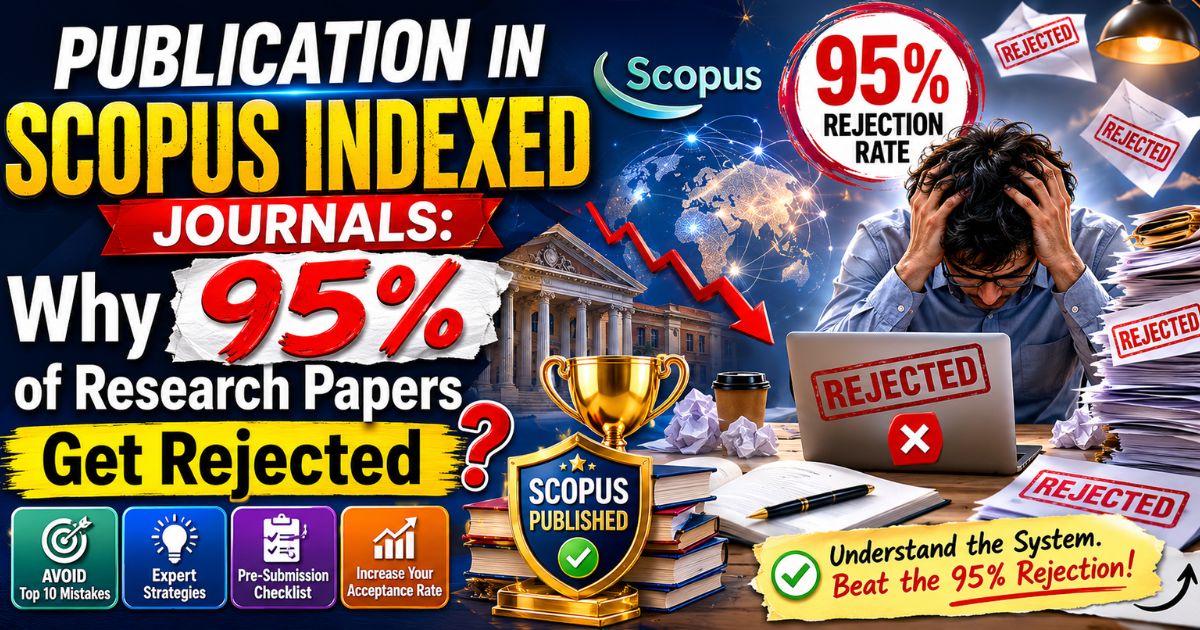
Every year, millions of researchers around the world pour months — sometimes years — of effort into original studies, only to submit their manuscripts to a Scopus-indexed journal and receive the dreaded rejection email. The rejection rate at top-tier indexed journals can exceed 90–95%, and for many early-career researchers, this wall feels impenetrable. But here is the truth that most supervisors fail to explain clearly: rejection is rarely random. It follows predictable, avoidable patterns that, once understood, can dramatically increase your chances of acceptance.
This guide breaks down exactly why the overwhelming majority of manuscripts fail to make it through the Scopus journal publication process — and what you must do differently if you want your research to see the light of day in a peer-reviewed, internationally indexed publication.
“Rejection is not the end of your research journey. It is a redirection — but only if you understand why it happened.”
SECTION 01 — UNDERSTANDING THE BATTLEFIELD
What Is a Scopus-Indexed Journal and Why Does It Matter?
Scopus, owned by Elsevier, is one of the world’s largest abstract and citation databases, currently indexing over 40,000 peer-reviewed journals across sciences, technology, medicine, social sciences, and the humanities. Getting published in a Scopus-indexed journal is considered a gold standard in academic circles — it signals that your work meets rigorous international quality standards, has been peer-reviewed, and is discoverable by researchers globally.
For many academics, a Scopus publication is not just a professional achievement — it is often a requirement. Universities in India, Pakistan, China, Saudi Arabia, and many other countries link faculty promotions, PhD graduation clearances, and research grant eligibility directly to the number of Scopus-indexed publications an individual holds. This institutional pressure creates an enormous volume of submissions, far exceeding what journals can publish.
The competition is fierce. Journals like Nature Communications, PLOS ONE, Computers & Education, or Journal of Cleaner Production receive thousands of submissions each month. Their editorial teams are highly selective, and their peer reviewers — unpaid, often overworked experts — have little tolerance for manuscripts that do not meet the bar.
SECTION 02 — THE TEN CARDINAL SINS
The Top Reasons Manuscripts Are Rejected
Through analysis of rejection letters, editorial guidelines, and conversations with published researchers and journal editors, ten core failure patterns emerge repeatedly. Understanding each one is your first step toward avoiding them.
01
Poor Scope Alignment — Wrong Journal, Wrong Audience
The single most common cause of desk rejection — rejection before peer review even begins — is submitting to the wrong journal. Every Scopus-indexed journal has a carefully defined scope. Editors reject manuscripts outright if the topic, methodology, or discipline does not fit. A paper on machine learning applications in agriculture sent to a journal focused on computational linguistics will be rejected in hours, regardless of quality. Always read the Aims and Scope page thoroughly, study recent published articles, and ask yourself honestly: does my paper belong here?
02
Lack of Novelty — “We’ve Seen This Before”
Peer reviewers are domain experts. They will instantly recognize if your contribution is incremental, redundant, or merely replicates existing work with a different dataset. A Scopus-indexed publication must demonstrate clear originality — a new theory, a novel method, a gap in the literature meaningfully addressed, or a surprising finding that challenges existing knowledge. Your introduction must convincingly answer: what does this paper add that did not exist before?
03
Weak Literature Review — Shallow or Outdated
A thin, poorly organized, or outdated literature review signals to reviewers that the author has not mastered their field. A strong literature review synthesizes prior work, identifies contradictions, highlights gaps, and clearly positions the current study within the scholarly conversation. Using sources that are more than 10 years old without justification, missing seminal works in your domain, or simply listing references without analysis will raise serious red flags for any experienced reviewer.
04
Methodological Flaws — The Achilles Heel of Most Submissions
Methodology is where most manuscripts die. Issues include inadequate sample sizes, inappropriate statistical tests, lack of validity and reliability testing for instruments, convenience sampling without justification, unaddressed confounding variables, and absent ethical approval statements. Reviewers who specialize in methodology will dissect your research design mercilessly. Pilot your instruments, justify your design choices, and never skip on statistical rigor.
05
Poor English Language Quality
English is the de facto language of international academic publishing. Manuscripts riddled with grammatical errors, unclear sentence structures, or translated-sounding prose create friction for reviewers. Many editors reject on language quality alone at the desk review stage. If English is not your first language, professional proofreading is not optional — it is essential. Tools like Grammarly help, but they do not replace a native-level academic editor who understands discipline-specific conventions.
06
Insufficient Contribution to Theory or Practice
Even technically sound papers get rejected when reviewers feel the contribution is not significant enough. The implications section must clearly articulate what researchers, policymakers, practitioners, or society gains from this work. Vague statements like “this study contributes to the existing literature” are not contributions. Be specific: what theory does your study extend, challenge, or validate? What practical decision can a manager, teacher, or clinician make differently because of your findings?
07
Ignoring Author Guidelines — A Fatal Shortcut
Journals have strict author guidelines covering word limits, reference formatting styles, figure resolution requirements, abstract structure, and section headings. Violating these guidelines signals carelessness. A paper formatted for APA submitted to an IEEE journal, or a 9,000-word manuscript submitted to a journal with a 6,000-word limit, will often be rejected outright before a single reviewer sees it.
08
Plagiarism and Self-Plagiarism — Zero Tolerance
Every Scopus-indexed journal runs submissions through plagiarism detection tools such as iThenticate or Turnitin. A similarity score above 15–20% typically triggers automatic rejection. Self-plagiarism — recycling large portions of your own previously published text, even from conference papers — is equally problematic. Write fresh, cite properly, and check your own similarity score before submission.
09
Unbalanced or Shallow Discussion of Findings
The results and discussion sections are where a paper truly earns its place in the literature. Researchers often merely report findings without interpreting them in depth, comparing them critically to prior studies, or explaining unexpected results. A discussion that says “the results show X, which supports previous studies” and nothing more is a missed opportunity. Why did you find what you found? What does it mean in context? Where does it challenge existing theory?
10
Choosing Predatory Journals Masquerading as Scopus-Indexed
A growing problem: predatory journals that falsely claim to be Scopus-indexed, or that have been recently delisted from Scopus but still advertise the credential. Always verify a journal’s Scopus status directly at scopus.com/sources before submitting. If a journal guarantees acceptance, charges unusually high fees with zero review rigor, or sends acceptance within 24 hours, it is almost certainly predatory.
⚠
⚠ CRITICAL WARNING — PREDATORY JOURNAL ALERT
Never pay Article Processing Charges (APCs) to a journal you have not independently verified on the official Scopus source list at scopus.com/sources. Predatory journals will accept your paper, take your money (often ₹50,000–₹2,00,000 or $500–$2,000), and publish work that damages your academic credibility. These publications are not recognized by most universities or funding bodies.
SECTION 03 — THE INVISIBLE BARRIERS
What Editors Never Tell You (But Always Think)
Beyond the explicit technical reasons for rejection, there are unspoken editorial considerations that shape decisions and rarely appear in formal rejection letters.
The Fit Factor
Editors think not just about your paper’s quality, but about its fit within the journal’s current publishing strategy. Journals aim to publish a balanced mix of methodologies, geographic contexts, and sub-topic areas. If a journal has recently published three papers on the same topic with similar methods, your technically sound fourth paper on that subject may still be declined — not because it is bad, but because it adds little new diversity to the journal’s portfolio.
Author Reputation and Institutional Affiliation
While peer review is supposed to be blind, research has consistently shown that papers from prestigious institutions receive more favourable assessments. Editors are human beings who recognize recurring names in their fields. The counter-strategy for newer researchers is to build your citation profile and visibility through conference presentations, preprints, and collaboration.
Reviewer Fatigue and the Timing Factor
Peer reviewers are volunteers — also some of the most overloaded professionals in academia. A reviewer who has just returned from a conference, finished grading student work, and agreed to review four papers simultaneously may not give your paper the careful attention it deserves. Submitting during periods of known low activity (early January, late summer for Western institutions) may modestly improve your chances of engaged review.
“The paper that gets published is not always the best paper submitted. It is the paper that was right, rigorous, and ready — submitted to the right journal, at the right time.”
SECTION 04 — YOUR ACTION PLAN
How to Join the 5%: A Strategic Framework
Understanding rejection is only half the battle. Here is a concrete, step-by-step framework that high-acceptance researchers follow — consciously or instinctively.
→
Start With a Gap, Not a Topic
Successful publications begin with a clearly identified gap in the literature, not simply a topic of personal interest. Use systematic literature review tools — Scopus itself, Web of Science, Google Scholar — to map what has been studied, what contradictions exist, what contexts have been under-researched, and what methodological limitations prior studies have acknowledged. Your research question must emerge from this gap analysis, not from intuition alone.
→
Select Your Target Journal Before You Write
Most researchers make the mistake of writing first, then searching for a suitable journal. Invert this process. Identify two or three target journals before you write the full manuscript. Read their scope, author guidelines, and recent issues. Model your paper’s structure, referencing style, and framing on what the journal actually publishes. This journal-first approach dramatically improves fit alignment and reduces time spent reformatting after rejection.
→
Invest in Your Introduction and Abstract
The abstract and introduction are the make-or-break moments in peer review. Both must clearly state: the problem, the gap, the objective, the method in brief, and the contribution. Your introduction should tell a compelling story — from the broad significance of the problem to the specific niche your study fills — within 800–1,000 words. A structured abstract (Background, Objectives, Methods, Results, Conclusions) signals professional competence immediately.
→
Respond to Reviewers Like a Diplomat, Not a Defendant
If you receive a “revise and resubmit” decision — which is actually a positive outcome — your response to reviewer comments will determine the final verdict. Address every single comment, even if you disagree. Quote the reviewer’s concern, explain your response, state what changes you made (with page and line numbers), and quote the revised text if necessary. A well-crafted revision letter is itself a demonstration of scholarly maturity.
→
Build a Pre-Submission Review Process
Before you submit, your manuscript should be reviewed by at least three people: a domain expert (ideally a co-author or colleague), a methodologist, and a language editor. Consider also submitting a preprint to SSRN, ResearchGate, or arXiv before formal submission — this builds visibility and may attract informal feedback that strengthens the paper before review.
SECTION 05 — PRE-SUBMISSION AUDIT
The Non-Negotiable Checklist Before You Hit Submit
SCOPUS SUBMISSION READINESS CHECKLIST
☐ Verified the journal is currently listed on the official Scopus Source List (scopus.com/sources)
☐ Confirmed the manuscript topic falls squarely within the journal’s stated Aims & Scope
☐ Read at least 5 recently published articles in the target journal to understand format and depth
☐ Clearly articulated the research gap and novelty in both the abstract and introduction
☐ Conducted a systematic literature review including sources from the last 5 years
☐ Justified all methodological choices with citations and addressed limitations honestly
☐ Obtained ethical clearance (if applicable) and stated it in the manuscript
☐ Run a plagiarism check — similarity score below 15% (excluding references)
☐ Had the manuscript proofread by a native English speaker or professional editor
☐ Followed all author guidelines: word count, reference style, figure resolution, file format
☐ Written a compelling cover letter that states the journal name, contribution, and fit
☐ Suggested 3–5 potential peer reviewers (most journals request this — don’t leave it blank)
☐ Confirmed all co-authors have reviewed and approved the final submitted version
☐ Declared all conflicts of interest and funding sources
SECTION 06 — THE LONG GAME
Building a Publication Track Record That Compounds
The researchers who publish consistently in Scopus-indexed journals are not necessarily more intelligent than those who do not. They are more strategic. They have internalized the system and treat academic publishing as a discipline in itself — one that requires as much skill and study as the research it communicates.
Start with journals that have acceptance rates closer to 25–40% — these still carry significant academic weight and are genuinely peer-reviewed, but they offer a more accessible entry point while you develop your publishing skills. As your citation count grows and your methodology strengthens, progressively target higher-impact journals. A single Q1 publication (first quartile by impact factor) carries more weight on a CV than five Q3 publications — but you need to build toward Q1 credibility, not leap there from zero.
Collaborate actively. Co-authored papers with established researchers in your field grant you credibility by association, access to better methodology guidance, and an expanded professional network. International collaborations across institutions in different countries are also viewed favourably by many journals.
Finally, develop a resilient mindset about rejection. Every successful researcher has a folder of rejection letters. Nobel laureates have had papers rejected. The difference between those who eventually publish and those who give up is not talent — it is the willingness to revise, resubmit, and keep learning from each feedback cycle. A rejection is not a verdict on your intelligence; it is peer feedback on a specific manuscript at a specific moment. Treat it as data, not judgment.
“The academic publishing system rewards persistence far more than it rewards genius. Show up, revise, resubmit — and stay in the game long enough to win.”
CONCLUSION
The Path Forward Is Clearer Than It Seems
The 95% rejection rate of Scopus-indexed journals is not a conspiracy against researchers without institutional privilege. It is the cumulative result of predictable, avoidable mistakes — wrong journal choice, poor methodology, missing novelty, language barriers, plagiarism, and shallow analysis — repeated across millions of submissions each year.
The researchers who break into the 5% are not those with unlimited resources or the most dramatic discoveries. They are methodical, strategic, and honest with themselves about the quality of their work. They select journals carefully, write with precision, respond to reviewers with grace, and treat every rejection as a curriculum rather than a verdict.
You now understand the system better than most of the people submitting papers today. Use that understanding. Audit your next manuscript against every failure point listed here. Give your work the time and rigour it deserves. And when rejection arrives — because it will, even for the best researchers — read the letter carefully, extract every lesson it offers, and get back to work.
The literature needs your research. Make sure it is ready to be found.
Visit us for more info. - https://thesislikho.com/