
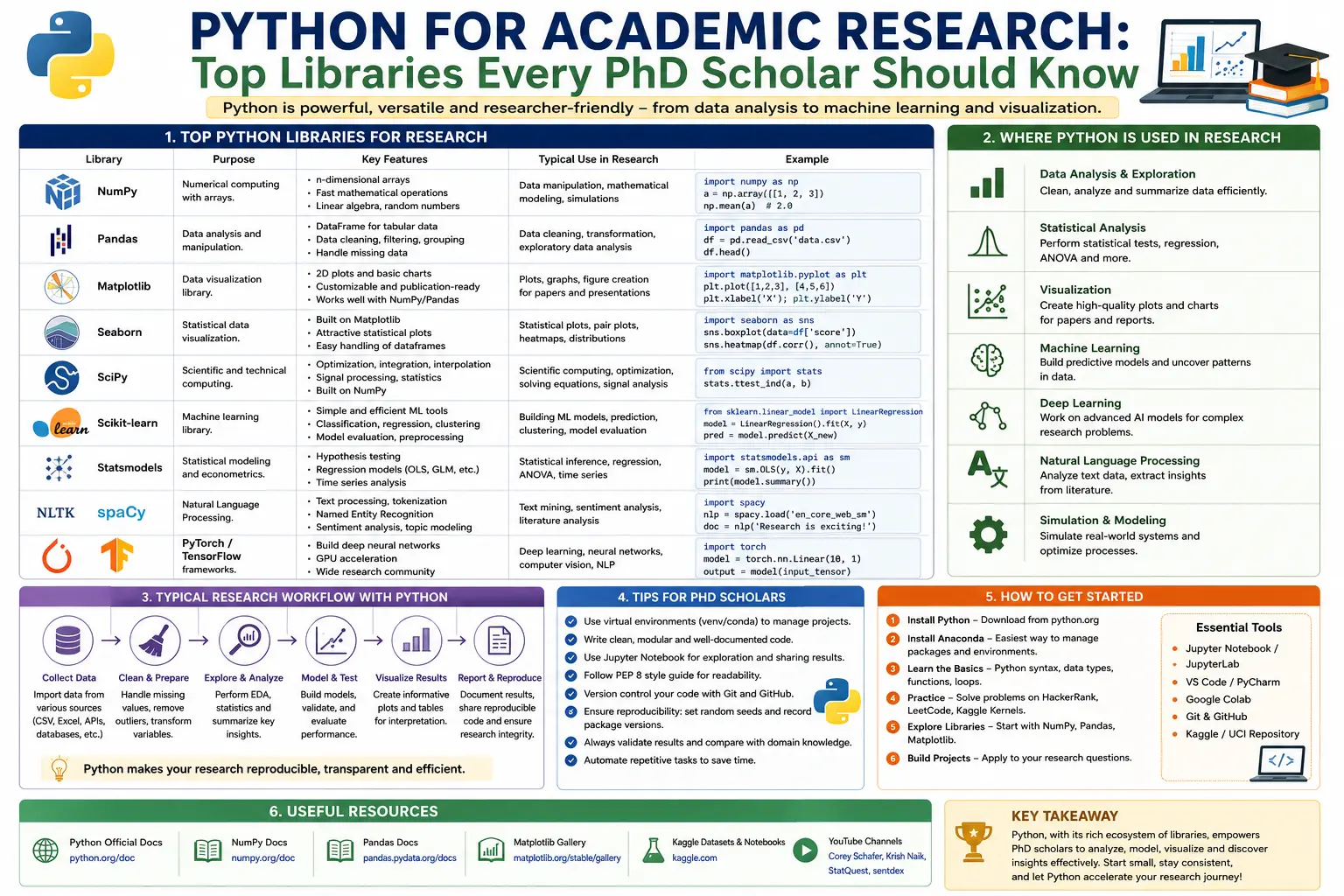
Python has become one of the most valuable programming languages in academic research. From data analysis and statistical modeling to artificial intelligence (AI), machine learning, natural language processing (NLP), and data visualization, Python enables researchers to perform complex tasks with efficiency and accuracy.
For PhD scholars, mastering Python can significantly improve research productivity. Instead of relying solely on traditional statistical software like SPSS, STATA, or SAS, researchers can automate repetitive tasks, analyze massive datasets, create publication-quality visualizations, and build predictive models using Python's extensive ecosystem of libraries.
Today, universities, research institutions, healthcare organizations, financial firms, and technology companies rely heavily on Python for research and innovation. Whether you're pursuing a PhD in engineering, computer science, management, economics, healthcare, social sciences, biology, or environmental science, learning the right Python libraries can make your research more efficient, reproducible, and impactful.
In this comprehensive guide, we'll explore the top Python libraries every PhD scholar should know, their applications, advantages, and practical use cases in academic research.
Why Python Is Becoming the Preferred Language for Researchers
Python's popularity in academia continues to grow because it combines simplicity with powerful analytical capabilities.
Some of its major advantages include:
- Easy-to-read syntax suitable for beginners.
- Open-source and free to use.
- Extensive scientific computing ecosystem.
- Large global developer and research community.
- Excellent integration with databases, cloud platforms, and APIs.
- Strong support for automation and reproducible research.
- Availability across Windows, macOS, and Linux.
Unlike many proprietary statistical software packages, Python allows researchers to customize workflows and combine multiple analytical techniques within a single programming environment.
Benefits of Using Python in Academic Research
Python offers several advantages that make it particularly valuable for doctoral research.
1. Automates Repetitive Tasks
Researchers often spend countless hours cleaning datasets, renaming variables, merging files, and formatting outputs.
Python can automate these repetitive processes, reducing manual effort and minimizing errors.
2. Handles Large Datasets Efficiently
Unlike spreadsheets that struggle with large volumes of data, Python can process millions of records efficiently when paired with optimized libraries.
3. Supports Advanced Statistical Analysis
Python provides tools for:
- Regression analysis
- Hypothesis testing
- Time series forecasting
- Bayesian statistics
- Multivariate analysis
- Survival analysis
These capabilities make it suitable for a wide range of quantitative research projects.
4. Enables Machine Learning and AI
Modern research increasingly incorporates predictive analytics and artificial intelligence.
Python is widely recognized as the leading language for developing machine learning models, deep learning systems, and AI-powered research applications.
5. Improves Reproducibility
Research transparency is essential.
Python scripts allow every step of data cleaning, analysis, and visualization to be documented and reproduced by supervisors, collaborators, or journal reviewers.
Top Python Libraries Every PhD Scholar Should Know
Python's true strength lies in its extensive collection of libraries. Each library is designed to solve specific research problems.
Let's explore the most useful ones.
1. NumPy
Purpose: Numerical computing and array operations.
NumPy is considered the foundation of scientific computing in Python.
It introduces fast, efficient multidimensional arrays and mathematical functions that outperform standard Python lists.
Common Uses
- Matrix operations
- Linear algebra
- Numerical simulations
- Statistical calculations
- Random number generation
Why Researchers Use NumPy
Almost every scientific Python library is built on top of NumPy, making it an essential starting point for data analysis and computational research.
2. Pandas
Purpose: Data manipulation and analysis.
Pandas is one of the most widely used Python libraries for handling structured data.
Researchers use it to import, clean, transform, filter, and summarize datasets.
Common Uses
- Reading Excel and CSV files
- Handling missing values
- Merging datasets
- Grouping and aggregating data
- Creating summary tables
Research Applications
- Survey data analysis
- Experimental datasets
- Clinical trial records
- Financial datasets
- Government statistics
Pandas is often described as the Python equivalent of spreadsheet software—but far more powerful.
3. SciPy
Purpose: Scientific and statistical computing.
SciPy extends NumPy by adding advanced mathematical and statistical functions.
Common Applications
- Hypothesis testing
- Optimization
- Signal processing
- Probability distributions
- Numerical integration
- Statistical modeling
Researchers in engineering, healthcare, economics, and physical sciences frequently rely on SciPy for advanced analyses.
4. Matplotlib
Purpose: Data visualization.
Research findings are easier to understand when presented visually.
Matplotlib enables researchers to create publication-quality graphs and charts.
Types of Visualizations
- Line charts
- Scatter plots
- Histograms
- Bar charts
- Pie charts
- Box plots
- Error bars
These visualizations are commonly included in theses, dissertations, conference presentations, and journal articles.
5. Plotly
Purpose: Interactive data visualization.
While Matplotlib is excellent for static figures, Plotly creates interactive charts that allow users to zoom, filter, and explore data.
Common Uses
- Dashboards
- Interactive reports
- Business analytics
- Exploratory data analysis
Plotly is particularly useful when presenting research findings to stakeholders or collaborators.
6. Statsmodels
Purpose: Statistical modeling.
Statsmodels provides advanced statistical techniques commonly used in academic research.
Supported Methods
- Linear regression
- Logistic regression
- ANOVA
- Time series analysis
- Generalized linear models
- Survival analysis
Researchers who previously relied on SPSS or STATA often appreciate Statsmodels because it offers detailed statistical outputs, including p-values, confidence intervals, and diagnostic tests.
7. Scikit-learn
Purpose: Machine learning.
Scikit-learn is one of the most popular machine learning libraries in Python.
Algorithms Included
- Linear regression
- Decision trees
- Random forests
- Support vector machines
- K-means clustering
- Principal Component Analysis (PCA)
- Naive Bayes
Research Applications
- Predictive analytics
- Classification
- Clustering
- Recommendation systems
- Pattern recognition
Even researchers outside computer science increasingly use Scikit-learn for data-driven research.
8. TensorFlow
Purpose: Deep learning and artificial intelligence.
Developed by Google, TensorFlow enables researchers to build sophisticated neural networks for complex analytical tasks.
Applications
- Image recognition
- Speech processing
- Natural language processing
- Medical diagnosis
- Predictive modeling
TensorFlow is widely used in healthcare, robotics, engineering, and computer vision research.
9. PyTorch
Purpose: Deep learning research.
PyTorch has become especially popular in academic research due to its flexibility and intuitive programming model.
Research Areas
- Artificial intelligence
- Computer vision
- Robotics
- NLP
- Reinforcement learning
Many cutting-edge AI research papers now use PyTorch because it simplifies experimentation and model development.
10. NLTK (Natural Language Toolkit)
Purpose: Natural Language Processing (NLP).
Researchers analyzing textual data frequently rely on NLTK.
Common Applications
- Sentiment analysis
- Text classification
- Tokenization
- Keyword extraction
- Text preprocessing
PhD scholars in linguistics, journalism, psychology, marketing, and social sciences often use NLTK to analyze interview transcripts, news articles, and social media content.
11. spaCy
Purpose: Advanced Natural Language Processing.
spaCy is designed for efficient processing of large volumes of text.
Features
- Named Entity Recognition (NER)
- Part-of-speech tagging
- Dependency parsing
- Text categorization
- Lemmatization
Compared with NLTK, spaCy emphasizes speed and production-ready NLP workflows.
12. Beautiful Soup
Purpose: Web scraping.
Researchers often need publicly available information from websites.
Beautiful Soup simplifies extracting structured information from HTML pages.
Research Applications
- Market research
- Policy analysis
- News collection
- Product price monitoring
- Social research
Always ensure that your data collection complies with website terms of use, copyright, and applicable laws.
13. Selenium
Purpose: Browser automation.
Some websites load content dynamically, making traditional scraping difficult.
Selenium automates web browsers to collect data, test web applications, or interact with dynamic content.
14. OpenCV
Purpose: Computer vision.
OpenCV enables researchers to analyze images and videos.
Applications
- Medical imaging
- Facial recognition
- Agricultural monitoring
- Traffic analysis
- Satellite imagery
15. Biopython
Purpose: Bioinformatics.
Researchers in biology and life sciences use Biopython for:
- DNA sequence analysis
- Protein structure analysis
- Genome research
- Molecular biology
How Python Supports Different Research Disciplines
Python's versatility makes it valuable across a wide range of academic fields.
Engineering
- Simulation
- Signal processing
- Optimization
- Predictive maintenance
Healthcare
- Clinical data analysis
- Medical imaging
- Disease prediction
- Survival analysis
Economics and Finance
- Econometric modeling
- Forecasting
- Risk analysis
- Financial data visualization
Social Sciences
- Survey analysis
- Text mining
- Behavioral research
- Public policy evaluation
Environmental Science
- Climate modeling
- Geographic data analysis
- Remote sensing
- Ecological forecasting
Computer Science
- Artificial intelligence
- Cybersecurity
- Robotics
- Software engineering research
Best Practices for Using Python in Academic Research
To maximize the benefits of Python, follow these recommendations:
- Learn the Fundamentals: Build a strong understanding of Python syntax before exploring advanced libraries.
- Use Virtual Environments: Isolate project dependencies to improve reproducibility.
- Document Your Code: Write clear comments and maintain organized scripts.
- Version Control Your Work: Use Git to track changes and collaborate effectively.
- Validate Results: Cross-check outputs against theoretical expectations and established statistical methods.
- Create Reproducible Workflows: Save scripts and notebooks so analyses can be repeated exactly.
- Stay Current: Python libraries evolve rapidly; review documentation and update packages responsibly.
Common Mistakes to Avoid
Many beginner researchers encounter avoidable issues when using Python.
Some of the most common mistakes include:
- Attempting to learn too many libraries at once.
- Ignoring data cleaning before analysis.
- Copying code without understanding it.
- Failing to document workflows.
- Not validating machine learning models.
- Overlooking ethical considerations when collecting online data.
- Forgetting to back up research scripts and datasets.
A thoughtful and methodical approach will save time and improve research quality.
Frequently Asked Questions (FAQs)
Is Python better than SPSS or STATA for research?
It depends on your research goals. Python offers greater flexibility, automation, and support for machine learning, while SPSS and STATA provide user-friendly interfaces and established statistical procedures. Many researchers use Python alongside traditional statistical software rather than replacing it entirely.
Which Python library should beginners learn first?
Pandas and NumPy are excellent starting points. Together, they provide the foundation for data manipulation and numerical analysis used by many other libraries.
Is Python suitable for non-computer science PhD students?
Yes. Researchers in management, healthcare, economics, education, psychology, environmental science, and many other disciplines use Python for data analysis, visualization, and automation. Numerous beginner-friendly resources are available to help new users get started.
Can Python be used for qualitative research?
Yes. Libraries such as NLTK and spaCy support text mining, sentiment analysis, topic modeling, and other natural language processing techniques that complement qualitative and mixed-methods research.
Is Python free to use?
Yes. Python is open-source and free, making it an attractive choice for students and researchers worldwide.
Conclusion
Python has transformed the way academic research is conducted by providing an open-source, flexible, and powerful platform for data analysis, visualization, automation, and artificial intelligence. Its extensive ecosystem of libraries allows PhD scholars to tackle everything from simple statistical analyses to advanced machine learning and deep learning projects within a single programming environment.
Libraries such as NumPy and Pandas simplify data preparation, SciPy and Statsmodels support rigorous statistical analysis, Matplotlib and Plotly produce publication-quality visualizations, while Scikit-learn, TensorFlow, and PyTorch enable cutting-edge predictive modeling and AI research. Specialized libraries like NLTK, spaCy, OpenCV, and Biopython further expand Python's usefulness across diverse academic disciplines.
For PhD scholars, investing time in learning Python is more than acquiring a programming skill—it is building a foundation for efficient, reproducible, and future-ready research. By starting with the core libraries and gradually expanding your toolkit based on your research needs, you can streamline your workflow, improve the quality of your analyses, and enhance the impact of your academic contributions.
Website: www.thesislikho.com
Call/WhatsApp: +91 96438 02216