
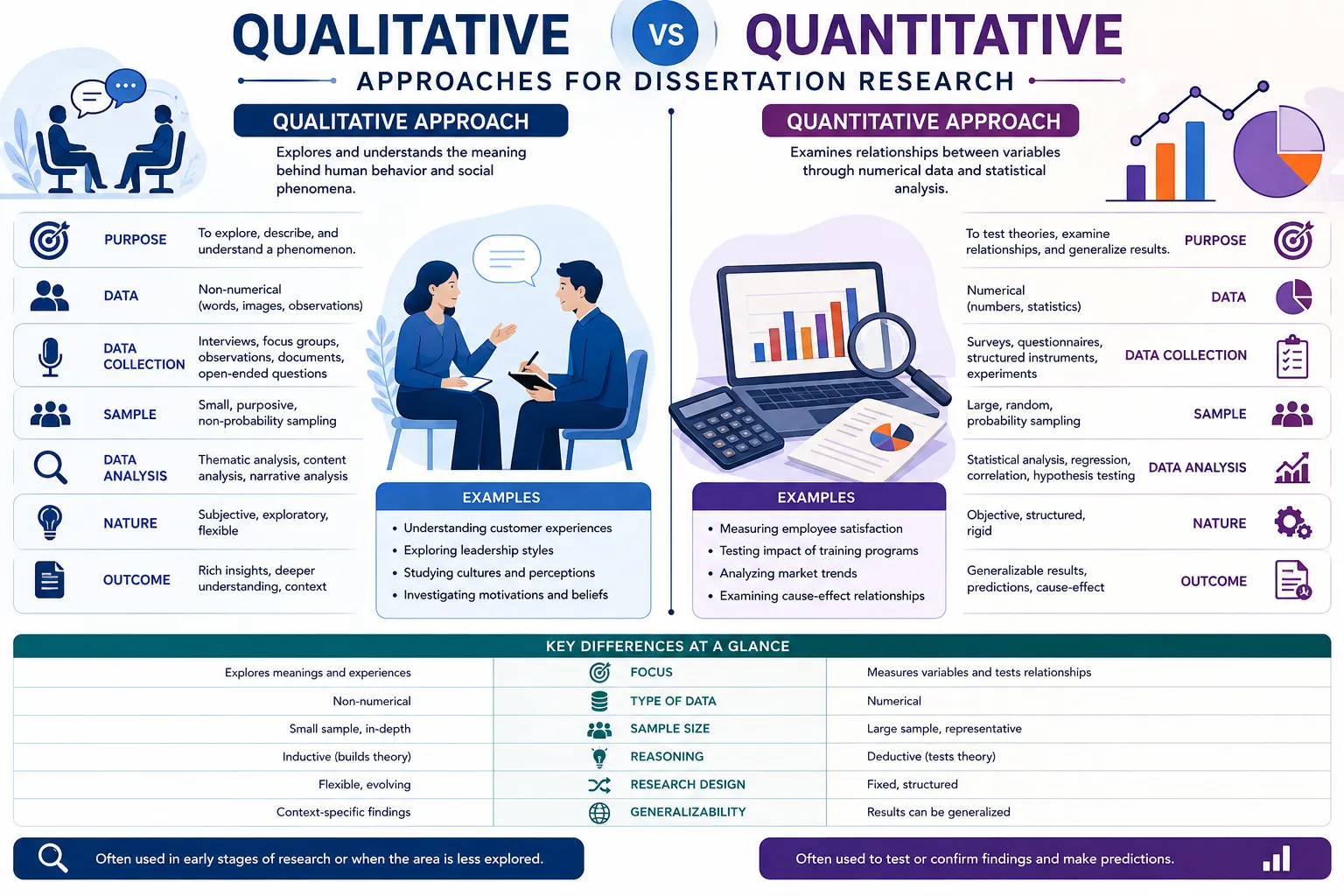
Somewhere in the early weeks of dissertation planning, almost every scholar hits the same fork in the road: "should this be a qualitative study or a quantitative one?" It sounds like a simple methods question, but it's really a decision about what kind of evidence will answer your research question — and getting it wrong doesn't just cost you a rewrite, it can mean redesigning your entire data collection plan mid-way through.
This guide walks through qualitative vs quantitative approaches for dissertation research the way an experienced research supervisor would — plainly, without assuming you already speak the language of research paradigms. If you're a first-time dissertation writer without a strong research background, this is written specifically with you in mind.
At ThesisLikho, our PhD-qualified mentors have guided more than 10,000 scholars through methodology design across disciplines — management, engineering, pharmacy, and the social sciences. What follows draws on that mentoring experience, checked against established methodology guidance from Mendeley's research resources and current UGC direction on doctoral research in India.
1. Why This Decision Matters More Than It Seems
The qualitative-versus-quantitative decision isn't just a style preference — it reflects different underlying assumptions about what counts as evidence and how you're allowed to draw conclusions from it. Choose quantitative methods for a question that's really asking "why" or "how," and you'll end up with numbers that don't actually explain anything. Choose qualitative methods for a question asking "how much" or "how many," and you won't have results you can generalize or defend statistically.
This is exactly why examiners and guides scrutinize this choice early: it determines your entire data collection design, your sample size logic, your analysis tools, and — ultimately — whether your conclusions can actually answer the question you set out to ask. Getting this right at the proposal stage saves you from the much more painful experience of realizing, mid-fieldwork, that your method can't answer your question.
It also matters because this decision isn't purely technical — it reflects deeper assumptions about knowledge and evidence that examiners are trained to evaluate. A committee isn't just checking whether you used a survey or conducted interviews; they're checking whether the logic connecting your research question, your chosen method, and your conclusions actually holds together as a coherent argument.
2. What Quantitative Research Actually Involves
Quantitative research is built around numerical data and statistical analysis, and it's the right fit when your research question is really asking "how much," "how many," or "is there a measurable relationship between X and Y." It typically uses structured tools — surveys, questionnaires, experiments — and produces results expressed in numbers, percentages, and statistical tests, allowing you to test or confirm hypotheses and, with a representative sample, generalize findings beyond just the people you studied.
A typical quantitative dissertation question might look like: "What is the relationship between employee engagement scores and voluntary attrition in mid-sized IT firms?" You'd collect structured survey data across a sample, then use statistical tools (correlation, regression, t-tests) to test whether that relationship actually holds. The reasoning here moves deductively — from an existing theory or hypothesis, tested against data, toward a confirmed or rejected conclusion.
3. What Qualitative Research Actually Involves
Qualitative research is built around non-numerical data — interviews, focus groups, observations, documents — and it's the right fit when your research question is asking "how" or "why" something happens. Rather than testing a hypothesis with statistics, qualitative analysis is interpretive: you look for patterns, themes, and meanings in the data, and the reasoning typically moves inductively, from specific observations toward broader insights.
A typical qualitative dissertation question might look like: "How do first-generation employees experience career progression in traditional Indian family-owned businesses?" You'd conduct in-depth interviews, then use thematic analysis to identify recurring patterns in how participants describe their experiences. Qualitative research is genuinely more than just "a different set of tools" — it reflects a different approach to the whole research process, including how you frame your research questions in the first place.
4. What Mixed Methods Research Involves — and Why It's Not "Doing Both"
Mixed methods research combines qualitative and quantitative approaches within a single study to answer the same overarching research question — but it's a deliberate integration, not simply running a qualitative study and a quantitative study side by side and reporting both. Genuine mixed methods work involves combining the data, comparing results across both strands, or using one method to build directly on the other — for instance, using interviews to develop or refine a survey instrument, or using a survey to identify cases worth exploring in depth through interviews afterward.
This integration is exactly where mixed methods dissertations succeed or fail. Examiners expect clear sequencing, an explicit rationale for why both methods were needed, and a genuine synthesis of findings — simply attaching a few interview quotes to a quantitative results chapter doesn't meet that bar, and reads as fragmented rather than integrated.
Mixed methods can be genuinely powerful — quantitative data shows you measurable patterns at scale, while qualitative data reveals the context and motivations behind those patterns — but it also increases the complexity of your study design, requires more time and resources for data collection, and can be harder to interpret when the two strands produce conflicting signals. Many doctoral programmes, in fact, encourage candidates to focus on a single methodology specifically so they can develop real depth in that method and its analysis, rather than spreading themselves across both.
5. How to Choose Based on Your Research Question
The single most reliable filter is this: let your research question drive the method, not the other way around. A few practical questions to ask yourself:
- Are you trying to measure or test a relationship between variables? That points toward quantitative methods.
- Are you trying to understand a lived experience, a process, or the reasoning behind a decision? That points toward qualitative methods.
- Do you need results that generalize to a larger population? Quantitative methods, with a representative sample, are built for this; qualitative methods generally aren't designed to generalize in the same statistical sense.
- Is your access limited to a small number of participants or one organization? Qualitative depth often makes more sense than a quantitative study that can't reach a meaningful sample size.
- Does answering your question genuinely require both "what's happening" and "why it's happening"? That's a legitimate signal for mixed methods — but only if you can realistically manage the added complexity within your timeline.
A word of caution: don't let comfort with (or fear of) statistics quietly make this decision for you. Gravitating toward qualitative research purely to avoid running a regression, or toward quantitative research purely because qualitative coding feels vague, is a common trap — and examiners can usually tell when a method was chosen for the researcher's comfort rather than the question's needs.
6. A Side-by-Side Look at the Two Approaches
Rather than a table, here's the core contrast laid out directly, since the differences matter more as a working mental model than as a chart you'll glance at once:
Quantitative research answers "how much" and "how many" questions using numerical data, structured instruments like surveys and experiments, and statistical analysis such as regression, correlation, or hypothesis testing; its reasoning moves deductively from theory to confirmed or rejected conclusions, and — with a representative sample — its findings can generalize to a wider population.
Qualitative research answers "how" and "why" questions using non-numerical data such as interviews, focus groups, and observations, analyzed through interpretive techniques like thematic coding; its reasoning moves inductively from specific observations toward broader insight, and its findings prioritize depth and context over statistical generalizability.
Mixed methods research answers questions that genuinely need both — measurable patterns and the context behind them — by deliberately integrating both data types within one study, sequenced so that one strand builds on or explains the other, at the cost of significantly more design complexity, time, and resource demand than either approach alone.
7. Common Myths That Lead Scholars Astray
- "Quantitative is more rigorous." Not true — rigor comes from a method matching the research question and being executed properly, not from the presence of numbers. A poorly designed survey with a biased sample is not more rigorous than a well-conducted set of in-depth interviews.
- "Qualitative is easier because there's no statistics." Also not true — thematic analysis, ensuring credibility and trustworthiness of findings, and avoiding researcher bias in interpretation are their own significant skills, often underestimated by first-time researchers.
- "Mixed methods is the safest choice because it covers both bases." Mixed methods is the most resource- and time-intensive option, not the safest — it requires justifying two methodologies and their integration, which is a meaningfully higher bar than doing one well.
- "The method should match what my classmates are doing." Your research question, access, and timeline should drive this decision — not what's currently common in your department or cohort.
8. How This Choice Affects Your Sample, Data Collection, and Analysis
The method you choose cascades into nearly every other methodology decision:
- Sampling — quantitative studies typically need a larger sample, often selected through probability sampling, to support generalizable statistical claims; qualitative studies typically use smaller, purposively selected samples chosen for their depth of insight rather than representativeness, often continuing data collection until reaching "saturation" — the point where new interviews stop producing new themes.
- Instruments — quantitative research typically uses structured, often pre-validated survey instruments with closed-ended items; qualitative research typically uses semi-structured interview guides that allow follow-up probing and adapt as the study progresses.
- Analysis tools — quantitative data is usually analyzed with statistical software (SPSS, R, Excel); qualitative data is usually analyzed manually or with coding-support software, through thematic or content analysis.
- Timeline implications — quantitative data collection can sometimes be completed faster once your instrument is finalized (a survey can go out to many respondents simultaneously), while qualitative data collection is typically slower per respondent but requires fewer participants overall; mixed methods studies generally take the longest, since both strands need to be executed and then integrated.
- Standards of rigor — quantitative studies are typically evaluated on validity (does the instrument measure what it claims to) and reliability (would it produce consistent results if repeated), often supported by statistics like Cronbach's alpha; qualitative studies are typically evaluated on credibility and trustworthiness of the interpretation, often supported by practices like member-checking (verifying your interpretation with participants) or maintaining a clear audit trail of how themes were developed from raw data. Knowing which standard applies to your chosen method — and addressing it explicitly in your methodology chapter — is a detail examiners specifically look for.
9. How to Justify Your Choice to Your Guide or Committee
A strong methodology chapter doesn't just name your chosen approach — it defends the choice explicitly. A few practical steps:
- State your research question first, then explain how your chosen method is the most direct route to answering it — not the reverse.
- Acknowledge the alternative you didn't choose, briefly, and explain why it was less suitable — this shows you made a genuine, informed decision rather than defaulting to a familiar method.
- Reference established methodology literature to support your choice (research-methods guidance widely referenced in university writing centers and via resources like Mendeley's research guides) rather than asserting the choice without grounding.
- Connect the method to your practical constraints honestly — limited access to a large sample, or limited time for extensive fieldwork, are legitimate factors in choosing between depth and breadth, and naming them shows methodological maturity rather than weakness.
For a full walkthrough of writing this chapter, see How to Write the Methodology Chapter of a Thesis.
10. Common Mistakes First-Time Dissertation Writers Make
- Choosing a method before finalizing the research question, then quietly reshaping the question to fit the method already chosen — this is backwards, and experienced guides usually notice.
- Choosing mixed methods without a genuine integration plan — collecting both types of data without a clear rationale for combining them produces two disconnected mini-studies, not one coherent piece of mixed methods research.
- Assuming qualitative research needs no justification for sample size — "saturation" is a real, defensible standard, but it needs to be stated and reasoned through, not simply assumed.
- Assuming quantitative research needs no justification beyond "I used a survey" — sample size, instrument validity, and statistical test selection all need explicit rationale.
- Treating the literature review and methodology chapters as disconnected — your chosen approach should visibly follow from the gap and question you established in your literature review, not appear as an unrelated methods menu.
- Underestimating the added workload of mixed methods, particularly for scholars balancing a dissertation timeline with other academic or professional commitments.
11. Two Realistic Case Studies
Case Study 1 — Choosing Quantitative Over a Vague Instinct Toward Qualitative A dissertation scholar initially planned interviews to study "employee satisfaction," largely because statistics felt intimidating. On reviewing the actual research question — whether specific workplace factors predicted satisfaction scores across a mid-sized organization — the scholar's guide pointed out that the question was fundamentally about measurable relationships between variables, better suited to a structured survey and regression analysis than open-ended interviews. Restructuring the study as quantitative, using a validated satisfaction scale, produced results the scholar could defend statistically rather than a set of rich but ungeneralizable interview narratives that didn't actually answer the original question.
Case Study 2 — Choosing Qualitative Depth Over an Infeasible Quantitative Design A first-time dissertation writer wanted to study decision-making patterns among small business owners during a specific regulatory transition, initially planning a large-scale survey. After realizing access to a large, representative sample of business owners willing to complete a structured survey wasn't realistic within the fieldwork window, the scholar redesigned the study as a qualitative, interview-based exploration of eight business owners' decision-making processes, reaching saturation around the sixth interview. The redesign matched the study's actual access constraints while still producing a rigorous, well-defended piece of research — arguably a stronger fit for the "how and why" nature of the original question than the abandoned survey design would have been.
If you're navigating this decision for your own dissertation, our Dissertation Writing service can help you match your research question to a feasible, defensible methodology before you present it to your guide.
FAQs
What is "qualitative vs quantitative approaches for dissertation research"?
It refers to the foundational choice between numerical, statistics-driven research (quantitative), interpretive, meaning-focused research (qualitative), or a deliberate integration of both (mixed methods) — a decision that shapes your entire dissertation's data collection and analysis design.
Why does qualitative vs quantitative approaches for dissertation research matter?
Because this choice determines whether your data collection and analysis plan can actually answer your research question. A mismatch between question and method is one of the most common reasons proposals get sent back for revision.
How does this approach affect a dissertation in practice?
Scholars who choose their method based on their research question — rather than personal comfort or convenience — typically face fewer committee objections, a smoother data collection process, and an analysis chapter that flows logically from a well-justified design.
How long does it take to complete a dissertation using this approach?
Timelines vary by programme and country, but the method itself affects pacing: quantitative data collection can sometimes move faster once the instrument is finalized, qualitative work is typically slower per participant but needs fewer of them, and mixed methods studies generally take the longest due to the added integration step.
Is professional help available for qualitative vs quantitative approaches for dissertation research?
Yes — methodology guidance, including matching your specific research question to a feasible and defensible approach, is available through services such as Dissertation Writing.
Ready to choose a methodology your committee will approve with confidence? Get Dissertation Help Now from ThesisLikho's PhD-qualified mentors.