
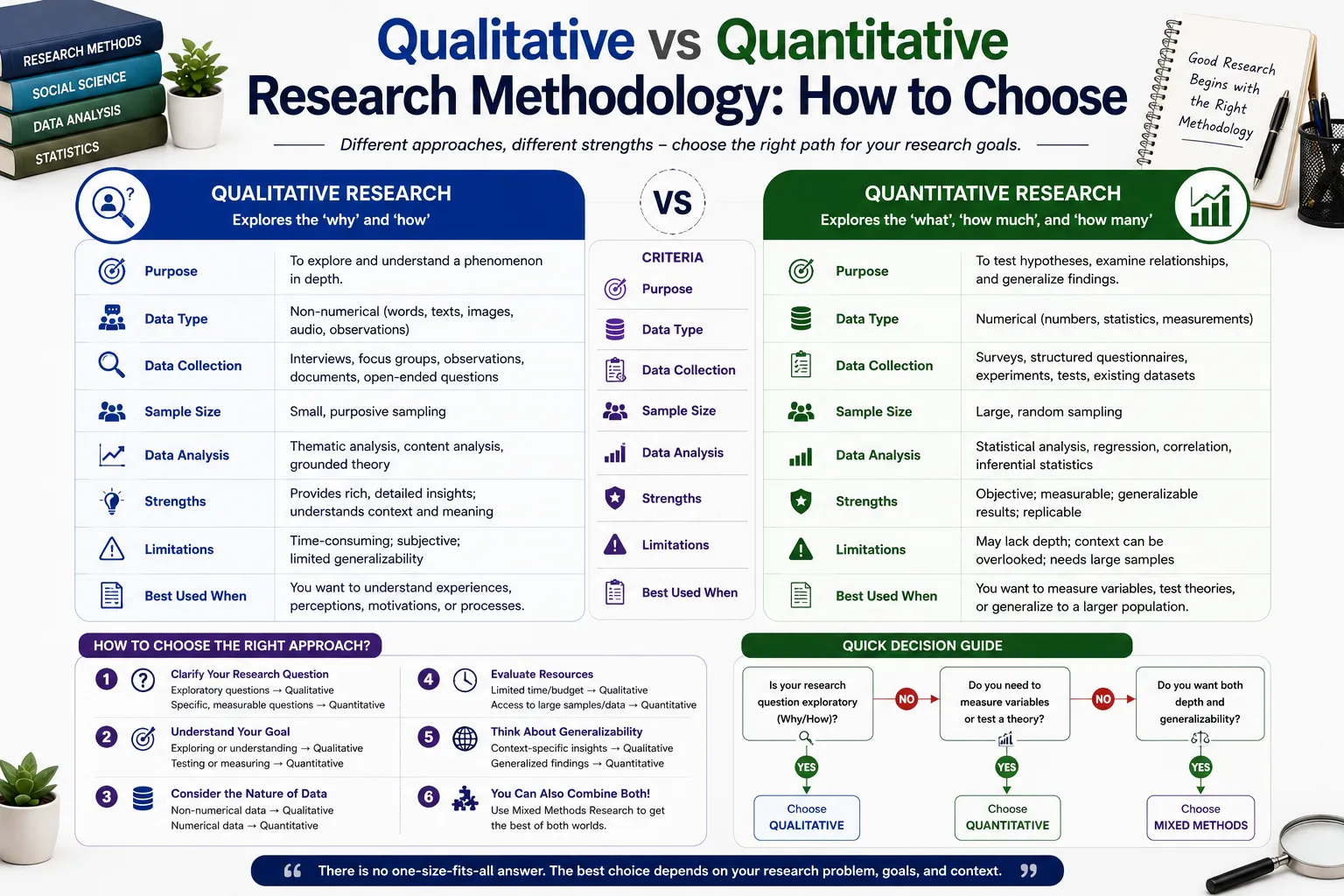
Somewhere in the early planning of almost every thesis, this exact question comes up: should this be a qualitative study, a quantitative one, or some combination of both? Get it right, and your entire research design — sampling, data collection, analysis — flows logically from your research question. Get it wrong, and you end up trying to force a phenomenon into the wrong kind of measurement, or running statistical tests on data that was never meant to be quantified.
This guide compares qualitative vs quantitative research methodology directly, so you can make this call with confidence for your own specific thesis. We've written it the way an experienced thesis mentor would talk you through the decision, because that's genuinely the kind of guidance ThesisLikho's PhD-qualified team gives to the thousands of scholars we've supported through exactly this choice.
The Core Distinction
Nearly every difference between these two approaches traces back to one underlying distinction: quantitative research produces numerical data used to test hypotheses and measure relationships, while qualitative research produces descriptive, word-based data used to explore concepts, motivations, and experiences that existing theory hasn't yet fully explained. Quantitative research asks "what is happening, and to what extent?" Qualitative research asks "why does this happen, and what does it mean to the people experiencing it?"
Elsevier Researcher Academy's guidance on methodology selection frames this the same way: quantitative approaches suit testing a hypothesis and establishing cause-and-effect relationships, while qualitative approaches suit topics that aren't yet well understood, relying on interpretation and thematic analysis rather than statistical testing. Neither approach is inherently more rigorous than the other — each is simply built to answer a different kind of question.
What Quantitative Research Actually Involves
Quantitative research uses structured data collection — most commonly surveys with closed-ended questions, though experiments and existing numerical datasets are common too — to produce data that can be analyzed statistically. The entire approach emphasizes precision, standardization, and replicability: two researchers following the same quantitative protocol should be able to collect comparable data and reach comparable conclusions.
This structure comes with a specific planning requirement most first-time thesis writers don't expect: quantitative studies require a sample size to be calculated in advance, based on statistical power, expected effect size, and your chosen significance level — you can't simply decide to survey "some people" and figure out later whether that's enough. This is one of the more common early-stage mistakes in quantitative thesis proposals, and it's worth resolving before data collection begins, not after.
What Qualitative Research Actually Involves
Qualitative research gathers descriptive data — through interviews, focus groups, or observation — specifically to understand how and why people think, feel, or act in a particular context. Rather than measuring predetermined variables, qualitative research often lets themes and patterns emerge from the data itself, particularly in more exploratory designs.
Unlike quantitative research, qualitative studies don't fix a sample size before data collection starts. Instead, researchers continue collecting data until they reach theoretical saturation — the point where new interviews or observations stop revealing genuinely new themes. In practice, this typically lands somewhere between six and thirty participants, depending on the specific design and how narrowly the research question is scoped. A tightly focused qualitative study exploring one specific managerial experience might reach saturation with ten interviews; a broader exploratory study might need closer to twenty-five or thirty.
Sampling Logic: Why the Two Approaches Differ So Much
This is one of the clearest, most practical differences between the two paradigms, and it's worth understanding on its own terms rather than treating it as a footnote. Quantitative sampling exists to achieve statistical representativeness — the goal is a sample that reasonably reflects the larger population, so that findings can be generalized beyond the specific people surveyed. This is why quantitative studies favor random or probability-based sampling wherever feasible, and why sample sizes tend to run into the hundreds for anything claiming population-level generalizability.
Qualitative sampling exists for an entirely different purpose: information richness and diversity of perspective, not statistical representativeness. This is why qualitative studies typically use purposive sampling — deliberately selecting participants who can offer particularly relevant or insightful perspectives on the research question, rather than trying to represent a broader population proportionally. A qualitative study exploring managerial perspectives on a specific ethical dilemma, for instance, might deliberately seek out managers who've directly navigated that exact situation, rather than randomly sampling managers in general.
When Quantitative Is the Right Fit
Quantitative methodology tends to be the right choice when your research question is fundamentally about measuring a relationship, testing a hypothesis, or establishing how common or widespread something is across a population. Signs your thesis calls for a quantitative approach include a research question phrased as "does X affect Y," access to a large enough potential respondent pool to reach a statistically meaningful sample, and an established, previously validated way to measure your key variables (an existing Likert-scale instrument, for example, rather than a concept you'd need to define from scratch).
Quantitative research is also generally the better fit when your primary audience — a committee, an industry stakeholder, or a policy body — specifically expects statistical evidence to support a conclusion, since numerical, generalizable findings tend to carry more immediate persuasive weight in these contexts than a smaller-scale qualitative account.
When Qualitative Is the Right Fit
Qualitative methodology tends to be the right choice when your research question is fundamentally about understanding a lived experience, exploring a phenomenon that isn't yet well defined, or investigating the reasons and meanings behind a behavior rather than simply its frequency. Signs your thesis calls for a qualitative approach include a research question phrased as "how do people experience X" or "why does Y happen," a topic where no well-established, validated measurement instrument yet exists, and a genuine need for depth and context that a numerical scale would strip away.
Qualitative research is also the more realistic choice when your access to participants is limited to a smaller, specific group — a handful of executives, a particular community, or a niche professional network — where a statistically representative sample simply isn't achievable, but rich, in-depth engagement with the people you can access genuinely is.
Can You Combine Both? Understanding Mixed Methods
Mixed methods research is a real, well-established third option — but it's worth being precise about what that actually means, since simply collecting some numbers and some interview quotes in the same thesis isn't automatically a mixed-methods design. Genuine mixed methods research requires deliberate integration of qualitative and quantitative data at one or more stages of the research process, not just parallel reporting of both.
Three core mixed-methods designs are most common in thesis-level research. An explanatory sequential design starts with quantitative data collection and analysis, then follows up with qualitative research specifically to explain unexpected or unclear patterns the numbers revealed — if a survey shows an unusual relationship between two variables, follow-up interviews can help explain why. An exploratory sequential design works in the opposite order: qualitative research first, to explore a topic and generate hypotheses, followed by a quantitative phase to test those emerging insights at scale. A convergent (or parallel) design collects both types of data around the same time and triangulates them — when qualitative and quantitative findings converge, this strengthens confidence in the conclusion; when they diverge, that divergence itself often reveals an important complexity worth discussing.
Mixed methods genuinely suits research that's complex, multi-phase, or applied — program evaluations, policy studies, or research questions that have both an exploratory and a confirmatory component. It's worth being honest, though, that a proper mixed-methods thesis takes meaningfully more time and requires competence in both quantitative and qualitative analysis techniques, which is a real resource consideration for a single-author thesis on a standard timeline.
Quality Criteria: Why You Can't Judge Both the Same Way
A mistake worth flagging explicitly: quality criteria differ fundamentally between the two paradigms, and applying quantitative standards to qualitative research (or vice versa) is a recognized and specific error, not just a stylistic quibble. Quantitative research is typically judged on reliability (consistency of measurement) and validity (whether you're measuring what you intend to). Qualitative research is judged on a different set of standards entirely — credibility, transferability, and dependability — which reflect a fundamentally different epistemological approach to establishing trustworthy findings.
If your committee or examiner seems to be evaluating your qualitative thesis purely by asking for a Cronbach's Alpha score or a p-value, it's worth having a clear, confident explanation ready for why those specific quantitative criteria don't directly apply to your qualitative design — and which qualitative quality criteria you've used instead.
How Analysis Differs Once Data Is Collected
The split between the two paradigms continues well past data collection, into how each is actually analyzed. Quantitative data is typically reduced into numerical form and examined using statistical techniques — descriptive statistics to summarize patterns, and inferential statistics (regression, ANOVA, structural equation modeling, depending on your design) to test whether relationships between variables are statistically significant and likely to hold in the broader population. Common software for this includes SPSS for general statistical testing and SmartPLS or AMOS for more advanced structural equation modeling.
Qualitative data, by contrast, is analyzed through coding and thematic interpretation — identifying recurring patterns, categories, and meanings across interview transcripts or observational notes, often using software like NVivo to organize and tag large volumes of text systematically. Rather than producing a single statistic or p-value, qualitative analysis typically produces a set of named themes, each supported by illustrative excerpts from participants, woven into a narrative argument about what the data reveals.
This difference in analysis style is also where a lot of first-time thesis writers get tripped up when reading published research to inform their own methodology choice: a paper reporting themes and quotes is not "less rigorous" than one reporting p-values — it's simply answering a different kind of question, using standards appropriate to that question. Reviewing how prior published studies in your specific area justified their qualitative or quantitative choice, and organizing those insights by theme as you read — a habit Mendeley's own guidance on literature management specifically recommends — is one of the most useful things you can do before finalizing your own methodology decision.
Common Mistakes When Choosing
Students most often go wrong in one of a few predictable ways. Some choose quantitative research simply because it feels more "scientific" or rigorous on the surface, without actually having a research question that calls for hypothesis testing — this usually produces a thin, mechanical survey study built around a question that would have been far better explored through interviews. Others choose qualitative research to avoid statistics, without recognizing that their specific research question is really asking about frequency, relationship strength, or generalizability — questions numbers are simply better equipped to answer.
A related mistake is attempting a full mixed-methods design without the time or skill set both halves genuinely require, resulting in two thin, poorly integrated components rather than one well-executed single-method study. And a final, easily avoidable mistake: choosing a methodology before finalizing the research question, rather than letting the question dictate the method — this backwards ordering is one of the most reliable ways to end up with a mismatch a committee will eventually flag.
A Realistic Decision Scenario
Scenario — Simran, an MBA student researching workplace flexibility
Simran initially planned a quantitative survey on remote work preferences, assuming this was the more rigorous choice for her thesis. But as she refined her research question, she realized what she actually wanted to understand wasn't how many employees preferred remote work — a question a survey could easily answer — but why certain employees felt strongly enough about flexibility to consider leaving a job over it, which meant she needed the depth only interviews could provide. Her supervisor helped her reframe the thesis around a qualitative design: fifteen semi-structured interviews with employees who had recently changed jobs partly due to flexibility preferences, continued until she noticed the same core themes recurring across her final few interviews. The lesson here is a common one: the "more rigorous-sounding" method isn't automatically the right one — the actual research question should always be the deciding factor.
Decision Checklist
Before committing to either approach, it's worth running through a few direct questions. Is your research question fundamentally about measuring a relationship or testing a hypothesis, or is it about understanding an experience, motivation, or meaning? Do you have realistic access to a large enough sample for statistical generalizability, or is your access limited to a smaller, specific group better suited to in-depth qualitative engagement? Does an established, validated way to measure your key concept already exist, or would you need to explore an under-defined phenomenon first? Does your department or committee have a clear expectation for one approach over the other, and have you confirmed this directly rather than assuming? And finally, have you chosen your methodology because it genuinely fits your research question, or because it felt like the more impressive or more comfortable option?
Getting Expert Support
Choosing between these two approaches — and defending that choice convincingly to a supervisor or committee — is a decision worth getting right early, since reversing course after weeks of data collection built around the wrong method is one of the more costly setbacks in thesis writing.
ThesisLikho's mentoring team — PhD-qualified experts who've guided over 10,000 scholars through this exact decision — offers structured methodology guidance as part of our Thesis Writing Service, helping you confirm which approach genuinely fits your specific research question before you commit.
Frequently Asked Questions
What is qualitative vs quantitative research methodology, and how do you choose?
Quantitative methodology uses numerical data to test hypotheses and measure relationships across larger, statistically representative samples, while qualitative methodology uses descriptive data from interviews or observations to explore experiences and meanings in smaller, purposively selected samples — the right choice depends entirely on whether your research question is about measurement and generalization or about depth and understanding.
How long does it take to complete a thesis using this approach?
Quantitative studies can sometimes move faster once the survey instrument is finalized, since data collection from a large sample can happen relatively quickly, while qualitative studies often require more researcher time per participant for interviewing and analysis, though qualitative research needs a much smaller sample overall, which can offset the difference.
Is professional help available for choosing between qualitative and quantitative research methodology?
Yes — structured mentoring on evaluating your research question and selecting the methodology that genuinely fits it is a standard, legitimate form of academic support. ThesisLikho's PhD-qualified mentors offer this kind of guided review for thesis scholars.
Why does choosing between qualitative and quantitative methodology matter?
Choosing the wrong approach either forces a numerical measurement onto a question that's really about meaning and context, or attempts statistical generalization from a method that was never designed to produce it — both mismatches tend to surface during committee review and can cost significant rework time.
How does this choice affect a thesis overall?
Your methodology choice shapes your entire research design — sampling strategy, data collection tools, analysis techniques, and even the quality criteria your work will be judged against — making it one of the most consequential decisions in your entire thesis, not just a technical detail to settle quickly.
Talk to a Thesis Expert
If you'd like a mentor to help confirm which methodology fits your specific research question, ThesisLikho's team is ready to help.