
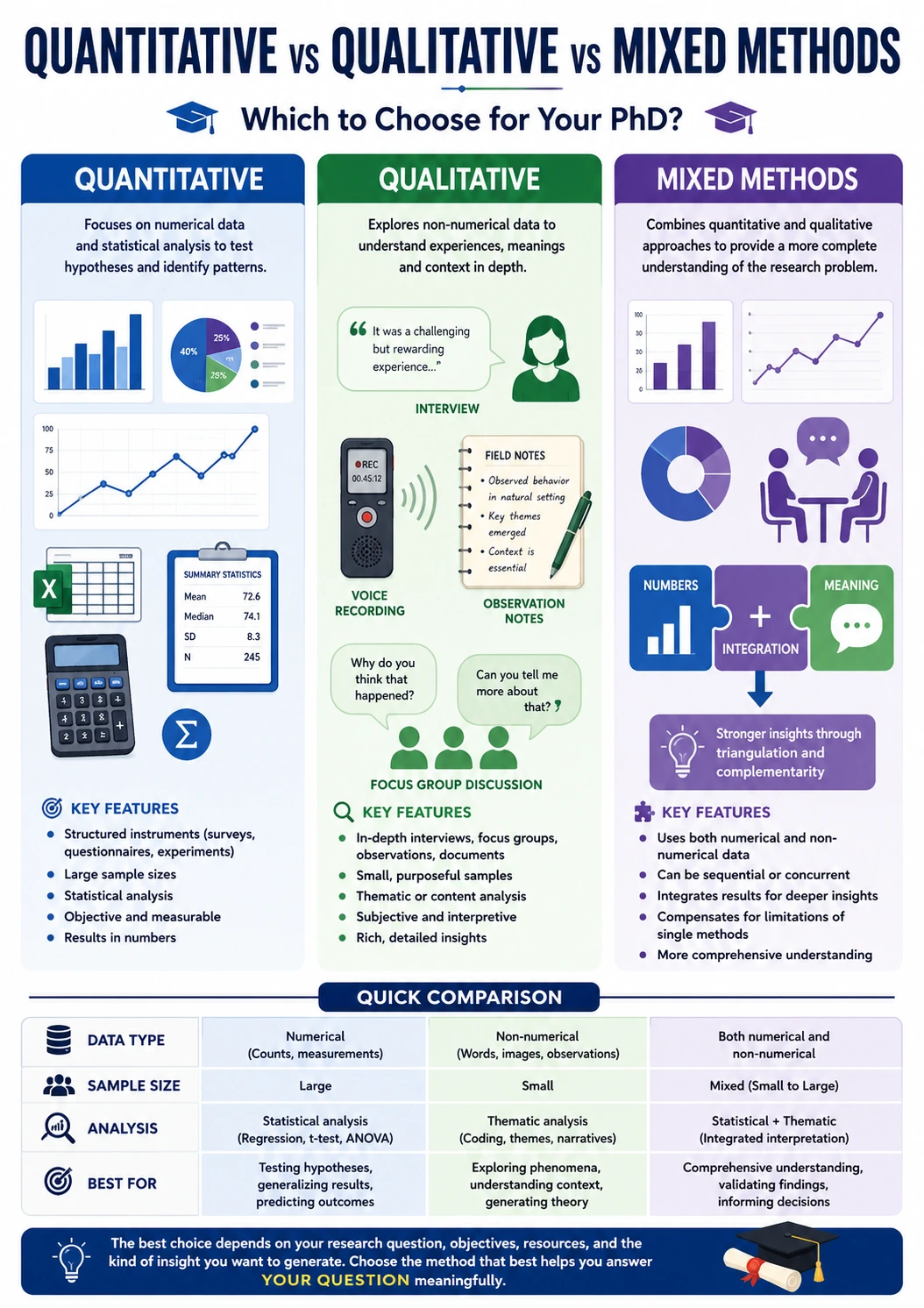
Choosing the right research methodology is one of the most important decisions you'll make during your PhD journey. Your research method determines how you collect data, analyze findings, answer research questions, and ultimately contribute to your academic field. A well-chosen methodology strengthens the credibility of your research, while an inappropriate choice can undermine even the most interesting research topic.
One of the biggest challenges faced by PhD scholars is deciding whether to use quantitative research, qualitative research, or a mixed methods approach. Each methodology has its own strengths, limitations, data collection techniques, and analytical tools. The best choice depends on your research objectives, research questions, type of data required, available resources, and the nature of the problem you want to investigate.
For example, if your goal is to measure relationships between variables using statistical analysis, quantitative research may be the ideal choice. If you want to understand people's experiences, opinions, or behaviors in depth, qualitative research is often more appropriate. In many modern research projects, combining both approaches through mixed methods provides a richer and more comprehensive understanding of the research problem.
This complete guide explains the differences between quantitative, qualitative, and mixed methods research, their advantages and disadvantages, when to use each approach, and how to select the most suitable methodology for your PhD research in India.
What Is Research Methodology?
Research methodology refers to the overall strategy or framework used to conduct a research study. It includes the methods used to collect, analyze, and interpret data in order to answer research questions or test hypotheses.
A research methodology typically includes:
- Research design
- Data collection methods
- Sampling techniques
- Data analysis procedures
- Ethical considerations
- Interpretation of findings
Selecting the right methodology ensures that your research objectives are addressed effectively and that your conclusions are supported by credible evidence.
What Is Quantitative Research?
Quantitative research focuses on collecting and analyzing numerical data. It uses statistical techniques to identify patterns, relationships, differences, or trends among variables.
The primary objective of quantitative research is to measure phenomena objectively and produce findings that can often be generalized to a larger population.
Characteristics of Quantitative Research
- Uses numerical data
- Tests hypotheses
- Employs structured questionnaires or experiments
- Relies on statistical analysis
- Produces objective findings
- Often involves larger sample sizes
Quantitative research is widely used in management, economics, healthcare, engineering, psychology, education, and the natural sciences.
Common Data Collection Methods in Quantitative Research
Researchers typically collect quantitative data using:
- Structured questionnaires
- Online surveys
- Experiments
- Clinical trials
- Standardized tests
- Existing numerical datasets
- Government databases
These methods generate measurable data suitable for statistical analysis.
Common Statistical Techniques Used
Depending on the research objectives, quantitative studies may use:
- Descriptive statistics
- Correlation analysis
- Regression analysis
- t-tests
- ANOVA
- Chi-square tests
- Factor analysis
- Structural Equation Modeling (SEM)
- Time series analysis
Software such as SPSS, R, STATA, Python, MATLAB, and SAS are commonly used for these analyses.
Advantages of Quantitative Research
Some key benefits include:
- Produces objective and measurable results.
- Supports statistical hypothesis testing.
- Allows analysis of large datasets.
- Facilitates comparison across groups.
- Findings may be generalized when appropriate sampling methods are used.
- Enables replication of studies.
These strengths make quantitative research ideal for studies that require measurable evidence.
Limitations of Quantitative Research
Despite its strengths, quantitative research has some limitations.
It may:
- Miss deeper explanations behind participant behavior.
- Restrict responses through structured questionnaires.
- Be less flexible once data collection begins.
- Require larger sample sizes for many analyses.
- Overlook contextual or cultural factors.
Researchers should consider these limitations when deciding whether a quantitative approach aligns with their research goals.
What Is Qualitative Research?
Qualitative research seeks to understand human experiences, perceptions, motivations, and social processes through non-numerical data.
Instead of measuring variables statistically, qualitative research explores meanings, interpretations, and context.
Characteristics of Qualitative Research
- Uses non-numerical data
- Explores experiences and opinions
- Flexible research design
- Small but information-rich samples
- Inductive analysis
- Rich, detailed findings
Qualitative research is common in education, sociology, anthropology, psychology, healthcare, public policy, and communication studies.
Common Data Collection Methods in Qualitative Research
Qualitative researchers often use:
- In-depth interviews
- Focus group discussions
- Participant observation
- Case studies
- Document analysis
- Field notes
- Open-ended survey questions
These methods provide detailed insights that cannot be captured through numerical data alone.
Common Data Analysis Methods
Qualitative data are typically analyzed using:
- Thematic analysis
- Content analysis
- Narrative analysis
- Grounded theory analysis
- Framework analysis
- Discourse analysis
Software such as NVivo, ATLAS.ti, and MAXQDA can assist with organizing and analyzing qualitative data.
Advantages of Qualitative Research
Qualitative research offers several benefits:
- Provides rich, detailed insights.
- Explores complex social and behavioral issues.
- Captures participants' perspectives in their own words.
- Flexible and adaptive research process.
- Useful for generating new theories and concepts.
It is particularly valuable when little is known about a phenomenon.
Limitations of Qualitative Research
Some limitations include:
- Smaller sample sizes.
- Findings are not always statistically generalizable.
- Data analysis can be time-consuming.
- Interpretation may be influenced by researcher bias.
- Replication can be more challenging.
Maintaining transparency and methodological rigor helps strengthen qualitative research.
What Is Mixed Methods Research?
Mixed methods research combines quantitative and qualitative approaches within a single study to provide a more comprehensive understanding of the research problem.
Rather than viewing the two methodologies as competing approaches, mixed methods integrates their strengths.
Characteristics of Mixed Methods Research
- Combines numerical and textual data.
- Uses both statistical and thematic analyses.
- Addresses complex research questions.
- Provides complementary evidence.
- Requires careful planning and integration.
This approach is increasingly popular in interdisciplinary research.
Common Mixed Methods Designs
Several mixed methods designs are widely used.
Convergent Design
Quantitative and qualitative data are collected simultaneously and then compared or integrated.
Explanatory Sequential Design
Researchers first collect quantitative data and then conduct qualitative research to explain the quantitative findings.
Exploratory Sequential Design
Researchers begin with qualitative exploration and then develop quantitative instruments to test emerging concepts.
Embedded Design
One method plays a primary role while the other provides supportive evidence.
Choose the design that best aligns with your research objectives.
Advantages of Mixed Methods Research
Mixed methods research offers several advantages:
- Provides a more comprehensive understanding of complex issues.
- Combines the strengths of quantitative and qualitative methods.
- Enables triangulation of findings.
- Improves confidence in conclusions.
- Supports both exploration and hypothesis testing.
It is particularly useful for multidisciplinary and applied research.
Limitations of Mixed Methods Research
Mixed methods studies also present challenges.
They may require:
- More time.
- Greater financial resources.
- Expertise in multiple methodologies.
- More complex data integration.
- Longer thesis chapters.
Researchers should ensure they have sufficient time and methodological support before choosing this approach.
When Should You Choose Quantitative Research?
Quantitative research is appropriate when you want to:
- Test hypotheses.
- Measure variables objectively.
- Examine relationships between variables.
- Compare groups statistically.
- Generalize findings to a larger population.
- Analyze numerical datasets.
Example
Research Topic: Impact of Remote Work on Employee Productivity in Indian IT Companies
The researcher collects survey data from 500 employees and uses regression analysis to examine the relationship between remote work practices and productivity.
When Should You Choose Qualitative Research?
Qualitative research is suitable when you aim to:
- Explore personal experiences.
- Understand motivations and behaviors.
- Investigate new or poorly understood topics.
- Examine social or cultural processes.
- Develop theories.
Example
Research Topic: Experiences of First-Generation PhD Scholars in Indian Universities
Researchers conduct in-depth interviews to understand participants' academic journeys, challenges, and support systems.
When Should You Choose Mixed Methods?
Mixed methods research is valuable when:
- Both numerical evidence and personal experiences are important.
- One method alone cannot fully answer the research question.
- Quantitative findings need further explanation.
- Qualitative insights require broader validation.
Example
Research Topic: Adoption of Artificial Intelligence in Indian Higher Education
Researchers first survey faculty members to measure AI adoption rates and then interview selected participants to explore barriers and opportunities in greater depth.
Choosing the Right Method for Your PhD
Selecting the appropriate methodology depends on several factors.
1. Research Questions
Ask yourself:
- Do I need numerical evidence?
- Do I need detailed personal experiences?
- Do I need both?
Your research questions should drive your methodological choice.
2. Research Objectives
Objectives focused on measurement often favor quantitative methods, while objectives centered on understanding experiences or meanings are generally better suited to qualitative approaches.
If your objectives require both, mixed methods may be appropriate.
3. Nature of the Research Problem
Simple, measurable problems may only require quantitative analysis.
Complex human, organizational, or social issues often benefit from qualitative or mixed methods research.
4. Resources and Time
Consider:
- Available funding.
- Time for data collection.
- Access to participants.
- Software requirements.
- Methodological expertise.
Mixed methods generally require the greatest investment of time and resources.
5. Supervisor and University Guidelines
Some departments or disciplines have methodological preferences.
Always discuss your proposed methodology with your supervisor and review your university's research guidelines before finalizing your research design.
Common Mistakes When Choosing a Research Method
Many PhD scholars make avoidable mistakes such as:
- Selecting a method before defining research questions.
- Choosing quantitative research simply because statistical software is available.
- Assuming qualitative research is easier because it involves fewer participants.
- Adopting mixed methods without sufficient time or expertise.
- Ignoring methodological literature when justifying the chosen approach.
- Failing to align methodology with research objectives.
A thoughtful and well-justified choice strengthens the overall quality of your thesis.
Best Practices for Selecting a Research Methodology
To make an informed decision:
- Start with clearly defined research questions.
- Align the methodology with your objectives.
- Review published studies in your field.
- Consider the type of data required.
- Evaluate available resources and skills.
- Discuss options with your supervisor.
- Justify your methodological choices using academic literature.
- Ensure consistency between methodology, data collection, and analysis.
Frequently Asked Questions (FAQs)
Which research method is best for a PhD?
There is no universally "best" method. The appropriate choice depends on your research questions, objectives, discipline, and the type of evidence needed to answer your research problem.
Can I combine quantitative and qualitative methods?
Yes. Mixed methods research intentionally combines both approaches to provide a more comprehensive understanding of complex research questions.
Is quantitative research more scientific than qualitative research?
No. Both methodologies are scientifically valid when applied appropriately and rigorously. They address different types of research questions and generate different forms of evidence.
Is mixed methods research more difficult?
Mixed methods research often requires additional planning, expertise, and time because it involves collecting, analyzing, and integrating two types of data. However, it can provide richer and more robust findings.
How do I justify my chosen methodology?
Explain how your research questions, objectives, theoretical framework, and existing literature support the chosen methodology. Your justification should demonstrate why the selected approach is the most suitable for addressing your research problem.
Conclusion
Choosing between quantitative, qualitative, and mixed methods research is one of the most significant methodological decisions in a PhD project. Each approach offers unique strengths and is designed to answer different types of research questions. Quantitative research excels at measuring variables and testing hypotheses, qualitative research provides deep insights into human experiences and social processes, and mixed methods integrates both perspectives to deliver a more comprehensive understanding of complex issues.
Rather than selecting a methodology based on familiarity or convenience, PhD scholars should carefully consider their research objectives, questions, data requirements, available resources, and disciplinary expectations. A well-justified methodological choice not only enhances the credibility of your research but also ensures that your findings make a meaningful contribution to academic knowledge.
By understanding the differences, advantages, and limitations of each approach, you can confidently choose the research methodology that best supports your PhD journey and lays the foundation for a rigorous, impactful, and publishable thesis.
Call / WhatsApp: +91 96438 02216
Website:www.ThesisLikho.com