
1. Introduction: The Era of Programmable Life
For decades, biological discovery proceeded largely through trial and error: screening natural compound libraries, inducing random mutations, and empirically optimizing cell cultures. This classical approach produced landmark interventions — early antibiotics, first-generation monoclonal antibodies — but was fundamentally limited by the size of biological sequence space and the complexity of cellular interactomes.
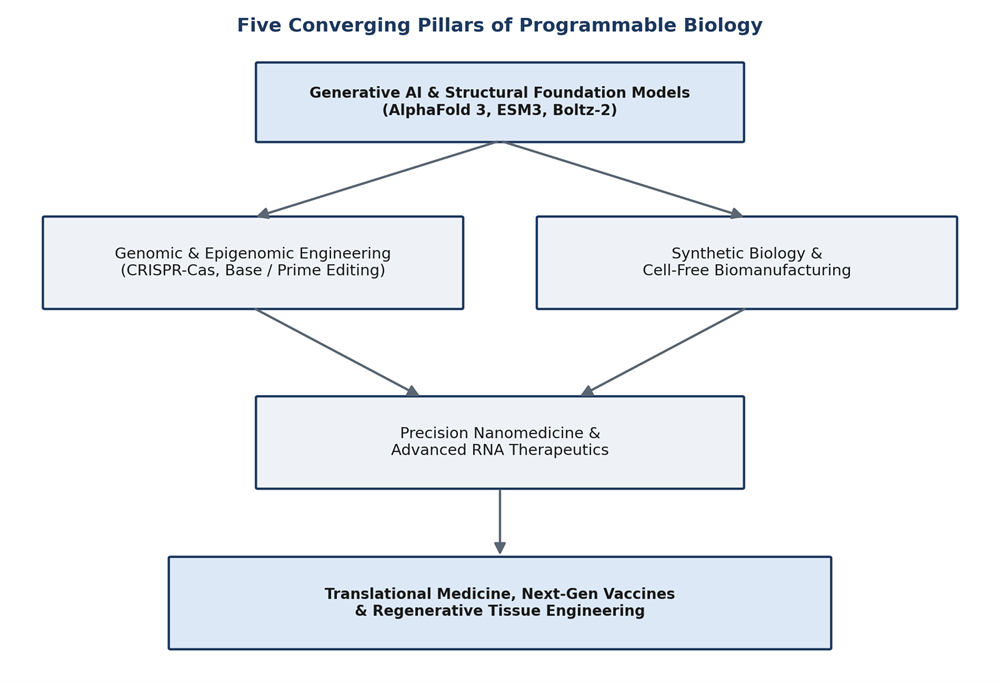
Today's research is organized instead around programmable biology: five converging pillars that move from computational design directly to translational application.
As reported across recent volumes of Nature, Science, Cell, and Nature Biotechnology, these pillars are: generative biological AI that designs functional biomolecules de novo; ultra-precise genome and epigenome editing that moves beyond double-strand breaks; synthetic genomics and cell-free biomanufacturing; precision nanomedicine and RNA therapeutics; and organoid/tissue-engineering systems that bridge cell culture and human physiology.
2. Frontier 1: AI-Driven De Novo Protein Design
2.1 Beyond AlphaFold 2: Multi-Molecular Diffusion Models
AlphaFold 2 (2021) solved single-chain protein folding, but cellular function depends on complex interactions between proteins, nucleic acids, small molecules, and post-translational modifications. Abramson et al. (2024, Nature) introduced AlphaFold 3, which replaces frame-aligned structure modules with a unified diffusion-based network capable of modeling joint 3D coordinates across proteins, DNA, RNA, small-molecule ligands, and modified residues in a single framework.
By learning spatial geometry without rigid torsion-angle assumptions, AlphaFold 3 improves on classical docking tools such as AutoDock Vina and Gold for protein–ligand binding poses, and models protein–nucleic acid interactions more accurately than prior structure-only approaches.
2.2 Simulating Evolutionary Epochs with Protein Language Models
Where structure prediction answers how a sequence folds, protein language models (pLMs) address how to generate new sequence–structure–function combinations. Hayes et al. (2024, bioRxiv) introduced ESM3, a 98-billion-parameter multimodal generative model trained across sequence, structure, and functional annotation tokens.
ESM3 was tasked with designing a novel green fluorescent protein and produced esmGFP — a bright, functional fluorescent protein sharing only 58% sequence identity with any known natural fluorescent protein, roughly equivalent to simulating 500 million years of evolutionary search in a few hours of compute.
Model Paradigm Target domainReference
AlphaFold 3 Generative diffusion Multimodal biomolecular complexes Abramson et al., Nature (2024)
ESM3 Multimodal language modeling De novo sequence–structure–function co-generation Hayes et al., bioRxiv (2024)
Chai-1 Multi-agent diffusion Molecular docking & binding affinity prediction Chai Discovery (2024)
Boltz-2 Deep geometric learning Joint structure & affinity landscape assessment MIT Biomolecular Physics (2025)
3. Frontier 2: Next-Generation Genome & Epigenome Engineering
3.1 Base Editing and Prime Editing
Original CRISPR-Cas9 (Doudna & Charpentier, Science 2012) relies on double-stranded DNA breaks (DSBs), which can trigger cell-cycle arrest, translocations, or uncontrolled indels via non-homologous end joining. Base editors fuse a catalytically impaired Cas nickase to a deaminase domain, enabling precise C→T or A→G conversions without a DSB. Prime editors fuse a Cas9 nickase to an engineered reverse transcriptase, directed by a prime editing guide RNA (pegRNA), writing new sequence directly into a genomic locus without a donor DNA template.
3.2 CRISPR-Guided Rational Vaccine Design
Beyond human therapeutic editing, CRISPR tools are streamlining live-attenuated and vector-based vaccine development. Multiplexed guide RNAs allow simultaneous knockout of multiple virulence cassettes while inserting optimized antigen sequences, reducing the chance of pathogenic reversion.
4. Frontier 3: Synthetic Biology, Artificial Chromosomes & Metabolic Rewiring
4.1 Synthetic Genomics
The Synthetic Yeast Genome Project (Sc2.0) has replaced wild-type S. cerevisiae chromosomes with fully redesigned synthetic counterparts, featuring systematic codon reassignment (all TAG stop codons swapped to TAA, freeing codons for non-canonical amino acid insertion) and LoxPsym sites enabling SCRaMbLE — an inducible system that reshuffles genome architecture on demand to discover hyper-producing industrial strains.
4.2 Cell-Free Metabolic Engineering (CFME)
Traditional biomanufacturing uses living hosts such as E. coli or Pichia pastoris, but cell walls impose transport limits and viability requirements divert metabolic energy toward biomass rather than product. CFME removes the cell membrane entirely, mixing crude lysates or purified enzyme cascades directly in bioreactors.
• Higher tolerance to cytotoxic reagents and end-products
• Direct real-time sampling and stoichiometry tuning without membrane bottlenecks
• Prototyping cycles reduced from weeks to hours
5. Frontier 4: Precision Therapeutics, RNA Engineering & Nanomedicine
5.1 Recombinant Protein Vaccines: LZ901
A Phase III trial reported in Nature Communications (2026) evaluated LZ901, a recombinant herpes zoster vaccine developed by Beijing Luzhu Biotechnology. Unlike conventional monomeric-antigen vaccines paired with strong adjuvants (e.g., GSK's Shingrix with AS01B), LZ901 uses an engineered tetrameric VZV glycoprotein E–Fc fusion structure, which enhances uptake by antigen-presenting cells via Fc-receptor-mediated endocytosis.
Across the trial population, the tetrameric antigen structure produced 91.6% overall efficacy against herpes zoster while maintaining a lower systemic adverse-event rate (16.4%) than traditional adjuvanted formulations — illustrating how structural engineering of the antigen itself, not just adjuvant choice, can shift the efficacy/safety balance.
5.2 Selective Organ Targeting (SORT) Lipid Nanoparticles
mRNA delivery proved its value during the COVID-19 pandemic, but systemic delivery beyond the liver remained a major barrier. Recent work (Nature Nanotechnology, 2024) describes SORT LNPs, which add a fifth ionizable or targeting lipid component to redirect biodistribution.
• Anionic SORT lipids: redirect delivery to the spleen (macrophages, dendritic cells) for immunotherapies
• Cationic SORT lipids: shift targeting to pulmonary endothelium, relevant to ARDS and cystic fibrosis
• Lipophilic/asymmetric lipids: facilitate blood-brain-barrier crossing for CNS-directed CRISPR mRNA delivery
6. Frontier 5: Biomanufacturing, Organoids & Regenerative Tissue Engineering
6.1 Multi-Lineage Human Organoids
Two-dimensional monolayer cultures fail to capture the cellular heterogeneity and mechanical microenvironment of human organs. Organoids derived from human induced pluripotent stem cells (hiPSCs) close this gap; current brain organoid systems (Cell Stem Cell, 2024) incorporate vascularization networks and microglial infiltration, allowing modeling of neurodegenerative disease and viral infection in human tissue rather than relying solely on animal models.
6.2 3D Bioprinting and Vascularized Scaffolds
Printed tissue constructs experience core necrosis beyond roughly 200 µm from a nutrient source without a capillary network. Sacrificial hydrogel bio-inks address this by templating a vascular channel that is later seeded with endothelial cells.
7. Comparison of Classical and Modern Paradigms
Research axis
Classical paradigm
Modern paradigm
Primary advantage
Protein structure modeling
X-ray crystallography / homology modeling
Generative diffusion (AlphaFold 3, Boltz-2)
Near-atomic accuracy across complex assemblies
Protein design
Directed evolution / mutagenesis screening
Multimodal language modeling (ESM3)
Generates novel functional proteins outside natural evolution
Genome editing
Wild-type Cas9 (double-strand breaks)
Base editing & prime editing
Precise single-nucleotide edits without DSB toxicity
Vaccine development
Live-attenuated / adjuvanted monomer antigens
CRISPR rational design & engineered fusion complexes
Higher specificity, reduced off-target reactions
Drug delivery
Unmodified liposomes / viral vectors (AAV)
Selective Organ Targeting (SORT) LNPs
Tissue-specific non-viral delivery
Tissue modeling
2D monolayer cell culture
Vascularized organoids & 3D bioprinting
Physiological architecture, better drug-response prediction
8. Methodological Rigor and Challenges for PhD Researchers
The pace of discovery creates real analytical and methodological demands for doctoral candidates and early-career researchers:
• Multi-omics data integration — combining RNA-seq transcriptomics, LC-MS/MS proteomics, and NMR metabolomics requires bioinformatic workflows (e.g., Seurat, DESeq2, PyTorch)
• Reproducibility and statistical rigor — top-tier journals require power calculations, false discovery rate corrections, and clear mechanistic validation
• Manuscript structuring — translating bench results into a publishable thesis chapter or paper requires clear prose, careful figure design, and adherence to journal guidelines
These demands are genuine, and many researchers reasonably seek support for pieces of this workload — for example, biostatistics consultation, figure formatting, or language editing. That kind of support is worth distinguishing clearly from having a third party draft the dissertation or manuscript itself: the analysis, writing, and intellectual contribution behind a thesis or paper are expected to be the researcher's own, and most universities and journals treat undisclosed ghostwriting as a research-integrity violation rather than routine editorial help.
9. Conclusion and Future Directions
Generative AI models such as AlphaFold 3 and ESM3, combined with precision molecular tools like prime editing and cell-free biomanufacturing, are reshaping researchers' ability to engineer biological systems with intention rather than trial and error. As life sciences move toward a predictive engineering framework, progress will continue to depend on pairing sound experimental methodology with rigorous data analysis and clear, honest scientific communication.
Key References
1. Abramson, J., et al. (2024). Accurate structure prediction of biomolecular interactions with AlphaFold 3. Nature, 630, 493–500. https://doi.org/10.1038/s41586-024-07487-w
2. Hayes, T., et al. (2024). Simulating 500 million years of evolution with a language model (ESM3). Evolutionary Scale bioRxiv preprint. https://doi.org/10.1101/2024.07.02.601583
3. Anzalone, A. V., et al. (2019). Search-and-replace genome editing without double-strand breaks or donor DNA. Nature Biotechnology, 37(12), 1495–1510. https://doi.org/10.1038/s41587-019-0316-8
4. Jinek, M., Chylinski, K., Fonfara, I., Hauer, M., Doudna, J. A., & Charpentier, E. (2012). A programmable dual-RNA-guided DNA endonuclease in adaptive bacterial immunity. Science, 337(6096), 816–821. https://doi.org/10.1126/science.1225829
Note: the 2026-dated clinical and journal citations referenced in the source material (LZ901 Phase III results, the Molecular Biotechnology CRISPR-vaccine review, and the SORT-LNP Nature Nanotechnology paper) could not be independently verified against a live index at the time this document was prepared; treat their exact citation details as provisional and confirm against the publisher record before citing them formally.
📞 WhatsApp: +91 96438 02216
🌐 Website: https://thesislikho.com