
Introduction
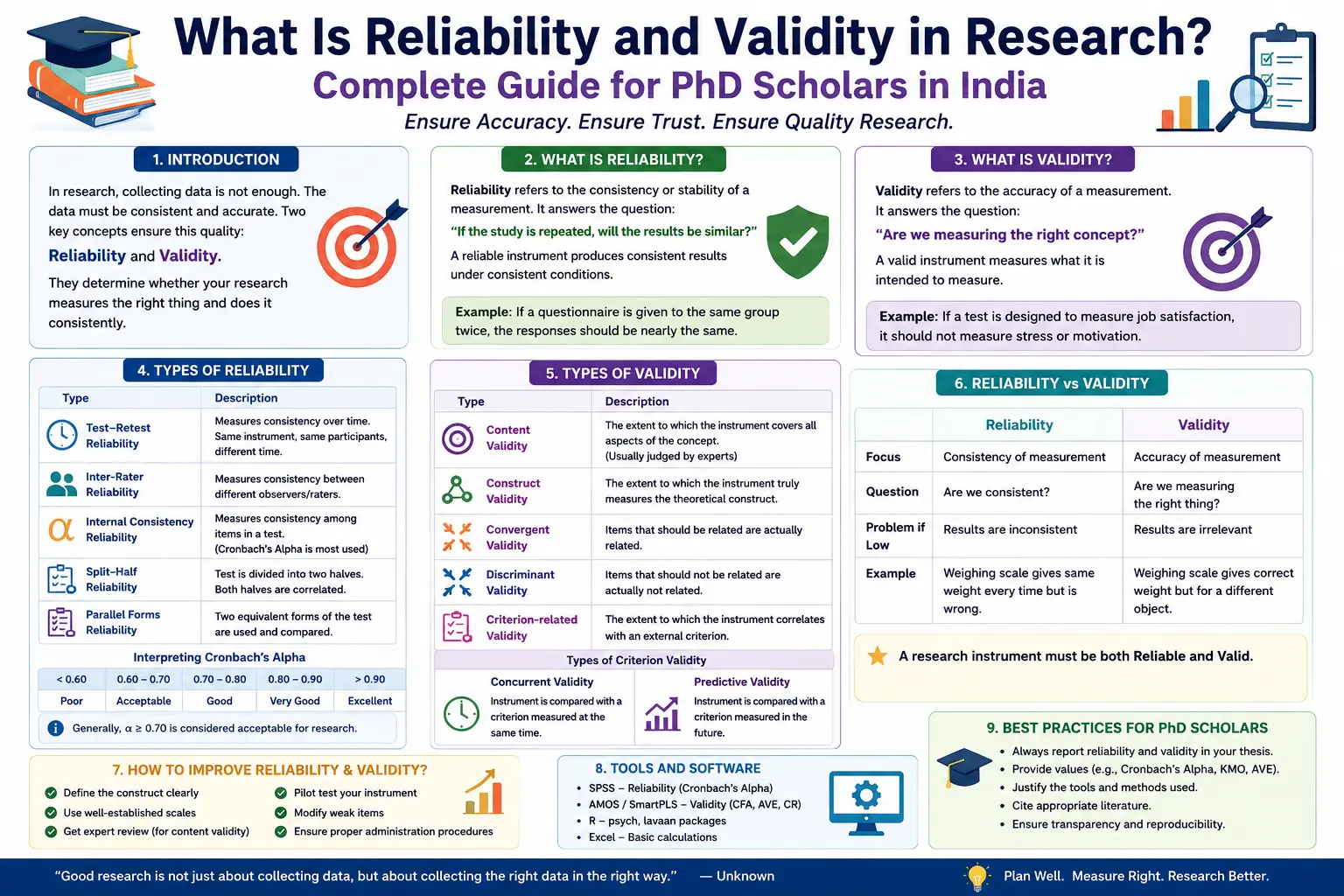
Every successful research study depends on collecting accurate, consistent, and meaningful data. Whether you are conducting surveys, interviews, experiments, observations, or case studies, the quality of your findings depends largely on two fundamental concepts: reliability and validity. These concepts determine whether your research instruments measure what they are intended to measure and whether they produce consistent results over time.
For PhD scholars in India, understanding reliability and validity in research is essential for designing high-quality studies, developing reliable questionnaires, interpreting results accurately, and producing credible theses. Universities, journal reviewers, and research supervisors often evaluate research based on these two important quality indicators.
This comprehensive guide explains the meaning of reliability and validity, their importance, different types, key differences, methods of assessment, practical examples, and strategies to improve both in quantitative and qualitative research.
What Is Reliability in Research?
Reliability refers to the consistency of a research instrument or measurement. A reliable instrument produces similar results when the same phenomenon is measured under similar conditions.
In simple terms, reliability answers the question:
"Will the instrument produce consistent results if repeated?"
For example, if a questionnaire measuring employee satisfaction is administered to the same group under similar conditions and produces nearly identical results, it is considered reliable.
Reliability focuses on consistency, stability, and repeatability of measurements.
What Is Validity in Research?
Validity refers to the accuracy of a research instrument. It indicates whether the instrument actually measures what it is intended to measure.
In simple terms, validity answers the question:
"Is the instrument measuring the correct concept?"
For example, a questionnaire intended to measure customer satisfaction should assess satisfaction rather than customer loyalty or purchasing behavior.
Validity focuses on accuracy, relevance, and appropriateness of measurement.
Why Are Reliability and Validity Important?
Reliability and validity are essential because they ensure research findings are trustworthy and scientifically sound.
They help researchers:
- Produce credible results.
- Improve research quality.
- Reduce measurement errors.
- Increase confidence in conclusions.
- Support evidence-based decision-making.
- Enhance publication opportunities.
- Strengthen thesis acceptance.
- Improve the quality of research instruments.
Without reliability and validity, research findings may be misleading or inaccurate.
Relationship Between Reliability and Validity
Reliability and validity are closely connected.
Imagine a dartboard:
- If all darts land close together but far from the center, the measurements are reliable but not valid.
- If darts are scattered randomly, the measurements are neither reliable nor valid.
- If darts consistently hit the center, the measurements are both reliable and valid.
Reliable measurements provide consistency, while valid measurements provide accuracy.
Types of Reliability
Test-Retest Reliability
Test-retest reliability measures the stability of results over time.
The same instrument is administered to the same participants at two different points in time.
If the results are similar, the instrument demonstrates high test-retest reliability.
Example:
A stress questionnaire administered to university students in January and again in February should produce similar scores if stress levels remain unchanged.
Internal Consistency Reliability
Internal consistency evaluates whether items within a questionnaire measure the same underlying concept.
The most common statistic used is Cronbach's Alpha.
General interpretation:
- Above 0.90 – Excellent
- 0.80–0.89 – Good
- 0.70–0.79 – Acceptable
- Below 0.70 – Needs improvement
Internal consistency is widely used in survey research.
Inter-Rater Reliability
Inter-rater reliability measures agreement between multiple observers or evaluators.
Example:
Two researchers independently code interview responses.
If both assign similar codes, inter-rater reliability is high.
This is particularly important in qualitative research.
Parallel Forms Reliability
This method compares two equivalent versions of the same instrument.
Both versions should produce similar results.
It is commonly used in educational and psychological testing.
Types of Validity
Face Validity
Face validity evaluates whether the instrument appears to measure the intended concept.
Although subjective, it provides an initial assessment of appropriateness.
Example:
A questionnaire measuring academic stress should contain questions related to stress rather than unrelated topics.
Content Validity
Content validity assesses whether the instrument adequately covers all dimensions of the concept being measured.
Experts usually evaluate content validity.
Example:
A leadership questionnaire should include communication, decision-making, motivation, and conflict resolution rather than focusing on only one aspect.
Construct Validity
Construct validity determines whether the instrument truly measures the theoretical construct it is intended to measure.
Researchers often use factor analysis to assess construct validity.
Examples of constructs include:
- Motivation
- Job satisfaction
- Organizational commitment
- Anxiety
Criterion Validity
Criterion validity examines how well an instrument correlates with an established standard.
It has two forms:
Concurrent Validity
Compares results with another established instrument measured at the same time.
Predictive Validity
Evaluates whether current measurements predict future outcomes.
Example:
An entrance examination predicting future academic performance.
Reliability and Validity in Quantitative Research
In quantitative research, researchers commonly evaluate:
- Cronbach's Alpha
- Composite Reliability
- Split-half Reliability
- Factor Analysis
- Convergent Validity
- Discriminant Validity
- Average Variance Extracted (AVE)
These statistical techniques help ensure measurement quality.
Reliability and Validity in Qualitative Research
Qualitative research uses different criteria.
Researchers focus on:
- Credibility
- Dependability
- Confirmability
- Transferability
These concepts help establish trustworthiness rather than relying solely on statistical measures.
How to Improve Reliability
Researchers can improve reliability by:
- Using standardized instruments.
- Writing clear questions.
- Training data collectors.
- Conducting pilot studies.
- Using consistent procedures.
- Removing ambiguous items.
- Increasing sample size where appropriate.
- Checking internal consistency.
Consistency throughout the research process enhances reliability.
How to Improve Validity
Researchers can improve validity by:
- Clearly defining research variables.
- Consulting subject experts.
- Conducting pilot testing.
- Using validated instruments.
- Reviewing literature thoroughly.
- Aligning questions with research objectives.
- Eliminating irrelevant questions.
- Performing statistical validation where appropriate.
Validity improves when the instrument accurately represents the intended construct.
Examples of Reliability and Validity
Example 1
A digital weighing machine gives exactly the same incorrect weight every day.
Result:
- High reliability
- Low validity
Example 2
A questionnaire measuring customer satisfaction asks only about product price.
Result:
- Low validity because satisfaction includes multiple dimensions.
Example 3
A depression scale consistently measures symptoms across repeated administrations and has been validated by experts.
Result:
- High reliability
- High validity
Common Methods for Testing Reliability
Researchers frequently use:
- Cronbach's Alpha
- Split-half Reliability
- Intraclass Correlation Coefficient (ICC)
- Cohen's Kappa
- Pearson Correlation
- Spearman Correlation
The choice depends on the research design and data type.
Common Methods for Testing Validity
Researchers commonly assess validity using:
- Expert Review
- Factor Analysis
- Correlation Analysis
- Known-Groups Validation
- Convergent Validity Testing
- Discriminant Validity Testing
- Criterion-Based Comparison
Using multiple validation methods strengthens research credibility.
Common Mistakes to Avoid
Researchers should avoid:
- Confusing reliability with validity.
- Assuming a reliable instrument is automatically valid.
- Using untested questionnaires.
- Ignoring pilot testing.
- Failing to assess internal consistency.
- Using poorly worded questions.
- Skipping expert review.
- Reporting reliability without discussing validity.
These mistakes can weaken the overall quality of the research.
Best Practices for PhD Scholars
To improve reliability and validity:
- Conduct a pilot study before the main research.
- Use previously validated instruments whenever possible.
- Adapt instruments carefully for the local context.
- Seek feedback from experts.
- Test reliability statistically.
- Assess different forms of validity.
- Document all validation procedures.
- Report reliability and validity results transparently in the methodology chapter.
These practices enhance the scientific rigor of your thesis.
Tips for PhD Students in India
If you are conducting doctoral research in India:
- Follow your university's research methodology guidelines.
- Validate translated questionnaires before use.
- Report Cronbach's Alpha for survey instruments where appropriate.
- Explain how validity was established.
- Keep records of expert reviews and pilot testing.
- Use statistical software such as SPSS, JASP, R, or SmartPLS for reliability and validity analysis.
- Clearly discuss the limitations of your measurement instruments.
These steps strengthen both academic quality and research credibility.
Frequently Asked Questions (FAQs)
What is reliability in research?
Reliability refers to the consistency of a research instrument in producing similar results under similar conditions.
What is validity in research?
Validity refers to the extent to which a research instrument accurately measures the concept it is intended to measure.
What is the difference between reliability and validity?
Reliability focuses on consistency, while validity focuses on accuracy. An instrument may be reliable without being valid, but a valid instrument must also be reliable.
Why are reliability and validity important in PhD research?
They ensure that research findings are accurate, consistent, credible, and scientifically sound, improving the overall quality of a thesis.
How can reliability be measured?
Common methods include test-retest reliability, internal consistency (Cronbach's Alpha), inter-rater reliability, and parallel forms reliability.
How can validity be assessed?
Validity can be evaluated through face validity, content validity, construct validity, and criterion validity using expert review and statistical techniques.
Conclusion
Reliability and validity in research are the foundation of high-quality academic studies. Reliability ensures that research instruments produce consistent and dependable results, while validity confirms that those instruments accurately measure the intended concepts. Together, they strengthen the credibility, transparency, and scientific rigor of research findings.
For PhD scholars in India, understanding and applying reliability and validity principles is essential for designing robust research instruments, collecting trustworthy data, and producing a thesis that meets academic and publication standards. By conducting pilot studies, using validated measurement tools, seeking expert feedback, and reporting reliability and validity assessments clearly, researchers can significantly improve the quality and impact of their doctoral research.
Website: www.thesislikho.com
Call/WhatsApp: +91 96438 02216