
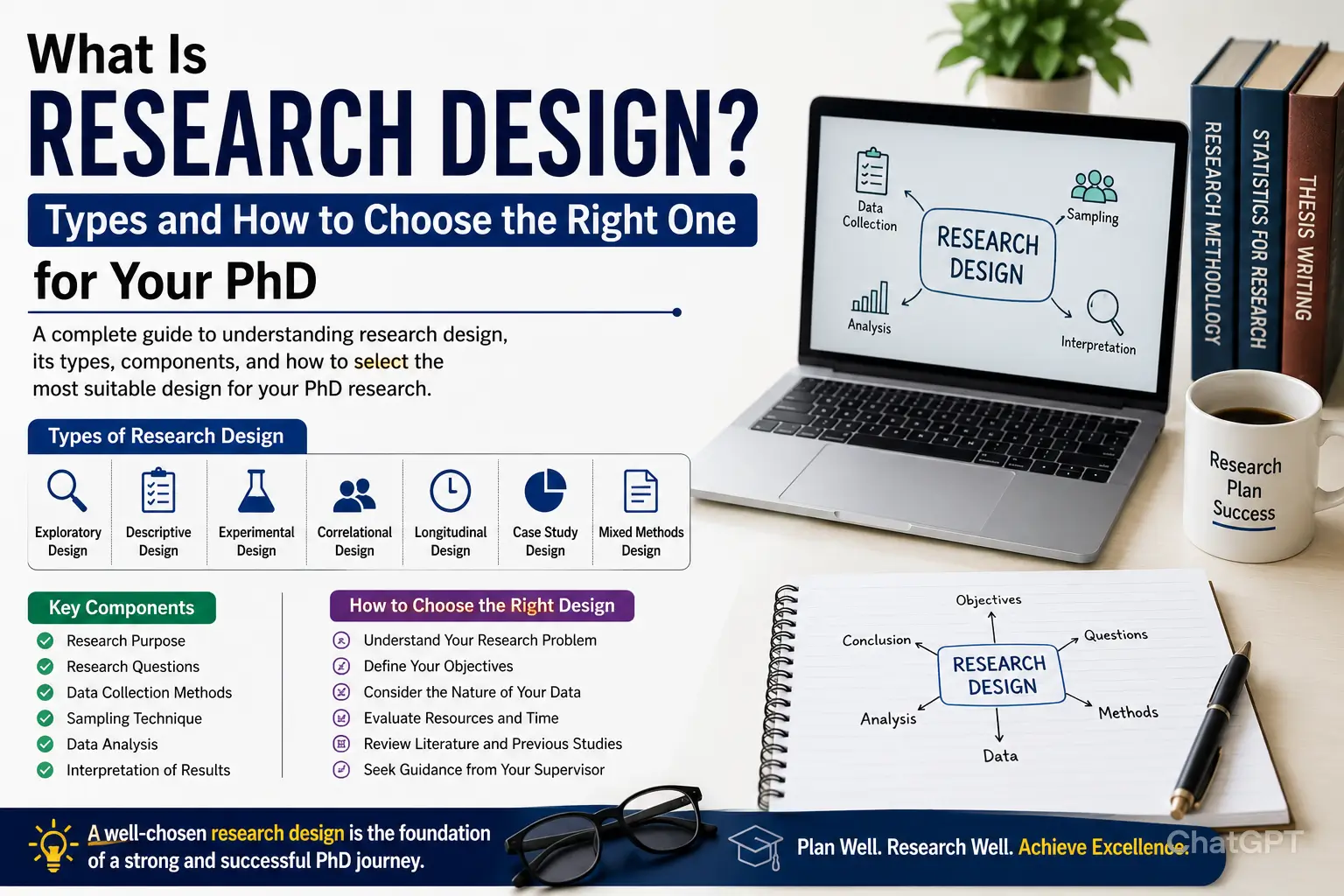
Research design is the overall plan or framework that guides how you will collect, analyze, and interpret data for your study. Think of it as the blueprint of your PhD — it connects your research questions to your methodology and ensures your findings are valid and credible.
A lot of students confuse research design with research methodology or research methods. These are related but different:
- Research design = the strategic plan (What will I do and why?)
- Research methodology = the philosophical foundation (What worldview shapes my approach?)
- Research methods = the tools and techniques (How will I collect data?)
When your supervisor asks, "What is your research design?" they want to understand the logical structure of your entire study — not just your survey or interview guide.
A well-defined research design for PhD work also helps you justify your choices to your dissertation committee and ensures your study answers the research questions you have set out to explore.
Why Research Design Matters in Doctoral Studies
Choosing the wrong research design is one of the top reasons PhD theses face major revisions or outright rejection at the viva stage. Your examiners will look closely at whether your design actually fits your research questions, your discipline, and the kind of knowledge you are trying to produce.
Beyond the viva, a solid research design:
- Ensures your study is replicable and trustworthy
- Aligns your data collection with your research objectives
- Helps you manage time and resources more efficiently
- Strengthens your contribution to existing literature
In short, your research design is not just a box to check — it is what makes your PhD study rigorous and defensible.
Major Types of Research Design for PhD Students
There is no single "best" research design. The right choice depends on your research questions, your discipline, and what kind of knowledge you want to generate. Here are the main types you need to know.
1. Qualitative Research Design
Qualitative research design focuses on exploring meanings, experiences, and social phenomena in depth. Instead of numbers, you are working with words — from interviews, observations, focus groups, documents, or field notes.
This design is common in education, sociology, psychology, anthropology, and the humanities. It works well when your research question begins with "How?" or "Why?" and when you are investigating something that cannot be easily quantified.
Common qualitative approaches:
- Phenomenology — exploring lived experiences of individuals
- Grounded theory — building theory from data, without a pre-existing framework
- Ethnography — immersive study of a cultural group or setting
- Case study — in-depth examination of one or more real-world cases
- Narrative inquiry — analyzing personal stories and lived accounts
When to choose it: Your research explores complex human experiences, marginalized voices, policy interpretations, or social phenomena where numbers alone cannot tell the full story.
2. Quantitative Research Design
Quantitative research design uses numerical data and statistical analysis to test hypotheses, identify patterns, and establish relationships between variables. It is rooted in a positivist or post-positivist worldview — the idea that there is an objective reality that can be measured.
This design is dominant in the natural sciences, economics, education research, and health sciences.
Common quantitative approaches:
- Descriptive design — describes characteristics of a population or phenomenon
- Correlational design — examines relationships between two or more variables
- Experimental design — tests cause-and-effect by manipulating one variable
- Survey design — gathers data from a large sample using structured questionnaires
- Quasi-experimental design — similar to experimental but without random assignment
When to choose it: You have clearly defined variables, a testable hypothesis, and access to a sample large enough for statistical analysis.
3. Mixed Methods Research Design
Mixed methods research design combines both qualitative and quantitative approaches within a single study. You collect and analyze both numerical data and narrative data, then integrate the findings to build a more complete picture.
This approach is increasingly popular in PhD research because it allows you to address questions that neither qualitative nor quantitative methods could answer alone.
Common mixed methods frameworks:
- Explanatory sequential design — start with quantitative data, then use qualitative to explain the results
- Exploratory sequential design — start qualitative to identify themes, then test them quantitatively
- Convergent parallel design — collect both types simultaneously and compare findings
When to choose it: Your research question has both measurable outcomes and experiential or contextual dimensions that need to be understood together.
4. Descriptive Research Design
Descriptive research design aims to describe a phenomenon, population, or situation as it exists — without manipulating variables or establishing cause and effect. It answers the question, "What is the current state of X?"
This design is often used as a precursor to more explanatory or experimental work. Surveys, observational studies, and case studies frequently fall under this umbrella.
When to choose it: You are mapping an understudied area, creating baseline data, or describing a trend or condition for the first time in your field.
5. Exploratory Research Design
Exploratory research design is used when you are investigating a topic that has not been well-studied yet. The goal is not to confirm a hypothesis but to identify key variables, generate new ideas, and define the problem more clearly.
This type of design gives you flexibility. It often uses literature reviews, expert interviews, focus groups, or pilot studies to lay the groundwork for future, more structured research.
When to choose it: Your PhD is entering relatively new territory, your research problem is not clearly defined yet, or existing literature has significant gaps.
6. Explanatory (Causal) Research Design
Explanatory research design goes beyond describing what is happening to explain why it is happening. It looks for causal relationships between variables — identifying what causes what.
Experimental and quasi-experimental designs are the most rigorous forms of explanatory research because they involve controlling variables to establish causation rather than just correlation.
When to choose it: You want to determine whether one variable causes changes in another, especially in clinical, psychological, or education research.
7. Longitudinal and Cross-Sectional Research Design
These designs refer to when and how often you collect data:
- Longitudinal design — follows the same participants over an extended period, tracking changes over time. Ideal for development studies, behavioral research, and policy evaluation.
- Cross-sectional design — collects data from multiple groups at a single point in time. Faster and less resource-intensive but unable to track change.
When to choose longitudinal: Your research question involves change, development, or the impact of interventions over time.
When to choose cross-sectional: You need a quick snapshot of a population, or time and resources are limited.
How to Choose the Right Research Design for Your PhD
Here is a practical step-by-step process to help you decide:
Step 1 — Start with your research question. The nature of your question determines nearly everything else. Is it asking what, how, why, or to what extent? Each question type aligns with different designs.
Step 2 — Consider your ontological and epistemological stance. Do you believe reality is objective and measurable, or socially constructed? Your philosophical worldview should align with your chosen design.
Step 3 — Review what has been done before. Look at published PhD theses and high-impact journal articles in your field. What designs are most common? What gaps can you fill?
Step 4 — Be honest about your constraints. Time, access to participants, available funding, and your own analytical skills are all real factors. A longitudinal experimental study may be the ideal design — but not if your PhD window is three years and your access to participants is limited.
Step 5 — Talk to your supervisor. This is non-negotiable. Your supervisor knows your field, your institution's expectations, and your personal development needs. Their input is invaluable.
Common Mistakes PhD Students Make with Research Design
- Choosing a design because it sounds impressive rather than because it fits the question
- Confusing research design with research methods
- Switching designs midway through the study without proper justification
- Failing to connect the design to the theoretical or conceptual framework
- Treating research design as a one-time decision rather than a living, justifiable choice
Frequently Asked Questions (FAQs)
Q1: What is the difference between research design and research methodology? Research design is the overall plan for your study — how it is structured and why. Research methodology refers to the philosophical assumptions and worldview underpinning your approach. Methodology informs design, but they are not the same thing.
Q2: Can I use more than one research design in my PhD? Yes. Mixed methods research combines qualitative and quantitative designs intentionally. You can also use a descriptive design in one phase and an explanatory design in another, as long as you justify each choice clearly.
Q3: Which research design is best for a PhD in social sciences? There is no single best design. However, qualitative designs (especially case study, phenomenology, and grounded theory) are widely used in social science PhDs. Mixed methods is also growing in popularity for its ability to address complex social questions from multiple angles.
Q4: How do I justify my research design in my PhD proposal? Justify your design by linking it directly to your research questions, your epistemological stance, and existing literature in your field. Explain why the design you chose is more appropriate than alternatives, and acknowledge any limitations honestly.
Q5: What is an exploratory research design in PhD research? Exploratory research design is used when your topic is relatively new or under-researched. It aims to generate insights, identify key variables, and develop a clearer understanding of the problem — rather than testing a specific hypothesis.
Q6: Is a case study a research design or a research method? Case study is both, depending on context. As a research design, it defines the overall strategy (studying one or a few bounded instances in depth). As a method, it refers to specific data collection and analysis techniques used within that strategy.
Final Thoughts: Get Your Research Design Right from the Start
Your research design is not a bureaucratic hurdle. It is the intellectual spine of your entire PhD. When it is well thought out and clearly justified, it gives your whole dissertation coherence — from your literature review and methodology chapter all the way to your findings and conclusion.
Take the time to understand your options, ask hard questions about your research problem, and make a deliberate, defensible choice.
Struggling to write up your research design chapter — or any part of your PhD? Whether you need help structuring your methodology, strengthening your literature review, or reviewing your dissertation draft, professional academic support can make a real difference. Explore expert PhD writing guidance tailored to your discipline and take the next step toward a thesis that stands up to scrutiny.
Your PhD journey is demanding enough — you deserve the right support at every stage.
Tags: research design for PhD, types of research design, qualitative vs quantitative research, mixed methods PhD, how to choose research design, PhD methodology guide, exploratory research design, descriptive research design, explanatory research design, doctoral research planning
Website: www.thesislikho.com
Call/WhatsApp: +91 96438 02216