
on measuring maximum oxygen uptake ( ) optimizing isolated muscle hypertrophy, and structuring K-12 physical education around competitive, sport-specific skill acquisition.
However, as we navigate the post-pandemic realities of 2026, the academic landscape of physical education and sports science has undergone a radical paradigm shift. Today’s most impactful research recognizes that human movement is deeply intertwined with mental health, social equity, and advanced biomechanical technology. From K-12 gymnasiums to elite sports laboratories, researchers are dismantling outdated dogmas. We are now exploring how varied movement extends human longevity, how "smart textiles" capture real-time biometrics without batteries, and how physical education K-12 curriculums are actively combating adolescent anxiety.
For doctoral scholars, sports scientists, and K-12 pedagogical researchers, this is a golden age of interdisciplinary discovery. Securing publication in top-tier SCI and Scopus-indexed journals—such as the Journal of Physical Education and Sport or Physical Education and Sport Pedagogy—now requires a synthesis of physiological data and psychosocial context.
Below is an expansive, evidence-based exploration of the seven most critical research frontiers currently defining Physical Education and Exercise Science in 2026.
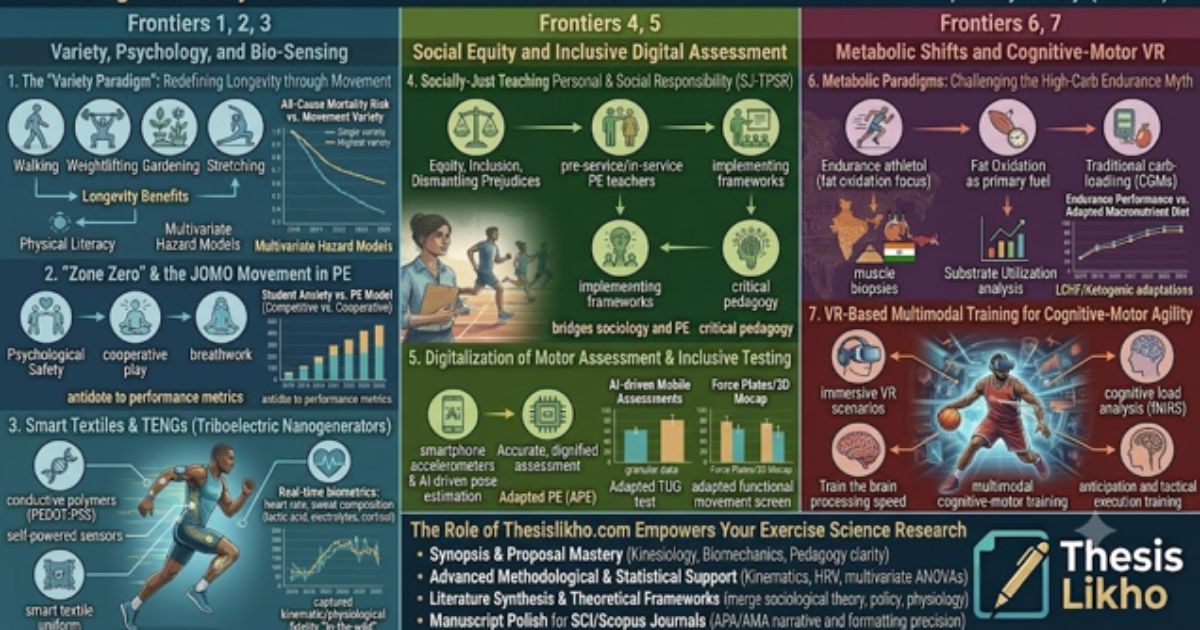
1. The "Variety Paradigm": Redefining Longevity Through Movement
For years, public health guidelines focused strictly on the volume and intensity of physical activity—typically recommending 150 minutes of moderate aerobic exercise per week. However, a landmark longitudinal study published in January 2026 has fundamentally altered how researchers understand the relationship between exercise and human lifespan.
The Research Context
A groundbreaking study led by researchers at the Harvard T.H. Chan School of Public Health analyzed the health and lifestyle data of over 111,000 adult men and women over a 30-year period. The researchers discovered that consistently engaging in a wide variety of exercises—mixing walking, weightlifting, gardening, and stretching—was associated with a significantly lower risk of premature mortality.
Crucially, this benefit held true even when the total physical activity duration was held constant. Participants who engaged in the highest variety of exercises exhibited a 19% lower risk of premature death compared to those who stuck to a single repetitive activity.
Methodological Approach and Significance
Researchers in this domain are now moving away from single-modality studies. Modern research utilizes multivariate hazard models to track how cross-training affects all-cause mortality, cardiovascular health, and neurogenesis
.
- Significance: This research shatters the "specialization" myth. For physical education curriculum designers, it provides the empirical evidence needed to prioritize "physical literacy"—teaching a broad spectrum of movement skills rather than forcing K-12 students to specialize in a single sport early on. Publications analyzing the biomechanical and cognitive benefits of "movement variability" are currently highly sought after in BMJ Medicine and the Journal of Sports Sciences.
2. "Zone Zero" and the JOMO Movement in Physical Education
The mental health crisis among adolescents has forced a massive reckoning in K-12 physical education. The hyper-competitive, anxiety-inducing environments of traditional PE classes often alienated students who lacked inherent athletic ability, driving them away from lifelong fitness. In 2026, the academic push is toward psychological safety and cooperative play.
The Research Context
The fitness and education sectors are experiencing the rise of JOMO (The Joy of Missing Out) as a direct antidote to the relentless pressure of performance metrics. According to 2026 reports tracking teaching and learning trends in physical education, schools are prioritizing "Zone Zero" training. Zone Zero focuses on ultra-low-intensity, mindful movement—such as breathwork, mobility flow, and cooperative games—that regulates the nervous system rather than taxing it.
The goal of modern PE is no longer just managing physical skills; teachers are actively managing social dynamics, screen-time recovery, and confidence gaps.
Methodological Approach and Significance
Pedagogical researchers are conducting longitudinal ethnographic studies and using psychometric assessments to measure student engagement and anxiety levels before and after implementing non-competitive, cooperative curriculum models.
- Significance: By proving that low-intensity, inclusive activities drastically reduce behavioral disruptions and increase long-term student adherence to physical activity, scholars are reshaping national K-12 physical education mandates. Research on the psychological outcomes of Zone Zero and cooperative play is dominating journals like Physical Education and Sport Pedagogy.
3. Smart Textiles and Triboelectric Nanogenerators (TENGs)
The integration of wearable technology in sports science has moved far beyond wrist-worn heart rate monitors. The cutting edge of biomechanical research in 2026 involves seamlessly integrating self-powered sensors directly into an athlete's uniform or footwear.
The Research Context
As reported by the Chemical Abstracts Service (CAS) in their 2026 sports science insights, the use of Triboelectric Nanogenerators (TENGs) and conductive polymers (like PEDOT:PSS) has revolutionized real-time biometric tracking. TENGs are extraordinary because they harvest electricity directly from the athlete's movement. Every sprint, jump, or tackle generates the micro-voltage needed to power the sensors.
These "smart textiles" track not only standard metrics like heart rate and GPS location, but they also utilize embedded biosensors to monitor sweat composition (electrolyte loss, lactic acid accumulation, and cortisol spikes) without the athlete wearing any bulky battery packs.
Methodological Approach and Significance
Sports engineers and biomechanists are utilizing these advanced textiles to conduct "in-the-wild" studies, capturing high-fidelity kinematic and physiological data during actual match play rather than in sterile laboratory environments.
- Significance: This technology allows for the creation of precise "digital twins" of athletes, enabling coaches and sports scientists to predict injury risk by monitoring micro-changes in gait or impact distribution over a 90-minute football match. Doctoral research focusing on the validation and material science of TENGs in athletic apparel is achieving high impact in journals like Sports Medicine and Nature Biomedical Engineering.
4. Socially-Just Teaching Personal and Social Responsibility (SJ-TPSR)
The traditional model of physical education has often inadvertently reinforced systemic inequities—whether through gendered expectations, ableism, or socioeconomic barriers to equipment access. The academic response is the widespread adoption of critical pedagogical frameworks.
The Research Context
A major focus in 2026 literature—highlighted by recent publications in Taylor & Francis K-12 education journals—is the evolution of the Teaching Personal and Social Responsibility (TPSR) model into the Socially-Just TPSR (SJ-TPSR) framework. Researchers are investigating how physical education teachers navigate the complexities of teaching social justice through movement. The goal is to use physical activity as a medium to teach students about equity, inclusion, and the dismantling of prejudices.
Methodological Approach and Significance
Scholars in this field utilize qualitative methodologies, including narrative inquiry and action research, to document how pre-service and in-service PE teachers implement SJ-TPSR in highly diverse urban school districts. They analyze the friction between K-12 policy mandates and the reality of enacting socially just pedagogy on the gym floor
- Significance: This research bridges the gap between sociology and physical education. By providing evidence-based strategies for fostering inclusive environments, researchers are helping to create physical education programs where marginalized students feel seen, safe, and valued. This is critical for K-12 policy reform and is widely published in the Sociology of Sport Journal and Quest.
5. The Digitalization of Motor Assessment and Inclusive Testing
For decades, physical fitness testing in schools (like the FitnessGram or the Eurofit battery) was a source of dread for many students and lacked the nuance required to assess students with physical or cognitive disabilities. The modern frontier focuses on the digitalization of these assessments to ensure equity and precision.
The Research Context
Recent studies in the Physical Education Theory and Methodology journal highlight the push toward digitizing functional movement screens. A prime example is the digitalization of the "Timed Up and Go" (TUG) test, historically used for elderly populations but now being adapted via mobile applications and computer vision for inclusive physical education. By utilizing smartphone accelerometers and AI-driven pose estimation, teachers can capture highly granular data on a student's balance, gait stability, and motor coordination without making the student feel like they are "failing" a traditional fitness test.
Methodological Approach and Significance
Researchers are conducting validation studies to compare the accuracy of AI-driven mobile assessments against gold-standard laboratory equipment (like 3D motion capture systems and force plates).
- Significance: Digitalization removes the subjective bias of the teacher holding a stopwatch and allows for the accurate, dignified assessment of students participating in adapted physical education (APE). The ability to track micro-improvements in motor control for students with conditions like cerebral palsy provides actionable data for individualized education programs (IEPs). This research is highly relevant for journals such as Adapted Physical Activity Quarterly.
6. Metabolic Paradigms: Challenging the High-Carb Endurance Myth
In the realm of elite sports nutrition and exercise metabolism, one of the most fiercely debated topics in 2026 is the role of carbohydrates versus fat oxidation in endurance performance. For half a century, "carb-loading" was the undisputed gospel of marathon runners and cyclists. Today, that dogma is being rigorously challenged.
The Research Context
Institutions like the Exercise Science Department at Grove City College have garnered massive international attention for their mechanism-driven research re-examining sports nutrition. Recent landmark publications have synthesized over 100 years of metabolic data, suggesting that low-carbohydrate, high-fat (LCHF) or ketogenic diets do not necessarily impair peak endurance performance for adapted athletes.
The research indicates that the body's ability to regulate blood glucose and utilize fat as a primary fuel source—sparing muscle glycogen—may be more critical for ultra-endurance performance than simply maximizing carbohydrate intake.
Methodological Approach and Significance
Exercise physiologists are utilizing continuous glucose monitors (CGMs), indirect calorimetry, and muscle biopsies to track substrate utilization in athletes on varying macronutrient protocols during steady-state and high-intensity interval training (HIIT).
- Significance: This research is fundamentally disrupting the multi-billion-dollar sports nutrition industry. By moving away from one-size-fits-all carbohydrate guidelines toward highly individualized metabolic profiling, researchers are optimizing performance while protecting athletes from the long-term cardiometabolic damage associated with chronic high-sugar consumption. Groundbreaking metabolic studies are frequently featured in the American Journal of Physiology and Endocrine Reviews.
7. VR-Based Multimodal Training for Cognitive-Motor Agility
The intersection of cognitive neuroscience and physical training has given rise to a new frontier in sports science: multimodal training utilizing immersive technology. It is no longer enough to train the muscles; athletes must train the brain's processing speed to react to complex, dynamic environments.
The Research Context
In 2026, the use of Virtual Reality (VR) and Augmented Reality (AR) has transcended basic simulation. Recent studies have investigated the effect of VR-based multimodal training programs on the balance, agility, and decision-making speed of young football and basketball athletes. By immersing athletes in high-pressure, cognitively demanding virtual scenarios, researchers can isolate the perceptual-cognitive skills required for anticipation and tactical execution.
Methodological Approach and Significance
Researchers employ a mix of neuroimaging (like functional Near-Infrared Spectroscopy, fNIRS) and biomechanical tracking to measure cognitive load and motor output while athletes perform tasks in VR. They assess how quickly visual information is translated into kinetic action (reaction time) and how mental fatigue in the virtual environment degrades physical mechanics.
- Significance: This research proves that "game intelligence" is not just an innate talent but a trainable skill. For sports academies, integrating VR allows injured athletes to maintain their tactical sharpness without loading their physical joints. The synthesis of motor learning theory and virtual reality is a rapidly expanding niche, heavily featured in the Journal of Sports Sciences and Psychology of Sport and Exercise.
Elevating Your Exercise Science Research with Thesislikho.com
The scope of Physical Education and Exercise Science in 2026 is intellectually demanding, deeply interdisciplinary, and technologically complex. Whether you are conducting a longitudinal study on the mental health benefits of cooperative K-12 play, validating the accuracy of Triboelectric Nanogenerators, or analyzing the metabolic pathways of ketogenic endurance athletes, the journey from raw data to a published, high-impact manuscript is fraught with methodological and administrative hurdles.
Unlike purely theoretical fields, sports science requires researchers to balance rigorous statistical analysis of physiological data with clear, actionable pedagogical or clinical implications. This is where many brilliant field studies falter—not due to a lack of insight, but due to challenges in structuring complex arguments, executing multivariate data analysis, or navigating the stringent formatting requirements of international peer review.
Thesislikho.com serves as your premier academic partner, providing the specialized scaffolding necessary to elevate your research in Physical Education and Exercise Science:
- Synopsis and Proposal Mastery: Securing admission into premier PhD programs (such as Kinesiology, Biomechanics, or Pedagogy departments) requires a proposal that is both novel and meticulously structured. Our consultants help you define clear research questions, ensuring your proposal highlights critical gaps in the current 2026 literature.
- Advanced Methodological & Statistical Support: Modern exercise science demands empirical rigor. If your research involves complex mixed-methods—such as analyzing heart-rate variability (HRV) data, interpreting kinematics from 3D motion capture, or running multivariate ANOVAs on survey data—our technical team provides the analytical support required to ensure your findings are robust and statistically valid.
- Literature Synthesis & Theoretical Frameworks: We assist in synthesizing massive volumes of literature into a coherent, defensible theoretical framework. If you are struggling to merge sociological theories of equity with K-12 physical education policy, our academic experts guide you in building a logical, unassailable foundation for your thesis.
- Manuscript Polish for SCI/Scopus Journals: The difference between rejection and acceptance in top-tier sports science journals often comes down to narrative clarity and strict adherence to formatting guidelines (APA, AMA, etc.). We provide comprehensive structural editing to ensure your research communicates its physiological and pedagogical significance powerfully to a global academic audience.
Your research has the potential to influence public health policy, revolutionize K-12 education, and redefine the limits of human athletic performance. Do not let the complexities of academic writing hinder your contribution. Partner with the experts at Thesislikho.com to ensure your academic journey culminates in research that is recognized, respected, and published at the highest levels of the scientific community.
As we look toward the future of human movement, do you believe the increasing reliance on digital tracking and wearable technology will ultimately enhance our connection to our bodies, or will it create an over-analytical approach that detracts from the inherent joy of physical play?