
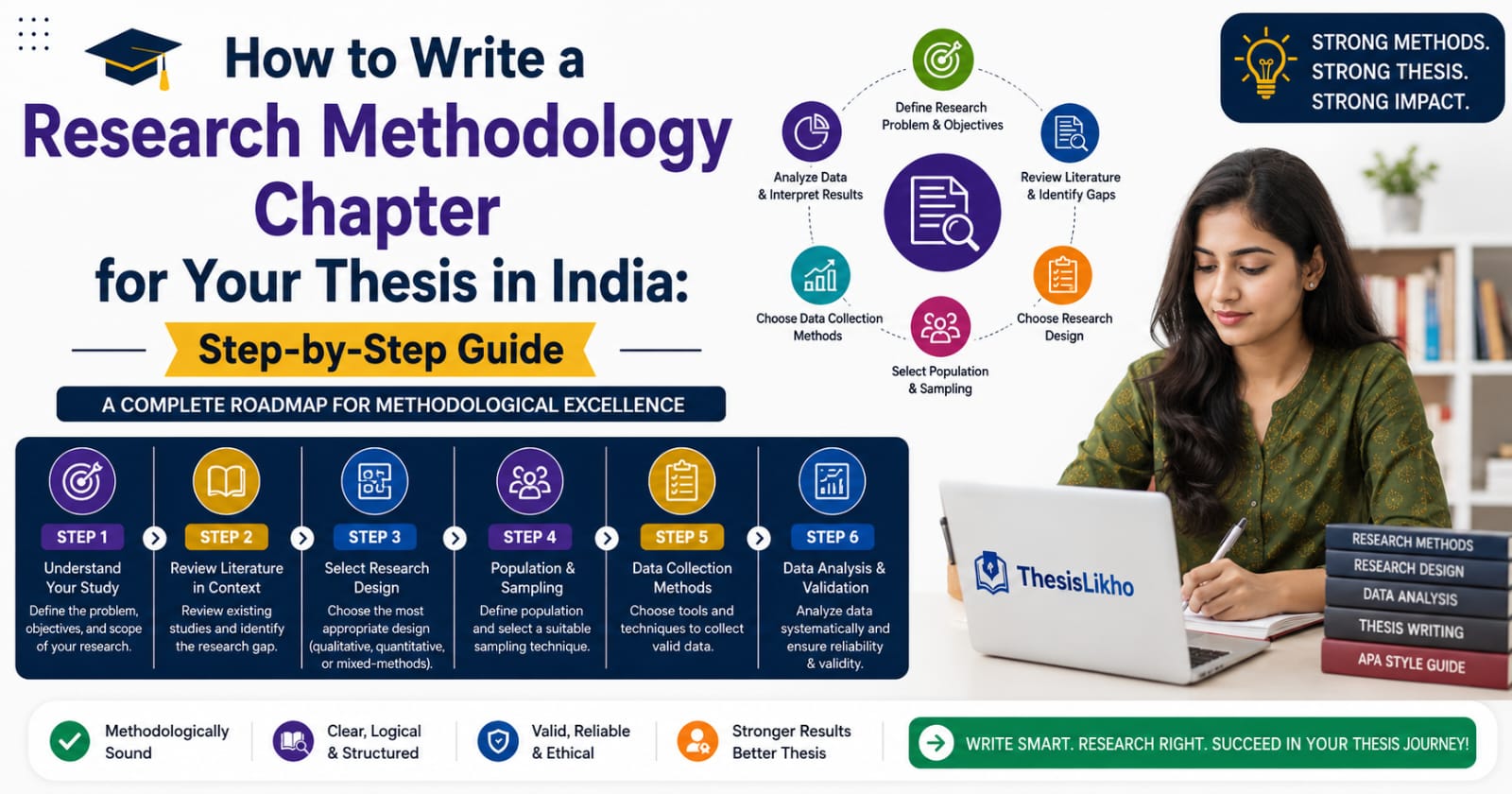
Ask any PhD scholar which chapter gave them the most trouble, and a surprising number will not say the literature review. They will say the methodology chapter.
And it makes sense. The literature review has a clear job — synthesize what others have done. But the research methodology chapter asks something harder: justify every decision you made about how you conducted your own research. Not just what you did, but why you did it that way, why you chose this sample, this instrument, this analysis technique — and why not the alternatives.
That level of accountability is unfamiliar for most students entering doctoral research. This guide walks you through exactly how to write a research methodology chapter for your thesis in India — step by step, with practical examples and honest advice about where most scholars go wrong.
What Is a Research Methodology Chapter and Why Does It Matter?
The research methodology chapter — typically Chapter 3 in Indian PhD theses — is the section where you explain and justify the entire design of your study. It is your research blueprint made visible.
A well-written methodology chapter does four critical things:
It establishes credibility. Examiners need to trust that your findings are valid, reliable, and not accidental. A rigorous methodology chapter is the foundation of that trust.
It enables replication. Any researcher reading your thesis should be able to replicate your study using only your methodology chapter as a guide. This is a standard academic requirement.
It shows intellectual maturity. Choosing a research design is not a mechanical exercise. Justifying why you made each choice — and acknowledging the trade-offs — signals doctoral-level thinking.
It directly supports your findings. The validity of Chapter 4 (Results) depends entirely on the soundness of Chapter 3. If your methodology is weak, your findings are questionable, no matter how interesting they are.
Research Methodology Chapter Structure: The Complete Breakdown
Most Indian universities follow a broadly similar structure for the methodology chapter. Here is the standard architecture, with guidance on what each section needs to contain:
3.1 Introduction to the Chapter
Open the chapter by briefly restating your research objectives and explaining what this chapter will cover. This gives the examiner a roadmap.
A clean opening might look like: "This chapter presents the research design and methodology adopted for the current study. It describes the philosophical underpinnings of the research, the design and sampling strategy, data collection instruments, and the analytical techniques used to address the research objectives stated in Chapter 1."
This is not the place to introduce new concepts or arguments — it is a signpost.
3.2 Research Philosophy (Paradigm)
This is the section most Indian PhD students either skip entirely or write superficially — and it is one of the most important.
Research philosophy refers to the set of beliefs and assumptions about how knowledge is created and what counts as valid evidence. The three most commonly discussed paradigms in Indian doctoral research are:
Positivism: The world can be measured objectively. Truth exists independent of the observer. Associated with quantitative research, surveys, experiments. Common in management, economics, and science research.
Interpretivism (Constructivism): Reality is socially constructed. Meaning depends on context and experience. Associated with qualitative research — interviews, ethnography, case studies. Common in sociology, education, and parts of management research.
Pragmatism: The research question drives the method. Both quantitative and qualitative approaches are used if needed. Associated with mixed methods research.
You do not need to write a philosophy essay here. But you do need to name your paradigm, briefly explain what it means, and justify why your research question fits within that worldview.
For example: "The present study adopts a positivist paradigm, as it seeks to examine measurable relationships between variables using a structured survey instrument and statistical analysis. This approach is appropriate given the objective nature of the research questions and the availability of large-scale secondary data."
That is all your examiner needs — a clear, reasoned declaration.
3.3 Research Approach
Research approach flows from your philosophy. There are three broad categories:
- Deductive approach: You start with an existing theory, develop hypotheses, and test them with data. Common in quantitative research.
- Inductive approach: You start with observations and build toward theory. Common in qualitative research.
- Abductive approach: You move back and forth between theory and data, refining both. Common in grounded theory and mixed methods.
State your approach and link it explicitly to your philosophy and your research objectives. These three elements — philosophy, approach, and design — should form a consistent, logical chain.
3.4 Research Design
Research design is the overall strategy that connects your research question to your data collection and analysis. The main types are:
Exploratory design: Used when little is known about a topic. Aims to generate insights and hypotheses rather than test them. Common in qualitative studies on emerging phenomena.
Descriptive design: Aims to describe the characteristics of a population, phenomenon, or situation. Survey-based studies with large samples often use this design.
Explanatory (Causal) design: Aims to explain why something happens — identifying cause-and-effect relationships. Experiments and regression-based studies use this design.
Case Study design: Examines a specific case — an organisation, community, event, or individual — in depth. Common in management and social science research.
Longitudinal design: Collects data from the same subjects over a period of time. Useful for studying change.
Cross-sectional design: Data collected from subjects at one point in time. Most common in Indian PhD survey-based research due to time and resource constraints.
State which design you have used and why. If you chose a cross-sectional survey design, explain why longitudinal data was not feasible. Acknowledging the limitation while justifying your choice is more credible than pretending your design has no limitations.
3.5 Research Method: Quantitative, Qualitative, or Mixed
This section declares and justifies your methodological approach at the data level:
Quantitative research collects numerical data and uses statistical analysis. Appropriate when your research seeks to measure, compare, or establish relationships between variables. Tools include surveys (Likert scale questionnaires), structured observation, and secondary data analysis.
Qualitative research collects textual or visual data and uses interpretive analysis. Appropriate when your research seeks to understand meaning, experience, or process. Tools include in-depth interviews, focus groups, document analysis, and observation.
Mixed methods research combines both. Increasingly common in Indian PhD research in management, education, and social sciences because it offers both breadth (quantitative) and depth (qualitative).
Connect this choice back to your research design, philosophy, and objectives. A consistent thread through these sections signals rigorous thinking.
3.6 Population and Sampling
This is often the most technically demanding section of the methodology chapter — and the one examiners scrutinise most closely.
Define your population clearly. Who exactly are the subjects of your research? Be specific: not "farmers in India" but "small and marginal farmers in the Bundelkhand region of Uttar Pradesh with less than 2 hectares of landholding."
Explain your sampling method. The main sampling techniques used in Indian PhD research are:
Probability sampling (for quantitative research):
- Simple random sampling
- Stratified random sampling — divides population into subgroups (strata) and samples from each
- Systematic sampling
- Cluster sampling
Non-probability sampling (often used in qualitative research):
- Purposive sampling — selecting information-rich cases deliberately
- Snowball sampling — used when the population is hard to access (e.g., gig workers, marginalised communities)
- Convenience sampling — least rigorous; used when access is limited
Justify your sample size. For quantitative studies, show your calculation. Cochran's formula is widely used in Indian management and social science PhD theses for determining sample size when the population is large:
n = Z²pq / e²
Where Z = confidence level (1.96 for 95%), p = estimated proportion (0.5 for maximum variance), q = 1–p, e = margin of error (typically 0.05).
For qualitative studies, justify sample size in terms of theoretical saturation — the point at which additional interviews or observations stop producing new insights.
3.7 Data Collection Methods and Instruments
Primary data sources — data you collect yourself:
- Questionnaire / structured survey
- Interview schedule (structured, semi-structured, or unstructured)
- Observation (participant or non-participant)
- Focus group discussion
Secondary data sources — data collected by others:
- Government databases (CMIE, NSS, Census of India, RBI databases)
- Company annual reports and SEBI filings
- Published research and institutional reports
- International databases (World Bank Open Data, IMF, WHO)
For each instrument you used, describe:
- The structure of the instrument (number of items, scale used)
- How it was developed (adapted from a validated scale? Developed freshly?)
- How it was administered (online, in-person, telephonic)
- Any pilot testing conducted
Describe your pilot study. Many Indian PhD scholars skip the pilot study entirely, which is a missed opportunity. A pilot study of 20–30 respondents tests whether your questionnaire is clear, whether the questions are interpreted correctly, and whether your Cronbach's alpha scores indicate acceptable reliability before full data collection begins.
3.8 Validity and Reliability
Validity refers to whether your instrument measures what it is supposed to measure.
- Content validity: Does the instrument cover all aspects of the concept? (Assessed through expert review)
- Construct validity: Does the instrument measure the theoretical construct accurately? (Assessed through factor analysis)
- Criterion validity: Does the instrument correlate with other established measures of the same construct?
Reliability refers to consistency — whether the instrument produces stable results across time and respondents.
- Cronbach's alpha is the most commonly reported reliability statistic in Indian management and social science PhD theses. A value of 0.7 or above is generally considered acceptable; 0.8+ is good.
For qualitative research, use the parallel concepts of credibility (analogous to internal validity), transferability (analogous to external validity), dependability (analogous to reliability), and confirmability (analogous to objectivity) — as established by Lincoln and Guba's trustworthiness framework.
3.9 Data Analysis Techniques
Describe every analysis technique you will use — and explain why each one is appropriate for your research objectives.
Common quantitative techniques in Indian PhD research:
- Descriptive statistics (mean, median, standard deviation, frequency distribution)
- Correlation analysis (Pearson, Spearman)
- Regression analysis (simple, multiple, logistic)
- t-test, ANOVA, MANOVA (for group comparisons)
- Factor Analysis (EFA and CFA)
- Structural Equation Modelling (SEM) using AMOS or SmartPLS
- Chi-square test (for categorical data)
Common qualitative analysis techniques:
- Thematic analysis (Braun and Clarke's 6-phase framework)
- Content analysis
- Discourse analysis
- Grounded theory coding (open, axial, selective)
- Narrative analysis
Software tools: Name the software you used — SPSS (most common in Indian universities), AMOS, SmartPLS, R, Stata, NVivo, ATLAS.ti, Excel. Examiners appreciate seeing that you used appropriate tools correctly.
3.10 Ethical Considerations
Every Indian PhD thesis involving human participants must address research ethics. Cover:
- Informed consent: Were participants told the purpose of the study and their right to withdraw?
- Confidentiality and anonymity: How was participant data protected?
- Institutional Ethics Committee (IEC) approval: Required for medical and clinical research; increasingly expected in social science and management research involving vulnerable populations
- Data storage and protection: Where is raw data stored? Who has access?
This section shows professional responsibility and is increasingly scrutinised by doctoral committees.
3.11 Limitations of the Methodology
Every research design has limitations. Acknowledging them honestly — and explaining why they do not fatally undermine your study — demonstrates intellectual honesty and doctoral maturity.
Common limitations in Indian PhD methodology chapters:
- Cross-sectional design limits causal inference
- Self-reported survey data is subject to social desirability bias
- Geographic scope of sampling limits generalizability
- Access constraints on sensitive populations or proprietary data
Do not bury limitations. State them clearly and briefly explain how you mitigated each where possible.
3.12 Chapter Summary
Close the chapter with a concise summary — one or two sentences on each section — and a brief transition sentence toward the next chapter (Results and Analysis).
Common Mistakes in Research Methodology Chapters — Indian PhD Context
Describing method without justifying it. Saying "a survey was conducted" is not enough. You must explain why a survey was the right choice for your research question.
Copying sampling sections from previous theses. This is detected during plagiarism checks and is also immediately obvious to experienced examiners. Write your sampling justification fresh for your specific population.
Using jargon without explanation. Terms like "structural equation modelling" or "interpretive phenomenological analysis" need to be explained — do not assume the examiner knows your specific technique.
Skipping the pilot study. Even a small pilot of 20 respondents strengthens your methodology significantly.
Inconsistency between sections. If you claim a positivist philosophy but then use unstructured interviews as your only data source, your methodology chapter contradicts itself. Examiners notice.
Frequently Asked Questions (FAQs)
Q1. How long should the research methodology chapter be in an Indian PhD thesis? Typically 25–45 pages, or 6,000–10,000 words. Science and engineering theses tend toward the shorter end. Management, social science, and education research tends toward longer methodology chapters with more detailed sampling and instrument justification.
Q2. Should I use first-person or third-person writing in the methodology chapter? Indian PhD theses traditionally use third-person passive voice ("Data were collected using..."). However, many modern universities and supervisors now accept first-person active voice ("I collected data using..."). Check your university's thesis writing guidelines or ask your supervisor directly.
Q3. What is the difference between research method and research methodology? Research method refers to specific techniques — survey, interview, observation. Research methodology is broader — it is the philosophical and strategic framework that justifies why those methods were chosen. Your methodology chapter covers both.
Q4. Can I change my methodology after the synopsis is approved? Minor modifications — such as changing the sample size or adding an analysis technique — are generally acceptable with supervisor approval. Major changes, like shifting from quantitative to qualitative design, typically require a Research Degree Committee (RDC) review.
Q5. Is a pilot study mandatory for PhD research in India? It is not universally mandatory, but it is strongly recommended by most doctoral committees. A pilot study demonstrates rigor, helps refine your instrument, and provides evidence of reliability before main data collection — all of which strengthen your methodology chapter significantly.
Q6. What Cronbach's alpha value is acceptable in Indian PhD theses? A Cronbach's alpha of 0.7 or above is the widely accepted minimum for acceptable reliability. Values above 0.8 are considered good; above 0.9 is excellent. Values below 0.6 generally indicate the need to revise or remove items from the scale.
Q7. How do I write a methodology chapter for qualitative research in India? Structure it similarly — philosophy (interpretivism/constructivism), approach (inductive), design (case study/phenomenology/grounded theory), sampling (purposive or theoretical), data collection (semi-structured interviews), and analysis (thematic analysis or grounded theory coding). Replace reliability/validity with Lincoln and Guba's trustworthiness criteria (credibility, transferability, dependability, confirmability).
Quick Checklist: Research Methodology Chapter
- [ ] Research philosophy named and justified (positivism/interpretivism/pragmatism)
- [ ] Research approach stated (deductive/inductive/abductive)
- [ ] Research design explained with justification (descriptive/explanatory/case study)
- [ ] Population defined with specific scope
- [ ] Sampling method explained with sample size calculation or justification
- [ ] Data collection instruments described with structure and administration details
- [ ] Pilot study results reported (if conducted)
- [ ] Validity and reliability addressed (Cronbach's alpha or trustworthiness framework)
- [ ] Analysis techniques listed and justified with software named
- [ ] Ethical considerations addressed
- [ ] Limitations acknowledged with mitigation noted
Final Thoughts
The research methodology chapter is the most technical chapter of a PhD thesis — but it is also the most defensible. Every decision you make in your methodology can be justified with logic, evidence, and existing methodological literature.
Do not treat Chapter 3 as a box-ticking exercise. Treat it as your opportunity to show examiners that you understand not just what you did, but why it was the right thing to do. That confidence — grounded in genuine methodological understanding — is what gets you through your viva voce with minimal corrections.
Ready to write your methodology chapter with confidence?
Take this guide section by section — do not try to write it all at once. Start with your research philosophy (it takes less time than you think), then move through design, sampling, and instruments in order. By the time you reach analysis techniques, the chapter will feel more like a document you built deliberately than a chapter you struggled through.
Explore our companion guides on how to write a PhD literature review, how to structure a PhD thesis chapter by chapter, and how to prepare for your viva voce in India. Every strong Chapter 3 starts with one clear paragraph — write it today.
Website: www.ThesisLikho.com
Call/WhatsApp: +91 96438 02216