
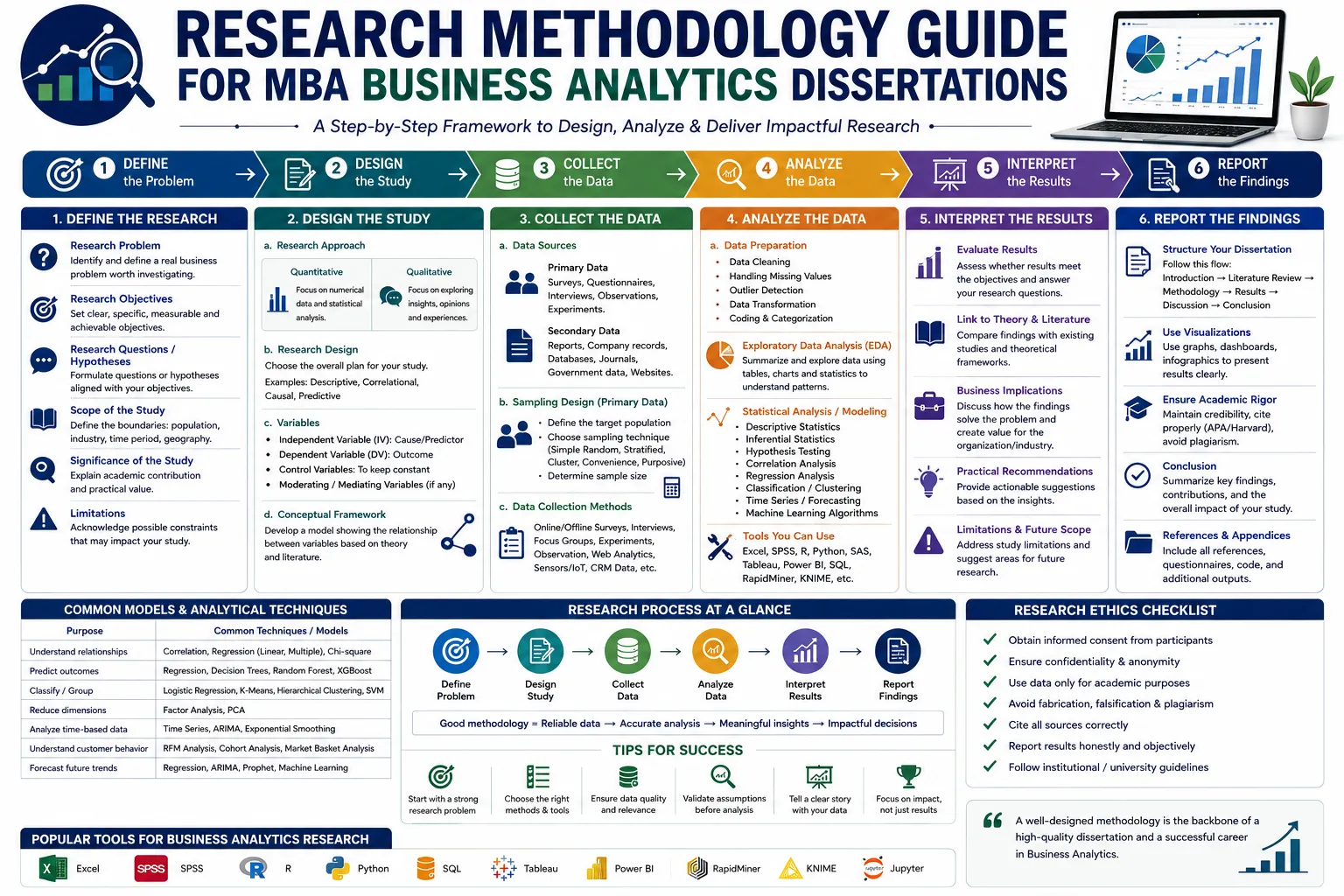
Business analytics dissertations sit in an unusual middle ground — they need the statistical rigor of a data science project and the business framing of an MBA thesis, and committees expect to see both done well simultaneously. A technically sound machine learning model that never connects back to a business problem will draw as much criticism as a well-framed business question backed by a sloppy analytical process. This guide walks through how to design a research methodology for an MBA business analytics dissertation that holds both sides together.
Why CRISP-DM Is a Strong Foundation for Your Methodology Chapter
CRISP-DM (Cross-Industry Standard Process for Data Mining) is a widely used, six-phase methodology for structuring data analytics and machine learning research: business understanding, data understanding, data preparation, modeling, evaluation, and deployment. This framework maps cleanly onto how an MBA business analytics dissertation should be structured — from business problem to actionable, evaluated finding — and using it explicitly in your methodology chapter gives your committee an immediately recognizable, well-established structure to evaluate your work against.
Step 1: Anchor Your Methodology in Business Understanding First
The business understanding phase is where your actual business problem gets translated into a specific analytics or research question. This framing step matters disproportionately for MBA-level work specifically — committees expect your methodology to clearly connect a genuine business problem to a measurable analytical objective, not just describe a statistical or machine learning technique in isolation. Before describing any data or model, your methodology chapter should state precisely what business decision or problem your analysis is meant to inform.
Step 2: Describe Your Data Understanding and Sources
Once your business problem is framed, describe your data sources clearly — whether secondary data (company records, public datasets, industry databases) or primary data you've collected specifically for this study. Include enough detail about data volume, time period, and relevant variables that your committee can judge whether your data is genuinely sufficient to answer your stated business question.
Step 3: Don't Underestimate Data Preparation and Validation
Data preparation is often treated as a footnote in student methodology chapters, but it deserves real attention. A specific, often under-emphasized step worth including explicitly: data validation should happen immediately after data preparation and before modeling, since faulty data used for training a model generates faulty, unreliable insights regardless of how sophisticated the subsequent modeling technique is. Best practice recommends having at least one person with independent understanding of the data and business context check for errors before modeling begins — for a thesis, this might mean your supervisor or a domain expert reviewing your prepared dataset before you proceed.
Step 4: Split Your Data Properly Before Modeling
Dataset splitting — separating your data into training, validation, and testing sets — is a foundational methodological step for any predictive analytics or machine learning-based MBA thesis. This ensures your model is evaluated on data it hasn't already seen during training, which is essential for producing a credible, generalizable result rather than one that simply fits the quirks of your specific sample.
For a more robust performance estimate than a single train-test split provides, use cross-validation — most commonly k-fold cross-validation. This works by splitting your training set into k groups, holding one group out for testing while the model trains on the remaining groups, and repeating this process across all k groups. The resulting overall cross-validation score is considerably more robust to how your data happened to be divided than a single split would be, and using it (and stating that you used it) signals methodological maturity to your committee.
Step 5: Select and Justify Your Algorithm Deliberately
Algorithm selection during the modeling phase should be explicitly justified against your specific business problem, not chosen by default or familiarity. For example, a classification model aimed at detecting a business outcome like customer churn or fraud might compare methods such as logistic regression, decision trees, or support vector machines. Choose your evaluation metrics based on whether your task is classification or regression — precision, recall, and F1 score for classification tasks, or mean squared error for regression tasks — and state clearly why your chosen metric fits your specific business objective.
Step 6: Address Overfitting and Underfitting Explicitly
Two core methodological risks deserve explicit attention in your methodology chapter: overfitting, where a model performs well on training data but poorly on new data because it has learned noise rather than genuine patterns, and underfitting, where a model is too simple to capture the real relationships present in the data. Cross-validation and appropriate model complexity selection are the standard safeguards against both — stating how you guarded against these risks strengthens your methodology considerably.
Step 7: Handle Imbalanced Data If Your Outcome Is Rare
If your research involves classification — fraud detection, churn prediction, default prediction, or similar rare-outcome business problems — address imbalanced data explicitly. When one outcome category is much rarer than another, standard accuracy metrics can be seriously misleading, since a model that simply predicts the majority class every time can still show high accuracy while being practically useless. Metrics like AUC-ROC, precision, and recall are more informative choices in these situations, and naming this consideration in your methodology shows you understand a genuinely common pitfall in applied business analytics work.
Step 8: Build Interpretability Into Your Evaluation
The evaluation phase of your methodology should include both technical validation — testing your model on data not used during training — and interpretability assessment: explicitly checking whether your model's results are understandable and actionable for business stakeholders, not just numerically accurate. This distinction matters specifically for MBA-level research, where practical business relevance is weighted alongside technical rigor. A highly accurate but completely uninterpretable model is a weaker MBA thesis contribution than a slightly less accurate model whose findings a business decision-maker could actually act on.
Step 9: Build in Room for Iteration
CRISP-DM explicitly allows and expects iteration back to earlier phases if evaluation results don't meet the study's objectives. Reflecting this principle in your methodology chapter — stating that your research design anticipated potential refinement rather than assuming a single modeling attempt would be sufficient — signals a realistic, mature understanding of how applied analytics research actually unfolds, rather than presenting an idealized, linear process that rarely matches reality.
Step 10: Demonstrate Breadth Even With a Narrow Focus
A comprehensive business analytics methodology should reflect awareness of the broader landscape — descriptive, diagnostic, predictive, and prescriptive analytics as distinct categories, core regression assumption checks (multicollinearity, heteroscedasticity, VIF), and machine learning fundamentals (overfitting, cross-validation, evaluation metrics) — even when your specific thesis focuses deeply on just one or two techniques. Briefly situating your specific method within this broader landscape in your methodology chapter shows your committee you chose your approach deliberately, having considered the alternatives, rather than simply defaulting to the first technique you learned.
Practical Checklist: Is Your Business Analytics Methodology Ready?
- Business problem is clearly stated and connected to a specific, measurable analytical objective
- Data sources and volume are described in enough detail to judge sufficiency
- Data validation step is explicitly described, occurring before modeling begins
- Dataset is properly split into training, validation, and testing sets
- Cross-validation (e.g., k-fold) is used and described for a robust performance estimate
- Algorithm choice is justified against the specific business problem, not chosen by default
- Evaluation metrics match the task type (classification vs. regression)
- Overfitting and underfitting risks are addressed explicitly
- Imbalanced data is addressed if the research involves rare-outcome classification
- Evaluation includes both technical validation and business interpretability assessment
- Methodology reflects awareness that iteration may be needed if initial results are unsatisfactory
- Chosen technique is briefly situated within the broader analytics landscape
Two Practical Scenarios
Scenario 1 — Catching a Data Validation Gap Before Modeling A scholar building a customer churn prediction model for a telecom dataset moved directly from data preparation into modeling without a separate validation step. After a supervisor review flagged several data entry inconsistencies in the customer tenure field that had gone unnoticed, the scholar added an explicit data validation step to the methodology — having a domain-familiar peer review the prepared dataset before modeling — catching and correcting the inconsistency before it could distort the eventual churn model's results.
Scenario 2 — Addressing Imbalanced Data in a Fraud Detection Study A scholar building a fraud detection classification model found that fraudulent transactions made up less than 2% of the dataset. Recognizing that standard accuracy would be misleading given this imbalance (a model predicting "not fraud" every time would still show over 98% accuracy while being completely useless), the scholar explicitly addressed this in the methodology chapter, using AUC-ROC and recall as the primary evaluation metrics instead, and justified this choice directly in relation to the business cost of missing actual fraud cases.
Common Mistakes MBA Business Analytics Dissertation Writers Make
- Describing a technique without connecting it back to a specific business problem, weakening the MBA-specific relevance of the research.
- Skipping explicit data validation, allowing data quality issues to propagate silently into the modeling phase.
- Using a single train-test split without cross-validation, producing a less robust and less defensible performance estimate.
- Choosing an algorithm by familiarity rather than justified fit to the specific business problem and task type.
- Ignoring imbalanced data in classification problems, relying on misleading accuracy figures instead of more appropriate metrics like AUC-ROC or recall.
Frequently Asked Questions
What is a research methodology guide for MBA business analytics dissertations? It's a structured framework — commonly based on CRISP-DM — for designing analytics or machine learning-based MBA research, covering business problem framing, data preparation and validation, model selection, evaluation (both technical and business-interpretability focused), and appropriate handling of common risks like overfitting and imbalanced data.
Why does research methodology guide for MBA business analytics dissertations matter?
Business analytics dissertations need to satisfy both technical rigor and business relevance simultaneously; a methodology that addresses only one side — a technically sound model with no business framing, or a well-framed business question with a weak analytical process — draws committee criticism regardless of how compelling the other half is.
How does research methodology affect an MBA thesis in business analytics specifically?
Since business analytics research often involves predictive models whose credibility depends on proper validation, cross-validation, and appropriate metric selection, a methodology that skips these safeguards can produce results that look impressive but don't actually generalize or hold up to scrutiny.
How long does it take to complete an MBA thesis using this approach?
Timelines vary based on data complexity and model choice, but building in proper validation and cross-validation steps from the start typically prevents the need to redo analysis after a committee identifies an overlooked methodological gap.
Is professional help available for research methodology guide for MBA business analytics dissertations?
Yes. ThesisLikho's PhD-qualified experts have guided 10,000+ scholars through business analytics research design, model validation planning, and complete MBA thesis writing assistance tailored to individual research questions.
Get Expert Guidance on Your MBA Business Analytics Methodology
Designing a business analytics methodology that satisfies both technical and business-relevance expectations takes careful planning across data validation, model selection, and evaluation design. If you'd like expert input on structuring your business analytics dissertation's methodology, ThesisLikho's PhD-qualified team offers research methodology support, model validation guidance, and complete MBA thesis writing assistance. If you need expert guidance with your methodology chapter, data analysis design, or overall thesis structure, you can explore our MBA Thesis Assistance service.
Get Free MBA Thesis Consultation → https://thesislikho.com/writing-services/thesis-assistance-mba