
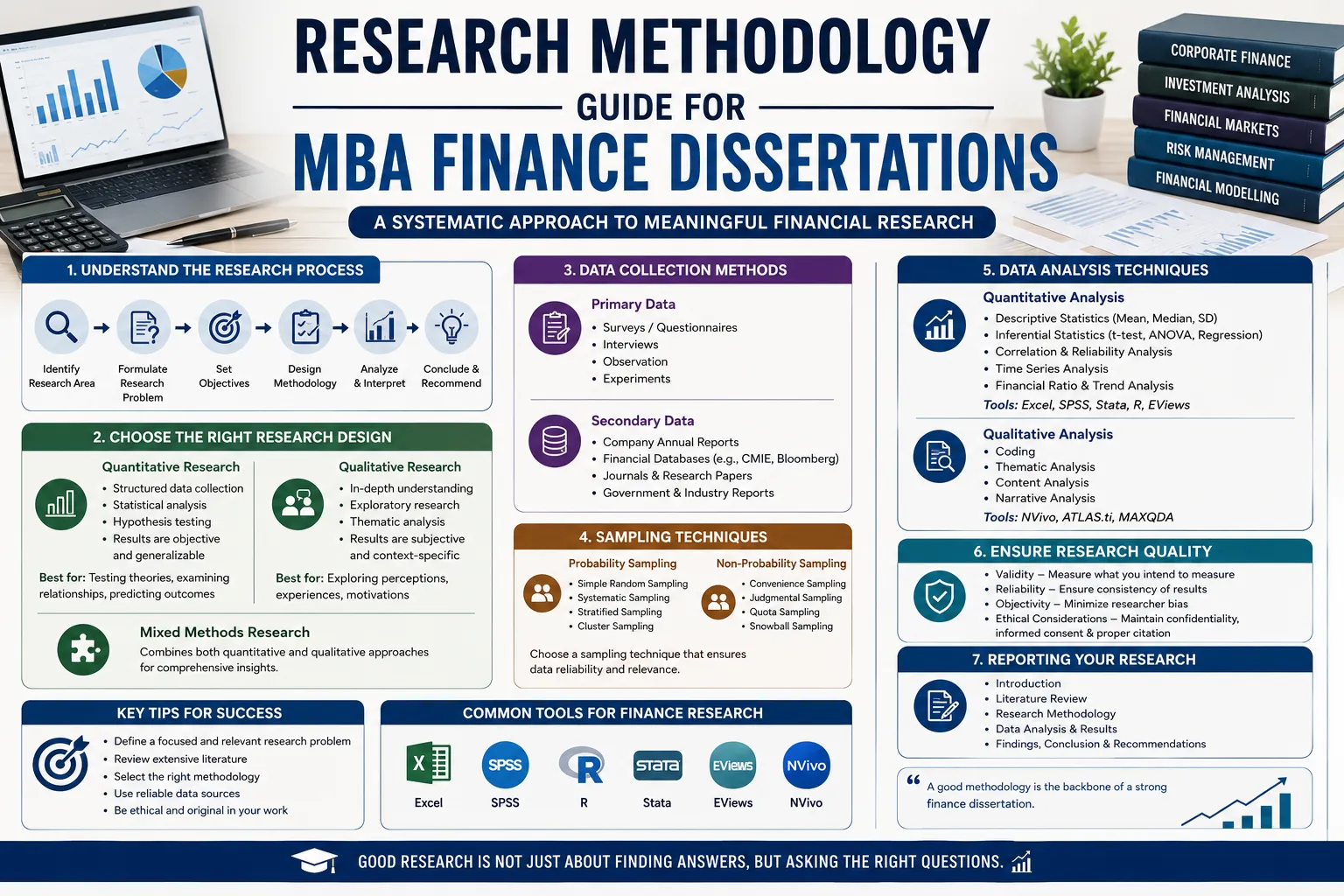
If you've settled on a finance topic but keep getting stuck at Chapter 3, you're facing one of the most common bottlenecks in MBA research. This research methodology guide for MBA finance dissertations walks through how to choose, justify, and structure the methodology that will hold up under committee scrutiny — whether your study leans quantitative, qualitative, or mixed.
Finance dissertations carry a specific expectation: committees want you to apply quantitative models, interpret financial data accurately, and evaluate real market behavior with analytical depth. Getting the methodology chapter right isn't just about picking a technique — it's about defending why that technique is the correct match for your specific research question.
Why Methodology Is the Hinge of an MBA Finance Dissertation
Your methodology chapter explains what you did and how you did it, allowing examiners to evaluate the reliability and validity of your entire study. In finance specifically, where quantitative models and numerical evidence carry substantial weight, a weak or poorly justified methodology is one of the fastest ways to undermine an otherwise strong topic.
A widely repeated practical tip among MBA dissertation guides is worth taking seriously: draft your methodology chapter before finalizing your literature review. Knowing your analytical approach in advance sharpens which prior studies are actually relevant to engage with — reviewing methodology first, then literature, often produces a tighter, more focused review.
Step 1: Match Your Method to Your Research Question — Not Your Comfort Level
The single most common methodological error among MBA finance students is choosing quantitative methods when a topic genuinely needs qualitative depth, or the reverse. If you want to measure something or test a hypothesis — say, whether ESG scores predict stock returns — quantitative methods are appropriate. If you want to explore executive decision-making around capital structure choices in depth, qualitative interviews may serve you better.
Quantitative vs. Qualitative vs. Mixed Methods for Finance Research
The choice of research approach in finance depends on the study objectives and the type of data required. Each method offers unique strengths for investigating financial issues.
Quantitative Research: This approach is best for testing hypotheses and measuring relationships using numerical data. It is commonly applied in regression analysis, event studies, portfolio analysis, and panel data research on stock returns or financial performance.
Qualitative Research: This method is suitable for understanding opinions, decision-making processes, and real-world experiences. Researchers often use interviews or case studies to explore topics such as CFOs' capital structure decisions, investment strategies, or corporate governance practices.
Mixed Methods Research: This approach combines quantitative analysis with qualitative insights to provide a more comprehensive understanding of a research problem. For example, regression analysis may identify patterns in financial data, while follow-up interviews explain the reasons behind those findings.
Step 2: Choose Between Primary and Secondary Data Deliberately
Most MBA finance dissertations rely heavily on secondary data — listed-company financial statements, stock market indices, central bank datasets — because it allows analysis of large, readily available datasets without the time and access constraints of primary collection (Source: Scribbr). Use primary data (surveys, interviews) only when you need information specific to your purpose that doesn't already exist in published form, such as investor sentiment on a niche product.
Step 3: Define Your Population, Sample, and Scope Explicitly
Before selecting an analytical technique, define your scope clearly: your population of study (e.g., NSE-listed manufacturing firms), your proposed sample size and selection criteria, and any anticipated confounding variables that could bias your findings if left unaddressed. This scope statement should appear early in your methodology chapter and directly justify every choice that follows.
Step 4: Select and Justify Your Quantitative Technique
Precision matters more than sophistication. Whether you're running regressions, conducting financial statement analysis, or comparing market performance across time periods, be exact about your chosen approach and why it fits your research question. Common finance dissertation techniques include:
- Regression analysis — testing relationships between financial variables (e.g., leverage ratio and firm profitability)
- Event studies — measuring abnormal stock returns around a specific corporate event (mergers, earnings announcements, policy changes)
- Panel data analysis — combining cross-sectional and time-series data to control for firm-specific and time-specific effects
- Ratio and trend analysis — comparing financial statement metrics across firms or periods
Step-by-Step: Building Your Quantitative Methodology Section
- State your research question and corresponding hypothesis (H0/H1 form if applicable)
- Define your population and sampling method (probability or non-probability)
- Identify your data source (e.g., CMIE Prowess, Bloomberg, company annual reports, RBI/SEBI databases)
- Specify your analytical software (SPSS, Excel, Stata, R, or Python) and why it fits your technique (Source: Ondezx)
- Describe your variables — dependent, independent, and control
- State your statistical test or model specification
- Address reliability and validity: how will your results be reproducible, and do they measure what you intend them to measure?
Step 5: Consider Mixed-Methods Designs Where Numbers Alone Aren't Enough
If your research question benefits from both statistical patterns and contextual explanation, a mixed-methods design may strengthen your dissertation. Four commonly used structures apply well to finance research:
- Explanatory sequential: Quantitative data collected and analyzed first, followed by qualitative interviews to explain the findings — useful if you expect your numbers to raise questions your data alone can't answer
- Exploratory sequential: Qualitative data first, followed by quantitative validation — useful for under-researched or emerging finance topics like fintech adoption
- Convergent parallel: Both data types collected simultaneously and analyzed separately, then compared
- Embedded: One data type nested within a larger design of the other, used when time or resources are limited.
Step 6: Address Reliability, Validity, and Ethics Directly
Reliability refers to whether your results can be reproduced under the same conditions; validity refers to whether your measures actually capture what they're intended to capture (Source: Scribbr). In a finance dissertation, this often means explicitly stating your data source's credibility, your model's assumptions, and any limitations arising from sample size or time period. Committees expect this addressed directly, not left implicit.
Practical Checklist: Is Your MBA Finance Methodology Ready?
- Research question and chosen method are genuinely matched, not selected for convenience
- Population, sample, and scope are explicitly defined
- Data source (primary or secondary) is justified, not just named
- Analytical technique (regression, event study, panel data, etc.) is specified with rationale
- Software tool is named and appropriate for the chosen technique
- Variables (dependent, independent, control) are clearly listed
- Reliability and validity are addressed explicitly
- Limitations and potential confounding variables are acknowledged
- Methodology chapter is written in the past tense (once study is complete)
- Turnitin-verified originality has been checked before submission
Two Practical Scenarios
Scenario 1 — Regression Analysis for Capital Structure Research An MBA scholar studying the relationship between leverage ratios and firm profitability across NSE-listed manufacturing firms selected secondary data from company annual reports and CMIE Prowess, ran a panel regression using Stata to control for firm-specific and year-specific effects, and explicitly justified the choice by noting that panel data allowed the study to isolate leverage's effect from broader industry trends. Being specific about why panel data — rather than simple cross-sectional regression — was the right fit satisfied the committee's request for methodological justification.
Scenario 2 — Explanatory Sequential Design for Fintech Adoption A scholar researching SME adoption of digital lending platforms first ran a quantitative survey analysis to identify adoption patterns, then conducted follow-up interviews with SME owners to explain why certain patterns emerged (for instance, why adoption was lower among older business owners despite favorable loan terms). This explanatory sequential design let the numbers establish the pattern while the interviews supplied the "why" — producing a methodology defensible on both quantitative and qualitative fronts.
Common Mistakes MBA Finance Dissertation Writers Make
- Choosing a technique because it feels familiar, rather than because it matches the research question.
- Using secondary data without justifying its credibility or limitations (e.g., not stating why a particular database or time period was chosen).
- Failing to define scope early, leading to scope creep once analysis begins.
- Skipping reliability and validity discussion, leaving examiners to guess how robust the findings are.
- Writing the literature review before methodology is settled, resulting in a review that doesn't clearly connect to the eventual analytical approach.
Frequently Asked Questions
What is a research methodology guide for MBA finance dissertations?
It is a structured framework for selecting, justifying, and describing the research design — quantitative, qualitative, or mixed methods — data sources, sampling, and analytical techniques used to answer a specific finance research question in an MBA dissertation.
Why does research methodology guide for MBA finance dissertations matter?
A well-justified methodology is what allows examiners to trust your findings' reliability and validity; a mismatched or poorly explained method is one of the most common reasons committees challenge or reject dissertation chapters.
How does research methodology affect an MBA thesis's overall quality?
It directly shapes credibility — findings built on a method that doesn't match the research question, or that lacks justification for data source and technique, weaken the entire dissertation regardless of how interesting the topic is.
How long does it take to complete an MBA thesis using this approach?
Timelines vary, but scholars who settle their methodology early — before finalizing the literature review — often move through the remaining chapters faster, since every subsequent decision follows logically from a clear methodological foundation.
Is professional help available for research methodology guide for MBA finance dissertations?
Yes. ThesisLikho's PhD-qualified experts have guided 10,000+ scholars through MBA finance research design, data analysis planning, and complete thesis writing assistance tailored to individual program requirements.
Get Expert Guidance on Your MBA Finance Methodology
Choosing and defending the right methodology is often the difference between a dissertation that sails through committee review and one that gets sent back for revision. If you'd like expert input on whether your chosen technique, data source, and sampling approach are defensible for your specific finance research question, ThesisLikho's PhD-qualified team offers research methodology support, data analysis guidance, and complete MBA thesis writing assistance. If you need expert guidance with your methodology chapter, data analysis, or overall thesis structure, you can explore our MBA Thesis Assistance service.
Get Free MBA Thesis Consultation → https://thesislikho.com/writing-services/thesis-assistance-mba