
Hospitality research has a personality all its own — it's rarely purely theoretical, since almost every good hospitality question eventually comes back to a real hotel, resort, restaurant, or guest experience. That practical grounding is exactly what makes the methodology chapter both easier and trickier than in more abstract MBA specializations: easier, because you're usually studying something concrete and observable; trickier, because getting access to guests, staff, or property-level data brings its own very specific planning challenges.
This research methodology guide for MBA hospitality management dissertations walks through exactly what that planning involves — how to choose between qualitative, quantitative, or mixed approaches for hospitality-specific questions, how to work with the SERVQUAL model correctly, how to sample guests or staff realistically, and how to avoid the mistakes that most commonly trip up first-time hospitality scholars. We've written it the way an experienced MBA mentor would talk you through your own methodology chapter, because that's genuinely the kind of guidance ThesisLikho's PhD-qualified team provides to the thousands of scholars we've supported through exactly this process.
Why Hospitality Research Methodology Has Its Own Character
Most MBA specializations research abstract relationships between variables. Hospitality research usually studies something you could physically walk into — a hotel lobby, a restaurant floor, a resort's guest services desk — which changes the practical shape of your methodology chapter in specific ways. You're not just designing a survey; you're often negotiating access to a property, working around a business's operational constraints, and studying people (guests, staff) who have limited time and patience for a lengthy academic questionnaire between checking in and heading to their room.
This practical, applied character is genuinely part of what makes hospitality management such a rich research area — but it also means your methodology chapter needs to address access and feasibility questions with more concrete detail than a purely survey-based marketing or finance thesis might require.
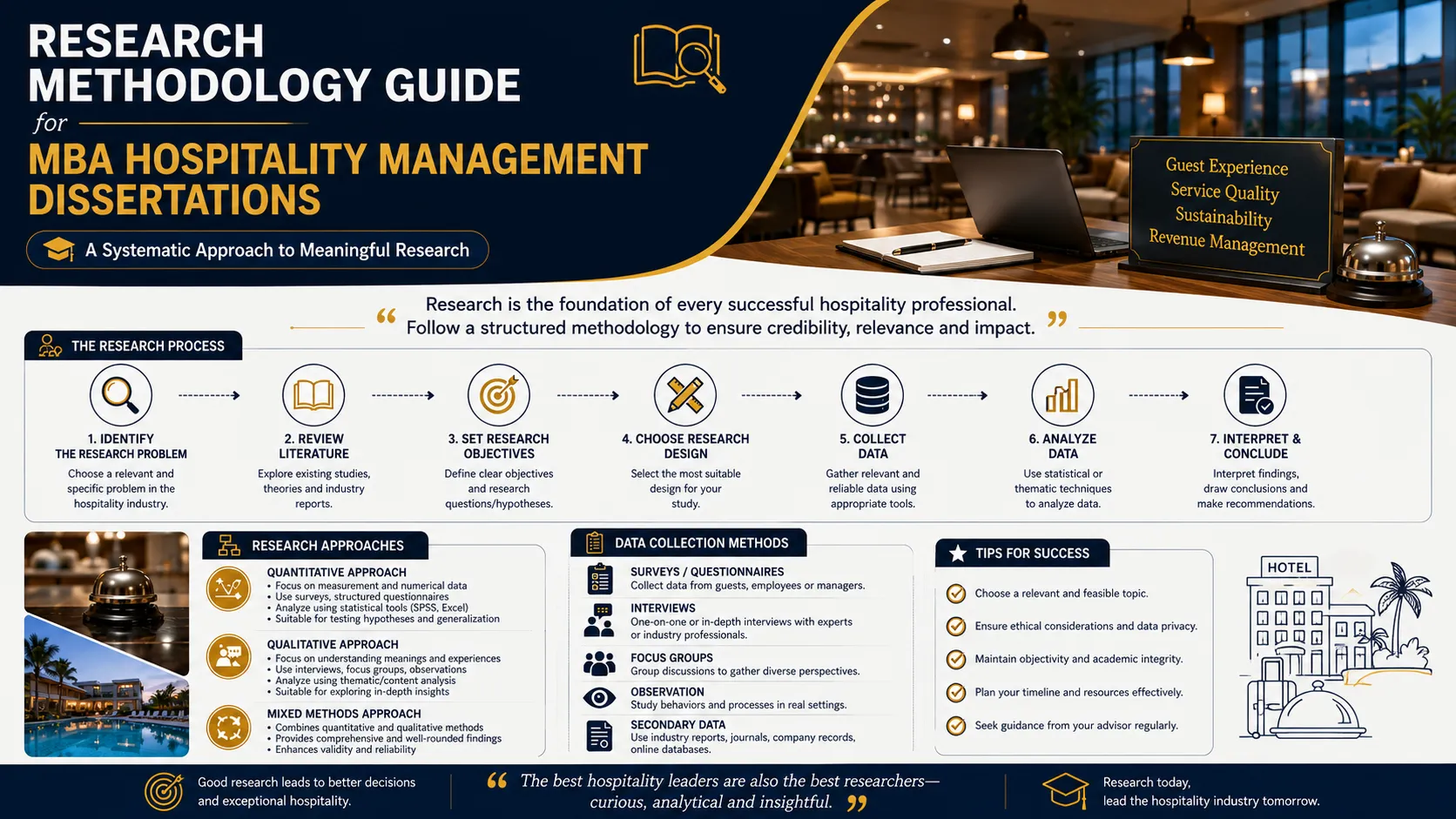
Choosing Between Qualitative, Quantitative, and Mixed Methods
The same underlying logic that governs methodology choice across every MBA specialization applies here: quantitative approaches suit testing a hypothesis and measuring a relationship (does service quality predict guest loyalty), while qualitative approaches suit exploring an experience or perception that isn't yet well understood (how do guests experience personalized service in a luxury resort context). Elsevier Researcher Academy's guidance on methodology choice reinforces this same principle broadly across disciplines, and it applies just as directly to hospitality research.
In practice, hospitality dissertations lean heavily quantitative, largely because guest satisfaction and service quality research has a well-established measurement tradition (SERVQUAL being the clearest example) that makes quantitative survey work relatively accessible. That said, qualitative approaches genuinely shine for questions about staff experience, organizational culture within a property, or nuanced guest experiences that a Likert scale can't fully capture — and mixed methods are common when a study wants both the statistical backing of a satisfaction survey and the explanatory depth of follow-up guest or staff interviews.
For a deeper walkthrough of this specific decision, see our companion guide: [Link: Qualitative vs Quantitative Research Methodology: How to Choose].
The SERVQUAL Model and How to Use It Properly
If your hospitality dissertation touches guest satisfaction or service quality in any way — and a large share of them do — you'll almost certainly encounter SERVQUAL, developed by Parasuraman, Zeithaml, and Berry in 1988. The model measures guest perceptions of service quality across five established dimensions: tangibles (the physical appearance of facilities, cleanliness, and amenities), reliability (the consistency and dependability of service delivery), responsiveness (staff willingness to help and respond promptly), assurance (staff knowledge, courtesy, and trustworthiness), and empathy (individualized, caring attention to guest needs).
Using SERVQUAL correctly means understanding it's a gap-measurement model at its core — it typically compares guest expectations against guest perceptions of actual service delivery, with the resulting gap serving as the key measure of service quality. A common methodological mistake is treating SERVQUAL purely as a satisfaction survey (measuring perception alone) without actually capturing the expectation side of the comparison it was originally designed to make.
Adapting SERVQUAL for Your Specific Study
SERVQUAL's original 22-item scale wasn't designed specifically for hospitality — it originated in financial services — and one of the most well-established, frequently cited applications of the model in hospitality research modified it into a 33-item questionnaire tailored specifically for hotel services, ultimately identifying five dimensions that explained a substantial share of the variance in guest satisfaction, though the specific dimension structure sometimes shifted from the original model once tested in a hospitality context.
This precedent matters practically: you're not expected to use SERVQUAL's generic 22 items unmodified. Adapting the instrument to your specific hospitality context — a resort, a budget hotel chain, a fine-dining restaurant — is standard, well-supported practice, provided you clearly document exactly what you changed and why, and ideally pilot-test your adapted version before full deployment. Simply lifting the original financial-services wording without adaptation is a more common weakness than over-adapting it.
Sampling Guests, Staff, or Properties
Hospitality research typically samples from one of three population types, each with different practical considerations. Guest-focused studies (satisfaction, loyalty, experience) usually rely on convenience sampling at a specific property or small set of properties, since accessing a truly random sample of hotel guests across a broader population is rarely feasible for a single-author thesis. Staff-focused studies (job satisfaction, organizational culture, service training effectiveness) sometimes use total enumeration sampling — surveying an entire eligible staff population within a smaller property — which is both practically achievable and methodologically stronger than partial sampling when the total population is small enough to survey in full. Property or organization-focused studies, where the property itself is your unit of analysis rather than individual guests or staff, typically use purposive sampling, deliberately selecting properties that meet specific criteria relevant to your research question (star rating, location type, ownership structure).
Whatever your sampling approach, be explicit about the trade-off it introduces — a convenience sample of guests at one specific property limits how far your findings can be generalized to hospitality broadly, and stating this clearly strengthens your chapter's credibility rather than weakening it.
Data Collection Methods Specific to Hospitality Research
Beyond standard surveys and interviews, hospitality research has a few field-specific data collection techniques worth knowing. Mystery shopping — where a researcher or trained evaluator experiences a service as an ordinary guest would, then records observations against a structured evaluation framework — offers a way to assess actual service delivery without relying solely on guests' self-reported opinions, which can be affected by social desirability bias or a guest's general mood at the time of survey completion. Direct observation of guest-staff interactions, where feasible and ethically appropriate, offers similarly grounded data less dependent on self-report.
For more standard survey and interview work, Purdue OWL's guidance on primary research remains directly applicable: interviews suit situations where you want in-depth insight from a smaller number of people (useful for staff perspectives on service culture, for instance), while surveys suit situations where breadth matters more than depth (useful for guest satisfaction measurement across a larger sample).
Case Study Methodology in Hospitality Dissertations
Given how property-specific many hospitality management questions naturally are, case study methodology is particularly common in this field — arguably more so than in most other MBA specializations. A single hotel, resort, or restaurant chain frequently serves as the bounded case, with your research question, data collection, and findings all explicitly scoped to that specific context rather than claimed as broadly generalizable across the hospitality industry.
If you're pursuing a case study design, your methodology chapter needs to clearly justify why this specific property or organization was chosen (convenience access, a particularly relevant characteristic, an interesting contrast case), and should be explicit that your findings are context-specific rather than industry-wide — a distinction examiners specifically check for in case-study-based hospitality dissertations.
Reliability and Validity for Hospitality Instruments
Reliability and validity apply to hospitality research the same way they apply broadly, but it's genuinely useful to know what realistic benchmarks look like in this specific field. Published hospitality research using adapted SERVQUAL or similar service-quality instruments commonly reports Cronbach's Alpha values in the 0.71 to 0.89 range across constructs — consistent with the general convention that treats 0.70 as a reasonable minimum threshold for confirmatory research, with values above 0.80 read as strong reliability.
For validity specifically, content validity — expert or practitioner review confirming your adapted instrument's items genuinely reflect the service dimensions you intend to measure — is particularly important in hospitality research given how frequently instruments are adapted from their original form. A brief expert review step, even informal feedback from a hospitality industry contact or your supervisor, strengthens your content validity claim considerably.
Data Analysis Approaches
Quantitative hospitality dissertations typically follow familiar territory: descriptive statistics to summarize guest or staff responses, followed by correlation or regression analysis to test relationships (does service quality predict satisfaction, does satisfaction predict loyalty), and sometimes gap analysis specifically comparing expectation and perception scores where SERVQUAL or a similar model is used. SPSS remains the standard tool for this kind of analysis at the MBA level.
Qualitative hospitality research — staff interviews, guest experience narratives — typically uses thematic analysis, following a structured coding process to identify recurring patterns in how staff or guests describe their experiences, usually organized and coded using NVivo for anything beyond a very small interview sample.
Ethical and Access Considerations
Hospitality research carries a few access considerations worth planning for early. If your study involves surveying or interviewing guests or staff at a real property, you typically need explicit permission from property management before data collection begins — not just informal cooperation, but a documented agreement, particularly if you plan to identify the property by name in your dissertation or if the study touches sensitive operational topics.
Standard ethical considerations apply too: informed consent from participants, confidentiality of individual responses (particularly important for staff surveys, where employees may be reluctant to give candid feedback if they fear it could reach management in identifiable form), and clear data storage and handling practices. If your study anonymizes the property itself (referring to "a mid-sized business hotel in a metro city" rather than naming it directly), state this clearly and consistently throughout your methodology chapter.
Common Mistakes in Hospitality Methodology Chapters
A frequent mistake is using SERVQUAL's generic wording without any adaptation to the specific hospitality context being studied, producing awkward, sometimes barely applicable survey items. Another common gap is treating SERVQUAL as a pure satisfaction survey, without actually measuring the expectation-versus-perception comparison the model was originally built around. Underestimating property access negotiation time is a frequent, avoidable planning mistake — securing formal permission from hotel or restaurant management can take considerably longer than students initially budget, especially for larger chains with formal research-request processes. Vague sampling justification — surveying "guests" or "staff" without specifying the selection process or acknowledging the limitations of a single-property sample — is a common, easily fixed weakness. And presenting case-study findings from one property as though they generalize broadly across the hospitality industry, without appropriately scoping the claim, is a mismatch examiners are quick to flag.
A Realistic Example Walkthrough
Scenario — Simran, an MBA hospitality management student studying guest loyalty
Simran initially planned to survey guests across "hotels in her city" broadly, assuming this would strengthen her findings' generalizability. As she began planning her methodology chapter, she realized this scope wasn't realistically achievable — she had no formal relationship with multiple properties, and cold-approaching several hotel chains for research access within her thesis timeline was unrealistic. Her supervisor helped her reframe the study as a case study of a single mid-sized business hotel where she'd secured a research placement, adapting SERVQUAL's 22 items into a 28-item questionnaire specifically reflecting business-traveler priorities (efficient check-in, reliable Wi-Fi, quiet rooms) rather than leisure-guest priorities the original scale didn't emphasize. The narrower scope wasn't a smaller contribution — it was a genuinely completable one, with a clearly justified sample and an honestly scoped claim about what her findings could and couldn't say beyond that specific property.
This is a pattern we see constantly in mentoring work: hospitality methodology problems are rarely about the underlying research idea — they're almost always about matching scope to realistic property access from the start.
Scenario — Arjun, an MBA student researching staff turnover in restaurants
Arjun's original plan was a purely quantitative survey measuring the relationship between job satisfaction and turnover intention among restaurant staff. After conducting a handful of informal conversations with restaurant managers during his initial site visits, he realized the more interesting and under-explored angle wasn't really about measuring the strength of an already well-established relationship — it was about understanding why certain specific working conditions in the fast-casual segment (irregular shift scheduling, limited career progression visibility) were driving turnover in ways broader hospitality literature hadn't fully captured. He shifted to a mixed-methods design: a shorter quantitative survey establishing baseline satisfaction and turnover intention levels across three restaurant locations, followed by in-depth interviews with a purposively selected subset of staff who had either recently left or were actively considering leaving. The qualitative component ended up producing his study's most cited and most useful findings — a result his original, purely quantitative plan would never have surfaced.
If you'd like a second opinion on your own methodology design before data collection begins, our MBA Thesis Assistance service offers exactly this kind of structural review from PhD-qualified mentors. Once your data is collected, our companion guide — How to Analyze Data for an MBA Hospitality Management Thesis — covers the next step in detail.
Citation Practices and Referencing Adapted Instruments
A detail specific to hospitality methodology chapters that's easy to overlook: whenever you adapt an established instrument like SERVQUAL, or draw on a specific published study's questionnaire structure, this needs a proper citation — not just a general mention that "SERVQUAL was used," but a specific reference to the original Parasuraman, Zeithaml, and Berry (1988) source, and to any published hospitality-specific adaptation you drew on for your own modifications. UGC's INFLIBNET guidelines require a standard, consistently applied citation style throughout an Indian thesis — commonly APA for management dissertations — and this consistency needs to extend fully into your methodology chapter, not just your literature review.
A practical habit worth adopting: whenever you name a specific technique, model, or adapted instrument in your methodology chapter, pause and confirm you've cited its original source and any intermediate adaptation you drew from, even if the citation is brief. This both strengthens your chapter's academic credibility and avoids an easily overlooked category of citation gaps.
Pre-Submission Checklist
Before finalizing your methodology chapter, confirm that your research approach (qualitative, quantitative, or mixed) genuinely matches your specific research question. Confirm that if you're using SERVQUAL or a similar instrument, you've clearly documented any adaptations made and why. Confirm your sampling technique and sample size are both specified and honestly justified, including acknowledgment of any generalizability limits. Confirm your data collection process, including any required property access permissions, is realistic given your actual timeline. Confirm your reliability and validity reporting includes actual figures with interpretation, not just a bare claim of rigor. And confirm any case-study findings are clearly scoped to their specific context rather than presented as broadly generalizable.
Getting Expert Support
Even experienced researchers benefit from a second, structured read on their hospitality methodology chapter before data collection begins — a property access assumption that doesn't hold up, or a SERVQUAL adaptation that hasn't been properly documented, is far easier to fix on paper than after fieldwork has already started.
ThesisLikho's mentoring team — MBA and PhD-qualified experts who've guided over 10,000 scholars through their dissertations — offers structured methodology review as part of our MBA Thesis Assistance services, helping you validate your research design and instrument adaptation before you commit to fieldwork.
Frequently Asked Questions
What is a research methodology guide for MBA hospitality management dissertations?
It's a structured framework covering how to design, justify, and execute the research approach for a hospitality-focused MBA dissertation — including method choice, hospitality-specific instruments like SERVQUAL, sampling of guests or staff, and property access considerations unique to this field.
How long does it take to complete an MBA thesis using this approach?
Following a structured hospitality methodology typically takes 3 to 6 months from research design to completed analysis, similar to other MBA specializations, though securing formal property access permissions can sometimes extend the timeline if a business's approval process is slow.
Is professional help available for research methodology in MBA hospitality management dissertations?
Yes — structured mentoring on methodology design, SERVQUAL adaptation, and analysis planning is a standard and legitimate form of academic support. ThesisLikho's PhD-qualified mentors offer this kind of methodology-focused guidance for MBA hospitality management students.
Why does research methodology matter in an MBA hospitality management dissertation?
Hospitality research's practical, property-specific nature means methodology choices — sampling, instrument adaptation, access planning — directly determine whether a study is actually completable within a student's timeline, not just whether it's theoretically sound.
How does research methodology affect an MBA hospitality thesis overall?
A well-designed methodology, with realistic property access secured early and a properly adapted measurement instrument, makes data collection considerably smoother and gives your results far more credibility than a study built on an assumption about access or scope that doesn't hold up in practice.
Get Free MBA Thesis Consultation
If you'd like a mentor to review your hospitality research design before you start data collection, ThesisLikho's team is here to help.