
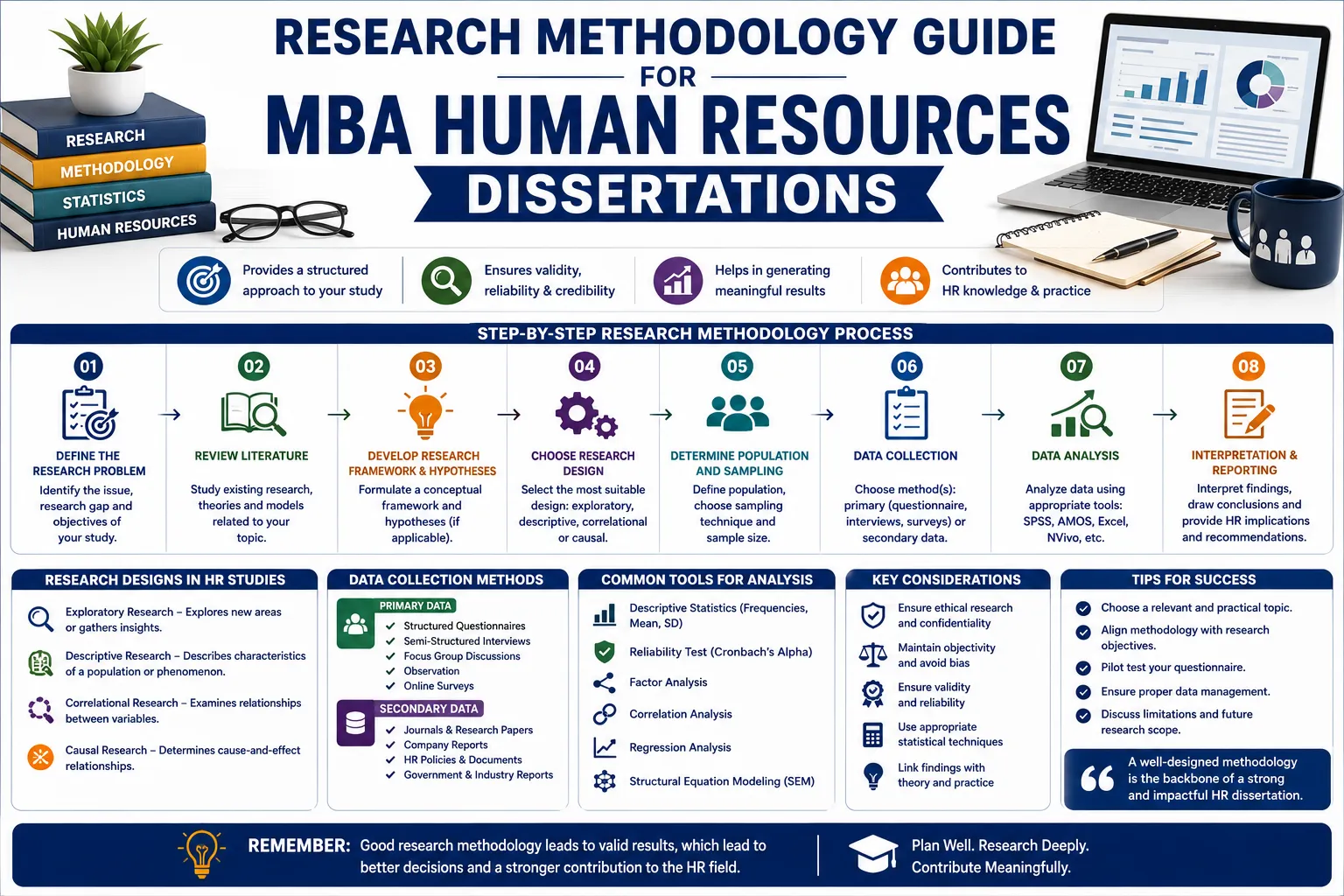
If you've finalized your HR thesis topic and are now staring at the methodology chapter wondering whether to run a survey, conduct interviews, or do both, you're at the stage that trips up more MBA HR scholars than any other. This research methodology guide for MBA human resources dissertations walks you through choosing the right approach, selecting validated instruments, designing a defensible sampling strategy, and avoiding the methodological pitfalls that most commonly derail HR research.
This guide is written specifically for first-time MBA thesis writers in India who want a practical, replicable methodology — not just a textbook explanation of quantitative versus qualitative research.
Why HR Research Needs Its Own Methodology Playbook
Generic research methodology advice tends to treat all business research the same way — pick quantitative or qualitative, run some tests, write it up. HR research has specific quirks that generic advice misses: validated psychological instruments (engagement, burnout, job satisfaction scales) that already exist and should usually be used rather than reinvented; a genuine risk of common method bias when both predictor and outcome are self-reported by the same employee; and sensitive data (performance ratings, attrition intentions, workplace conflict) that raises ethical considerations beyond standard business research.
ThesisLikho's MBA research experts, who've guided over 10,000 scholars through methodology design, consistently see the same gap: HR scholars who default to a self-designed questionnaire without checking whether a validated scale already exists for their exact construct, and who don't account for common method bias when collecting both predictor and outcome data from the same survey.
Step 1: Match Your Methodology to Your Research Question
Before choosing any method, your research question should already point toward quantitative, qualitative, or mixed-method design:
- Quantitative — if you're testing a relationship, difference, or predictive effect between HR variables (e.g., "does flexible work policy predict employee retention intention?").
- Qualitative — if you're exploring perceptions, meaning, or lived experience (e.g., "how do mid-level managers experience leading hybrid teams?").
- Mixed-method — if you need both a measurable relationship and an explanation of why it exists (e.g., measuring burnout levels and understanding what specifically drives them in employees' own words).
Impact-Based Research Questions
If your research asks "What is the impact of X on Y?", such as the impact of employee engagement on productivity, a quantitative methodology using correlation or regression analysis is the most appropriate choice.
Perception or Experience-Based Research Questions
For questions like "How do employees perceive or experience X?", a qualitative methodology with thematic analysis is ideal because it explores opinions, experiences, and personal insights in depth.
Comparison-Based Research Questions
When the objective is to determine whether there is a significant difference between two or more groups, such as employees working remotely versus in-office, a quantitative approach using statistical tests like the t-test or ANOVA is recommended.
Exploratory Research Questions
If your study aims to understand what drives a particular behavior and why employees respond in a certain way, a mixed-method approach combining surveys with interviews provides both numerical evidence and detailed explanations.
Mediation or Relationship-Based Research Questions
For research questions examining whether one variable mediates the relationship between two others, such as organizational support mediating the relationship between leadership and employee engagement, a quantitative methodology using Structural Equation Modeling (SEM) or PLS-SEM is the most suitable analytical approach.
Quantitative Methodology for HR Dissertations
Most MBA HR dissertations using quantitative methods follow this sequence:
- Descriptive statistics on your sample's demographics and key variables.
- Reliability testing (Cronbach's alpha) for each construct in your survey.
- Validity testing through factor analysis or SEM validity metrics.
- Correlation analysis to check relationships before more complex testing.
- Regression, ANOVA, or SEM/PLS-SEM to directly test your hypotheses.
- Interpretation in plain language alongside the statistical output.
For HR studies involving multiple mediating or moderating variables (e.g., "does job satisfaction mediate the relationship between leadership style and turnover intention?"), SEM-based approaches like PLS-SEM are usually more appropriate than simple regression, since they can model these indirect pathways explicitly.
Qualitative Methodology for HR Dissertations
If your HR research question centers on perception, experience, or organizational culture, a qualitative approach — typically thematic analysis of interview or focus-group data — is usually the right fit:
- Transcribe interviews or focus-group sessions fully and accurately.
- Familiarize yourself with the data through multiple reads before coding.
- Generate initial codes using a qualitative analysis tool (NVivo or Atlas.ti) rather than manual highlighting.
- Group codes into broader themes.
- Review themes against the full dataset to confirm they genuinely represent the data.
- Write up themes with supporting, anonymized participant quotes — typically 2–3 illustrative quotes per theme.
Mixed-Method Designs for HR Research
HR research lends itself particularly well to mixed methods, since many HR phenomena (engagement, burnout, retention intention) can be measured quantitatively but are best explained qualitatively. Two common structures:
- Sequential explanatory — run your quantitative survey first (e.g., regression showing manager support predicts retention intention), then conduct follow-up interviews to explore why that relationship holds from employees' own perspective.
- Convergent parallel — collect quantitative and qualitative data around the same time, then integrate both sets of findings in your discussion chapter.
The most common mistake in mixed-method HR dissertations is presenting the quantitative and qualitative findings as two disconnected chapters rather than explicitly showing where the qualitative data explains, contradicts, or adds nuance to the quantitative results.
Using Validated Instruments Instead of Self-Designed Scales
This is one of the highest-value methodology decisions an HR scholar can make. Rather than designing your own questionnaire items from scratch, use an existing, pre-validated scale wherever one exists for your construct — it strengthens your study's credibility and lets you directly compare your findings against prior published research.
Employee Engagement
A widely accepted instrument for measuring employee engagement is the Utrecht Work Engagement Scale (UWES-9). The 9-item version is commonly used because it has demonstrated strong reliability and validity across different industries and countries.
Burnout
The Maslach Burnout Inventory (MBI) is one of the most established tools for assessing burnout. It measures three distinct dimensions: emotional exhaustion, depersonalization (or cynicism), and reduced professional efficacy.
Job Satisfaction
Researchers frequently use the Job Satisfaction Survey (JSS) or the Minnesota Satisfaction Questionnaire (MSQ) to evaluate employee job satisfaction. Both instruments have been validated across a wide range of organizational settings.
Organizational Commitment
The Meyer and Allen Three-Component Model Scale is commonly used to measure organizational commitment by assessing affective, continuance, and normative commitment separately.
Turnover Intention
Turnover intention is typically measured using validated short scales containing three to six items. These scales are often included alongside engagement and burnout questionnaires to better understand employees' intentions to leave an organization.
Choosing the Right Instrument
Although employee engagement and burnout are closely related, they represent different psychological constructs and should be measured using separate validated instruments. Using UWES to assess engagement and MBI to measure burnout provides more accurate and methodologically sound research findings than treating one as the opposite of the other.
Sampling Strategy for HR Dissertations
HR research typically samples employees, managers, or HR professionals within one or more organizations, and your sampling strategy needs to be explicitly justified:
- Probability sampling (random, stratified) — strongest for generalizability, but often impractical for a single-organization MBA study with a defined, accessible employee population.
- Purposive sampling — common in qualitative HR research, selecting participants specifically because they hold relevant experience (e.g., managers who've led hybrid teams for at least a year).
- Convenience sampling — the most commonly used (and most commonly criticized) approach in MBA-level HR research; if you use it, be upfront about the limitation it introduces to generalizability rather than glossing over it.
Whichever approach you choose, your sample size needs to be adequate for your planned statistical test — SEM-based analysis in particular is sensitive to sample size, and a rule-of-thumb minimum is worth confirming with your supervisor based on your specific model's complexity before finalizing your data collection plan.
It's also worth thinking through your unit of analysis early, since HR research sometimes blurs this without scholars noticing. Are you studying individual employees, teams, departments, or organizations as your actual unit of analysis? A study asking "does team psychological safety predict innovation behavior" is really analyzing teams, even if data is collected from individual team members — which has implications for your sample size calculation and the level at which you aggregate and report your findings. Getting this distinction wrong is a subtle but common source of confusion in HR dissertation defenses.
Common Method Bias: What It Is and How to Handle It
This is one of the most important — and most frequently overlooked — methodological risks in HR research specifically. Common method bias (CMB) occurs when both your predictor and outcome variables are collected from the same respondent, using the same instrument, at the same time — a very common setup in HR surveys, since employees typically self-report both, say, their perceived organizational support and their own turnover intention in a single questionnaire.
Procedural remedies (applied before data collection):
- Guarantee respondent anonymity to reduce social-desirability bias.
- Randomize question order across your survey.
- Where feasible, separate the collection of predictor and outcome variables in time (e.g., collect engagement data at one point, retention outcomes weeks later).
Statistical checks (applied after data collection):
- Harman's single-factor test remains the most commonly reported CMB check in published HR and management studies — if an unrotated single factor explains more than roughly 50% of variance across your items, this is traditionally taken as a signal of concern.
- It's worth noting, however, that a recent large-scale study examining 1,619 published management sources found Harman's single-factor test doesn't reliably distinguish between stronger and weaker research designs — meaning it shouldn't be treated as a definitive, standalone safeguard. Combining it with procedural remedies (rather than relying on the statistical test alone) is the more defensible approach for a dissertation methodology chapter.
Being upfront about this limitation in your own methodology chapter — acknowledging CMB as a risk, describing the procedural steps you took to reduce it, and reporting Harman's test as one supporting check rather than definitive proof — reads as more methodologically sophisticated to an examiner than simply stating "CMB was not a concern" without qualification.
Cronbach's Alpha
Cronbach's Alpha measures the internal consistency of questionnaire items. A value of 0.70 or higher is generally considered acceptable, while 0.80 or above indicates strong reliability.
Kaiser-Meyer-Olkin (KMO)
The KMO test evaluates whether your sample is suitable for factor analysis. A value above 0.60 is acceptable, while 0.70–0.80 or higher indicates good sampling adequacy.
Composite Reliability (CR)
Composite Reliability (CR) is commonly used in Structural Equation Modeling (SEM) to assess construct reliability. A CR value greater than 0.70 suggests that the measurement model is reliable.
Average Variance Extracted (AVE)
Average Variance Extracted (AVE) measures convergent validity by indicating how much variance a construct explains in its indicators. An AVE value above 0.50 is generally considered acceptable.
Why Reliability and Validity Matter
Even when using well-established instruments such as the Utrecht Work Engagement Scale (UWES) or the Maslach Burnout Inventory (MBI), researchers should reassess reliability and validity using their own dataset. Differences in organizational settings, industries, or cultural contexts can influence how a measurement scale performs, making validation an essential step in HR research.
Ethical Considerations Specific to HR Research
HR research involves data that's often more sensitive than typical business research — performance ratings, turnover intentions, workplace conflict experiences, and mental health/burnout indicators all carry a higher risk of participant discomfort or organizational sensitivity if mishandled.
- Informed consent should clearly explain that participation is voluntary and that responses won't be shared with the participant's direct manager or used in any way affecting their employment.
- Anonymity and confidentiality matter more in HR research than in many other business contexts, since employees may reasonably fear that honest answers about burnout, engagement, or manager relationships could affect their standing if identified.
- Organizational gatekeeping — securing access through HR departments is common, but be alert to the risk that this access itself could make employees feel less free to respond candidly; explicitly separating your data collection from any organizational reporting channel helps address this.
- Data storage and handling should follow your university's ethics guidelines, with special care given to any data that could indirectly identify a participant even without a name attached (e.g., a very small department where "the only female manager" is identifiable).
Two Realistic Methodology Scenarios
Scenario 1 — Engagement and Burnout Using Validated Scales
Priya, an MBA HR scholar, studied the relationship between remote-work intensity and employee burnout, with engagement as a potential moderating variable, among 180 employees at a mid-sized Indian IT firm. Rather than designing her own burnout and engagement items, she used the UWES-9 and the Maslach Burnout Inventory — both pre-validated instruments — allowing her to directly compare her sample's scores against prior published benchmarks. Because her predictor (remote-work intensity) and both outcome variables came from the same self-report survey, she built in procedural remedies (anonymized responses, randomized question blocks) and reported Harman's single-factor test as one supporting check rather than definitive proof of no bias, explicitly acknowledging the limitation in her methodology chapter. Her supervisor specifically praised this honesty about CMB as evidence of methodological maturity.
Scenario 2 — Mixed-Method DEI Study
Rohit's thesis examined the effectiveness of DEI initiatives at a large Indian multinational, using a sequential explanatory design: first a quantitative survey measuring employees' perceived inclusion across demographic groups, followed by qualitative interviews with a purposively sampled subset of employees from underrepresented groups to explore why certain initiatives felt effective or performative. His quantitative phase used purposive stratified sampling to ensure adequate representation across demographic groups, while his qualitative phase deliberately recruited participants who'd given contrasting survey responses (both highly positive and highly critical), so his interviews could genuinely explain the variation his survey had revealed — rather than only interviewing employees who agreed with each other.
Both scenarios illustrate the same principle: a well-designed HR methodology anticipates its specific risks (validated instrument selection, common method bias, sensitive data ethics) rather than applying generic business-research methodology without adaptation.
Writing the Methodology Chapter Itself
Whatever methodology you choose, your methodology chapter should be detailed enough that another researcher could replicate your study from the description alone — a standard commonly emphasized in academic methodology guidance and equally applicable to an MBA dissertation as to a published journal article. Concretely, this means specifying:
- Your exact sampling frame, sample size, and sampling technique (not just "employees were surveyed").
- The exact validated instrument(s) used, including the specific version (e.g., UWES-9, not just "an engagement scale").
- Your data collection timeline and any steps taken to reduce common method bias.
- Your planned statistical tests, stated before you report results, not selected after seeing what "worked."
If your methodology chapter also includes a structured literature synthesis (for example, reviewing prior DEI intervention studies systematically), the PRISMA Statement's structured approach to documenting how sources were identified, screened, and included offers a transferable framework for demonstrating a systematic, defensible selection process rather than an arbitrary one (Source: PRISMA Statement). For more on structuring this chapter overall, our related guide on [Link: How to Write the Methodology Chapter of a Thesis] covers the full chapter structure in depth.
Common Mistakes in HR Research Methodology
- Designing a brand-new questionnaire for a construct (engagement, burnout, satisfaction) that already has a well-validated, widely used instrument available.
- Ignoring common method bias entirely when both predictor and outcome variables come from the same self-report survey.
- Treating Harman's single-factor test as definitive proof of no bias, rather than one supporting check among several.
- Choosing convenience sampling without acknowledging its limitation to generalizability in the methodology chapter.
- Under-specifying ethical safeguards for sensitive HR data like performance ratings or burnout indicators.
- Presenting mixed-method findings as two disconnected chapters rather than explicitly integrating quantitative and qualitative results.
Methodology Design Checklist
- Methodology (quantitative/qualitative/mixed) matches your specific research question
- Validated instruments are used wherever they exist for your constructs, rather than self-designed items
- Sampling strategy is explicitly justified, with limitations acknowledged if using convenience sampling
- Common method bias risk is addressed both procedurally (anonymity, randomization) and statistically
- Reliability (Cronbach's alpha) and validity (KMO, CR, AVE where applicable) are planned for and correctly reported
- Ethical safeguards specific to sensitive HR data (anonymity, non-disclosure to managers) are built into your data collection plan
- Methodology chapter is detailed enough that another researcher could replicate your study
How Long Does This Stage Take?
Designing a defensible HR research methodology — choosing your approach, selecting validated instruments, and finalizing your sampling plan — typically takes 3–4 weeks when approached systematically, including time for supervisor review and any required ethics committee approval. From there, most MBA HR dissertations take 6 to 12 months from methodology finalization to submission, with data collection timelines varying depending on whether you're relying on convenience sampling within one organization (faster) or need broader, harder-to-secure organizational access (slower).
If you'd like expert support with your research methodology, instrument selection, or overall thesis development, you can explore our MBA Thesis Assistance service, where our MBA research experts help scholars design methodologically sound, examiner-ready HR dissertations from proposal to final submission.
FAQs
What is a research methodology guide for MBA human resources dissertations?
It's a structured framework for choosing between quantitative, qualitative, and mixed-method approaches for HR research specifically, including guidance on using validated instruments (like the UWES and MBI), managing common method bias, and designing an ethically sound sampling strategy for sensitive HR data.
Why does a research methodology guide for MBA human resources dissertations matter?
HR research carries specific methodological risks — common method bias from self-reported predictor and outcome variables, and sensitive data requiring extra ethical care — that generic business-research methodology advice doesn't address. Getting this right the first time avoids a supervisor sending your methodology chapter back for revision.
How does a research methodology guide for MBA human resources dissertations affect a MBA thesis?
Your methodology choice directly determines your data collection timeline, the credibility of your findings with examiners, and how defensible your results are against common critiques like common method bias or unvalidated instruments.
How long does it take to complete a MBA thesis using this approach?
Methodology design itself typically takes 3–4 weeks, while the full MBA HR dissertation, from methodology finalization to submission, generally takes 6 to 12 months depending on data collection access and complexity.
Is professional help available for research methodology guide for mba human resources dissertations?
Yes. Many MBA HR scholars work with experienced research mentors to select validated instruments, design defensible sampling strategies, and address common method bias appropriately — this is exactly the kind of support ThesisLikho's MBA research experts provide.
Get Free MBA Thesis Consultation: If you're unsure which methodology or validated instrument fits your specific HR research question, ThesisLikho's MBA research experts can help you design a methodologically sound, examiner-ready approach. Get Your Free Consultation →