
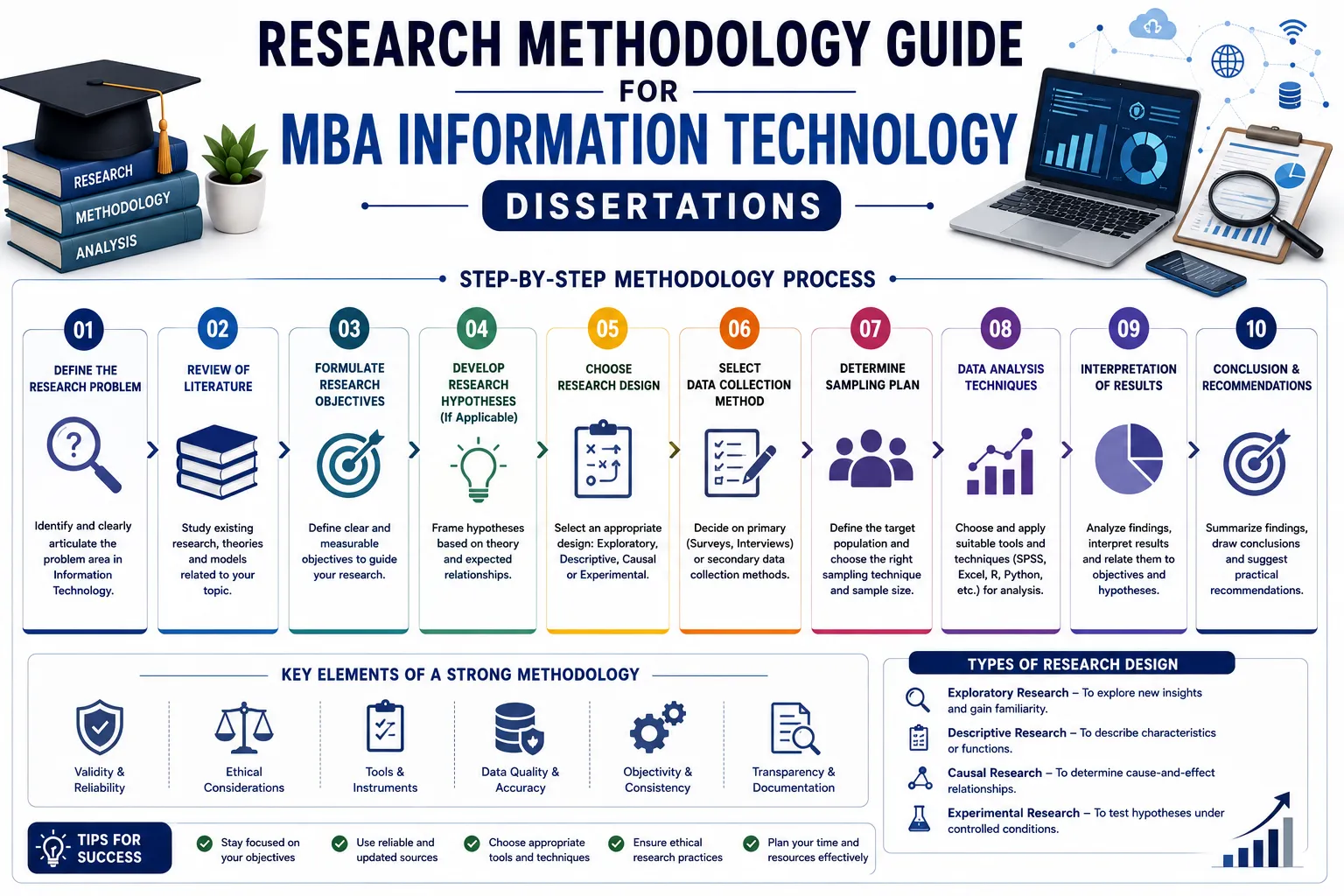
Ask any MBA scholar what stalls their dissertation the longest, and most will say the same thing: Chapter 3. Research methodology is where a good topic either becomes a defensible piece of research or falls apart under a guide's first round of questions — "why this sample size," "why survey and not interviews," "how will you actually analyze this data."
This guide walks through a research methodology guide for MBA information technology dissertations the way an experienced research supervisor would — step by step, without the jargon that makes Chapter 3 feel harder than it needs to be. If you're a first-time PhD or MBA thesis writer without a strong research background, this is written specifically for you.
At ThesisLikho, our PhD-qualified mentors have guided more than 10,000 scholars through methodology design, data collection planning, and analysis strategy across MBA, PhD, and other research programmes. What follows draws on that mentoring experience, grounded in established academic writing guidance (Purdue OWL, Google Scholar-indexed methodology literature) and shaped specifically for IT-focused MBA dissertations in the Indian academic context.
1. Why Methodology Is the Chapter Guides Scrutinize Most
The literature review chapter shows you've read the field. The methodology chapter shows you actually know how to do research — and it's the chapter most likely to trigger a synopsis-defense objection. A topic can be excellent and still get sent back if the methodology doesn't logically follow from the research questions, if the sample size has no justification, or if the analysis method doesn't match the data type being collected.
This is exactly why guides scrutinize this chapter closely: it's the technical proof that your study is executable, not just interesting. Getting it right early saves you the far more painful experience of redesigning your data collection plan after fieldwork has already started.
A useful way to think about it: your literature review earns you the right to ask a question, and your methodology chapter earns you the right to answer it credibly. If the two don't connect — if your research questions imply a "why" answer but your design only measures "how much" — that mismatch is usually the first thing an experienced guide notices, often before reading a single data point.
2. What a Research Methodology Chapter Actually Needs to Contain
A standard MBA dissertation methodology chapter, following widely used academic guidance for structuring the methods section of a research paper, typically covers: the overall methodological approach and why it fits your research problem, the research design (descriptive, exploratory, or explanatory), the population and sampling strategy, the data collection instrument and procedure, the data analysis plan, and a statement on validity, reliability, and ethical considerations (Source: Purdue OWL; academic methodology-writing guidance widely referenced across university research guides).
For an IT-focused MBA dissertation specifically, this chapter also needs to explicitly justify why your chosen method can actually answer a managerial question about the technology — not just describe how the technology works. A chapter that spends three pages explaining what cloud computing is, and half a page on your actual research design, has its priorities backwards.
3. Qualitative, Quantitative, or Mixed Methods: Choosing for an IT Dissertation
This is usually the first fork in the road, and it should be decided by your research question — not by which method feels easier.
Quantitative methods suit questions asking "how much," "how many," or "is there a statistically significant relationship between X and Y" — for example, measuring the relationship between AI adoption maturity and decision-making speed across a sample of firms. Quantitative approaches are strong for testing established models (like TAM or UTAUT) against survey data, and they produce results that are easier to generalize if your sample is representative.
Qualitative methods suit questions asking "how" or "why" something happens — for example, understanding how leadership support shapes digital transformation outcomes inside a single organization. Interviews, focus groups, and case studies fall here, and they're often more feasible for MBA scholars working with limited organizational access, since depth matters more than sample size.
Mixed methods combine both, often used when a qualitative phase (interviews) helps you build or refine a survey instrument used in a subsequent quantitative phase, or vice versa — a design researchers commonly call an exploratory or explanatory sequential design (Source: methodology literature indexed via Google Scholar, e.g., Creswell's mixed-methods design typology, widely cited in dissertation methodology chapters).
One important reminder that resurfaces constantly in academic writing guidance: don't avoid a quantitative approach purely because statistics feel intimidating, and don't default to qualitative work purely to avoid running a regression — the method should follow the question (Source: Purdue OWL/academic writing guidance on methodology selection).
4. Research Design Options for MBA IT Topics
Once you've picked qualitative, quantitative, or mixed, you still need a specific design:
- Descriptive research design — useful when your goal is to describe current adoption patterns, perceptions, or practices (e.g., "the current state of cybersecurity awareness among mid-level IT managers"). Common in early-stage or exploratory MBA topics.
- Exploratory research design — useful when the research area is genuinely under-studied (e.g., a newly emerging technology adoption pattern) and you're building understanding rather than testing a hypothesis.
- Explanatory (causal) research design — useful when you want to test relationships between variables (e.g., "does IT governance maturity predict project success rates"). This typically pairs with quantitative methods and inferential statistics.
- Case study design — extremely common and practical for MBA IT dissertations because it allows deep, organization-specific analysis within a single semester's timeline, matching the common academic guidance that MBA dissertations should be organization-specific rather than broad macro-level studies.
- Comparative design — useful when contrasting two organizations, sectors, or technology adoption approaches (e.g., comparing cloud migration outcomes across two mid-sized firms).
5. Sampling Techniques and Sample Size Reasoning
Sampling is one of the most common places methodology chapters lose marks — usually because the sample size is stated without justification, or the sampling technique doesn't match the research design.
- Probability sampling (simple random, stratified, systematic) is appropriate when you want statistically generalizable results and have access to a complete sampling frame — realistic when your organization can share a full employee list or customer database.
- Non-probability sampling (purposive, convenience, snowball) is far more common in MBA dissertations, since access is usually limited to one organization or a specific professional network. Purposive sampling — deliberately selecting IT managers, project leads, or specific department heads — is typically the strongest choice for case-study or interview-based work, because it directly targets people who can actually answer your research question.
- Sample size justification doesn't need to be a formal power calculation for most MBA dissertations, but it does need a stated rationale: for surveys, referencing similar published studies' sample sizes is a reasonable justification; for qualitative interviews, reaching "data saturation" — the point where additional interviews stop producing new themes — is the standard justification used in qualitative methodology literature.
Whatever you choose, state it explicitly in the chapter rather than leaving your guide to infer it — a stated rationale, even a short one, is far stronger than a bare number.
6. Data Collection Methods for IT-Focused Business Research
Common instruments for MBA IT dissertations include:
- Structured surveys/questionnaires — best for quantitative studies testing established models (TAM, UTAUT) on user adoption, perception, or satisfaction; typically using Likert-scale items adapted from validated prior instruments rather than newly invented ones.
- Semi-structured interviews — best for understanding "how" and "why" questions with IT leaders, project managers, or department heads; allows follow-up probing that a survey can't.
- Case study document analysis — useful when internal reports, implementation logs, or policy documents are accessible (e.g., ERP implementation records, IT governance policy documents).
- Secondary data analysis — using existing organizational data (system usage logs, help-desk ticket data, financial performance data tied to IT investment) where primary collection isn't feasible within your timeline.
- Focus groups — less common in MBA IT dissertations but useful when exploring shared perceptions across a small, accessible team (e.g., a specific IT department navigating a transformation).
Whichever instrument you choose, pilot-test it with two or three respondents before full rollout — this single step catches confusing wording or irrelevant questions before they cost you real fieldwork time.
A few practical notes worth building into your data collection plan from the start:
- Digital distribution matters for IT dissertations specifically. Since your respondent pool is often IT-literate, tools like Google Forms or Microsoft Forms are usually acceptable and speed up both distribution and initial data cleaning, provided your university doesn't mandate a specific platform.
- Keep the instrument length realistic. A 25–30 item survey completed in under ten minutes gets meaningfully higher response rates than a 60-item questionnaire, especially when your respondents are busy IT managers or project leads.
- Record interviews with consent wherever possible rather than relying on notes alone — verbatim transcripts make thematic analysis far more accurate and defensible during your viva.
- Keep a data collection log. Noting who was contacted, when, and their response status isn't just administrative housekeeping — it becomes useful evidence of your data collection rigor if a guide asks about response rates or non-response bias.
7. Choosing the Right Theoretical Model (TAM, UTAUT, RBV, COBIT)
Anchoring your methodology to an established theoretical model does two things: it gives your data collection instrument a validated structure to build from, and it signals to your guide that your analysis isn't ad hoc.
- Technology Acceptance Model (TAM) — well suited to studies on individual user adoption of a specific technology (e.g., employee acceptance of a new CRM or AI tool), built around perceived usefulness and perceived ease of use.
- Unified Theory of Acceptance and Use of Technology (UTAUT) — an extension of TAM incorporating performance expectancy, effort expectancy, social influence, and facilitating conditions; useful for more nuanced adoption studies, particularly across different user groups.
- Resource-Based View (RBV) — useful for dissertations examining whether IT capability itself functions as a source of competitive advantage (e.g., data analytics capability and firm performance).
- COBIT (Control Objectives for Information and Related Technologies) — the reference framework for IT governance research, useful for dissertations examining governance maturity, IT-business alignment, or risk management structure.
Pick one model rather than trying to combine three — a single, well-applied framework produces a cleaner, more defensible chapter than an ambitious hybrid that's hard to operationalize within an MBA timeline.
8. Data Analysis Approaches by Method Type
- For quantitative survey data: descriptive statistics (means, frequencies) to summarize the sample, followed by inferential statistics — correlation, regression, or t-tests/ANOVA depending on your hypotheses — using tools like SPSS or Excel, both widely accessible to MBA scholars.
- For qualitative interview/case study data: thematic analysis is the most common and approachable method for first-time researchers — reading transcripts, coding recurring ideas, and grouping them into themes that directly answer your research questions.
- For mixed-methods designs: analyze each phase according to its own method (thematic analysis for qualitative, statistical analysis for quantitative), then explicitly connect the two in your discussion — this integration step is often skipped and is exactly what separates a strong mixed-methods chapter from two disconnected mini-studies stapled together.
- For case study designs: pattern-matching against your theoretical framework — showing how the organizational evidence aligns with, or departs from, what the chosen model (TAM, UTAUT, RBV, COBIT) would predict.
On tools: SPSS remains the most widely taught statistical package in Indian B-schools and is a safe default for regression, correlation, and ANOVA work; Excel's data analysis toolpak is a reasonable substitute for simpler descriptive and correlation work if SPSS access is limited. For qualitative thematic analysis, manual coding in a spreadsheet is entirely acceptable for MBA-level dissertations — software like NVivo is useful but not mandatory unless your university specifically requires it. Choose the simplest tool that gets the analysis done correctly rather than the most sophisticated one you can find; a guide evaluates the reasoning in your analysis, not the software brand behind it.
9. Validity, Reliability, and Ethical Considerations
Every methodology chapter needs a short section addressing these, even if briefly:
- Validity — does your instrument actually measure what it claims to measure? For adapted survey items, note that they're drawn from previously validated instruments rather than newly created ones, which strengthens your validity argument.
- Reliability — would your instrument produce consistent results if repeated? For quantitative surveys, reporting an internal consistency measure like Cronbach's alpha (where feasible) is standard practice.
- Ethical considerations — informed consent from respondents, anonymity or confidentiality of organizational data, and, where your university requires it, formal ethics committee or institutional review clearance before data collection begins. Even for a business dissertation without medical/clinical stakes, stating your consent and confidentiality procedure signals research maturity to your guide.
In practice, this section doesn't need to be long, but it does need to be specific. Rather than a generic line like "ethical guidelines were followed," state exactly what you did: a consent statement shared before each interview or survey, an assurance that organizational names would be anonymized or coded in the final report, and confirmation that no personally identifiable respondent data would appear in the appendix. Guides and external examiners notice the difference between a genuine procedure and a placeholder sentence.
10. Step-by-Step Guide to Writing Your Methodology Chapter
- Restate your research questions/objectives at the top of the chapter so the methodology reads as a direct response to them.
- State your overall research philosophy and approach (qualitative/quantitative/mixed) with a one-paragraph justification tied to your research questions.
- Specify your research design (descriptive, exploratory, explanatory, case study, or comparative).
- Describe your population and sampling technique, with a stated rationale for your sample size.
- Detail your data collection instrument, including whether it's adapted from a validated source, and your data collection procedure/timeline.
- Explain your planned data analysis method, matched explicitly to your data type.
- Address validity, reliability, and ethical considerations in a short closing section.
- Cross-check that every method chosen here is something you can realistically execute within your remaining dissertation timeline — this step catches over-ambitious designs before they become a Year-2 problem.
11. Common Mistakes First-Time Writers Make
- Choosing a method because it "sounds academic" rather than because it fits the research question — a chapter built around jargon rather than justification is easy for a guide to spot.
- Listing a sample size with no reasoning — even a short justification is far stronger than a bare number.
- Mismatching analysis to data type — running correlation analysis on qualitative interview data, or thematic coding on numeric survey responses, is a common structural error that undermines the whole chapter.
- Skipping the pilot test — a poorly worded survey item discovered mid-fieldwork wastes time you don't have.
- Forgetting to justify the theoretical model — simply naming TAM or COBIT without explaining why it fits your specific research question weakens the chapter's logic.
- Treating validity/reliability as a formality — a two-line throwaway paragraph here is a common, easily fixed gap that guides frequently flag.
- Not aligning the methodology with actual data access — designing a 200-respondent survey when you only have access to 40 employees is a feasibility problem that should have been caught during topic selection, not methodology writing.
12. Two Realistic Case Studies
Case Study 1 — Choosing Mixed Methods for an AI Adoption Study An MBA scholar researching AI-driven customer service chatbots initially planned a purely quantitative survey but realized, after an early literature review, that employee perceptions of AI trust varied significantly by role and weren't well captured by existing survey items. The scholar redesigned the methodology as an exploratory sequential mixed-methods study: five semi-structured interviews with customer service team leads first, used to refine survey items, followed by a structured UTAUT-based survey across a larger employee sample. This sequencing — qualitative first, quantitative second — directly addressed a gap the scholar found in the initial literature review rather than forcing a single method onto a two-part question.
Case Study 2 — Building a Defensible Case Study Around Limited Access A first-time MBA thesis writer with placement access to a single mid-sized IT services firm chose a case study design over a multi-organization survey, recognizing that a broader quantitative study wasn't feasible within the fieldwork window. The scholar used document analysis of internal ERP implementation logs alongside eight semi-structured interviews with project team members, analyzed through pattern-matching against a COBIT-based governance framework. Because the design matched the actual access available, the scholar avoided the most common failure point in IT dissertations — a methodology that looks impressive on paper but can't be executed with the data at hand.
If your methodology chapter feels stuck at any of these decision points, our MBA Thesis Assistance service can help you match your research questions to a feasible, defensible design before you present it to your guide.
FAQs
What is a research methodology guide for MBA information technology dissertations?
It's a structured approach to designing Chapter 3 of an IT-focused MBA dissertation — covering the choice between qualitative, quantitative, or mixed methods, research design, sampling, data collection instruments, and analysis techniques, all justified against your specific research questions.
Why does research methodology matter this much for an MBA thesis?
Because it's the technical proof that your study is executable. A well-designed topic can still be rejected at the synopsis stage if the methodology doesn't logically follow from the research questions or if the sample size and analysis plan aren't justified.
How does this approach affect an MBA thesis in practice?
Scholars who match their methodology explicitly to their research questions and actual data access typically face fewer guide revisions, smoother fieldwork, and a data analysis chapter that flows naturally from a well-justified design.
How long does it take to complete an MBA thesis using this approach?
Most Indian MBA dissertations run within a single semester (commonly the fourth), and a well-designed, feasibility-checked methodology chapter meaningfully reduces the time typically lost to redesigning data collection mid-fieldwork.
Is professional help available for research methodology guide for MBA information technology dissertations?
Yes — methodology design support, including matching your research questions to a feasible method, sampling plan, and analysis strategy, is available through services such as MBA Thesis Assistance.
Ready to design a methodology your guide will approve on the first try? Get Free MBA Thesis Consultation with ThesisLikho's PhD-qualified mentors.