
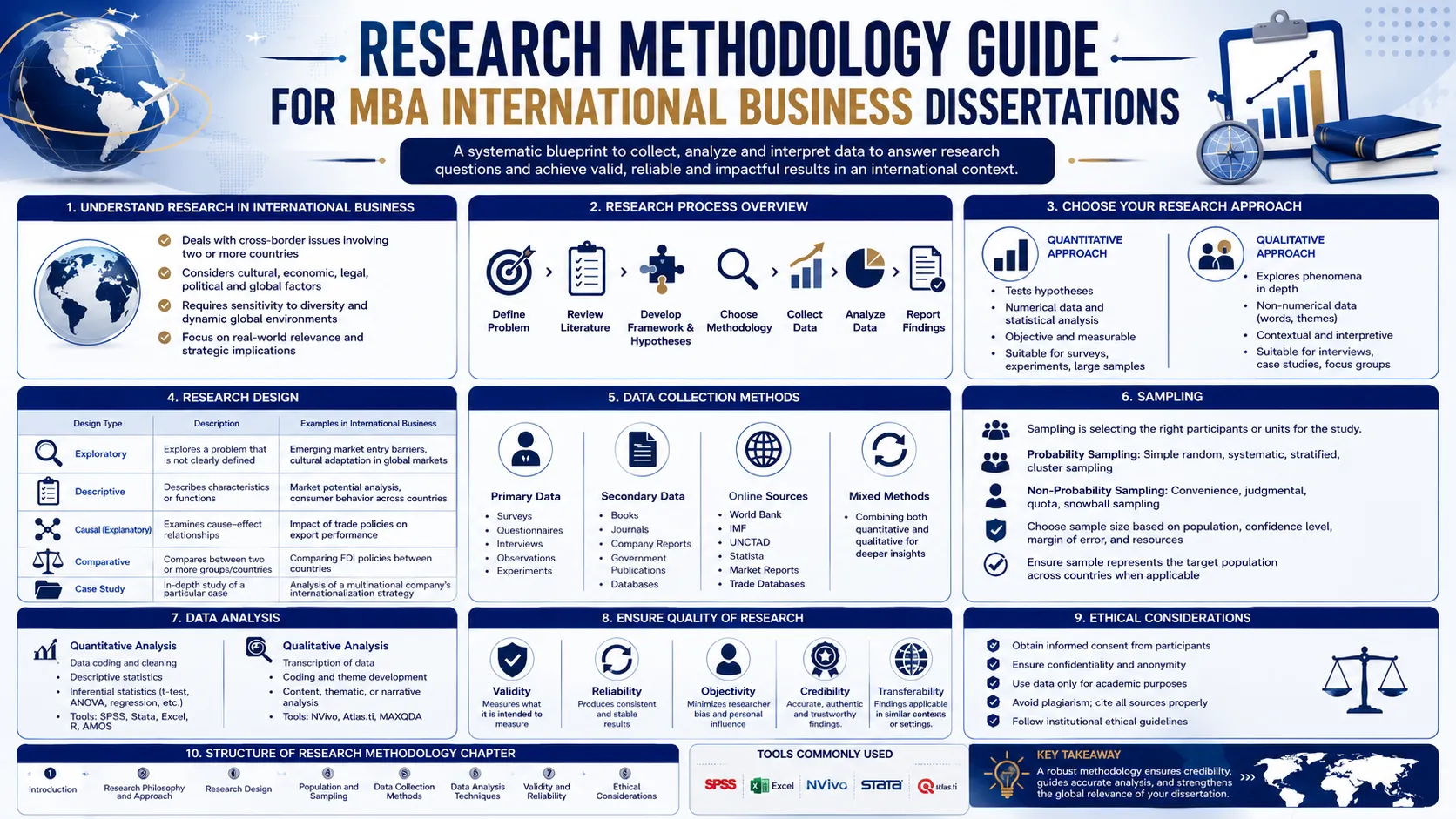
International business research carries a methodological challenge most other MBA specializations don't face head-on: comparing data, behavior, or attitudes across countries and cultures that may not mean the same thing in every context. A survey item that reads clearly in English might carry different connotations once translated into Mandarin or Portuguese. A "high-performing team" in one national business culture might look completely different from one in another. This guide walks through how to design a research methodology for an MBA international business dissertation that accounts for these challenges properly, rather than assuming cross-national comparisons are as straightforward as single-country research.
Why Cross-Cultural Methodology Needs Special Attention
Data equivalence refers to the extent to which the elements of your research design carry the same meaning and can be applied the same way across different cultural contexts. Failure to establish data equivalence in cross-cultural studies can quietly bias findings and undermine the entire comparison your study is built around — even if every individual step of your data collection and analysis looks methodologically sound on its own. This is the central methodological concern that distinguishes international business research from single-market MBA dissertations, and it needs to be addressed explicitly and early, not treated as a minor footnote.
Step 1: Decide Whether Your Study Is Genuinely Comparative
Before designing anything further, be clear about whether your research is comparing something across countries or cultures (a genuinely comparative design) or studying an international business phenomenon within a single context (which doesn't carry the same cross-cultural equivalence burden). Comparative cross-cultural business research is inherently comparative in nature, and most such studies employ quantitative methods of data collection and analysis — though qualitative comparative methodologies also have an established tradition, particularly for cultural and contextual topics that don't reduce well to numerical comparison.
Step 2: Choose Your Overall Methodological Approach
Common approaches used across MBA international business dissertations include:
- Comparative case study analysis — for example, comparing market entry strategies used by firms across two or more emerging economies
- Quantitative analysis of macroeconomic relationships — for example, examining the relationship between currency fluctuations and foreign direct investment flows
- Qualitative research into cross-border management phenomena — for example, studying leadership styles in cross-border business teams or the role of cultural intelligence in expatriate management effectiveness
Match your approach to your specific research question rather than defaulting to whichever method feels most familiar — a question about cultural adaptation in leadership style calls for a genuinely different design than a question about the statistical relationship between trade agreements and export competitiveness.
Step 3: Understand the Types of Equivalence You Need to Address
Equivalence in cross-cultural research breaks down into several distinct types, each addressing a different way bias can enter a cross-national comparison:
- Linguistic equivalence — does your instrument mean the same thing once translated into different languages?
- Structural equivalence — does the underlying construct you're measuring have the same structure and meaning across cultures?
- Measurement unit equivalence — do your measurement scales function consistently across different cultural groups?
- Full-score equivalence — can scores be directly compared numerically across cultural groups, or only interpreted relatively within each group?
You don't need to achieve all four types for every study, but you do need to explicitly state which types are relevant to your specific design and how you addressed them.
Step 4: Handle Translation Properly if Working Across Languages
If your data collection instrument needs to be used in more than one language, test translation commonly relies on back-translation — translating your instrument into the target language, then having a separate, independent translator translate it back into the original language to check for consistency and catch meaning that's been lost or distorted. Committee-based translation designs, where multiple bilingual reviewers collaboratively refine the translation, are another recognized approach.
It's worth noting that recent international business methodology scholarship pushes back against treating translation as simple, mechanical word-for-word equivalence. Word-for-word accuracy doesn't guarantee that a construct is understood the same way across cultural contexts — a more contextualized view treats translation as a process of intercultural interaction, not just lexical transfer. In practice, this means your methodology chapter should describe not just that you back-translated your instrument, but how you checked that the underlying concepts, not just the words, carried across cultures intact.
Step 5: Match Your Samples Deliberately
A specific methodological pitfall flagged repeatedly in international business research is what's been called the "stampede toward Hofstede's framework" — researchers applying Hofstede's cultural dimensions without adequately considering sample design. Using unmatched or poorly matched national samples undermines the validity of any cross-national comparison built on this kind of framework.
The practical standard: match your samples on relevant demographic and contextual criteria — age range, institutional type, occupational level, organizational size — as closely as possible across the countries or cultural groups in your study. True comparability is genuinely difficult to achieve without deliberately matched samples, and stating explicitly how you matched (or attempted to match) your samples strengthens your methodology chapter considerably.
Step 6: Consider Measurement Invariance Testing for Quantitative Designs
If you're using a quantitative survey instrument to compare data across countries — particularly with structural equation modeling (SEM) or partial least squares (PLS) path modeling — measurement invariance testing is an increasingly expected step. This tests whether your instrument measures the same underlying construct the same way across the different groups or countries in your sample, rather than assuming this is automatically true because you used the same questionnaire everywhere.
Step 7: Decide How You'll Use Secondary Cross-National Data
Given the practical difficulty of collecting large-scale primary data across multiple countries within a typical MBA thesis timeline, many international business dissertations draw on secondary cross-national datasets alongside (or instead of) primary data collection — trade flow statistics, foreign direct investment data, and indicators from sources like the World Bank or UNCTAD. If your design relies on secondary data, be explicit in your methodology about the source, time period, and any known limitations of the dataset, just as you would for primary data.
Step 8: State Your Equivalence Strategy Explicitly in Your Methodology Chapter
Don't leave equivalence considerations implicit. Your methodology chapter should explicitly state: which types of equivalence are relevant to your design, how you approached translation if applicable, how (or whether) you matched your samples, and whether you conducted measurement invariance testing. Committees evaluating international business dissertations specifically look for this kind of explicit methodological awareness — its absence is one of the more common weaknesses flagged in cross-cultural MBA research.
Practical Checklist: Is Your International Business Methodology Ready?
- Study is clearly identified as comparative (cross-national/cross-cultural) or single-context
- Overall methodological approach (comparative case study, quantitative macro analysis, qualitative cross-border research) matches the specific research question
- Relevant types of equivalence (linguistic, structural, measurement unit, full-score) are identified and addressed
- Translation approach (back-translation or committee design) is described, if applicable
- Samples across countries/cultures are matched on relevant demographic and contextual criteria
- Measurement invariance testing is planned or conducted for cross-national quantitative comparisons using SEM/PLS
- Secondary cross-national data sources are named with time period and known limitations disclosed
- Equivalence strategy is stated explicitly in the methodology chapter, not left implicit
Two Practical Scenarios
Scenario 1 — Addressing Translation Properly in a Cross-National Survey
A scholar studying consumer trust in cross-border e-commerce platforms needed to survey respondents in both India and Germany. Rather than simply translating the questionnaire into German and distributing it, the scholar used back-translation with two independent translators, then held a review session comparing the German and English versions specifically for conceptual — not just linguistic — equivalence, catching one item where a common English business term had no direct cultural equivalent in German respondents' typical vocabulary. Documenting this process in the methodology chapter directly addressed a concern the committee had raised in an earlier proposal review.
Scenario 2 — Matching Samples for a Cross-Cultural Leadership Study
A scholar comparing leadership styles across cross-border business teams in two countries initially planned to survey any available managers in each location. After reviewing methodological guidance on the risks of unmatched samples, the scholar instead restricted the sample to managers with comparable seniority levels, similar organizational size, and comparable industry sector in both countries — a deliberate matching strategy that strengthened the validity of the eventual cross-national comparison and was explicitly justified in the methodology chapter.
Common Mistakes MBA International Business Dissertation Writers Make
- Treating translation as a simple mechanical task rather than checking for genuine conceptual equivalence across languages.
- Applying Hofstede's or similar cultural frameworks without addressing sample matching, undermining the validity of the resulting comparison.
- Leaving equivalence considerations implicit, rather than explicitly stating which types of equivalence apply and how they were addressed.
- Skipping measurement invariance testing in cross-national quantitative designs using SEM or PLS, despite comparing scores across countries as if the instrument functioned identically everywhere.
- Using secondary cross-national data without disclosing its limitations, such as inconsistent reporting standards or missing years across different countries' datasets.
Frequently Asked Questions
What is a research methodology guide for MBA international business dissertations?
It's a structured framework for designing cross-national or cross-cultural business research, addressing the specific methodological challenges — data equivalence, translation, sample matching, and measurement invariance — that arise when comparing data, behavior, or attitudes across different countries or cultures.
Why does research methodology guide for MBA international business dissertations matter?
Cross-cultural research carries unique risks of bias that single-country research doesn't face; a methodology that doesn't explicitly address equivalence, translation, and sample matching can produce comparisons that look valid on the surface but are actually undermined by unaddressed cultural or linguistic bias.
How does research methodology affect an MBA thesis in international business specifically?
Since the core value of international business research often lies in its comparative claims, a methodology that fails to establish genuine equivalence across the compared groups weakens the central contribution of the entire dissertation, regardless of how sophisticated the surrounding analysis is.
How long does it take to complete an MBA thesis using this approach?
Cross-national primary data collection typically takes longer than single-country research due to translation, sample matching, and coordination across locations — many scholars mitigate this by combining secondary cross-national datasets with a smaller-scale primary data component.
Is professional help available for research methodology guide for MBA international business dissertations?
Yes. ThesisLikho's PhD-qualified experts have guided 10,000+ scholars through cross-cultural research design, data equivalence planning, and complete MBA thesis writing assistance tailored to international business and other specializations.
Get Expert Guidance on Your MBA International Business Methodology
Designing a cross-cultural research methodology that genuinely holds up to scrutiny takes careful attention to equivalence, translation, and sample matching — details that are easy to overlook but heavily weighted by committees evaluating comparative research. If you'd like expert input on strengthening your international business dissertation's methodology, ThesisLikho's PhD-qualified team offers cross-cultural research design support, data equivalence guidance, and complete MBA thesis writing assistance. If you need expert guidance with your methodology chapter, data collection design, or overall thesis structure, you can explore our MBA Thesis Assistance service.
Get Free MBA Thesis Consultation → https://thesislikho.com/writing-services/thesis-assistance-mba