
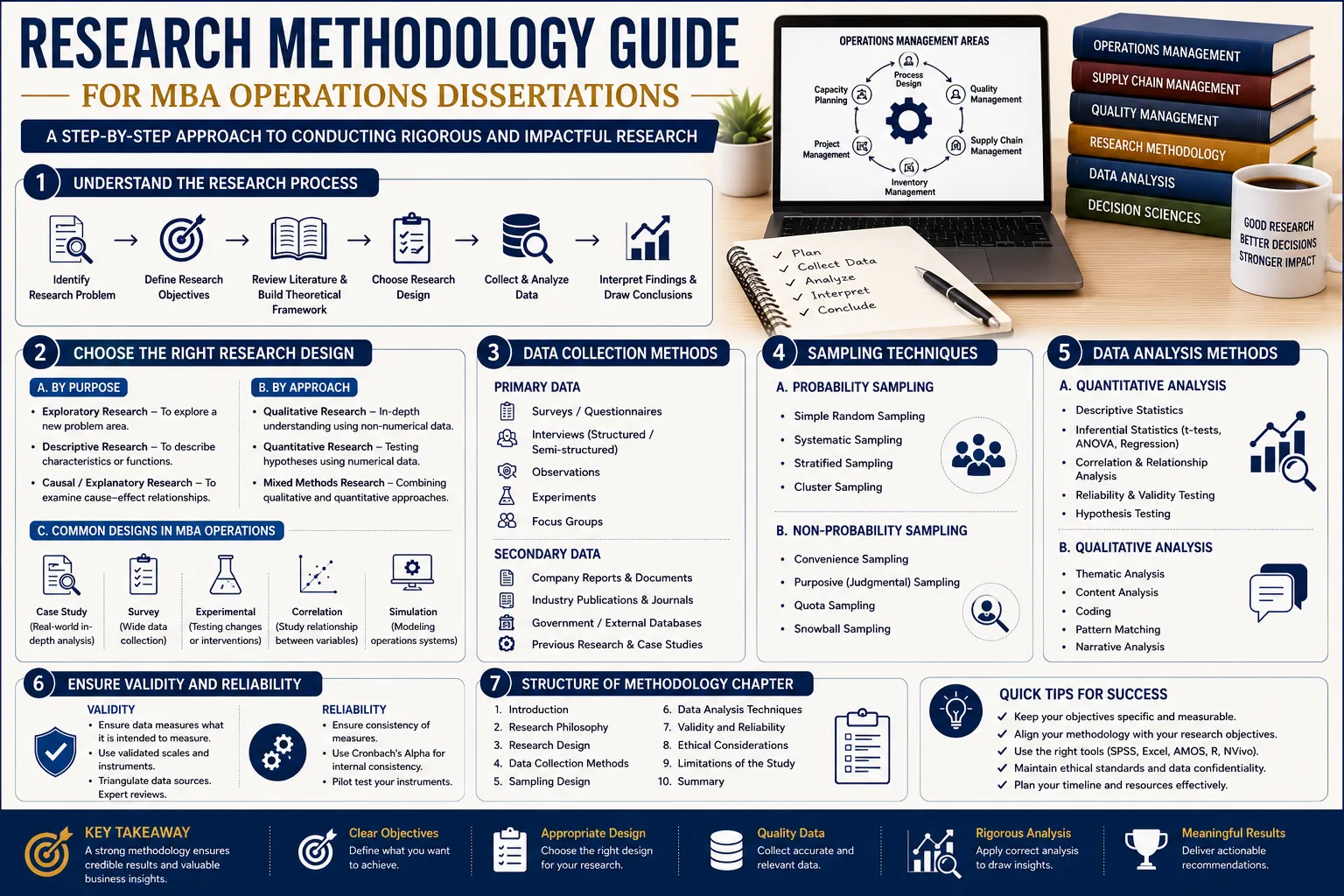
If you're staring at Chapter 3 of your MBA operations dissertation wondering whether you need a full PhD-style methodology or something simpler, here's the short answer: MBA operations research is meant to be applied, practical, and grounded in a real business problem — not a multi-year academic exercise. This research methodology guide for MBA operations dissertations walks through exactly what that means in practice: how to pick a research design that fits a one-semester timeline, how to use tools like case studies, Lean Six Sigma, and process simulation the way operations scholars actually use them, and how to avoid the methodology mistakes that cost MBA students marks at the viva or final defence.
This guide covers research philosophy through to data analysis, with operations-specific examples and real dissertation scenarios throughout. We've grounded this in current 2026 operations management research patterns and the guidance we give MBA scholars ThesisLikho supports through their dissertation methodology chapter.
What Makes MBA Operations Methodology Different
An MBA operations dissertation methodology differs from a PhD methodology in three important ways: scope, timeline, and purpose. Where a PhD thesis typically unfolds over three to five years and aims to make an original theoretical contribution to the field, an MBA dissertation is usually completed within a single semester or over three to six months, and its primary purpose is to demonstrate that you can apply operations management concepts to solve or analyze a real business problem — often within your own organization, a company you have access to, or an industry you're targeting for your post-MBA career.
This doesn't mean methodological rigor doesn't matter — it absolutely does, and weak methodology is still one of the most common reasons MBA dissertations get sent back for revision. It means your methodology should be right-sized: a case study of one manufacturing plant's inventory practices with a clear, well-justified approach will usually serve an MBA dissertation better than an ambitious multi-site quantitative study you don't have the time or resources to execute properly.
Research Philosophy for Operations Dissertations
Operations management research tends to lean pragmatic more than most other management sub-fields, because the underlying goal is usually solving a concrete operational problem rather than testing abstract theory for its own sake. That said, the same three broad philosophical positions apply:
A positivist stance fits well if you're measuring something quantifiable — defect rates, cycle times, inventory turnover, on-time delivery percentages — and want generalizable, statistically supported conclusions. An interpretivist stance fits better if you're exploring how managers or shop-floor employees experience and make sense of an operational change, such as a new quality system or a supply chain restructuring. A pragmatist stance, combining both, is common in operations dissertations that both measure an outcome (say, defect reduction) and explore the human factors behind why an intervention succeeded or struggled.
For most MBA operations dissertations working with a single company case, pragmatism is often the most natural fit, since real operational problems rarely separate cleanly into pure numbers or pure narrative — you'll usually need both a measurable outcome and an understanding of the process changes that produced it.
Choosing Your Research Approach
A deductive approach — starting from existing operations theory (Lean, Six Sigma, the SCOR model, Theory of Constraints) and testing whether it explains what you observe in your case organization — is the most common choice for MBA operations dissertations, since it gives you a clear theoretical anchor and a straightforward way to structure your analysis and conclusions.
An inductive approach — starting from close observation of an operational process and building insight from what you find, without a predefined theoretical framework — suits dissertations exploring a genuinely novel or under-studied operational context, such as a small business adapting operations informally without any formal management system in place.
Most MBA supervisors expect a deductive or lightly abductive approach, since it demonstrates that you can apply established operations frameworks correctly — a core MBA-level competency — rather than attempting to generate new theory, which is more appropriately a PhD-level goal.
Research Design Options for Operations Topics
Three research designs cover the large majority of MBA operations dissertations:
A case study design examines one organization, department, or process in depth, and is by far the most common choice for MBA operations dissertations because it aligns naturally with the applied, single-company access most MBA students actually have. A cross-sectional survey design collects data from multiple respondents (managers, employees, or customers) at a single point in time, and suits topics measuring perceptions or practices across a broader population — for example, surveying supply chain managers across several companies about resilience practices. A comparative design examines two or more cases side by side — comparing operational practices between two plants, two companies, or before-and-after a specific intervention — and works well when your research question specifically involves contrast rather than depth in a single setting.
Longitudinal designs, tracking a process over an extended period, are rarely feasible within an MBA dissertation's timeline and are generally best avoided unless you already have access to historical data spanning the needed period.
The Case Study Method in Operations Research
Because case studies dominate MBA operations dissertations, it's worth understanding how to execute one properly rather than treating it as simply "writing about a company." A strong operations case study specifies clear boundaries (which department, process, or time period you're examining), triangulates multiple data sources (interviews with operations staff, company documents and process data, direct observation where possible), and explicitly connects your findings back to an operations management framework or theory rather than simply describing what you observed.
A common weakness in MBA case studies is treating them as descriptive company profiles rather than analytical investigations — the difference is whether you're evaluating the company's operations against established best practice or theory and drawing reasoned conclusions, versus simply narrating what the company does. Your methodology chapter should explicitly justify why a single-case design is appropriate for your specific research question, and acknowledge the generalizability limitations that come with studying one organization.
Survey-Based Quantitative Designs
If your research question involves measuring perceptions, practices, or relationships across multiple organizations or a larger group of respondents — for example, examining how supply chain digitalization relates to perceived resilience across mid-sized Indian manufacturers — a survey-based quantitative design is the better fit. This typically means adapting previously validated scales from the operations management literature wherever possible, distributing a structured questionnaire to a defined population (operations managers, supply chain professionals, plant staff), and analyzing the results using standard statistical techniques appropriate to your sample size and research questions.
At MBA level, survey-based studies usually stay closer to descriptive and correlational analysis (means, frequencies, correlation, basic regression) rather than the more advanced structural equation modelling common in PhD-level quantitative research — a scope decision that's entirely appropriate given the shorter dissertation timeline, as long as it's clearly justified in your methodology chapter.
Common Operations-Specific Analytical Tools
Beyond generic statistical or qualitative analysis, operations dissertations often draw on frameworks specific to the discipline:
Lean Six Sigma and the DMAIC framework (Define, Measure, Analyze, Improve, Control) provide a structured way to investigate a process improvement problem, and many MBA operations dissertations are explicitly built around walking through these five phases for a specific operational issue. The SCOR model (Supply Chain Operations Reference) offers a standardized framework for benchmarking supply chain performance across plan, source, make, deliver, and return processes, useful for dissertations comparing or evaluating supply chain practices. Data Envelopment Analysis (DEA) is a quantitative technique for measuring relative efficiency across comparable units — useful if your dissertation compares operational efficiency across multiple branches, plants, or suppliers. Discrete-event simulation models a process (such as a production line or service queue) to test the effect of proposed changes without disrupting actual operations, useful for dissertations proposing process improvements where live experimentation isn't feasible.
Choosing one of these frameworks doesn't replace the need for a clear philosophical and design justification — it sits within your broader methodology as the specific analytical lens you're applying to your chosen case, process, or dataset.
Sampling for an MBA-Scale Study
For case study designs, sampling usually refers to which interviewees, documents, or processes you select within your chosen organization — a purposive approach, selecting people and materials most relevant to your specific research question, is standard and doesn't require the large sample justifications expected in PhD-level quantitative work. Five to fifteen interviews with relevant operational staff is a common, defensible range for an MBA case study, depending on the size of the department or process you're studying.
For survey-based designs, sample size expectations are more modest than PhD-level research — MBA dissertations commonly work with response counts in the range of 30 to 100, particularly when the accessible population itself (managers at a specific type of company, for instance) is naturally limited. What matters most is that your sample is clearly defined and appropriately matched to your research question, not that it hits a specific large number — a smaller, well-justified sample from the right population is stronger than a larger, poorly targeted one.
Data Collection Sources in Operations Research
Operations dissertations typically draw on a mix of primary and secondary sources: primary data through interviews with operations managers or staff, direct process observation, or structured surveys; and secondary data through company records (production logs, inventory data, quality reports), industry reports, or published case studies and benchmarking data where direct company access is limited. Combining both is common and often strengthens a dissertation considerably — company-provided operational data grounds your analysis in real numbers, while interviews add the contextual reasoning behind what the data shows.
If you're relying on a company's internal data, secure written permission early and clarify exactly what data you'll have access to before finalizing your research design — a common and avoidable setback is designing a study around data access that turns out to be more restricted than initially assumed.
Reliability and Validity at MBA Level
For quantitative, survey-based MBA dissertations, reporting basic reliability (Cronbach's Alpha, with 0.70 as the conventional minimum acceptable threshold) for any multi-item scales you use remains good practice, even at a reduced scale compared to PhD-level rigor. For case study and qualitative work, the equivalent concepts are credibility (are your findings well-supported by your data), and dependability (is your process transparent enough that someone could follow your reasoning) — achieved through triangulating multiple data sources and being explicit about how you arrived at your conclusions, rather than through formal statistical testing.
You don't need the full depth of validity testing expected in a PhD methodology chapter, but you do need to show your supervisor that you've thought about whether your data actually supports the conclusions you're drawing — this is often exactly what separates a strong MBA dissertation from a merely descriptive one.
Structuring Your Methodology Chapter
A typical MBA operations dissertation methodology chapter runs shorter than a PhD equivalent but follows a similar logical sequence:
- Introduction and chapter overview
- Research philosophy (briefly justified, not exhaustively debated)
- Research approach
- Research design (case study, survey, or comparative)
- Population and sampling strategy
- Data collection methods and sources
- Data analysis approach and tools used
- Reliability, validity, or credibility considerations
- Ethical considerations, particularly around company confidentiality
- Limitations of the chosen methodology
- Chapter summary
Keeping each section focused and avoiding unnecessary theoretical elaboration is appropriate at MBA level — your supervisor wants to see that you understand and can justify your choices, not that you've written an exhaustive methodological treatise.
Real MBA Operations Dissertation Example
An MBA student studying inventory management inefficiencies at a mid-sized Indian auto-parts distributor built her methodology around a single-case design, combining semi-structured interviews with eight operations and warehouse staff, direct observation of two weeks of warehouse activity, and six months of the company's actual inventory turnover data. She applied the DMAIC framework to structure her analysis: defining the specific inefficiency (stockouts on fast-moving items despite adequate overall inventory), measuring current turnover and stockout frequency, analyzing root causes through her interviews and observation (poor demand forecasting communication between sales and warehouse teams), and proposing an improvement (a simple weekly forecast-sharing process) with projected impact estimated from her data. Because her methodology chapter clearly justified the case study approach, specified her data sources, and connected her analysis explicitly to an established operations framework, her committee approved the dissertation without requesting methodology revisions — a contrast to a classmate who wrote a similar topic as a purely descriptive company narrative and was asked to rebuild the analysis around a clearer framework.
Common Methodology Mistakes in MBA Operations Dissertations
- Choosing a methodology scope that doesn't fit the timeline. Proposing a multi-site quantitative study with a target of 300 survey responses when you have three months and no existing distribution list is a common and avoidable setback.
- Treating a case study as a company profile rather than an analysis. Description alone, without evaluation against a framework or theory, reads as a business report rather than a dissertation.
- Skipping a clear philosophical and approach justification, jumping straight into "I did interviews and analyzed the data" without explaining why that approach fits the research question.
- Not securing data access before finalizing the research design, then discovering mid-dissertation that the company won't share the specific data the methodology depends on.
- Applying an operations framework loosely, referencing Lean Six Sigma or SCOR by name without actually walking through its structure in the analysis.
- Overreaching on sample size ambitions relative to what an MBA-scale study realistically needs or can achieve.
- Ignoring confidentiality and ethical considerations when using real, potentially sensitive company operational data, particularly around anonymizing the organization if required.
- Weak connection between the stated research objectives and the chosen methodology, leaving a supervisor unable to see why this specific method addresses this specific question.
Methodology Submission Checklist
Before submitting your MBA operations dissertation methodology chapter, confirm you have:
- A clearly stated research philosophy, briefly justified rather than exhaustively debated
- A research approach (deductive, inductive, or pragmatist) explicitly named and justified
- A research design (case study, survey, or comparative) matched to your specific research question
- Written permission secured for any company data or access your study depends on
- A clearly defined population and sampling approach, appropriately scaled for an MBA timeline
- Data collection methods and sources specified in enough detail to be reproducible
- At least one relevant operations framework (Lean Six Sigma, SCOR, DEA, or equivalent) explicitly applied, not just referenced
- Reliability or credibility considerations addressed, appropriately scaled to your design
- Ethical considerations, especially company confidentiality, explicitly stated
- Limitations of your chosen methodology honestly acknowledged
For guidance on the broader qualitative-versus-quantitative decision that underpins much of this chapter, see our related guide, [qualitative vs quantitative research methodology: how to choose]. And once your methodology is set, our companion piece, [how to write the methodology chapter of a thesis], walks through the actual drafting process in more detail.
How Long Does It Take to Complete an MBA Thesis Using This Approach?
Most MBA operations dissertations, from finalizing the methodology to submitting the completed document, take three to six months within an overall MBA program timeline of one to two years. Designing the methodology chapter itself — including securing company data access and finalizing your research design — typically takes two to four weeks when approached systematically, though rushing this stage to save time often costs more time later if data access or scope problems surface mid-dissertation.
Is Professional Help Available for Research Methodology Guide for MBA Operations Dissertations?
Yes — many MBA students work with academic mentors or research consultancies to design a methodology that fits their specific company access and timeline, choose the right operations framework for their topic, and structure a defensible case study or survey approach. ThesisLikho's research experts have supported MBA scholars across operations, supply chain, and general management dissertations, helping ensure methodology chapters are both academically sound and realistically achievable within an MBA timeline — all while keeping the underlying research and analysis entirely your own. Explore ThesisLikho's MBA thesis assistance services for one-on-one guidance.
FAQs
What is a research methodology guide for MBA operations dissertations?
It's a structured approach to designing the methods section of an MBA operations dissertation — covering research philosophy, approach, design (typically case study or survey-based), data collection, and analysis — scaled appropriately for a one-semester to six-month MBA timeline rather than a multi-year PhD study.
How long does it take to complete an MBA thesis using this approach?
Most MBA operations dissertations take three to six months from methodology design to final submission, with the methodology chapter itself typically taking two to four weeks to design properly, including securing any needed company data access.
Is professional help available for research methodology guide for MBA operations dissertations?
Yes. Research consultancies and academic mentors, including ThesisLikho's experts, help MBA students design realistic, well-justified methodologies for operations dissertations while preserving full research originality.
Why does research methodology guide for MBA operations dissertations matter?
Because a poorly scoped or weakly justified methodology is one of the most common reasons MBA dissertations get sent back for revision — getting the design right from the start, matched to your actual timeline and data access, saves significant time and strengthens your final grade.
How does research methodology guide for MBA operations dissertations affect an MBA thesis?
Your methodology choice determines what data you can realistically collect, which operations frameworks you can meaningfully apply, and how convincingly you can defend your findings and recommendations — a well-matched methodology makes every later chapter easier to write and defend.
Ready to design a methodology that fits your MBA operations dissertation?
Get Free MBA Thesis Consultation → https://thesislikho.com/writing-services/thesis-assistance-mba