
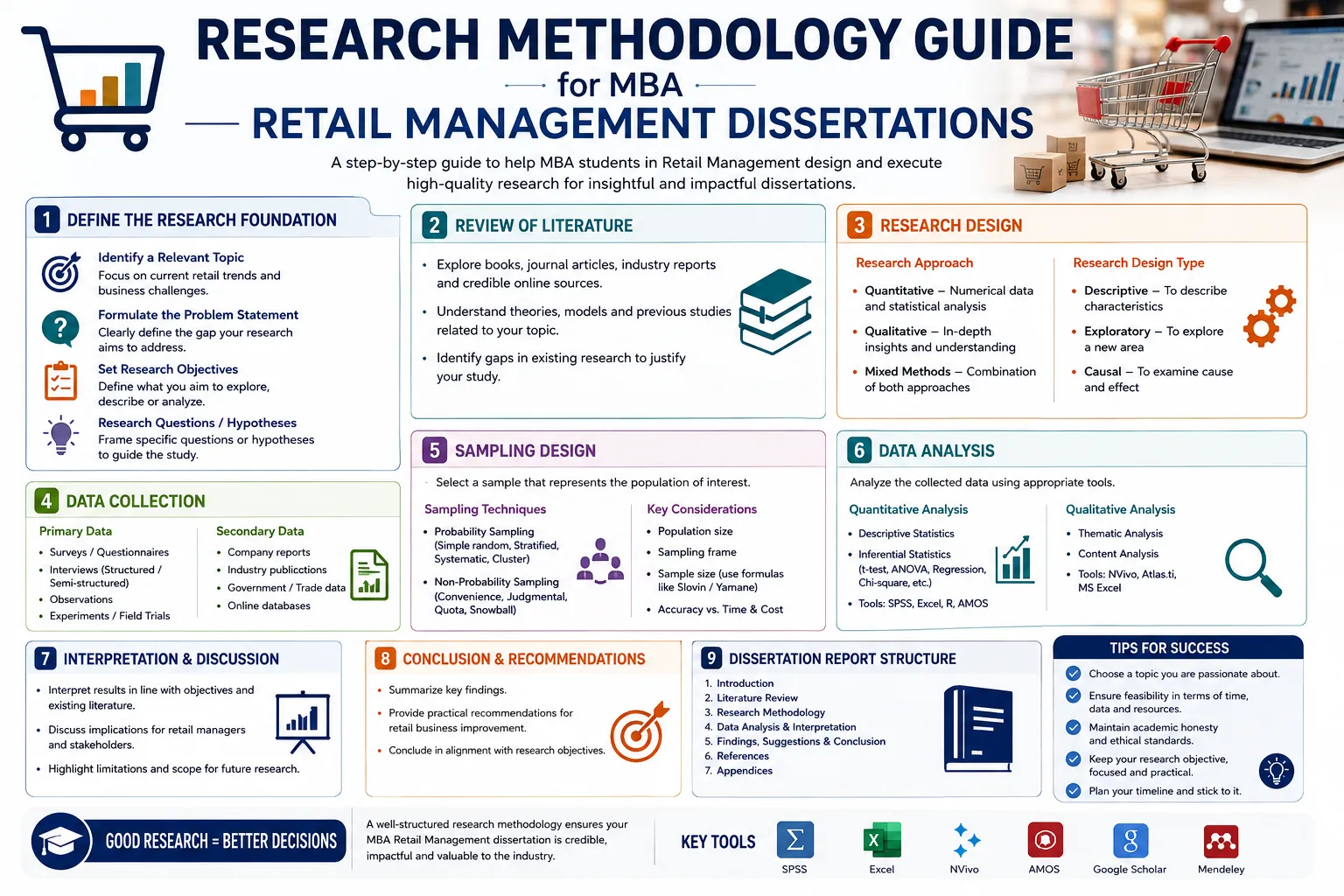
Retail management research sits in a genuinely tricky spot methodologically: you're usually trying to understand real, dynamic human purchasing behavior, but you're almost always limited to studying it indirectly, through surveys and self-report rather than direct observation of every purchase decision. This guide walks through how to design a research methodology for an MBA retail management dissertation that handles this limitation honestly and produces genuinely defensible findings.
Start With an Honest Framing of What Consumer Behavior Research Can Actually Do
Consumer behaviour research is concerned with real and social occurrences that are dynamic and difficult to interpret precisely. Methods in consumer behavior analysis generally don't aim to make precise predictions of these phenomena — instead, they seek to clarify and provide rationale for why the phenomena occur. This is worth stating explicitly in your own methodology chapter: you're not claiming your study will predict exactly how consumers will behave, but rather building a defensible explanation for observed patterns. Framing your research goals this way, rather than overpromising predictive precision, sets more appropriate and defensible expectations from the outset.
Choosing Your Data Collection Approach
Primary vs. Secondary Data
Primary data collection in retail consumer behavior research commonly draws on focus groups, surveys, and interviews, while secondary data draws on existing sources — industry reports, retailer sales data, prior published studies. Whether you use primary data, secondary data, or a combination should be justified explicitly based on your specific research question, not chosen simply because one is more convenient to access.
The Survey Method Remains Dominant — For Good Reason
The survey technique remains one of the most popular approaches in consumer behavior and retail management research, aiming to investigate the features of a target group — their behaviors, expectations, motivations, and values. Success with this method requires careful attention to three things working together as a coherent whole: sample selection, questionnaire development, and data collection design. Weakness in any one of these three undermines the credibility of the whole study, even if the other two are executed well.
Grounding Your Study in a Theoretical Framework
Extending TAM Beyond Pure Technology Contexts
The Technology Acceptance Model (TAM) has traditionally been applied within technological contexts, but recent research has demonstrated that TAM can be successfully extended to consumer goods and broader retail contexts. A 2026 study validated a conceptualised Consumer Goods Acceptance Model (CGAM), extending TAM using an exploratory research approach based on a quota sample, and found the adjusted model reliable and valid even outside a purely technological context. This is genuinely useful for MBA retail management scholars: if your research touches on any new retail offering — a new service format, a new in-store experience, a new product category — TAM-derived frameworks give you an established, credible theoretical foundation to build from, rather than starting entirely from scratch.
A Representative Quantitative Methodology Example
A representative TAM-adjacent quantitative study used PLS-SEM (Partial Least Squares Structural Equation Modeling) to analyze 352 valid questionnaires collected through an online survey, testing multiple hypothesized relationships — between subjective norm, enjoyment, perceived usefulness, perceived ease of use, attitude, and intention. This gives you both a realistic sample size benchmark and a specific, commonly used statistical technique for this kind of retail consumer research if your design involves testing multiple interrelated hypotheses simultaneously.
Scaling Your Methodology to Your Actual Resources
A Feasible Single-Retailer Study Scale
A representative smaller-scale, single-retailer case study used a structured questionnaire with 100 respondents and convenience sampling to analyze consumer behaviour toward a specific retail chain, finding that discounts, product variety, digital payment facilities, and brand trust were the major factors influencing purchase decisions. This illustrates a realistic, genuinely feasible scale for MBA-level single-retailer consumer research — you don't need thousands of respondents to produce a credible, defensible study, provided your sampling and analysis are conducted rigorously.
Know What a Larger-Scale Study Actually Requires
For context on the other end of the scale spectrum, a larger cross-national retail consumer study used snowball sampling to collect 1,717 completed survey responses across multiple recruitment channels — academic platforms, social media, personal contacts — over roughly a year of data collection. This illustrates how sampling technique and data collection duration scale considerably for more ambitious studies, well beyond typical MBA scope. Use this as a calibration point: if your proposed methodology starts to resemble this scale, it's worth honestly reassessing feasibility against your actual thesis timeline.
Consider Combining Self-Report With Behavioral Observation
Self-reported purchase intent doesn't always match actual purchase behavior — a genuine methodological limitation worth addressing directly. When feasible, methodologies combining direct behavioral observation (such as tracking actual purchase decisions during a specific retail intervention or program) with statistical analysis provide stronger evidence than self-report survey data alone. A representative example combined direct observation of an in-store sampling program with statistical techniques including ANOVA, chi-square tests, and probit regression, giving the study a behavioral evidence base beyond what respondents merely said they would do.
If observational data collection is feasible for your specific retail context, it's worth strongly considering as a complement to (not necessarily a replacement for) survey-based self-report.
Be Explicit About Which Retail Sub-Area Your Study Addresses
Retail management as a discipline spans marketing strategies, consumer behaviour, supply chain management, e-commerce, and customer experience. A genuinely well-scoped MBA retail management methodology should be explicit about which of these specific sub-areas your research question addresses, since methodological conventions and expectations differ meaningfully across them — a supply chain-focused retail study calls for different methods than a consumer psychology-focused one, even though both fall under the broad "retail management" umbrella.
Acknowledge the Limitations of Cross-Sectional Design
Cross-sectional survey data collection — a single point-in-time snapshot — is the most common design for retail consumer behavior research given practical feasibility constraints within a thesis timeline. But this design carries genuine limitations worth acknowledging explicitly in your methodology chapter: cross-sectional data assumes consumers already have existing knowledge of the product or service being studied, and can force responses based on assumptions rather than genuine lived experience. This limitation is particularly relevant if you're studying attitudes toward emerging retail technologies or services many respondents may have limited direct experience with — state this limitation directly rather than presenting your cross-sectional findings as if they capture something more longitudinal or experientially grounded than they actually do.
Practical Checklist: Is Your Retail Management Methodology Ready?
- Research framed honestly as explanatory rather than precisely predictive of consumer behavior
- Primary vs. secondary data choice (or combination) explicitly justified against the specific research question
- Specific retail sub-area (marketing, consumer behavior, supply chain, e-commerce, customer experience) clearly identified
- Theoretical framework (such as TAM or an extended model like CGAM) named and justified, if applicable
- Sample size and sampling technique scaled realistically to available time and resources
- Statistical analysis technique matches the study's design (e.g., PLS-SEM for multi-hypothesis models)
- Behavioral observation considered as a complement to self-report, where feasible
- Cross-sectional design limitations explicitly acknowledged, particularly for emerging or unfamiliar retail offerings
Two Practical Scenarios
Scenario 1 — Applying an Extended TAM Framework to a New Retail Service A scholar studying consumer adoption of a new same-day delivery subscription service initially struggled to find a directly applicable theoretical framework, since TAM's traditional application focused on pure technology adoption. After reviewing research extending TAM to consumer goods contexts, the scholar adapted a similar extended framework, treating the subscription service as the object of adoption rather than a technology per se, and used it to structure hypotheses around perceived usefulness and ease of use specific to the service — giving the study a credible, established theoretical foundation rather than an ad-hoc framework built from scratch.
Scenario 2 — Scaling Methodology to Match Realistic Resources A scholar initially planned a cross-national retail consumer study modeled on a large published example using snowball sampling across multiple countries and platforms. After honestly comparing this design against their actual thesis timeline and resources, the scholar scaled the study down to a single-retailer, single-city design using convenience sampling with a target of 120 respondents — a scale much closer to feasible single-retailer examples in the literature — preserving methodological rigor while matching what could genuinely be accomplished within the available time.
Common Mistakes MBA Retail Management Dissertation Writers Make
- Overpromising predictive precision for consumer behavior findings, rather than framing the research as explanatory.
- Choosing primary or secondary data by convenience rather than justifying the choice against the specific research question.
- Proposing a study scale that doesn't match realistic thesis timeline and resources, modeled on much larger published studies.
- Relying entirely on self-reported survey data for questions where actual behavioral observation would strengthen the evidence considerably.
- Failing to acknowledge cross-sectional design limitations, particularly when studying attitudes toward retail offerings respondents may have limited direct experience with.
Frequently Asked Questions
What is a research methodology guide for MBA retail management dissertations?
It's a structured framework for designing consumer behavior and retail-focused research, covering primary versus secondary data choices, survey-based methodology, theoretical grounding (such as extended TAM models), realistic sample scaling, and honest acknowledgment of cross-sectional design limitations.
Why does research methodology guide for MBA retail management dissertations matter?
Retail consumer behavior is genuinely complex and dynamic, and a methodology that overpromises predictive precision, relies solely on self-report without acknowledging its limitations, or is scaled unrealistically against available resources produces findings that are harder to defend credibly.
How does research methodology affect an MBA thesis in retail management specifically?
Since much of this field's research depends on survey-based self-report data, methodological choices around sampling, theoretical framing, and honest limitation disclosure directly determine whether findings are seen as genuinely credible rather than overstated.
How long does it take to complete an MBA thesis using this approach?
Timelines vary based on sample size and sampling technique — convenience sampling for a single retailer generally proceeds faster than snowball sampling across multiple channels and locations, so scale your design realistically against your actual available time.
Is professional help available for research methodology guide for MBA retail management dissertations?
Yes. ThesisLikho's PhD-qualified experts have guided 10,000+ scholars through retail management research design, consumer behavior methodology planning, and complete MBA thesis writing assistance.
Get Expert Guidance on Your MBA Retail Management Methodology
Designing a retail management methodology that's both theoretically grounded and realistically scaled to your available time takes careful, deliberate planning. If you'd like expert input on structuring your dissertation's methodology, ThesisLikho's PhD-qualified team offers research methodology support, survey design guidance, and complete MBA thesis writing assistance. If you need expert guidance with your methodology chapter, research design, or overall thesis structure, you can explore our MBA Thesis Assistance service.
]
Get Free MBA Thesis Consultation → https://thesislikho.com/writing-services/thesis-assistance-mba