
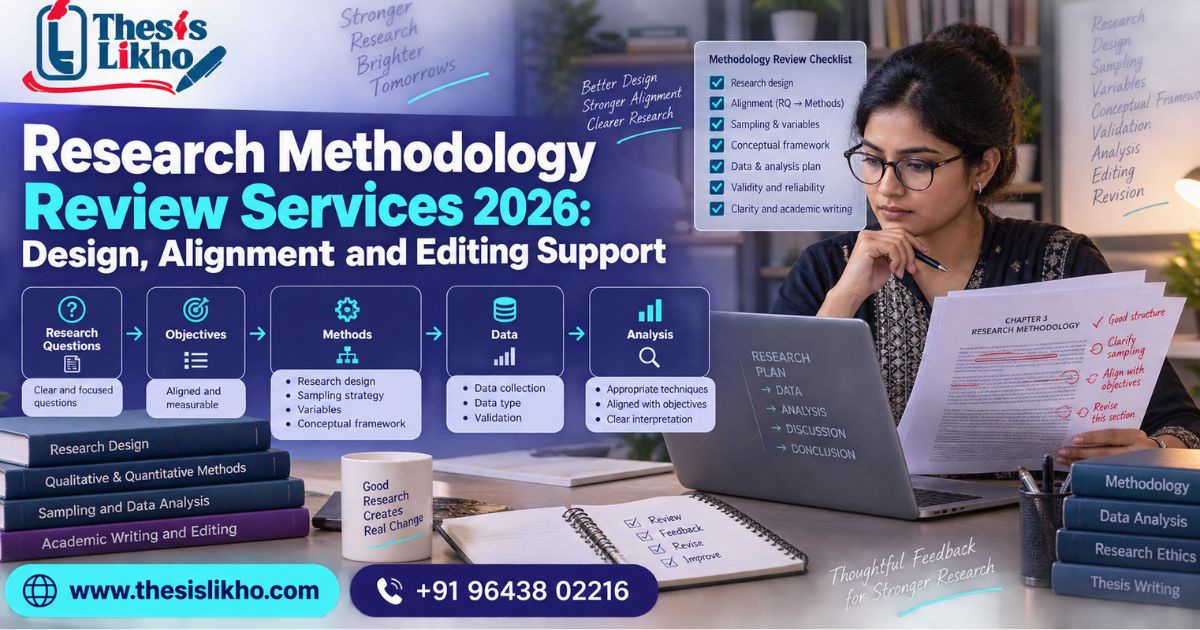
A methodology chapter must show that the research question, design, sample, evidence and analysis logically belong together. Generic definitions of qualitative and quantitative research are not enough. ThesisLikho’s Research Methodology Review Services help scholars identify weaknesses in an existing research plan or chapter, clarify methodological decisions and improve how the process is documented. Support can cover research-design alignment, sampling logic, measurement tools, data-collection procedures, ethics reporting, analysis planning and thesis-methodology editing. Every assessment is based on the scholar’s objectives, discipline, study stage and available evidence. No design, sample size, statistical result, university approval or publication outcome is guaranteed.
CTA #1: Request a confidential methodology assessment
Quick answer: Research methodology review examines whether a study’s questions, design, sampling, tools, data collection and analysis plan are logically aligned and clearly documented. Scholars may request help with an existing proposal or thesis chapter, research-design decisions, supervisor comments or editing. The review flags problems and explains options; the scholar and authorised academic guide approve final decisions.
Table of Contents
- Who needs methodology review
- Problems the service addresses
- Detailed service scope
- Included and not included
- Design consultation
- Working process
- Tools and research areas
- Documents required
- Deliverables, cost and timeline
- Revisions and confidentiality
- FAQs
Who Needs Research Methodology Review
Methodology review is useful when a scholar has a research idea or draft but is uncertain whether the proposed procedure can answer the research question. Typical situations include:
- a proposal returned with comments such as “design is unclear” or “method is not justified”;
- objectives that cannot be measured using the selected variables or tools;
- uncertainty between qualitative, quantitative, mixed-method, experimental or design-based approaches;
- a sample or sampling method selected without a defensible rationale;
- questionnaires, interview guides or measurement scales that do not map to the constructs;
- data already collected but the thesis chapter does not accurately report what was done;
- analysis techniques chosen because they are popular rather than suitable; or
- supervisor corrections that affect several connected sections of the methodology.
This service can be relevant at proposal, synopsis, pre-data-collection, post-data-collection and thesis-revision stages. The type of support changes by stage. A design can be adjusted before data collection; after data collection, the review must honestly document limitations rather than pretend a different procedure was used.
Common Methodology Problems
Objectives and methods do not match.
An objective may say “explore lived experiences,” while the plan uses only a closed-response questionnaire. Another may claim causal impact although the study only records a one-time association. The problem is not wording alone; it is a mismatch between the knowledge claim and the evidence that will be collected.
The design is named but not explained.
Calling a study “descriptive,” “experimental,” “phenomenological”, or “mixed method” does not show how the design operates. A clear chapter explains why the design fits the question, what procedures follow from it and which limitations remain.
Sampling decisions are copied from another thesis.
Population, sampling frame, unit of analysis, eligibility criteria, sample-size reasoning and recruitment method must fit the current study. Copying a number or formula without its assumptions creates a weak justification.
Variables or constructs are not operationalised.
The reader should understand what each key concept means in this study, how it is observed or measured and how scores or categories will be interpreted.
Data collection and analysis are disconnected.
A questionnaire may collect ordinal responses while the proposed analysis assumes a different measurement structure. Qualitative questions may generate rich data, but the plan merely says “themes will be created” without explaining coding, interpretation or quality procedures.
Ethics is reduced to one sentence.
Ethical reporting may need to address consent, privacy, data handling, risk, vulnerable groups, institutional approval and participant withdrawal, depending on the study. Methodology editing should not invent approval that has not been obtained.
Research Methodology Review Scope
Review area: What is examined; Possible output.
Research alignment Problem, gap, questions, objectives and hypotheses Alignment matrix and inconsistency notes
Design selection Nature of the question, evidence needed and feasible procedures Design-options note with trade-offs.
Population and sample Target population, frame, unit, eligibility and recruitment Sampling review and query sheet
Measurement Variables, constructs, indicators and tools Variable-to-measurement map
Data collection Sequence, setting, administration and record handling Procedure flow and missing-detail notes
Analysis planning Objective-to-analysis fit and assumptions Analysis-alignment matrix
Quality procedures Reliability, validity, credibility or trustworthiness as relevant Quality-control checklist
Ethics reporting Consent, privacy, approvals and risk considerations Ethics-reporting queries.
Chapter structure Logical order, reproducibility and academic clarity Reorganised outline or edited chapter
Supervisor corrections Comment interpretation and connected revisions Response matrix and tracked changes.
PhD Research Methodology Help
PhD research methodology help should strengthen a scholar’s reasoning rather than provide a universal template. Doctoral research may require theoretical justification, methodological originality, multi-stage studies, advanced analysis or discipline-specific standards. Assistance may therefore include a diagnostic review, design comparison, operationalisation framework, pilot-study planning, analysis alignment or chapter editing.
Thesis Methodology Editing
Editing is appropriate when the method has already been approved or conducted, but the chapter is unclear, repetitive or incomplete. It may improve:
- the order of methodology sections;
- tense consistency between proposed and completed procedures;
- definitions of population, sample and variables;
- descriptions of instruments and administration;
- explanation of analysis steps;
- table, figure and appendix references;
- academic language and transitions; and
- citation and reference consistency.
Editing must not rewrite the study history. If the draft claims random sampling but the actual recruitment was non-random, the discrepancy should be corrected and its implications considered.
What Is Included and Not Included
Included when agreed in scope; not included
Diagnostic review of an existing plan or chapter Fabricated participants, data, results or approvals
Objective–method–analysis alignment Backdating or inventing ethics clearance
Research-design consultation Guaranteed proposal or thesis approval
Sampling and measurement review Selecting methods only to obtain significance
Data-collection procedure review Disguising a method different from the one used
Qualitative or quantitative analysis planning Unauthorised use of copyrighted instruments
Thesis methodology editing with tracked changes Guaranteed marks, publication or similarity score
Defined revisions against consolidated feedback Unlimited additions outside the written scope
The scholar remains responsible for source verification, access permissions, ethical compliance, data authenticity and final decisions approved by the university or research supervisor.
CTA #2: Have objectives, a proposal or a methodology draft? Share the current document stage for a scope-based review.
Research Design Consultation
Research design consultation helps the scholar compare feasible approaches before committing to a method. It does not begin by choosing a software package. It begins with the type of answer the research question requires.
Research purpose Possible design family Key questions before selection
Describe a population or condition Descriptive survey, observational or case-based design Is the population defined and can the sample represent it?
Examine association Correlational or analytical observational design Are variables measurable and are confounders considered?
Estimate intervention effect Experimental or quasi-experimental design Is assignment feasible, ethical and sufficiently controlled?
Understand experience or meaning Phenomenology, narrative or qualitative descriptive approach Who can provide relevant experience and how will interpretation be checked?
Develop theory from data Grounded-theory family Is iterative collection and constant comparison feasible?
Study a bounded case deeply Case study What defines the case and which evidence sources will be triangulated?
Build and evaluate an artefact Design science or engineering evaluation What requirements, baselines and performance criteria apply?
Integrate numerical and contextual evidence Mixed-method design Why are both strands needed, and where will they be integrated?
The selected design still requires discipline-specific refinement. For example, experimental controls in engineering, qualitative reflexivity in social science and reporting of clinical procedures in health research are not interchangeable.
Original Methodology Alignment Test
A useful methodology can be audited through seven links:
- Problem → question: Does the question address the identified gap?
- Question → objective: Is every objective answerable and specific?
- Objective → evidence: What observation, response, document or measurement is needed?
- Evidence → tool: Can the proposed instrument produce that evidence?
- Tool → sample: Can the selected participants, cases, or data source provide it?
- Evidence → analysis: Does the analytical technique fit the evidence and objective?
- Analysis → claim: Is the conclusion limited to what the design can support?
Audit finding | Why it matters | Example corrective question
Objective has no corresponding data It cannot be answered What evidence would directly answer this objective?
Tool contains unrelated items It increases burden and weakens focus Which item maps to which construct?
Sampling frame excludes key members Findings may not represent the target population Who is missing from the available frame?
Analysis assumes unsupported conditions Results may be misleading Are the technique’s assumptions satisfied?
Conclusion claims causality from association The design cannot support the claim What alternative explanations remain?
This alignment test provides page-specific expert value and helps distinguish methodology review from generic proofreading.
How the Methodology Review Process Works
1. Research-stage assessment
The reviewer identifies whether the study is at the idea, proposal, pre-collection, post-collection or correction stage. Recommendations must respect what can still be changed ethically and practically.
2. Input and requirement check
The topic, problem, questions, objectives, conceptual framework, current method, university guidance and supervisor feedback are reviewed. Missing information is recorded before substantive recommendations are made.
3. Alignment diagnosis
The problem–objective–method–analysis chain is mapped. Contradictions, unsupported decisions and ambiguous terms are listed with their potential impact.
4. Design and method options
Where consultation is required, feasible options are compared according to evidence quality, ethics, access, time, resources and disciplinary expectations. The recommendation states limitations rather than presenting any design as perfect.
5. Chapter development or editing
The methodology is structured and edited according to the agreed scope. Queries are left where scholar confirmation, institutional approval or source evidence is required.
6. Technical quality review
Sampling details, tools, variables, procedures, analysis terms, tables, citations and appendices are checked for internal consistency. A statistical or qualitative specialist review is included only when agreed.
7. Scholar review and supervisor discussion
The scholar reviews tracked changes and uses the documented reasoning when discussing decisions with the authorised supervisor or committee.
8. Defined revision and handover
Consolidated feedback within the confirmed scope is addressed. The final handover identifies resolved changes and outstanding decisions requiring scholar or institutional action.
Research Areas, Methods and Tools
Potential subject areas include management, commerce, economics, education, psychology, social sciences, law, engineering, computer science, life sciences, pharmacy, nursing, public health and selected interdisciplinary fields. Highly specialised clinical, laboratory or advanced statistical requests are accepted only when suitable expertise is available.
Methodological support may involve:
- quantitative, qualitative and mixed-method research;
- surveys, observational studies, experiments and quasi-experiments;
- interviews, focus groups, document analysis and case studies;
- design-science, simulation and computational evaluation;
- questionnaire or interview-guide mapping;
- pilot-study planning;
- reliability, validity or qualitative trustworthiness planning; and
- objective-to-analysis alignment.
Possible tools include reference managers, structured alignment matrices, spreadsheet-based data dictionaries, qualitative coding software and statistical packages such as SPSS, R, Stata, SmartPLS or Python where relevant. Tool availability does not determine methodological suitability, and no software output should be accepted without checking assumptions and research context.
Documents Required for Assessment
For a focused assessment, share:
- Academic level, discipline and university requirements
- Research title and background
- Problem statement and research gap
- Questions, objectives and hypotheses, if applicable
- Conceptual or theoretical framework
- Existing proposal, synopsis or methodology chapter
- Population, sample and access information
- Data-collection instrument or interview guide
- Planned or completed analysis details
- Supervisor or reviewer comments
- Required deliverables and genuine deadline
Do not share passwords, unnecessary personal documents or identifiable participant data. Remove confidential information before sending research files.
Deliverables, Cost and Timeline Factors
Possible deliverables
- Diagnostic methodology review
- Research-alignment matrix
- Design-options consultation note
- Sampling and measurement queries
- Objective-to-analysis matrix
- Reorganised methodology outline
- Edited chapter with tracked changes
- Instrument-mapping comments
- Supervisor-comment response matrix
- Quality-control and handover checklist
What affects cost?
Cost depends on the research stage, number of objectives, methodological complexity, chapter condition, number and type of tools, statistical or qualitative specialist input, supervisor comments, deadline and revision scope. A consultation, diagnostic review and complete chapter edit are different services and should not be priced as if they were identical.
What affects timeline?
The timeline depends on document completeness, complexity, access to required inputs, scholar response time and the depth of review. A pre-data-collection design assessment generally requires different work from documenting a completed study. Urgency cannot justify fabricated decisions, false ethical statements or unverified analysis.
Revision, Communication and Confidentiality
The written scope should define deliverables, exclusions, milestones, communication method and revision terms. Consolidated supervisor feedback is preferred. A changed topic, new dataset, additional objectives or redesigned study is treated as new work rather than a minor revision.
Confidential research files should be accessed only for the agreed task. Identifiable participant information should not be shared. Any anonymised work example displayed publicly requires permission and must remove personal, institutional and sensitive research details.
Quality and Trust Standards
A methodology page should show genuine expertise through accurate scope and transparent limits—not unsupported promotional claims.
Author: Dr Rajesh Kumar Modi
Last reviewed: 16 September 2026
Add a named methodology or subject-area reviewer only when the person, qualifications, and completed review can be verified. Publish testimonials only when they are genuine and used with permission. Business details should remain consistent across the page and Organisation schema.
Remove unsupported student counts, university associations, “best-rated” statements, approval guarantees and claims that a methodology is “university approved.” A university may approve a scholar’s proposal; a service provider cannot truthfully guarantee or pre-declare that approval.
Ethical academic-support disclaimer: ThesisLikho provides methodology guidance, developmental review, editing and research-support services. Scholars must follow university, ethics-committee and disciplinary requirements; verify all sources and procedures; and retain responsibility for submitted research. Approval, marks, statistical significance, similarity scores, publication and examination outcomes are not guaranteed.
CTA #3: Book a confidential research-design consultation with your topic, objectives and current stage.
Frequently Asked Questions
1. What do Research Methodology Review Services cover?
They may cover objective alignment, design selection, sampling, variables, measurement tools, data collection, ethics reporting, analysis planning, chapter structure and methodology editing. Scope depends on the study stage.
2. Can I get PhD research methodology help before data collection?
Yes. Pre-collection review can compare designs, examine feasibility, map variables, review sampling and tools, and align planned analysis. Final decisions require scholar and authorised academic approval.
3. Can you edit a methodology chapter after data collection?
Yes. Editing can clarify the procedure actually followed, improve structure and flag missing details. It should not claim that a different design, sample or procedure was used.
4. Does research design consultation include sample-size calculation?
It may be scoped separately when the study type, outcome, assumptions and required inputs are available. No valid universal sample size applies to every research project.
5. Which documents are needed for assessment?
Share the title, problem, questions, objectives, framework, current methodology, planned tools, university requirements and supervisor comments. Data-related requests also need a data dictionary or analysis details.
6. How long does methodology review take?
The timeline depends on the study stage, complexity, document length, available inputs and requested deliverables. A realistic schedule is provided after assessment.
7. How is methodology-support cost calculated?
Cost depends on whether you need consultation, diagnostic review, chapter editing, instrument mapping, analysis planning or response to supervisor corrections, along with complexity and deadline.
8. Do you guarantee methodology approval or publication?
No. Approval and publication decisions are made independently by universities, committees, supervisors, editors and reviewers. Ethical methodology support cannot guarantee those outcomes.
Conclusion
A strong methodology explains why each research decision is appropriate and how the selected evidence can answer the stated question. ThesisLikho’s Research Methodology Review Services help scholars examine the alignment between their problem, objectives, design, sample, instruments, data collection and analysis plan. Support may involve PhD methodology guidance, research-design consultation, chapter restructuring or focused thesis methodology editing. The process begins with the actual study stage and available documents, so limitations are addressed honestly rather than hidden behind generic language. Scholars who need wider chapter-level assistance can also review PhD Thesis Writing Services. Share your research topic, objectives, current methodology and supervisor comments for a confidential assessment and a clearly defined next step.
📞 Call/WhatsApp: +91 96438 02216
Website: https://thesislikho.com/