
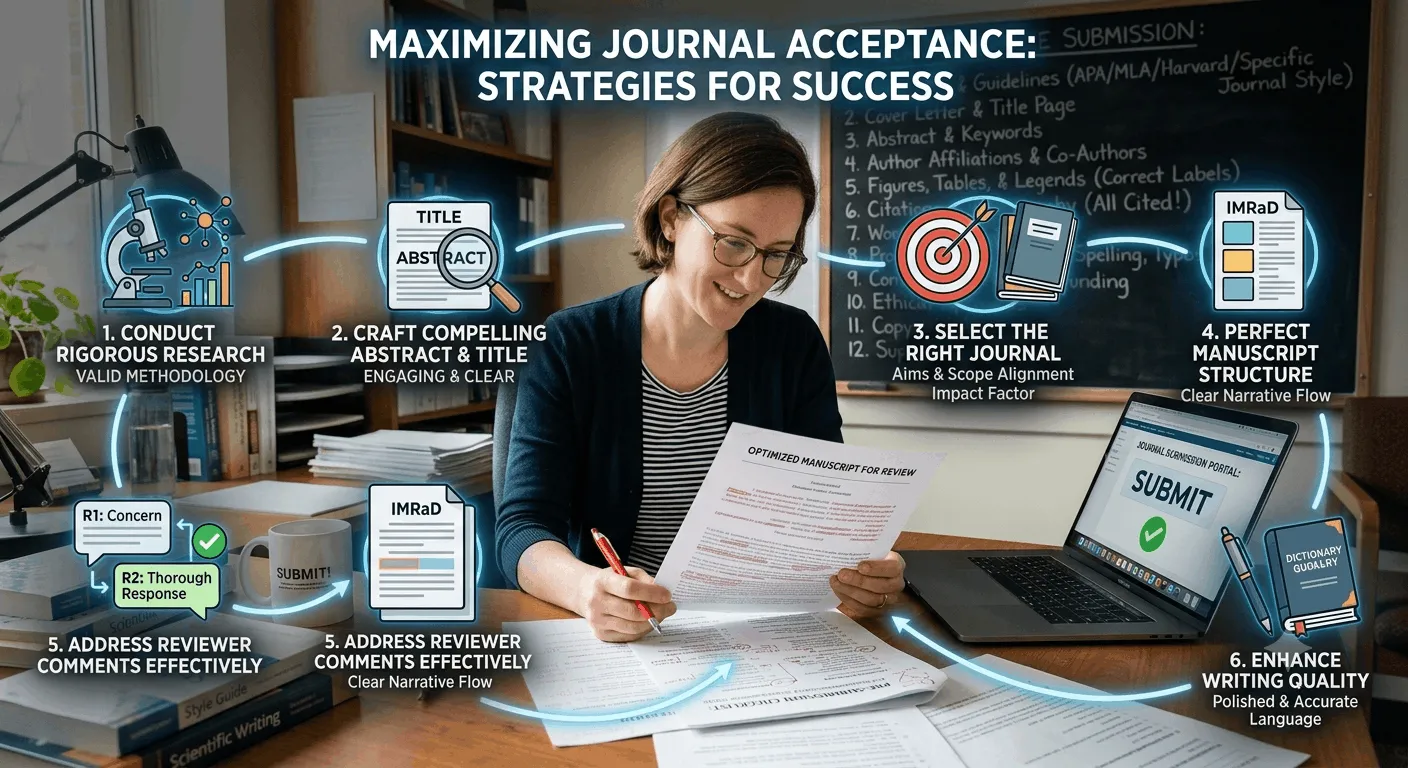
If you've ever opened a rejection email from a journal editor and felt your stomach drop, you're in enormous company. Even seasoned researchers with strong data and sound methodology get turned away — sometimes within 48 hours, before a single reviewer ever sees the manuscript. That single fact surprises most first-time authors, and it's the starting point for understanding research paper acceptance tips that actually work. Getting published isn't only about doing good science; it's about presenting that science in a way that matches what a specific journal, its editors, and its reviewers are looking for at that specific moment. This article walks through what genuinely moves the needle — from choosing the right journal and structuring your manuscript, to writing a cover letter that doesn't waste an editor's goodwill, to handling revisions, ethics disclosures, and the newer question of how to disclose AI tool use without triggering a technical rejection. By the end, you'll have a practical, editor's-eye view of peer reviewed journal publication that you can apply to your very next submission.
Why Do So Many Research Papers Get Rejected? Understanding the Real Numbers
Most researchers underestimate just how competitive journal acceptance rate figures really are, and that miscalibration is often the first mistake. At elite general-science journals, overall acceptance can sit below 10%, with the large majority of that rejection happening before peer review even begins. Mid-tier specialty journals typically reject somewhere between 30% and 40% of submissions at the desk stage alone, while highly selective journals in fields like economics, biomedicine, and high-impact engineering can desk-reject the majority of what lands in their inbox.
This isn't a sign that most rejected research lacks value — it's a sign that fit, framing, and presentation matter enormously. A 2026 study on editorial decision-making found that co-editors at the same journal, reviewing the very same manuscripts, agreed on desk-rejection calls only about 43% of the time, with statistical agreement scores describing that consistency as moderate at best. In plain terms: a chunk of desk rejection is genuinely about scope, timing, and editorial judgment calls rather than objective manuscript quality. Separate analysis of papers that went on to become highly cited found that a striking share had been desk-rejected somewhere else first. None of this means the process is arbitrary — it means authors should treat a rejection as information about fit with that particular venue, not necessarily a verdict on the research itself.
Understanding where rejection actually happens changes how you prepare. Roughly speaking, submissions face two decision gates: an editorial screening (desk review) that checks scope, novelty, formatting, and basic quality, and a peer review stage that scrutinizes methodology, data, and contribution in depth. Papers that survive desk screening at prestigious journals often still face acceptance rates in only the 30–35% range once they reach reviewers. That two-gate reality is exactly why the tips in this guide are split between "getting past the editor" and "getting past the reviewers" — they require different preparation.
The Most Common Reasons Editors and Reviewers Reject Manuscripts
Before you can fix a manuscript's weak points, you need a clear map of what actually causes rejection. The good news is that the same handful of issues shows up again and again across disciplines, which means most of them are preventable with deliberate revision rather than more raw research effort.
Reviewers consistently flag a lack of novelty as the single biggest reason for rejection. If your paper doesn't clearly articulate what it adds beyond existing literature — a new method, population, dataset, or theoretical angle — editors read it as incremental at best and redundant at worst. Weak or outdated framing compounds this: a technically sound study that leans on old data or fails to engage with the last two to three years of research in its field signals to a reviewer that the authors aren't current with the conversation they're claiming to join.
Methodological weakness is the second major cluster. This includes small or biased samples, inappropriate statistical tests, unclear variable definitions, and inadequate controls — the kind of design flaws that undermine confidence in the results regardless of how interesting the topic is. Closely related is poor data presentation: reviewers regularly reject papers where tables and figures are cluttered, inconsistently labeled, or disconnected from the surrounding narrative, because confusing data makes it impossible to verify the paper's claims.
Writing quality and clarity issues round out the list, alongside scope mismatch (submitting to a journal that simply doesn't cover your subject area), formatting non-compliance, and overreaching conclusions that aren't fully supported by the data presented. A few of the most frequent, avoidable rejection triggers:
- Claims in the abstract or discussion that go beyond what the data actually shows
- Literature reviews that ignore recent, directly relevant work in the field
- Manuscripts formatted for a different journal's template or word count
- Statistical or methodological choices left unjustified in the text
- Poorly organized or unlabeled figures and tables
How Can I Increase My Chances of Journal Acceptance? Start With Journal Selection
Journal selection is, in short, the decision that determines whether your paper gets read on its merits or dismissed on scope alone — and it should happen before you finalize your manuscript, not after. Editors report that a large share of desk rejections happen simply because a submission doesn't match what the journal actually publishes, regardless of how strong the underlying research is. This is one of the most controllable factors in the entire process, because it depends entirely on your homework rather than your data.
Start by reading three to five recent issues of your shortlisted journals rather than relying solely on the "Aims and Scope" page, which tends to describe an idealized, broad mission rather than what the journal is actually publishing right now. Journals drift over time — a title that welcomed broad interdisciplinary work five years ago may have narrowed considerably. If you consistently see papers that resemble yours in topic, method, and depth, that's a strong signal of fit. If nothing looks similar, treat that as a warning sign even if the journal's official scope statement seems to match on paper.
Impact factor matters, but chasing it blindly is one of the most common rookie mistakes in academic publishing. A study that would be a strong, well-cited contribution to a respected specialty journal can look thin and unremarkable to the editors of a top-tier generalist title, resulting in a fast rejection that costs weeks of turnaround time for nothing. The healthier approach is to match your paper's scope and significance honestly: niche, highly technical contributions usually belong in specialized journals, while broadly relevant findings with cross-disciplinary implications are better suited to wider-reach titles.
A Practical Journal-Selection Checklist
Working through a structured checklist before submission prevents the single costliest mistake in the process — submitting to the wrong venue and losing precious weeks to a rejection that never should have happened. Treat every question below as something to genuinely research, not simply glance at.
Subject Scope: Read 3–5 recent issues instead of relying only on the journal's scope page. The articles a journal actually publishes often reveal its true focus, which may differ from the stated scope.
Article Type: Confirm that the journal accepts your manuscript format, such as an original research article, review paper, or case study. Many journals only publish specific types of manuscripts.
Indexing: Verify whether the journal is indexed in reputable databases like Scopus, Web of Science, or PubMed. Indexing improves the credibility, discoverability, and long-term visibility of your research.
Turnaround Time: Check the average time to the first editorial decision, which typically ranges from 4 to 12 weeks. This helps you plan your submission and publication timeline more effectively.
Publication Fees: Review the Article Processing Charges (APCs) and any additional publication costs before submitting your manuscript. Knowing the fees in advance helps you avoid unexpected expenses and identify potential predatory journals.
Editorial Board: Examine the editorial board to see whether it includes recognized experts in your research field. A strong editorial board is a good indicator that the journal is reputable and relevant to your discipline.
Review Transparency: Read the author guidelines and understand the journal's peer-review process. Journals with clear submission and review policies generally provide a more transparent and consistent publication experience.
Journal-matching tools such as Elsevier's Journal Finder, Springer Nature's Journal Suggester, and JANE (Journal/Author Name Estimator) can help generate an initial shortlist by comparing your abstract against indexed publications, though they should supplement — not replace — your own reading of the target journals. When you're genuinely torn between two or three well-matched options, a brief, professional pre-submission inquiry to the editor is increasingly considered normal practice and can save both sides significant time.
Best Practices for Structuring a Manuscript Reviewers Want to Accept
A well-organized manuscript does more than look professional — it actively reduces the cognitive load on a busy reviewer, and reviewers who aren't fighting your structure are far more likely to engage generously with your ideas. Most peer-reviewed empirical work follows the IMRaD structure (Introduction, Methods, Results, and Discussion), and deviating from that convention without good reason tends to frustrate reviewers who expect to find specific information in predictable places.
Your introduction carries more weight than most authors realize. It needs to state the research gap clearly, explain why that gap matters, and preview your contribution — all within the first few paragraphs, before a time-pressed reviewer's attention drifts. A frequent, fixable mistake is burying the novelty statement in the middle of a long literature review instead of stating it explicitly near the introduction's opening and closing.
The methods section is where rigor gets demonstrated, not just claimed. Reviewers want enough detail to evaluate — and ideally replicate — your approach: sample size and selection, instruments or tools used, data collection procedures, and the statistical or analytical methods applied, along with a clear justification for why those methods suit your research question. Vague methods sections are one of the fastest routes to a "major revisions" verdict, because reviewers cannot assess validity they cannot fully see.
Results and discussion should stay honestly separated. Present findings first without interpretation, then use the discussion to explain what they mean, how they relate to existing literature, and — critically — what the limitations are. Reviewers consistently respond better to authors who acknowledge limitations directly than to those who imply a level of certainty the data doesn't support; overstated or exaggerated conclusions are a recurring, avoidable reason for rejection.
Common Manuscript Mistakes and How to Fix Them
Recognizing your own likely blind spots before a reviewer does is one of the highest-leverage things you can do in the entire submission process. A short table makes the fixes concrete:
Weak Novelty Statement: Reviewers often ask, "What does this actually add?" Clearly state your research contribution in both the opening and closing paragraphs of the introduction so readers immediately understand the study's significance.
Outdated Citations: A common concern is, "Is this author current in the field?" Include a meaningful proportion of references published within the last two to three years to demonstrate awareness of recent developments.
Overreaching Conclusions: Reviewers may feel that "The data doesn't support this claim." Ensure every conclusion is directly supported by your results, and acknowledge the study's limitations honestly instead of making broad generalizations.
Cluttered Figures and Tables: If reviewers struggle to interpret your visuals, the impact of your research is reduced. Keep figures simple, label all axes and units clearly, and ensure each figure communicates one primary message.
Inconsistent Formatting: Reviewers may question whether the submission followed the journal's instructions. Use the journal's official template, citation style, and formatting guidelines exactly as specified.
Thin Literature Review: A weak literature review suggests limited understanding of existing research. Instead of citing only classic studies, discuss and compare your work with the 8–10 most relevant and recent publications in your field.
Writing a Cover Letter That Helps Rather Than Hurts Your Submission
A cover letter is a required part of the submission package at most peer-reviewed journals, and treating it as a formality is a missed opportunity, since it's often the very first thing an editor reads before opening the manuscript itself. A strong cover letter briefly states your paper's core contribution, explains why it fits this specific journal (referencing recent related work the journal has published is a strong signal), confirms the work is original and not under review elsewhere, and discloses anything the editor needs to know upfront — including any preprint posting.
Length discipline matters here. Most publishers expect a cover letter to fit comfortably on a single page; a rambling two-page letter suggests an author who can't prioritize, which is an unfortunate first impression to create right before an editor opens a manuscript that claims rigorous, disciplined analysis. Close professionally, thank the editor for their time, and avoid both over-familiarity and any language that pressures them toward a faster decision.
One increasingly important and frequently mishandled element: disclosing generative AI tool use. If you used a tool like ChatGPT or Claude anywhere in preparing the manuscript — drafting text, polishing language, assisting with code, or generating figures — current guidance from bodies like the International Committee of Medical Journal Editors treats disclosure as expected, not optional, and that disclosure needs to live in the right place. A growing number of journals require the statement inside the manuscript itself (commonly in the Methods or Acknowledgments section), not merely mentioned in the cover letter, since the cover letter isn't part of the permanent published record that reviewers and later readers can see. Getting this placement wrong has already caused desk rejections on cases where the underlying science was sound — a technicality that's completely avoidable with a quick check of the specific journal's current policy before you submit.
What Happens After Submission: Peer Review, Revisions, and Resubmission
Understanding the review timeline helps you calibrate expectations and respond effectively when feedback arrives. On average, journals take somewhere between four and twelve weeks to deliver a first decision, though this varies considerably by field, journal workload, and reviewer availability. That decision typically falls into one of several categories: acceptance, minor revisions, major revisions, or rejection — and for most researchers, "minor" or "major revisions" is a genuinely good outcome, not a disappointment, since it means the paper cleared the much harder novelty-and-fit bar already.
When revision requests arrive, resist the instinct to treat reviewer comments as personal criticism or, at the other extreme, to accept every suggestion uncritically without pushback where you have solid grounds to disagree. The strongest revision responses do three things consistently: they address every single point a reviewer raises (even briefly, if you're respectfully declining a suggested change), they explain the reasoning behind any pushback rather than simply ignoring it, and they make changes traceable — usually through a clearly organized point-by-point response letter alongside a marked-up or tracked-changes version of the manuscript.
If the outcome is rejection after peer review rather than at the desk stage, that feedback is genuinely valuable and shouldn't be discarded. Reviewer comments at one journal frequently identify real weaknesses worth fixing before resubmitting elsewhere — and, as the citation data on desk-rejected-but-later-influential papers suggests, a rejection is often more about fit and editorial capacity at that specific venue than a verdict on the work's ultimate value to the field.
Checklist Before You Hit Submit
A final pass through a structured checklist catches the kind of small, avoidable errors that create an unfairly negative first impression regardless of how strong your research actually is.
- Manuscript matches the target journal's exact formatting and citation style
- Abstract accurately reflects what the data shows, without overselling
- All co-authors have reviewed and approved the final version
- Ethics approvals, funding disclosures, and conflict-of-interest statements are complete
- Any AI tool use is disclosed in the correct section, matching the journal's specific policy
- Figures and tables are clearly labeled, high-resolution, and referenced correctly in-text
- Reference list is complete, correctly formatted, and includes recent relevant literature
- Cover letter is under one page and tailored to this specific journal
- A colleague outside your immediate research group has read the full draft
Frequently Asked Questions
How can I increase my chances of journal acceptance?
The most effective approach combines three things: choosing a journal whose actual published scope matches your paper (not just its stated scope), presenting a clearly framed novel contribution backed by rigorous methodology, and following every submission guideline exactly, from formatting to word count. Read recent issues of your shortlisted journals before submitting, engage recent literature in your introduction, and have a colleague outside your immediate team review the draft for clarity gaps you may not notice yourself. Small, avoidable errors — mismatched formatting, an overreaching abstract, weak figure labeling — cause a disproportionate share of desk rejections, so a careful final pass often improves your odds more than additional data collection would.
What is considered a good journal acceptance rate?
Most competitive, well-regarded journals accept somewhere between 15% and 40% of submissions, while acceptance rates below 10% typically signal an extremely selective, high-prestige venue with correspondingly strict editorial standards. It's worth remembering that acceptance rate alone doesn't tell you everything about difficulty of fit — a lower-acceptance journal in your exact niche may actually be a better match than a higher-acceptance journal outside your subfield, because fit affects your real odds more than the raw published percentage does.
Why do research papers get rejected at the desk stage before peer review?
Desk rejection happens when an editor determines a manuscript is unsuitable before it ever reaches outside reviewers, and it accounts for a very large share of all submissions — sometimes the majority at highly selective journals. Common triggers include scope mismatch, an abstract that overpromises relative to the actual findings, poor formatting or guideline non-compliance, weak or unclear writing, and insufficient novelty relative to existing published work. Because desk decisions involve real editorial judgment rather than a fixed formula, the same manuscript can occasionally receive different desk outcomes at different journals — which is exactly why fit-focused preparation matters so much.
How long does it typically take to hear back from a journal?
Average first-decision timelines run about four to twelve weeks, though this varies by field, by the individual journal's editorial workflow, and by reviewer availability at that particular moment. Desk rejections tend to arrive far faster, often within one to two weeks, since they don't require external reviewer input. If a journal advertises unusually fast peer review turnaround as a headline selling point, treat that as a signal worth investigating further before submitting, since legitimate rigorous review takes time.
Should I always aim for the highest-impact-factor journal first?
Only if your work genuinely warrants that level of broad significance — and being honest with yourself about that is harder than it sounds. Desk rejection at a top-tier journal typically arrives within one to two weeks and costs you little beyond that time, so an ambitious first submission isn't inherently a mistake. However, a pattern of consistently misaligned submissions can quietly cost you editorial goodwill at journals you may want to submit to again in the future, so calibrate ambition against an honest read of your paper's actual scope and significance.
Do I need to disclose using ChatGPT or other AI tools when writing my paper?
In 2026, the safe default is to assume disclosure is expected if generative AI touched your manuscript in any substantive way — drafting sections, restructuring arguments, generating or refining figures, or assisting with code. Policies differ by publisher, but a growing consensus, reflected in guidance from bodies like the ICMJE, is that the disclosure needs to appear inside the manuscript itself, typically in the Methods or Acknowledgments section, rather than only in the cover letter. Basic grammar and spelling correction is treated more leniently by most journals than substantive drafting or content generation, but when in doubt, check the specific target journal's current policy before submission, since mismatched disclosure has already caused otherwise-avoidable rejections.
What's the difference between minor revisions, major revisions, and rejection after review?
Minor revisions typically means the core contribution and methodology are sound, with only smaller clarifications, additional citations, or presentation fixes needed before acceptance. Major revisions signals reviewers see real potential but have identified more substantial concerns — perhaps additional analysis, expanded discussion, or methodological clarification — that must be addressed before a final decision, usually with a chance to resubmit. Outright rejection after full peer review means reviewers concluded the paper's contribution, methodology, or fit doesn't meet the bar for that journal at this time; the reviewer feedback is still valuable and often directly transferable to strengthening a resubmission elsewhere.
How important is the literature review for acceptance chances?
Very important, because it's where reviewers assess whether you genuinely understand the existing conversation you're claiming to contribute to. A thin or outdated literature review is a common, avoidable rejection trigger — reviewers specifically look for engagement with the last two to three years of directly relevant work, not just foundational or classic references. A strong literature review does more than list prior work; it explicitly frames the gap your study fills and positions your contribution relative to what's already known.
Can a rejected paper still be published somewhere else?
Yes, and this is extremely common rather than exceptional. Research tracking desk-rejected manuscripts has found that a meaningful share of papers later recognized as influential in their field had been turned away by other journals first — sometimes more than once. Use reviewer feedback from the rejection to strengthen the manuscript, reassess journal fit honestly, and consider whether the paper needs restructuring for a different audience before resubmitting elsewhere.
What role do figures and tables play in acceptance decisions?
A larger role than most authors assume. Reviewers regularly cite confusing, cluttered, or inconsistently labeled data presentation as a specific reason for rejection, because it undermines their ability to verify your claims regardless of how sound the underlying data actually is. Each figure or table should carry one clear message, use consistent labeling and units, and be explicitly referenced and explained in the surrounding text rather than left to speak for itself.
Is it worth contacting a journal editor before submitting?
Yes, particularly when you're genuinely uncertain between two or three well-matched journals or want to confirm your topic fits current scope. Pre-submission inquiries have become increasingly normalized and can save considerable time on both sides — editors would generally rather answer a brief scope question upfront than process a manuscript that's clearly a poor fit. Keep the inquiry short, specific, and professional.
Conclusion
Getting a research paper accepted by a peer-reviewed journal has always required strong science — but the data makes clear it also requires deliberate strategy around fit, framing, and process. Understanding realistic journal acceptance rate expectations, choosing a journal based on its actual recent scope rather than its stated ambitions, structuring your manuscript the way reviewers expect, writing a cover letter that builds rather than spends editorial goodwill, and handling AI disclosure and revisions correctly are all genuinely within your control. None of these research paper acceptance tips replace rigorous methodology or a real contribution to your field — but they remove the avoidable friction that causes so many strong papers to get an unnecessarily hard time in peer reviewed journal publication. Treat your next submission as a complete package, not just a manuscript attached to an email, and give it the same care in presentation that you gave the research itself.