
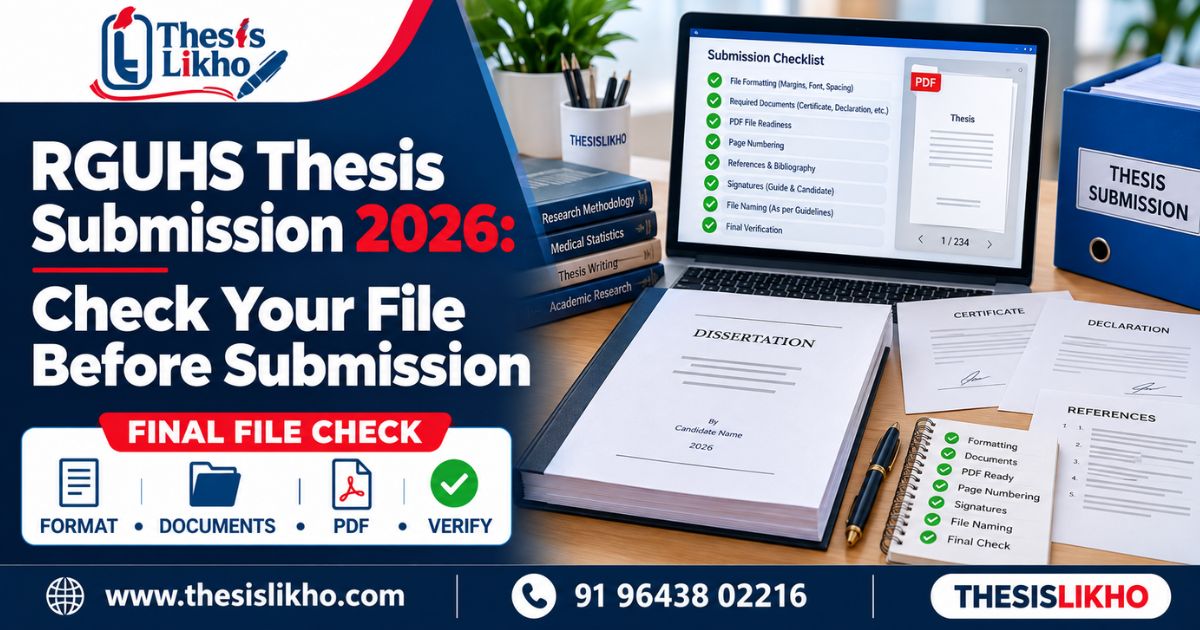
You have finished the writing, but is the thesis actually ready to leave your desk? RGUHS thesis submission can be delayed by problems that are easy to miss in a final read: a title that differs from the approved synopsis, an unsigned document, a reference missing from the bibliography, or instructions taken from another programme’s notification. A postgraduate dissertation and a PhD thesis may also follow different routes.
This guide helps you perform a practical final check. Start with the notification for your course, batch and examination session. Then compare the approved research record with the manuscript, confirm each required approval, inspect the final file and keep proof of submission. Where a requirement is unclear, seek written clarification from your college or the relevant RGUHS department before sending the file.
Quick answer
For RGUHS thesis submission, first identify the current instructions for your programme and examination session. Check your approved topic or synopsis, supervisor clearance, research documentation, references and final file against those instructions. Submit through the route specified for your course and retain its acknowledgement. Do not assume that a PhD thesis and a postgraduate dissertation share the same requirements.
Table of contents
- What is RGUHS thesis submission?
- Why do final submission problems occur?
- How to verify your submission in seven steps
- Check each part of the manuscript.
- Documents and information to keep ready
- Common mistakes and how to correct them
- Final submission checklist
- When is an expert review useful?
- Frequently asked questions
Quick highlights
Main problemA finished manuscript may still have an approval, content or file error.Recommended approachCompare the final file with your approved research record and current course-specific instructions.Information neededApplicable notification, approved topic or synopsis, supervisor feedback, required approvals and final manuscript.Major risksWrong course instructions, title mismatch, missing sign-off, incomplete references or an incorrect file.Final actionSubmit through the specified route and save the acknowledgement.
What is RGUHS thesis submission?
RGUHS thesis submission is the formal process of presenting completed research for the evaluation required by Rajiv Gandhi University of Health Sciences. In searches, “thesis” may refer to a PhD research thesis, while RGUHS dissertation submission may refer to a postgraduate course requirement. The terms are often used together online, but the applicable instructions depend on the programme.
For PhD candidates, RGUHS’s published FAQ describes an approved final synopsis and an application routed through the guide, department and institution for permission to submit the thesis. That FAQ should be read alongside any applicable current ordinance or notification. A postgraduate student should instead follow the instructions issued for their particular course and examination session.
Why do final submission problems occur?
Most last-stage problems begin before a file is uploaded or handed in:
- The wrong notification is used. A student finds instructions for a different course, batch or examination.
- The manuscript no longer matches the approved research plan. The title, objectives, study population or methods changed without the necessary review.
- Approvals are assumed rather than confirmed. Verbal feedback is treated as final supervisor or institutional clearance.
- Corrections are made in only one copy. The submitted PDF differs from the version the supervisor reviewed.
- References are checked by appearance alone. Citations may be missing, duplicated or linked to the wrong source.
- Submission proof is overlooked. A student prepares the file but cannot later establish which version was submitted and when.
Use these causes as a diagnostic list. The correction is to compare the approved record, the final manuscript and the current instructions side by side.
How to verify your submission in seven steps
1. Identify your exact submission category
Write down your programme, batch, examination session and whether you are submitting a PhD thesis or a postgraduate dissertation. Locate the corresponding RGUHS notifications page. Risk: a general RGUHS guide may omit a course-specific deadline or procedure.
2. Compare the approved topic with the title page
Check the title, candidate details, department, guide details and study description against the approved record. If the research question or methods changed materially, ask the supervisor whether additional approval is required. Risk: a polished thesis can still conflict with its approved synopsis.
3. Confirm research and institutional approvals
Locate the approvals that apply to your study, such as ethics permission or institutional authorisation. Check approval numbers, dates and conditions wherever they appear in the manuscript. Risk: claiming an approval that the records do not support creates a serious documentation problem.
4. Close every supervisor comment
Make a simple log with three columns: comment, change made and page or section. Review the resolved version with your supervisor and confirm which file has been cleared. Risk: submitting an older draft can undo weeks of corrections.
5. Audit the evidence behind the results
Match each table and figure to the underlying analysis. Check denominators, units, labels and whether the discussion supports what the results actually show. Risk: inconsistent figures weaken the thesis even when the document looks complete.
6. Inspect the final file as a reader would
Open the exported file on another device if possible. Check that pages render, tables are legible, appendices are present, and no tracked changes, comments or blank pages remain. Verify the required filename and format against your course instructions. Risk: a correct working document may produce an incomplete final export.
7. Submit and preserve the record
Use the submission route stated for your course. Save the final submitted file, any acknowledgement, transaction record and relevant correspondence together. Risk: without an acknowledgement, you may have difficulty resolving a later question about submission status. RGUHS’s notifications, rather than a third-party blog, should determine the current route.
Check each part of the manuscript.
Topic and proposal
Does the final title and research scope match what was approved?Literature review
Does it explain the research gap without presenting unsupported claims as established facts?Methodology
Can a reader understand the design, sampling, measures and analysis used?Data analysis
Do reported values agree across text, tables and figures?Results and discussion
Are findings separated from interpretation, and are limitations stated honestly?Citations and references
Does every in-text citation have a matching reference, and vice versa?Formatting
Do the title page, section order, pagination and appendices meet the applicable instructions?Final submission
Is the approved version the same version being submitted?
Documents and information to keep ready
This is a working checklist, not a claim that every item is compulsory for every RGUHS programme:
- Current course-specific notification: Determines the relevant dates, route and file requirements.
- Approved topic or synopsis record: Used to verify consistency with the final thesis.
- Supervisor’s cleared version and comments log: Establishes that requested revisions were addressed.
- Study approvals, where applicable: Used to verify statements about ethics and institutional permission.
- Manuscript and supporting appendices: The actual material to be reviewed and submitted.
- Analysis records: Used to reconcile reported findings with source calculations.
- Submission acknowledgement: Kept after the required submission step is completed.
PhD scholars should specifically review the university’s PhD FAQ on final synopsis and thesis submission, then confirm whether newer instructions affect their case.
Common mistakes and how to correct them
Using an older notificationWrong deadline or routeRecheck the current course and session notice.Title differs from the approved recordClarification or correction requestResolve the discrepancy with the supervisor before submission.Missing approval evidenceDocumentation questionsLocate the record and verify every claim made in the manuscript.Submitting an earlier draftUnresolved reviewer commentsCompare the final file with the supervisor-cleared copy.Tables disagree with the textQuestions about analysisReconcile figures against the underlying results.In-text citations lack referencesIncomplete source recordRun a two-way citation and bibliography check.Appendices are absent or unreadableIncomplete research recordOpen and inspect the exported final file.No submission acknowledgement is savedDifficulty tracing statusDownload or record the official confirmation immediately.
Final submission checklist
Before thesis submission at RGUHS, confirm:
- The correct programme and examination notification were checked.
- The title, objectives and methods agree with the approved record.
- Every substantive supervisor comment was addressed.
- Results, tables, figures and discussion are consistent.
- In-text citations and reference entries match.
- Required formatting, appendices and signatures were checked.
- Applicable approvals were verified.
- The exact final file opens and displays correctly.
- Submission instructions were followed, and an acknowledgement was retained.
When is an expert review useful?
An additional academic review can help when you have substantial supervisor corrections, conflicting results, uncertain references or difficulty presenting your methods clearly. Ask the reviewer to identify specific issues and explain proposed revisions so you can assess and approve them. Your supervisor and RGUHS remain the authorities for academic clearance and submission requirements. An external review cannot guarantee acceptance, a particular similarity outcome or a submission date.
Frequently asked questions
Is RGUHS thesis submission the same for every course?
No. RGUHS thesis submission can refer to a PhD thesis, while postgraduate students may be preparing a course-specific dissertation. Dates, required materials, and submission routes should be checked against the notification for the exact programme and examination session. Begin with the official notifications page and ask your college to clarify any instruction that does not clearly apply to your course.
Should I submit immediately after my supervisor reviews the thesis?
First confirm that the reviewed version is the final cleared version and that all other applicable requirements have been met. Compare the exported submission file with that version, including its title page, tables and appendices. For a PhD thesis, the university’s published FAQ also describes a final synopsis and permission process; verify the applicable current instructions before treating manuscript review as submission clearance.
Where can I find the RGUHS dissertation submission deadline?
Look for the notification covering your programme, batch and examination session on the official RGUHS site. Avoid copying a date from a blog written for another course or an older examination. If you find a main notification and a later corrigendum, confirm with your college which instruction controls your submission and retain a copy for your records.
What if my thesis title changed after synopsis approval?
Do not quietly change the title only on the final manuscript. Show the approved title and proposed final title to your supervisor, explain the reason for the change and ask whether the university or institution requires formal approval or a correction to its records. The same caution applies when the change affects objectives, study design or the population studied.
Do PhD and postgraduate dissertation students need the same documents?
Do not assume so. The RGUHS PhD FAQ describes a specific final synopsis and permission process for doctoral candidates. A postgraduate dissertation student should use the notice for their own course and examination. Keep a personal checklist drawn from those applicable instructions, then have the college verify any document or approval whose status is uncertain.
What should I do if I notice an error after submission?
Record the error and contact your supervisor or college promptly. Explain exactly which page, file or document is affected, and keep the acknowledgement and the version you submitted. Ask the responsible office about its correction procedure rather than uploading or sending a replacement file through an unverified route.
Conclusion
A dependable RGUHS thesis submission begins with the right course notification and ends with a verified final file and submission record. Check approvals, manuscript consistency, references and supervisor clearance before taking the last step. If you need an independent review of your draft or corrections, contact ThesisLikho through its website with your programme and current research stage. Confirm every final requirement with RGUHS and your institution.
Academic integrity: The scholar is responsible for their research, data, writing and final submission. Academic support should clarify and improve the scholar’s own work; it does not replace required approvals or university decisions.