
Introduction
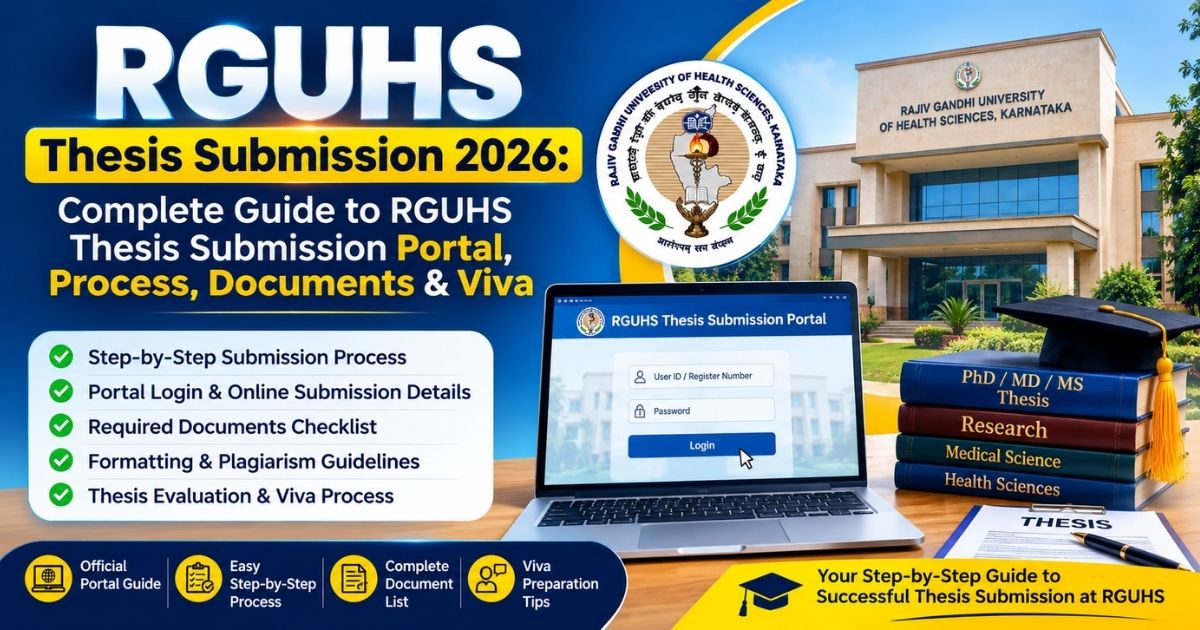
Completing a PhD thesis is a major academic milestone, but the RGUHS thesis submission process can involve several stages, including final synopsis approval, research paper requirements, documentation, plagiarism checking, examiner evaluation, and viva voce. Students searching for the RGUHS thesis submission portal often want to know where to submit, what documents are required, when the thesis can be submitted and what happens after submission.
This 2026 guide explains the RGUHS PhD thesis submission process in simple steps. It is based primarily on information published by Rajiv Gandhi University of Health Sciences (RGUHS), including its Research & Development information and current 2026 notifications. RGUHS states that its R&D Department coordinates and regulates research activities and evaluates submitted synopsis and thesis through experts.
Important: RGUHS updates research notifications and ordinances. Always verify the latest notification applicable to your registration year before submitting your synopsis or thesis.
Table of Contents
- What Is RGUHS Thesis Submission?
- RGUHS Thesis Submission Portal 2026
- RGUHS PhD Thesis Submission Process
- Eligibility Before Thesis Submission
- Final Synopsis Requirements
- Documents Required for RGUHS Thesis Submission
- RGUHS Thesis Format and Preparation
- Plagiarism and Originality Requirements
- Research Paper Publication Requirement
- Important Dates and Submission Timeline
- RGUHS Thesis Submission Fee
- RGUHS Thesis Evaluation Process
- Modification and Re-Submission
- RGUHS Viva-Voce Process
- Common Problems During Thesis Submission
- Step-by-Step Problem-Solving Checklist
- Career Scope After RGUHS PhD
- Comparison Table
- Expert Tips
- Frequently Asked Questions
- Conclusion
What Is RGUHS Thesis Submission?
RGUHS thesis submission is the formal process through which an eligible PhD scholar submits the completed research work to Rajiv Gandhi University of Health Sciences for evaluation.
RGUHS’s Research & Development Department plays an important role in coordinating and monitoring PhD research. The university describes synopsis and thesis submission as part of its rigorous research evaluation process.
A completed thesis generally represents the outcome of:
- Approved research proposal
- PhD registration
- Pre-PhD requirements
- Research work
- Progress monitoring
- Data collection and analysis
- Research publications
- Final synopsis
- Synopsis presentation/approval
- Plagiarism/originality verification
- Thesis submission
- External evaluation
- Viva-voce
RGUHS Thesis Submission Portal 2026
Students commonly search for the RGUHS thesis submission portal because they want a direct online location for uploading or submitting their thesis.
RGUHS currently maintains separate sections for its Research & Development Department, notifications and examinations. The university website also indicates that information hosted before 16 July 2026 may be available through the previous website.
For the latest official information, check:
- RGUHS Research & Development Department
- RGUHS Notifications/Circulars
- RGUHS Examination notifications
- Relevant PhD ordinance
- Notification applicable to your academic year
RGUHS Official Website
RGUHS Research & Development Department
Is there one permanent RGUHS thesis upload portal?
Not necessarily.
A common mistake is assuming that every RGUHS research submission is handled through one permanent public upload page. RGUHS publishes specific research notifications and formats, and the applicable process can depend on the type of submission and academic year.
The RGUHS R&D page currently lists 2026-27 PhD-related notifications, including the preliminary synopsis format and a notification concerning changes in the PhD Ordinance in 2026.
Therefore, do not upload or dispatch a thesis using an unofficial portal simply because it appears in a Google search.
RGUHS PhD Thesis Submission Process 2026
The thesis submission journey can be understood through the following stages:
Research completion → Progress requirements → Final research presentation → Final synopsis → Approval → Thesis preparation → Originality/plagiarism verification → Submission → Examiner evaluation → Corrections, if required → Viva-voce → Degree recommendation
According to RGUHS’s published FAQ information, a candidate must complete the applicable minimum period and submit the approved final synopsis through the prescribed university channel before proceeding toward thesis submission.
Step 1: Complete the Required Research Period
RGUHS’s published FAQ states that the minimum prescribed period is three years for full-time candidates and five years for part-time candidates from provisional registration, subject to the applicable rules.
The university also states that the maximum period can extend to seven years from provisional registration for the categories described in its FAQ, with a possible extension of up to one year with Vice Chancellor permission under the prescribed procedure.
Because the RGUHS PhD Ordinance has been updated in 2026, scholars should verify the rule applicable to their registration year before relying on older timelines.
Step 2: Complete Progress and Academic Requirements
Before reaching final thesis submission, scholars should ensure that:
- Required progress reports have been submitted.
- Pre-PhD requirements have been completed.
- Research work has been completed.
- Guide/supervisor approvals are available.
- Required research publications have been completed.
- The final research presentation has been completed.
- Final synopsis requirements have been satisfied.
- Plagiarism/originality requirements have been addressed.
RGUHS states that six-monthly progress reports are submitted through the guide and considered by the PhD Registration Committee.
RGUHS Final Synopsis Requirements
The final synopsis is an important stage before thesis submission.
RGUHS states that PhD candidates must present their research work before the PhD Registration Committee and subject experts before submitting the final synopsis and should obtain approval for writing the final synopsis and thesis.
A final synopsis should clearly communicate:
- Research problem
- Background
- Objectives
- Methodology
- Study design
- Major findings
- Important results
- Conclusions
- Research contribution
- Key references
Why is synopsis approval important?
The synopsis provides the university and experts with a concise view of the completed research.
If the committee identifies major concerns, the scholar may need to address them before moving forward.
Documents Required for RGUHS Thesis Submission
The exact document list can vary according to the current RGUHS notification and the scholar’s registration category.
A practical preparation checklist may include:
Document / RequirementPurposeApproved final synopsisConfirms final research summaryThesis submission applicationFormal submission requestPhD registration detailsEstablishes research registrationGuide/Supervisor approvalConfirms supervisory authenticationProgress reportsDemonstrates research monitoringPre-PhD documentationConfirms required academic stageResearch publication evidenceSupports publication requirementPlagiarism/originality documentationEstablishes research originalityInstitutional forwarding documentsConfirms institutional approvalFinal thesis copiesMain research documentPrescribed electronic copyDigital thesis record, where requiredOther certificatesAs specified by the latest notification
Do not assume that an older checklist is still valid in 2026. RGUHS currently lists a 2026 notification concerning changes in its PhD Ordinance, so scholars should cross-check their checklist against the latest applicable notification.
RGUHS Thesis Format: What Should the Thesis Contain?
A strong RGUHS PhD thesis should be academically structured, internally consistent and easy for examiners to evaluate.
A typical research thesis structure includes:
- Title Page
- Certificate/Declaration
- Acknowledgement
- Abstract
- Table of Contents
- List of Tables
- List of Figures
- Abbreviations
- Introduction
- Review of Literature
- Research Gap
- Aim and Objectives
- Research Methodology
- Results
- Discussion
- Limitations
- Conclusion
- Recommendations
- References
- Appendices/Annexures
Example
For a nursing PhD thesis, the methodology section should clearly explain:
- Study population
- Sample size
- Sampling method
- Inclusion/exclusion criteria
- Data collection tool
- Ethical approval
- Statistical methods
- Data analysis procedure
For a pharmaceutical research thesis, additional details may include experimental protocols, formulation methods, analytical techniques and validation procedures.
RGUHS Thesis Plagiarism and Originality Requirements
Originality is a critical part of PhD thesis evaluation.
RGUHS has published information regarding the implementation of plagiarism detection software, and its research-related notifications should be checked before final submission.
An older RGUHS ordinance available through the university’s previous website also states that plagiarism checking is mandatory before the thesis is sent for evaluation and that the thesis should contain an originality declaration/certificate.
How to reduce plagiarism risk
Do not simply replace words in copied text.
Instead:
- Understand the source.
- Write the explanation in your own academic language.
- Cite the source.
- Use quotation marks for direct quotations where appropriate.
- Maintain accurate references.
- Check tables and figures separately.
- Verify references against the actual sources.
- Run an institutional plagiarism check before final submission.
Expert Tip
A low similarity percentage alone does not automatically prove research quality. Examiners also consider methodology, originality, research contribution, interpretation and academic integrity.
Research Paper Publication Requirement
Research publications can be an important prerequisite for RGUHS PhD thesis submission.
RGUHS’s FAQ states that PhD candidates should have published a minimum of three research papers from their original research work before submitting the PhD thesis, while Pharmacy candidates are stated to require four research papers in that published guidance.
However, because RGUHS has listed changes to its PhD Ordinance in 2026, candidates should verify whether the publication requirements applicable to their registration have changed.
Publication checklist
Before thesis submission, verify:
- Journal eligibility
- Indexing requirements
- Authorship position
- Publication status
- DOI details
- Volume/issue information
- Research-topic relevance
- University-required documentation
Avoid predatory journals simply to satisfy a publication count.
Important Dates for RGUHS Thesis Submission 2026
There is no single universal thesis-submission date that applies to every RGUHS PhD scholar.
RGUHS publishes research notifications and extensions through its official notification system. The current 2026 notification list includes an extension of the last date for submission of the PhD preliminary synopsis, demonstrating that deadlines can be updated through university notifications.
Therefore, check three dates carefully:
DateWhy It MattersSynopsis submission dateDetermines whether your proposal/final synopsis is accepted on timeThesis submission deadlineDetermines whether the final thesis can be submittedMaximum registration periodDetermines whether an extension is required
Important
Do not rely on WhatsApp messages, old PDFs or unofficial websites for the final deadline.
Always verify the latest RGUHS notification applicable to your batch.
RGUHS Thesis Submission Fee
The exact RGUHS thesis submission fee should be confirmed from the current notification applicable to your programme and registration year.
It is safer not to publish an old fee figure as a universal 2026 fee because university fees and submission procedures can be revised.
RGUHS itself states in its FAQ that fee information is updated through the relevant university sections/notifications.
Before paying any fee, verify:
- Fee amount
- Payment mode
- Challan/payment reference
- Last payment date
- Applicable programme
- Whether late fee applies
- Whether the payment receipt must accompany submission
RGUHS Thesis Evaluation Process
After submission, the thesis enters the evaluation stage.
RGUHS states that a board of three examiners is appointed for PhD thesis adjudication, with the guide normally serving as chairman/coordinator and internal examiner, while external experts are nominated for evaluation.
StageWhat HappensThesis submissionScholar submits completed thesisAdministrative scrutinyDocuments and requirements are checkedExaminer constitutionBoard/examiners are appointedExternal evaluationResearch quality is assessedReportsExaminer observations/recommendations are receivedCorrectionsRequired modifications are completedVivaCandidate defends researchFinal recommendationBoard recommends award subject to requirements
What do examiners usually evaluate?
They may consider:
- Research originality
- Literature review
- Research gap
- Methodology
- Statistical analysis
- Results
- Discussion
- Scientific interpretation
- Limitations
- Research contribution
- References
- Overall academic quality
What Happens If Examiners Ask for Corrections?
A request for corrections does not necessarily mean rejection.
RGUHS states that where modifications and re-submission are suggested, the candidate is informed and asked to incorporate the required modifications within the prescribed period; the modified thesis is then referred again for evaluation.
Example
An examiner may identify:
“The statistical analysis requires additional justification.”
A suitable response could include:
- Review the examiner’s observation.
- Discuss it with the supervisor.
- Re-check the underlying data.
- Add the appropriate statistical explanation.
- Update the relevant chapter.
- Prepare a point-by-point response.
- Submit the revised thesis according to RGUHS instructions.
RGUHS Viva-Voce Process
The viva-voce is the stage where the scholar defends the research before the designated panel.
RGUHS describes an open defence involving the external examiner, guide and co-guide, with a University representative serving as observer.
Common viva questions
Q1. Why did you select this research topic?
Explain the research problem and gap.
Q2. What is the main contribution of your research?
Give a concise answer based on your findings.
Q3. Why did you select this methodology?
Connect the methodology to the research question.
Q4. What are the major limitations?
Be honest and explain how future studies can address them.
Q5. What are the practical implications?
Explain how your findings may benefit healthcare, education, clinical practice, policy or future research.
Common RGUHS Thesis Submission Problems
Students may face several avoidable problems near submission.
ProblemLikely ReasonSolutionSubmission deadline confusionOld notificationCheck latest RGUHS notificationSynopsis not approvedCommittee observationsComplete required revisionsPublication issueJournal doesn’t meet applicable criteriaVerify requirements before submissionPlagiarism concernExcessive similarity or poor citationRevise and run institutional checkMissing certificateIncomplete documentationUse a submission checklistWrong thesis formatOld templateConfirm current formatFee/payment issueIncorrect payment processVerify current notificationPortal confusionMultiple university sectionsFollow official R&D notificationExaminer delayEvaluation processTrack through authorised university/department channelViva preparation problemWeak understanding of researchPrepare methodology, results and limitations
Step-by-Step Solution Before Final Submission
Use this workflow to reduce last-minute errors.
Step 1: Confirm your registration status
Check your provisional registration, programme, guide and applicable ordinance.
Step 2: Check your maximum submission period
Make sure you are within the permissible timeframe or have an approved extension where required.
Step 3: Verify publications
Confirm that your publications satisfy the rules applicable to your batch and discipline.
Step 4: Complete final synopsis
Make sure the final synopsis accurately represents the completed research.
Step 5: Obtain committee approval
Complete the required presentation and approval process.
Step 6: Complete originality/plagiarism verification
Use the institutional process rather than relying only on an unofficial online checker.
Step 7: Prepare the thesis
Check every chapter, table, figure, reference and annexure.
Step 8: Prepare documents
Keep physical and electronic documents according to the latest RGUHS instructions.
Step 9: Verify the notification
Check the latest RGUHS Research & Development notification before submission.
Step 10: Submit through the prescribed channel
Follow the exact submission route specified by the applicable notification.
Admission-Specific Information: Eligibility, Documents, Fees and Reservation
Because this article focuses on RGUHS thesis submission, admission requirements are different from final thesis requirements.
For candidates entering the RGUHS PhD programme, the university FAQ states that candidates with a Master’s degree in relevant Health Science courses of RGUHS, or an equivalent PG qualification accepted by the university, may be eligible.
RGUHS also states that PhD applications may require documents such as:
- Application form
- Application fee proof
- Research proposal
- Proposed guide/supervisor consent
- NOC from the relevant institution
- Supporting qualification documents
Admission vs Thesis Submission
FactorPhD AdmissionThesis SubmissionMain objectiveEnter research programmeComplete research degreeResearch proposalRequiredFinal research is completedGuide approvalRequiredRequiredEligibilityAcademic eligibilityRegistration and research requirementsSynopsisInitial proposalFinal synopsisThesisNot applicableMandatoryVivaNot applicableRequiredPublicationsDepends on applicable rulesImportant prerequisite under RGUHS rulesReservationApplicable according to admission rulesNot an admission-stage issue
Scholarship Information
Scholarship availability should be checked separately against the current RGUHS or applicable government scholarship notification. Do not assume that admission scholarship rules automatically apply to thesis submission.
Reservation Policy
Reservation is primarily relevant to admission and seat allocation rather than the academic evaluation of a completed thesis. Candidates should follow the reservation rules applicable to their admission category and academic year.
RGUHS Thesis vs Dissertation Submission
The terms thesis and dissertation are sometimes used interchangeably by students, but the applicable process can differ according to programme.
FeaturePhD ThesisPG DissertationAcademic levelDoctoralPostgraduateResearch depthExtensiveProgramme-specificEvaluationPhD examiner processProgramme/exam processVivaPhD viva-voceDepends on programmeRGUHS R&D involvementStrongDepends on disciplinePublication requirementApplicable under PhD rulesDepends on programmeSubmission deadlinePhD notification/ordinanceExamination notification
RGUHS’s 2026 examination notifications separately list dissertation submission schedules for various postgraduate and super-speciality programmes, showing why students should not confuse a PG dissertation deadline with a PhD thesis deadline.
Career Scope After RGUHS PhD
Completing a PhD can expand opportunities across academic, research and healthcare-related environments.
Potential Career Opportunities
- Assistant Professor
- Associate Professor
- Research Scientist
- Clinical Researcher
- Research Consultant
- Principal Investigator
- Academic Researcher
- Healthcare Research Professional
- Research Project Coordinator
- Scientific Writer
- Research & Development Specialist
Future Opportunities
A doctoral qualification may support careers in:
- Universities
- Medical colleges
- Research institutions
- Hospitals
- Pharmaceutical companies
- Biotechnology organisations
- Public-health organisations
- Clinical research organisations
- Government research projects
- Healthcare innovation
Skills That Improve Career Prospects
A PhD alone is not enough for every research role.
Develop skills in:
- Research methodology
- Biostatistics
- SPSS/R/Python
- Scientific writing
- Systematic literature review
- Research ethics
- Data visualisation
- Grant writing
- Journal publishing
- Presentation skills
- Academic communication
Top Organisations and Recruiter Categories
Depending on discipline and role, PhD graduates may explore opportunities with:
- Medical colleges
- Universities
- Government research organisations
- Pharmaceutical companies
- Biotechnology companies
- Hospitals
- Clinical research organisations
- Public-health institutions
Expert Tips for a Successful RGUHS Thesis Submission
1. Do not wait until the deadline
Start document verification several weeks before the expected submission date.
2. Maintain a research document folder
Keep:
- Registration documents
- Progress reports
- Publications
- Certificates
- Ethical approval
- Data-analysis outputs
- Synopsis
- Plagiarism report
- Guide communications
- Payment receipts
3. Check every reference
A thesis can lose credibility because of incorrect references even when the research itself is strong.
4. Keep the thesis and publications consistent
The research question, objectives, methodology and results should not contradict your published papers.
5. Prepare for examiner questions
Do not memorise the thesis.
Understand it.
6. Check the 2026 ordinance
RGUHS currently lists a notification concerning changes in the PhD Ordinance in 2026. Therefore, older blogs and PDFs should not automatically be treated as the current rule.
Original Example: RGUHS PhD Thesis Submission Timeline
Consider a hypothetical PhD scholar who has completed the required research work.
Month 1
- Finalise research analysis
- Complete remaining chapters
- Discuss thesis with supervisor.
Month 2
- Prepare final synopsis
- Complete research presentation
- Address committee feedback
Month 3
- Complete plagiarism/originality verification
- Finalise publications documentation
- Prepare submission documents
Month 4
- Verify current RGUHS notification.
- Complete prescribed submission process.
- Submit thesis
After Submission
- Thesis enters evaluation
- Examiner reports are processed.
- Corrections may be required.
- Viva-voce is conducted
- Final recommendation is made.
This is an illustrative planning example, not an official RGUHS timeline.
E-E-A-T Checklist for RGUHS Thesis Information
For students researching an important academic process, trustworthy information matters.
This guide uses:
- Official RGUHS Research & Development information
- Official RGUHS FAQs
- Official RGUHS notifications
- 2026 university information
- Clear distinction between current and older requirements
- Warnings against relying on unofficial portals
- Practical examples
- Step-by-step explanations
RGUHS’s official website identifies the university as a state health sciences university established under the RGUHS Act and provides dedicated Research & Development and notification sections.
Frequently Asked Questions About RGUHS Thesis Submission
1. What is RGUHS thesis submission?
RGUHS thesis submission is the formal process of submitting a completed PhD research thesis to Rajiv Gandhi University of Health Sciences for academic evaluation.
2. Where can I find the RGUHS thesis submission portal?
Check the official RGUHS Research & Development and notification sections for the submission method applicable to your programme and academic year. RGUHS’s current website also maintains a separate notifications section for updated university instructions.
3. Can I submit my thesis without final synopsis approval?
The RGUHS FAQ indicates that candidates must obtain approval of the final synopsis before proceeding with thesis submission.
4. How many research papers are required for RGUHS PhD thesis submission?
RGUHS’s published FAQ states a minimum of three research papers from original research for PhD candidates and four for Pharmacy candidates. Because a 2026 PhD Ordinance change is listed by RGUHS, candidates should confirm the current requirement for their registration year.
5. Is plagiarism checking required?
RGUHS has published information concerning plagiarism detection, and its earlier PhD guidance states that plagiarism checking is mandatory before evaluation. Candidates should follow the latest applicable university procedure.
6. Who evaluates an RGUHS PhD thesis?
RGUHS states that a board of three examiners is appointed for PhD thesis adjudication, including external experts nominated according to the university process.
7. What happens if an examiner asks for corrections?
The candidate may be required to modify and resubmit the thesis within the prescribed period. RGUHS states that a modified thesis can be referred again to the concerned examiner for re-evaluation.
8. Is viva-voce compulsory after thesis evaluation?
The RGUHS process includes an open viva-voce defence following thesis evaluation and applicable examiner recommendations.
9. What should I do if the thesis submission deadline is extended?
Follow the latest official RGUHS notification rather than an older deadline. RGUHS publishes research-related deadline updates through its notification system.
10. Can I rely on an old RGUHS thesis format?
It is better not to. RGUHS currently lists 2026 PhD-related notifications, including a notification concerning changes to the PhD Ordinance. Verify the latest format before submission.
Final RGUHS Thesis Submission Checklist
Before submitting, verify:
- PhD registration is valid.
- Required research period is completed.
- Progress reports are complete.
- Pre-PhD requirements are complete.
- Required publications are verified.
- Final research presentation is complete.
- Final synopsis is approved.
- Thesis chapters are final.
- References are checked
- Tables and figures are numbered correctly.
- Plagiarism/originality requirements are completed.
- Guide/Supervisor approval is obtained.
- Required certificates are attached.
- Fee/payment requirement is verified.
- Current 2026 notification is checked.
- Submission channel is confirmed.
- Electronic and physical copies are prepared as required.
- Viva preparation has started.
Conclusion
RGUHS thesis submission is not simply the act of handing over a completed research document. It is a structured academic process involving research completion, progress requirements, final synopsis approval, publication requirements, originality verification, documentation, thesis evaluation and viva-voce.
For 2026, students should pay particular attention to the latest RGUHS Research & Development notifications because the university is publishing updated PhD-related information, including a notification on changes to the PhD Ordinance.
If you are unsure about your RGUHS thesis submission portal, thesis format, synopsis, research paper requirement, plagiarism report, documentation or viva preparation, first verify the latest university notification and then take expert academic guidance for the specific stage of your PhD.
Need help with RGUHS PhD thesis preparation, research methodology, data analysis, formatting, synopsis preparation or viva preparation?
WhatsApp: +91 96438 02216
Get structured academic guidance from research professionals and make your thesis submission process more organised, accurate and deadline-focused.