
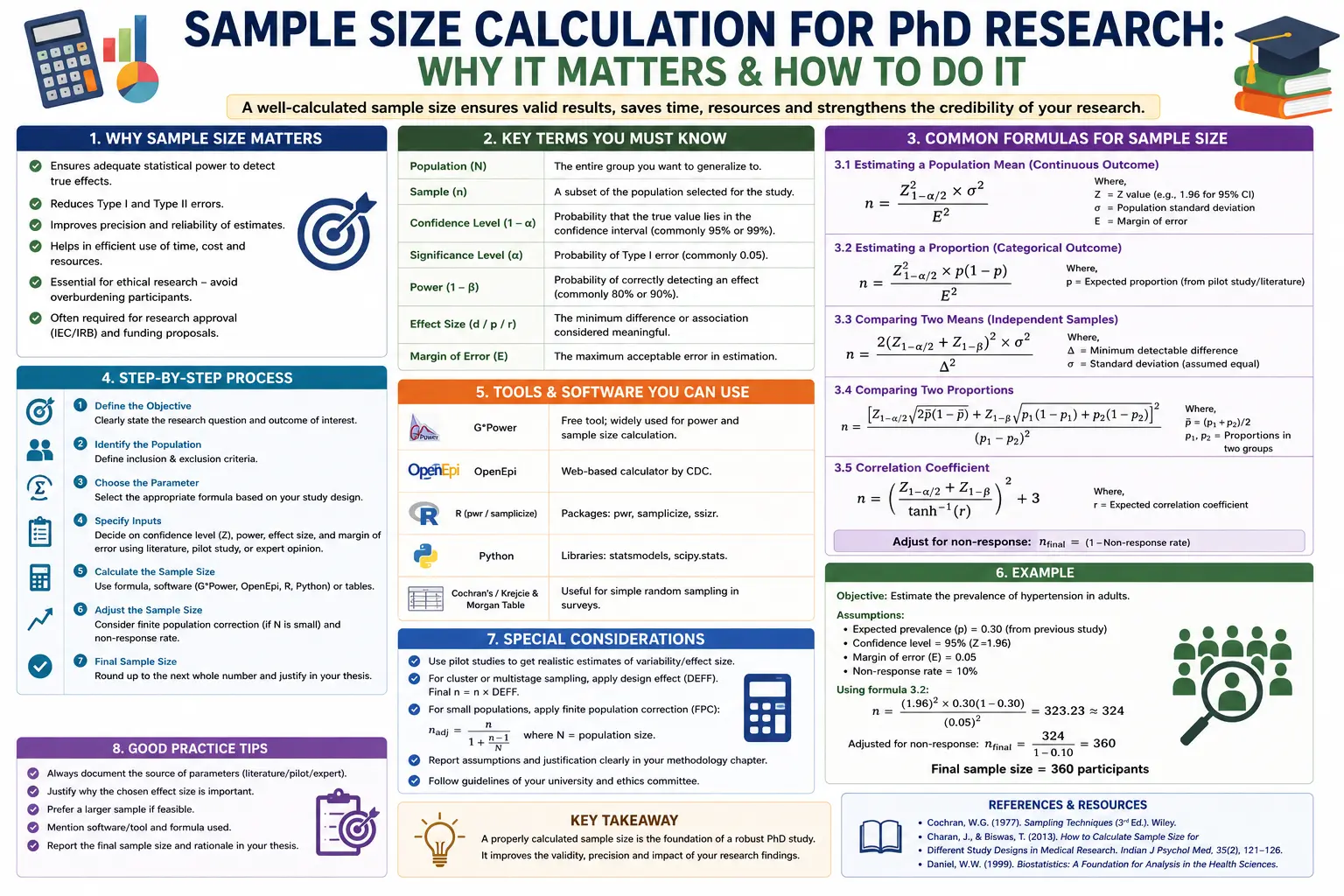
One of the most important decisions in any PhD research project is determining the right sample size. Whether you're conducting surveys, experiments, interviews, clinical studies, or observational research, the number of participants or observations you include directly affects the reliability, validity, and credibility of your findings.
Unfortunately, many PhD scholars either choose a sample size based on convenience or rely on arbitrary numbers without proper statistical justification. This can lead to unreliable results, reduced statistical power, biased conclusions, and criticism from supervisors, thesis examiners, or journal reviewers.
A well-calculated sample size ensures that your study has enough data to answer the research questions accurately without wasting time, resources, or participant effort. It also demonstrates that your research design is scientifically sound and ethically responsible.
In this comprehensive guide, you'll learn what sample size is, why it matters, the factors that influence it, common calculation methods, formulas, software tools, and best practices for determining the right sample size for your PhD research.
What Is Sample Size?
Sample size refers to the number of participants, observations, cases, or experimental units included in a research study.
Instead of studying an entire population—which is often impractical or impossible—researchers collect data from a representative sample and use the findings to draw conclusions about the larger population.
Example
Suppose you are studying job satisfaction among teachers in a state with 80,000 teachers.
Surveying every teacher would be costly and time-consuming. Instead, you might collect data from 400–600 teachers, provided the sample is selected appropriately and justified statistically.
The accuracy of your conclusions depends greatly on whether this sample size is sufficient.
Why Does Sample Size Matter in PhD Research?
Choosing the right sample size is essential because it affects every stage of your research.
A suitable sample size helps:
- Increase the accuracy of estimates.
- Improve statistical power.
- Reduce sampling error.
- Enhance the credibility of findings.
- Produce more reliable hypothesis tests.
- Increase the likelihood of publication in peer-reviewed journals.
An inappropriate sample size, however, can undermine even the most carefully designed study.
Problems with a Sample Size That Is Too Small
Many PhD scholars struggle to recruit participants and end up using very small samples.
A small sample may lead to:
- Low statistical power.
- Wide confidence intervals.
- Failure to detect meaningful effects.
- Unstable statistical estimates.
- Reduced generalizability.
- Greater influence of random variation.
As a result, important relationships may remain undetected even when they truly exist.
Problems with a Sample Size That Is Too Large
While larger samples generally increase precision, excessively large samples are not always beneficial.
Oversized studies may:
- Increase research costs.
- Require unnecessary time and effort.
- Raise ethical concerns by involving more participants than needed.
- Detect statistically significant but practically unimportant differences.
The goal is not to obtain the largest sample possible but to determine the appropriate sample size for your research objectives.
Factors That Influence Sample Size
Several factors determine how many participants you need.
1. Research Design
Different research designs require different sample sizes.
Examples:
- Cross-sectional surveys
- Experimental studies
- Longitudinal research
- Case-control studies
- Cohort studies
- Qualitative interviews
Experimental studies often require power analyses, while qualitative studies focus on data saturation.
2. Population Size
The total number of individuals in the target population influences sample size calculations, particularly for smaller populations.
Example:
Studying 500 employees in one organization requires a different calculation than studying all employees in a country.
3. Margin of Error
The margin of error indicates how much your sample estimate may differ from the true population value.
Common choices include:
- ±5%
- ±3%
- ±2%
A smaller margin of error requires a larger sample.
4. Confidence Level
The confidence level reflects how certain you want to be that the confidence interval contains the true population value.
Common confidence levels are:
Confidence Level Typical Use
90% Exploratory studies
95% Most academic research
99% High-precision studies
Higher confidence levels generally require larger samples.
5. Population Variability
Greater variability within the population usually requires a larger sample to estimate population characteristics accurately.
If little is known about variability, researchers often make conservative assumptions or use evidence from previous studies or pilot data.
6. Expected Effect Size
Effect size represents the magnitude of the relationship or difference you expect to detect.
General interpretation:
- Small effect
- Medium effect
- Large effect
Smaller expected effects require larger sample sizes because they are more difficult to detect statistically.
7. Statistical Power
Statistical power is the probability of detecting a true effect if one exists.
Most researchers aim for 80% power, although 90% power may be appropriate for some studies.
Higher statistical power generally requires larger sample sizes.
Types of Sample Size Calculations
The appropriate method depends on your research design and analytical approach.
Sample Size for Surveys
Survey research commonly uses formulas based on:
- Population size
- Margin of error
- Confidence level
- Estimated population proportion
Many online calculators simplify these computations.
Sample Size for Experimental Research
Experimental studies often use power analysis, which considers:
- Expected effect size
- Significance level (α)
- Desired statistical power
- Planned statistical test
Power analysis is widely regarded as the preferred approach for experimental research.
Sample Size for Regression Analysis
Regression models require sufficient observations relative to the number of predictor variables.
Although rules of thumb exist, formal power analysis is preferable because the required sample depends on expected effect sizes and model complexity.
Sample Size for Factor Analysis
Factor analysis generally requires relatively large samples.
Common recommendations include:
- At least 150–200 participants.
- Approximately 5–10 participants per questionnaire item.
However, required sample sizes also depend on factor loadings, communalities, and model complexity.
Sample Size for Structural Equation Modeling (SEM)
SEM usually requires larger samples because it estimates multiple relationships simultaneously.
The exact requirement depends on the complexity of the model, estimation method, and expected effect sizes.
Researchers should justify SEM sample sizes using methodological literature or power analysis whenever possible.
Sample Size for Qualitative Research
Qualitative studies do not usually rely on statistical power calculations.
Instead, researchers aim for data saturation, the point at which additional interviews or observations no longer produce substantially new insights.
Typical ranges vary depending on methodology:
- Phenomenology
- Grounded theory
- Case studies
- Ethnography
The focus is on depth rather than numerical representation.
Common Sample Size Formulas
For estimating a population proportion in large populations, a commonly used formula is:
n = (Z² × p × (1 − p)) / E²
Where:
- n = Required sample size
- Z = Z-score corresponding to the chosen confidence level
- p = Estimated population proportion
- E = Margin of error
If the population is relatively small, a finite population correction may be applied.
In practice, many researchers use software or online calculators rather than calculating sample size manually.
Popular Sample Size Calculators
Several trusted tools help researchers determine appropriate sample sizes.
1. G*Power
One of the most widely used free software programs for statistical power analysis.
Suitable for:
- t-tests
- ANOVA
- Regression
- Correlation
- Chi-square tests
2. OpenEpi
Useful for:
- Epidemiological studies
- Public health research
- Survey sample calculations
3. Raosoft Sample Size Calculator
A simple online calculator frequently used for questionnaire-based research.
4. Cochran-Based Online Calculators
Many websites implement Cochran's formula for estimating survey sample sizes.
Always verify that the assumptions match your study before relying on any calculator.
Sampling Technique and Sample Size
Sample size alone does not guarantee high-quality research.
Your sampling technique is equally important.
Common methods include:
Probability Sampling
- Simple random sampling
- Stratified sampling
- Cluster sampling
- Systematic sampling
These approaches generally improve representativeness.
Non-Probability Sampling
- Convenience sampling
- Purposive sampling
- Snowball sampling
- Quota sampling
These methods are common in exploratory and qualitative research but may limit generalizability.
Always explain why your chosen sampling strategy is appropriate.
How to Report Sample Size in a PhD Thesis
Your methodology chapter should clearly describe:
- Target population.
- Sampling frame.
- Sampling technique.
- Sample size calculation method.
- Assumptions used (confidence level, effect size, power, etc.).
- Number of participants approached.
- Number of responses received.
- Final number included in the analysis.
- Reasons for excluding incomplete responses.
Example
A priori power analysis indicated that a minimum sample of 280 participants was required to detect a medium effect size with 80% statistical power at a 5% significance level. A total of 320 valid responses were analyzed after excluding incomplete questionnaires.
Clear reporting enhances transparency and strengthens methodological credibility.
Common Mistakes to Avoid
Many doctoral researchers make avoidable errors when determining sample size.
Some common mistakes include:
- Choosing a sample size based solely on convenience.
- Failing to justify the chosen sample.
- Ignoring expected effect size and statistical power.
- Using rules of thumb without considering study design.
- Confusing population size with sample size.
- Assuming larger samples automatically produce better research.
- Overlooking anticipated non-response when planning recruitment.
- Not reporting how the final sample was obtained.
Avoiding these pitfalls will improve the quality of your thesis and increase confidence in your findings.
Best Practices for Sample Size Calculation
To ensure your study is methodologically sound:
- Define your research objectives clearly before calculating sample size.
- Choose a calculation method appropriate for your research design.
- Base assumptions on previous studies or pilot data whenever possible.
- Conduct an a priori power analysis for hypothesis-testing studies.
- Plan for non-response or participant attrition by recruiting more participants than the minimum required.
- Document all assumptions and calculation procedures.
- Consult a statistician if your study involves complex designs or advanced analytical methods.
- Follow your university's guidelines and your supervisor's recommendations.
Frequently Asked Questions (FAQs)
What is the ideal sample size for a PhD thesis?
There is no universal sample size. The appropriate number depends on the research design, statistical methods, expected effect size, desired precision, and study objectives. Every sample size should be scientifically justified.
Is 100 participants enough for PhD research?
It depends on the methodology. For some qualitative studies or small experimental designs, 100 participants may be sufficient. For large surveys, regression analyses, or structural equation models, a larger sample may be necessary.
Which confidence level is commonly used?
A 95% confidence level is the standard choice for most academic research because it balances precision and practicality.
What is statistical power?
Statistical power is the probability of detecting a true effect if one exists. Researchers commonly aim for 80% power, although higher values may be appropriate in some situations.
Can I use an online sample size calculator?
Yes, provided the calculator is appropriate for your study design and you understand the assumptions it uses. Report the calculation method transparently in your methodology chapter.
Conclusion
Determining the right sample size is one of the most important methodological decisions in PhD research. A carefully justified sample size strengthens the reliability of your findings, improves statistical validity, enhances ethical research practice, and increases the credibility of your thesis in the eyes of supervisors, examiners, and journal reviewers.
Rather than relying on arbitrary rules or convenience, researchers should base sample size decisions on scientific principles such as confidence level, margin of error, expected effect size, statistical power, and the chosen research design. Whether your study involves surveys, experiments, regression analysis, factor analysis, structural equation modeling, or qualitative interviews, selecting the appropriate approach to sample size calculation is essential for producing meaningful and trustworthy results.
By planning your sample size early, documenting your methodology clearly, and using established calculation methods or power analysis tools, you can lay a strong foundation for a rigorous PhD study that meets international standards of academic research.
Website: www.thesislikho.com
Call/WhatsApp: +91 96438 02216