
You know how you're going to collect your data. You know who your participants or samples will be. The hard part is explaining both clearly, convincingly, and briefly enough to fit inside a synopsis that's already tight on space. This guide walks through exactly how to explain sampling and data collection in a synopsis — what committees expect to see, how much detail is enough, and how to avoid the vague phrasing that gets proposals sent back for revision.
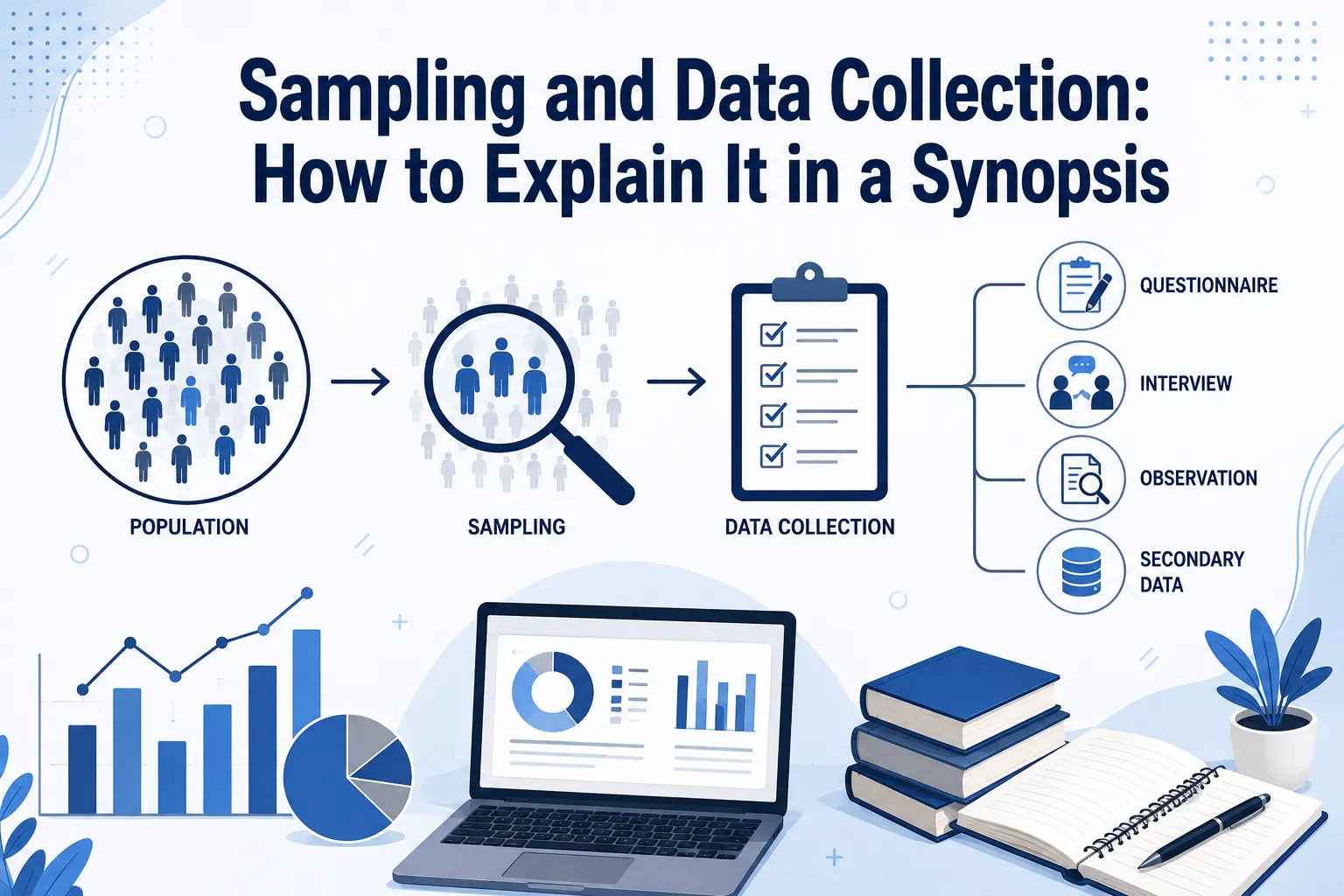
Sampling and data collection are related but distinct components of your methodology. Sampling involves selecting a representative subset of the population being studied, while data collection involves gathering data using your chosen research instruments — surveys, interviews, lab equipment, and so on. A synopsis needs to explain both clearly, and just as importantly, show how they connect to each other.
Why This Section Gets Scrutinized So Closely
Discussing your sampling process matters because it determines how representative your sample actually is of the wider population — and that directly affects your study's validity. Transparency in sampling methods is what allows committees to trust that your eventual conclusions are reproducible, not accidental. Similarly, how — and how many — respondents, objects, or units you choose to study has direct implications for what generalisations you'll be able to make later, and for the overall reliability of your findings. Vague or underspecified sampling language at the synopsis stage is one of the fastest ways to raise committee doubts before data collection has even begun.
What Changes at the Synopsis Stage vs. the Full Thesis
A synopsis-specific methodology summary should elaborate on your research design, data collection methods, sample or participants, and analysis method — but the emphasis shifts somewhat compared to the full thesis. At synopsis stage, you're moving from full justification (expected later, in the complete methodology chapter) toward clear description with a brief defence of your choices. In practice, this means: name your approach, explain why it fits your research question in a sentence or two, and move on — you don't need to pre-empt every possible methodological objection at this stage.
Keep the overall length constraint in mind too. A commonly cited academic synopsis format sets a firm ceiling of 3,000–4,000 words excluding appendices — which means your sampling and data collection explanation typically needs to fit within a few tightly written paragraphs, not a standalone chapter.
How to Explain Your Sampling Strategy
State Whether You're Using Probability or Non-Probability Sampling
Your sampling strategy should explicitly name which category applies — probability sampling (random, stratified, systematic) or non-probability sampling (convenience, purposive, snowball) — and this choice must be justified in relation to your specific research goals, not simply stated without rationale. A sentence like "purposive sampling will be used because the study requires participants with specific domain expertise not evenly distributed across the general population" does far more work than simply writing "purposive sampling will be used."
Specify Your Population and Sample Size
Name your target population precisely (e.g., "mid-level managers in manufacturing firms in Telangana" rather than "employees in India") and state your intended or actual sample size. If your sample size is based on a formula, a precedent from similar published studies, or a pilot study, briefly say so — this signals that the number wasn't chosen arbitrarily.
Explain How Participants or Units Will Be Selected
Briefly describe the practical selection process — how you'll identify and recruit participants, or how you'll select the specific units (documents, firms, samples) for a non-human-subject study. This is where committees check that your plan is actually executable, not just theoretically sound.
How to Explain Your Data Collection Method
State Where, When, and How Data Will Be Collected
Your data collection description should specify where, when, and how data were or will be collected — including administration procedures, interview format, survey distribution method, observation protocols, or document selection rules. Avoid vague statements about the process; committees want to see a plan they could actually follow.
Match Your Method to Your Research Type
Quantitative research typically relies on surveys, lab-equipment-generated data, analytics software, or existing datasets, while qualitative research typically uses interviews, focus groups, participant observation, or ethnography. Make clear in your synopsis which category — or combination, for mixed-methods work — applies, and briefly explain why it fits your specific research question rather than simply naming the instrument.
Mention Your Pilot Study Plan, If Applicable
For Indian PhD scholars, particularly in management, commerce, and social sciences, structured questionnaire survey research using Likert scales is the most common approach. Running a pilot study on 30–50 respondents before full-scale data collection is considered a methodological requirement rather than an optional step, since it tests instrument clarity, identifies ambiguous questions, and checks reliability before the main study begins. If your design includes a pilot study, mention it briefly — it signals methodological rigor to your committee.
Discipline-Specific Emphasis to Keep in Mind
How heavily this section gets weighted varies by discipline:
- Sciences & Engineering committees expect detailed explanations of experimental design, instrumentation, data collection methods, and statistical analyses, with precise hypothesis formulation
- Social Sciences & Humanities committees give primacy to theoretical framework and reflexivity, though sampling and data collection still need to be clearly described
- Management & Business Studies committees expect confirmed industry access for primary data collection to be established before submission — don't propose a sampling plan requiring access you haven't yet secured
Addressing Reliability, Validity, and Limitations Briefly
Address reliability and validity (or credibility, transferability, and reflexivity, if your work is qualitative) using terminology appropriate to your chosen approach. Also disclose any limitations directly — sample size constraints, access issues, missing data, or measurement limits — along with a brief note on how you plan to manage them, rather than leaving these unaddressed. Even two or three sentences here shows the committee you've thought critically about your design's weaknesses, not just its strengths.
Step-by-Step: Writing This Section of Your Synopsis
- State your research approach (quantitative, qualitative, or mixed methods) in one sentence
- Name your target population and intended sample size
- State your sampling strategy (probability or non-probability, and the specific type) with a brief justification
- Describe your data collection instrument and method precisely — where, when, and how
- Mention your pilot study plan, if applicable
- Briefly address reliability/validity or credibility/trustworthiness
- Disclose any anticipated limitations and how you'll manage them
- Read the section back and cut anything that repeats what's already implied elsewhere
Practical Checklist: Is Your Sampling and Data Collection Section Ready?
- Research approach (quantitative/qualitative/mixed) is stated clearly
- Target population is named precisely, not generically
- Sample size is specified, with brief justification if based on a formula or precedent
- Sampling strategy (probability or non-probability, specific type) is named and justified
- Data collection instrument and procedure (where, when, how) are described specifically
- Method matches the research type (survey/instrument-based for quantitative; interview/observation-based for qualitative)
- Pilot study plan is mentioned, if applicable
- Reliability/validity or credibility/trustworthiness is briefly addressed
- Anticipated limitations are disclosed along with how they'll be managed
- Section fits within the synopsis's overall word or page limit without vague filler
Two Practical Scenarios
Scenario 1 — Strengthening a Vague Sampling Statement A scholar's initial synopsis draft stated only: "A sample of employees will be surveyed using a questionnaire." A committee member flagged this as too vague to evaluate. The revised version specified: "A stratified random sample of 250 mid-level managers across five manufacturing firms in Telangana will be surveyed using a structured Likert-scale questionnaire, piloted on 40 respondents to test item clarity before full deployment." The added specificity — population, sample size, sampling type, instrument, and pilot plan — satisfied the committee's request for a clear, executable plan.
Scenario 2 — Addressing an Access Limitation Proactively A management scholar proposing primary data collection from a specific industry hadn't yet secured formal access when drafting their synopsis. Rather than presenting the plan as fully settled, they explicitly noted in the limitations section that industry access was in progress and outlined a backup plan using a related but more accessible sector if formal access wasn't confirmed by the data collection stage — a proactive disclosure that satisfied the committee's expectation that access be addressed before, not after, approval.
Common Mistakes Scholars Make in This Section
- Naming a sampling method without justifying why it fits the specific research goals, leaving the committee to guess the rationale.
- Describing data collection vaguely ("data will be collected via survey") instead of specifying administration procedures, timing, and format.
- Omitting sample size justification entirely, making the number look arbitrary.
- Skipping the pilot study mention for quantitative survey-based designs, where it's often expected as standard practice.
- Failing to disclose access-related limitations for primary data collection, particularly in management and business studies contexts where this is specifically scrutinized.
Frequently Asked Questions
What is sampling and data collection: how to explain it in a synopsis?
It refers to the specific way a scholar describes, within the space constraints of a synopsis, who or what will be studied (sampling) and how the relevant data will actually be gathered (data collection) — covering population, sample size, sampling strategy, and data collection instrument with enough precision for a committee to evaluate feasibility.
Why does explaining sampling and data collection clearly matter in a synopsis?
Vague sampling or data collection descriptions are one of the most common reasons synopses are sent back for revision, since committees need this section to judge whether the proposed study is both valid and feasible before granting approval.
How does this section affect a synopsis's approval chances?
A precise, well-justified sampling and data collection plan signals methodological readiness; a vague or underspecified one raises doubts that can delay approval regardless of how strong the rest of the synopsis is.
How long does it take to complete a synopsis using this approach?
Scholars who plan their sampling and data collection details precisely before drafting typically move through this section faster, since they avoid the back-and-forth revision that vague initial descriptions tend to trigger.
Is professional help available for sampling and data collection explanation in a synopsis?
Yes. ThesisLikho's PhD-qualified mentors have guided 10,000+ scholars through synopsis methodology drafting, sampling strategy planning, and complete thesis writing assistance tailored to individual university requirements.
Get Expert Guidance on Your Synopsis Methodology
Explaining sampling and data collection clearly, within a tight word limit, takes practiced judgment about what to include and what to leave for the full methodology chapter later. If you'd like expert input on tightening this section of your synopsis, ThesisLikho's PhD-qualified team offers methodology drafting support, sampling strategy guidance, and complete thesis writing assistance. If you need expert guidance with your synopsis methodology, sampling plan, or overall structure, you can explore our Synopsis Writing Assistance service.
Get Synopsis Help Now → https://thesislikho.com/writing-services/synopsis-writing