
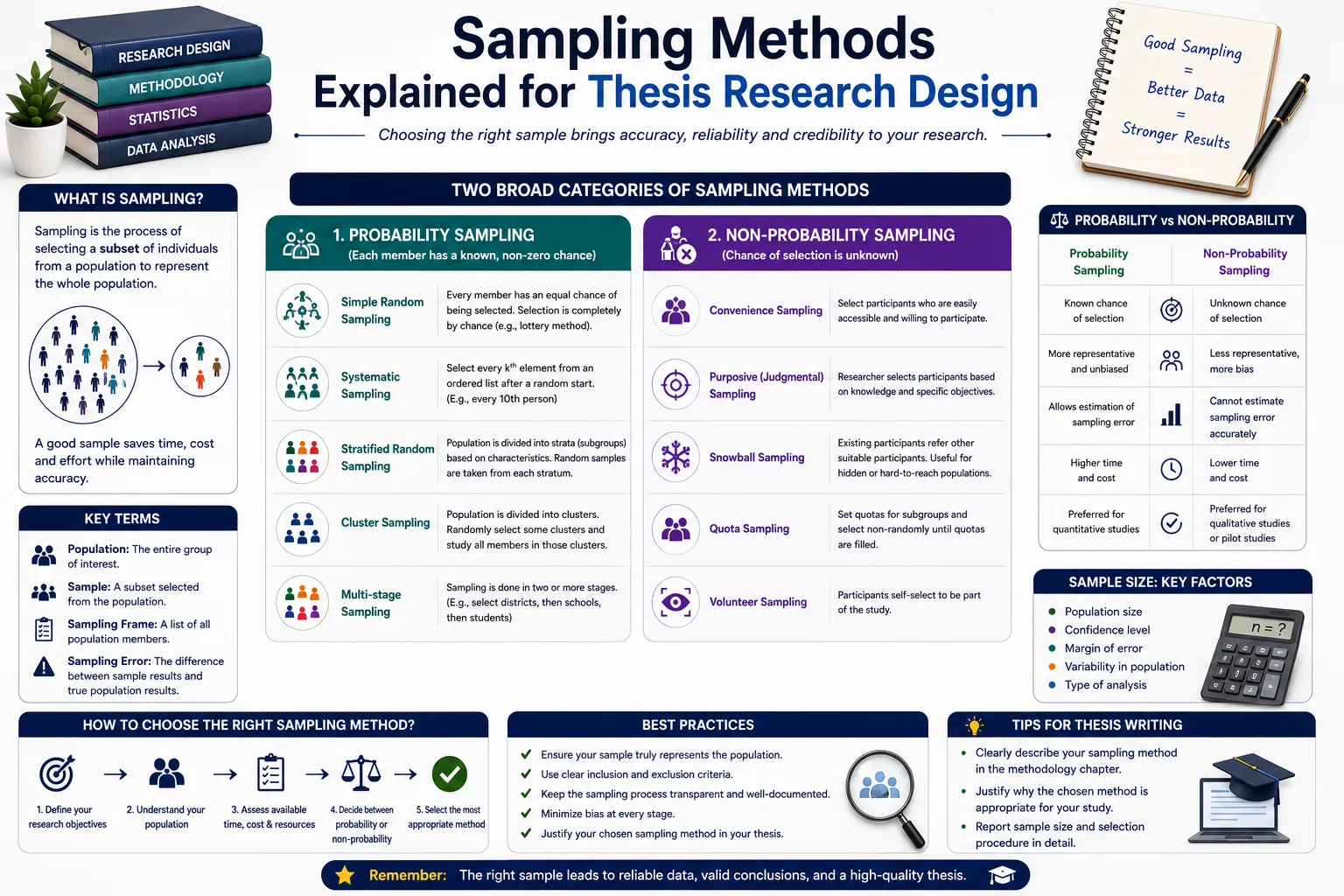
Almost every methodology chapter runs into the same quiet decision point: who exactly will you study, and how will you actually select them from the larger group you're interested in? This is sampling, and getting it right (and justified) shapes everything that follows — your data's credibility, how far your conclusions can reasonably extend, and how confidently you can defend your results later.
This guide explains sampling methods for thesis research design in plain terms — what the major techniques actually are, when each one genuinely fits, and how to justify your choice convincingly rather than just naming it. We've written it the way an experienced thesis mentor would talk you through your own sampling decision, because that's genuinely the kind of guidance ThesisLikho's PhD-qualified team provides to the thousands of scholars we've supported through exactly this stage.
The Core Split: Probability vs. Non-Probability Sampling
Every sampling technique falls into one of two broad categories, and understanding this split first makes everything else in this guide easier to place. Probability sampling means every member of your target population has a known, non-zero chance of being selected into your sample — this randomization is precisely what allows you to statistically generalize your findings back to the wider population with a stated degree of confidence. Non-probability sampling means selection isn't randomized in this way; some members of the population may have no realistic chance of being included at all, which means the sample's representativeness can't be statistically guaranteed, even if the sample still produces genuinely valuable data.
Neither category is inherently superior — each is built for a different purpose. Probability sampling exists to support generalizable, population-level claims. Non-probability sampling exists to support depth, accessibility, and relevance, particularly when a full randomized approach isn't feasible or isn't actually what your research question needs.
Probability Sampling Methods Explained
Simple random sampling gives every member of your population an equal chance of selection, typically achieved through a random number generator or an equivalent randomization method applied to a complete population list. It's the most straightforward probability method conceptually, but it requires you to actually have a complete, accessible list of your entire population — something that's often harder to obtain in practice than it sounds.
Systematic sampling selects every nth member from a population list, starting from a randomly chosen point. This is often more practical than simple random sampling when you have a long list to work through, since it avoids needing to generate and cross-reference random numbers against every entry, while still preserving much of probability sampling's statistical logic.
Stratified sampling divides your population into meaningful subgroups — strata — based on a characteristic relevant to your research (income level, age group, department, region), then samples proportionally from within each stratum. This is particularly useful when you specifically want to compare results across subgroups, or when you need to ensure smaller subgroups aren't underrepresented relative to their actual share of the population.
Cluster sampling randomly selects whole naturally occurring groups — schools, branches, districts — rather than individuals directly, then either samples within those selected clusters or includes everyone in them. This significantly reduces the logistical cost of reaching a geographically spread-out population, though it comes with a trade-off: individuals within the same cluster often resemble each other more than the broader population does, which can introduce a specific kind of sampling error worth acknowledging in your methodology chapter.
Non-Probability Sampling Methods Explained
Convenience sampling selects whoever is easiest to access — students in your own class, respondents at a single accessible location, an existing contact list. It's fast and low-cost, which is exactly why it's so common in thesis-level research, but it comes with a real generalizability trade-off that needs to be acknowledged rather than glossed over.
Purposive (or judgmental) sampling deliberately selects participants because they have specific expertise, characteristics, or experience directly relevant to your research question. This is the standard, well-accepted approach for most qualitative research, since the goal isn't statistical representativeness but rather access to genuinely information-rich perspectives — a study on managerial decision-making during a crisis, for instance, would purposively seek out managers who've actually navigated one, rather than sampling managers broadly.
Snowball sampling starts with a small number of accessible participants who then refer additional participants they know meet your selection criteria. This works particularly well for hard-to-reach or specialized populations — a study on a niche professional community, for example, where no complete population list exists and personal referral is genuinely the most realistic way to build a sample.
Quota sampling sets target numbers for specific subgroups (similar in spirit to stratified sampling) but without randomizing selection within those subgroups — researchers simply recruit until each quota is filled, using whatever accessible means available. This offers some of stratified sampling's subgroup-balance benefit without requiring a complete, randomizable population list.
Matching Sampling Method to Research Design
A useful starting heuristic, though never a substitute for your own specific justification: experimental research typically uses simple random or stratified sampling to assign participants to groups fairly. Broad survey research aiming for population-level claims often uses stratified or cluster sampling, particularly across large or diverse populations. Qualitative research typically uses purposive or snowball sampling to reach genuinely information-rich cases rather than a statistically representative cross-section. Early-stage exploratory or pilot research commonly uses convenience sampling as a practical, low-cost starting point, with the explicit understanding that a later, more rigorous phase might use a different technique if the research develops into a larger study.
The underlying logic worth internalizing: your sampling method should follow directly from what your research question actually needs — a generalizable population-level claim, or a rich, specific understanding of a smaller, deliberately chosen group — rather than being chosen out of habit or convenience alone.
Why Convenience Sampling Is Both Common and Controversial
Convenience sampling deserves its own honest discussion, since it's simultaneously the most commonly used sampling method in student research and one of the most methodologically criticized. Academic literature on sampling design describes convenience sampling as controversial precisely because of how popular it is relative to its actual ability to support generalizable conclusions — a study built entirely on whoever happened to be easiest to reach can introduce real bias into the sample and its findings.
This doesn't mean convenience sampling is off-limits for thesis-level research — quite the opposite; it's a legitimate, widely used technique given genuine time and resource constraints most single-author theses face. What it does mean is that using convenience sampling responsibly requires explicitly acknowledging its limitations in your methodology and limitations sections, rather than presenting your sample as more representative than it actually is. A thesis that says "a convenience sample of 150 respondents was used, which limits generalizability beyond the specific population accessed" reads as far more credible to a committee than one that simply reports the number without any acknowledgment of the trade-off involved.
Documenting Your Sampling Process Transparently
One habit worth borrowing from formal systematic review methodology, even for a standard thesis: document your sampling process as a clear, traceable sequence, not just a final number. PRISMA's reporting framework for systematic reviews requires researchers to transparently document each stage of participant or study selection — how the initial population was identified, how it was screened, what eligibility criteria were applied, and how the final included sample was arrived at — specifically so an independent reader could retrace exactly how you got from your starting population to your final sample.
Applying this same discipline to a standard thesis's sampling section — even without following formal PRISMA reporting — makes for a substantially stronger methodology chapter. Rather than simply stating "180 respondents were surveyed," a transparent version specifies your starting population size or accessible pool, your specific inclusion and exclusion criteria, how many potential participants were approached, and how many ultimately completed valid responses. This traceability is exactly what turns a sampling description from a bare assertion into something a committee can genuinely evaluate.
Explaining Sampling Techniques Without Falling Into Plagiarism Traps
A detail that catches many first-time thesis writers off guard: explaining what a sampling technique is — defining "stratified sampling" or "purposive sampling," for instance — is exactly the kind of content students are tempted to lightly reword from a textbook rather than genuinely paraphrase in their own words. Turnitin's own guidance on originality is a useful reminder here: standard methodological definitions are commonly available across many sources, which makes them a frequent, avoidable source of inflated similarity scores when writers rephrase too closely to the original wording rather than explaining the concept from genuine understanding.
The practical fix is straightforward: rather than defining a sampling technique in the abstract and citing a textbook, explain it specifically in terms of your own study — what population you drew from, why this particular technique fit your access and research question, and what trade-off you're consciously accepting by using it. This approach is both more original in a plagiarism-check sense and, more importantly, more useful to your reader, since it demonstrates applied understanding rather than a recited definition.
Common Sampling Mistakes in Thesis Research
A recurring issue in weaker methodology chapters is naming a sampling technique without any real justification for why it fits the specific research question — simply stating "convenience sampling was used" without explaining why convenience sampling, specifically, made sense given the study's goals and constraints. Another common gap is failing to specify eligibility or inclusion criteria clearly, leaving a reader unsure exactly who was and wasn't eligible to participate. Overstating generalizability is a particularly serious mistake — presenting findings from a convenience or purposive sample as if they apply broadly to an entire population, when the sampling technique used never supported that kind of claim in the first place. And finally, mismatching sampling technique to research paradigm — attempting to draw statistical, population-level conclusions from a small purposive qualitative sample, for instance — is a mismatch examiners are quick to flag.
Recognizing Sources of Sampling Bias
Beyond choosing a technique and justifying it, it's worth actively watching for specific ways bias can creep into your sample regardless of which method you've selected. Self-selection bias occurs when participants who choose to respond differ systematically from those who don't — a survey on job satisfaction distributed via email, for instance, might disproportionately attract either particularly satisfied or particularly dissatisfied employees, skewing results in either direction. Access bias occurs when your sampling frame itself excludes part of your intended population — surveying only employees with company email access, for example, might systematically exclude frontline or field staff without regular digital access. Volunteer bias, closely related to self-selection, reflects the tendency for people who volunteer for research to differ meaningfully from the general population in motivation, opinion strength, or availability.
None of these biases automatically invalidate a thesis-level study — they're worth naming explicitly rather than pretending they don't exist. A methodology section that says "given the online distribution method, respondents needed regular email access, which may have underrepresented frontline staff without such access" reads as considerably more credible to a committee than one that simply reports a response count without acknowledging who might have been systematically left out.
A Realistic Decision Scenario
Scenario — Tanvi, a master's student researching workplace mentorship programs
Tanvi initially planned to survey "employees" broadly using convenience sampling, recruiting whoever responded to a general company-wide email. As she refined her research question — specifically investigating how formal mentorship programs affect early-career retention — she realized her actual population of interest was much narrower: employees who had been in a formal mentorship program within their first two years at the company. A general convenience sample risked capturing mostly employees with no mentorship experience at all, diluting her ability to answer the actual question she cared about. She switched to purposive sampling, specifically targeting employees who met that mentorship criterion through HR records, and supplemented this with snowball referrals from initial participants to reach additional eligible employees across departments. The shift wasn't about making her sampling more complicated — it was about recognizing that her actual research question demanded a different, more targeted selection approach than a broad convenience sample could provide.
Scenario — Rohit, an MBA student conducting a large-scale retail survey
Rohit's thesis compared customer satisfaction across three retail store formats operating in different regions of a national chain. His first instinct was convenience sampling — surveying whoever happened to be shopping when he visited a handful of stores near his university. His supervisor raised a specific concern: since his research question explicitly compared store formats and regions, an uneven, convenience-based sample risked confounding format differences with regional or footfall differences that had nothing to do with his actual variables of interest. He revised his approach to stratified sampling, dividing his target population by store format and region, then surveying a proportional number of customers within each stratum. This required more upfront coordination — arranging access across multiple store locations rather than just the ones nearest to him — but it meant his eventual comparisons across store formats were genuinely comparable, rather than confounded by which stores happened to be most convenient to visit.
How Sample Size Considerations Connect to Sampling Method
Choosing a sampling technique and determining an appropriate sample size are related decisions, not separate ones, and it's worth understanding how they interact. For probability sampling methods aiming at generalizable, population-level claims, sample size is typically calculated formally in advance, based on your desired confidence level, acceptable margin of error, and the size of your target population — a small population might need a relatively large proportion sampled to achieve confidence, while a very large population's required sample size grows much more slowly beyond a certain point.
For non-probability methods, particularly purposive sampling in qualitative research, sample size isn't fixed by a formula at all — instead, data collection typically continues until reaching thematic saturation, the point at which additional participants stop revealing genuinely new themes or insights. This is why qualitative sample sizes are often reported as a range (commonly ten to thirty participants, depending on the specific design) rather than a single precalculated number.
A common error worth avoiding: applying probability-sampling sample-size logic (a fixed number calculated via statistical power analysis) to a fundamentally non-probability, qualitative design, or conversely, treating a quantitative survey's sample size as flexible and open-ended the way qualitative saturation is. Each sampling paradigm has its own internally consistent logic for determining "enough," and mixing the two typically signals to a committee that the underlying research design itself may not be fully coherent.
Sampling Considerations Across Disciplines
While the core sampling techniques covered in this guide apply broadly, certain disciplines lean more heavily on specific methods, and it's worth knowing your field's typical conventions before finalizing your approach. Management and business research frequently uses stratified sampling for comparative studies across organizational units, and purposive sampling for qualitative studies involving managerial perspectives. Engineering and computer science research often relies on convenience or purposive sampling for user studies and system evaluations, given the practical difficulty of achieving true random sampling from a technical user base.
Health sciences research tends to hold probability sampling to a higher standard given the field's historical emphasis on generalizable clinical findings, and often requires more rigorous justification when non-probability methods are used instead. Social sciences and humanities research frequently favors purposive and snowball sampling, given the field's general orientation toward depth and interpretation over statistical generalization.
Checking your specific department's typical expectations — through published theses in your program, or a direct conversation with your supervisor — is worth doing before committing to a technique that might read as unconventional or under-justified within your specific disciplinary context.
Justifying Your Sampling Choice to a Committee
Whatever technique you choose, a committee is ultimately evaluating three things: does this sampling method genuinely fit the research question, is the resulting sample size and composition realistic given your access and timeline, and have you honestly acknowledged what this technique can and can't tell you. A strong sampling justification typically follows this shape: naming the technique, explaining specifically why it suits your research question and population, describing your practical selection process in enough detail to be traceable, and acknowledging the specific trade-off or limitation this choice introduces.
Committees are generally far more reassured by a modest, honestly justified convenience or purposive sample than by an ambitious claim of broad representativeness that the actual sampling process can't support. Confidence in a methodology chapter comes from precision and honesty, not from overstating what a particular technique was ever designed to deliver.
Pre-Submission Checklist
Before finalizing your sampling section, confirm that you've named your specific sampling technique rather than leaving it vague or implied, explained clearly why this technique fits your research question and population, specified your inclusion and exclusion criteria explicitly, documented your selection process as a traceable sequence rather than just a final number, honestly acknowledged the generalizability trade-off your chosen technique introduces, and explained any sampling-related terminology in your own words, tied specifically to your study, rather than reworded from a generic textbook definition.
Getting Expert Support
Even experienced researchers benefit from a second, informed read on their sampling justification before it goes to committee — a technique that isn't clearly matched to the research question, or a selection process that isn't transparently documented, is far easier to strengthen on paper than after data collection has already been completed around it.
ThesisLikho's mentoring team — PhD-qualified experts who've guided over 10,000 scholars through this exact decision — offers structured methodology and sampling guidance as part of our Thesis Writing Service, helping you choose and justify a sampling approach that genuinely fits your research question.
Frequently Asked Questions
What are sampling methods for thesis research design, and how do you choose?
Sampling methods fall into two broad categories — probability sampling (random selection enabling statistical generalization) and non-probability sampling (deliberate or convenience-based selection prioritizing accessibility or relevance) — and the right choice depends on whether your research question needs population-level generalizability or depth and access to a specific, information-rich group.
How long does it take to complete a thesis using this approach?
Selecting and justifying a sampling method typically takes a few days to a week of focused planning once your research question is settled, though probability sampling techniques requiring a full, accessible population list often add meaningfully more setup time than convenience or purposive non-probability approaches.
Is professional help available for sampling methods in thesis research design?
Yes — structured mentoring on selecting and justifying a sampling technique appropriate to your specific research question is a standard, legitimate form of academic support. ThesisLikho's PhD-qualified mentors offer this kind of guided review for thesis scholars.
Why do sampling methods matter for thesis research design?
Your sampling choice directly determines how far your findings can credibly extend — a technique mismatched to your research question either wastes effort chasing unnecessary statistical representativeness, or overstates generalizability a smaller, targeted sample was never designed to support.
How does sampling method choice affect a thesis overall?
Your sampling technique shapes your sample size, your data collection process, the kinds of statistical or thematic claims you can credibly make, and ultimately how convincingly you can defend your results — making it one of the most consequential early decisions in your entire methodology chapter.
Talk to a Thesis Expert
If you'd like a mentor to help you choose and justify the right sampling method for your specific thesis, ThesisLikho's team is ready to help.