
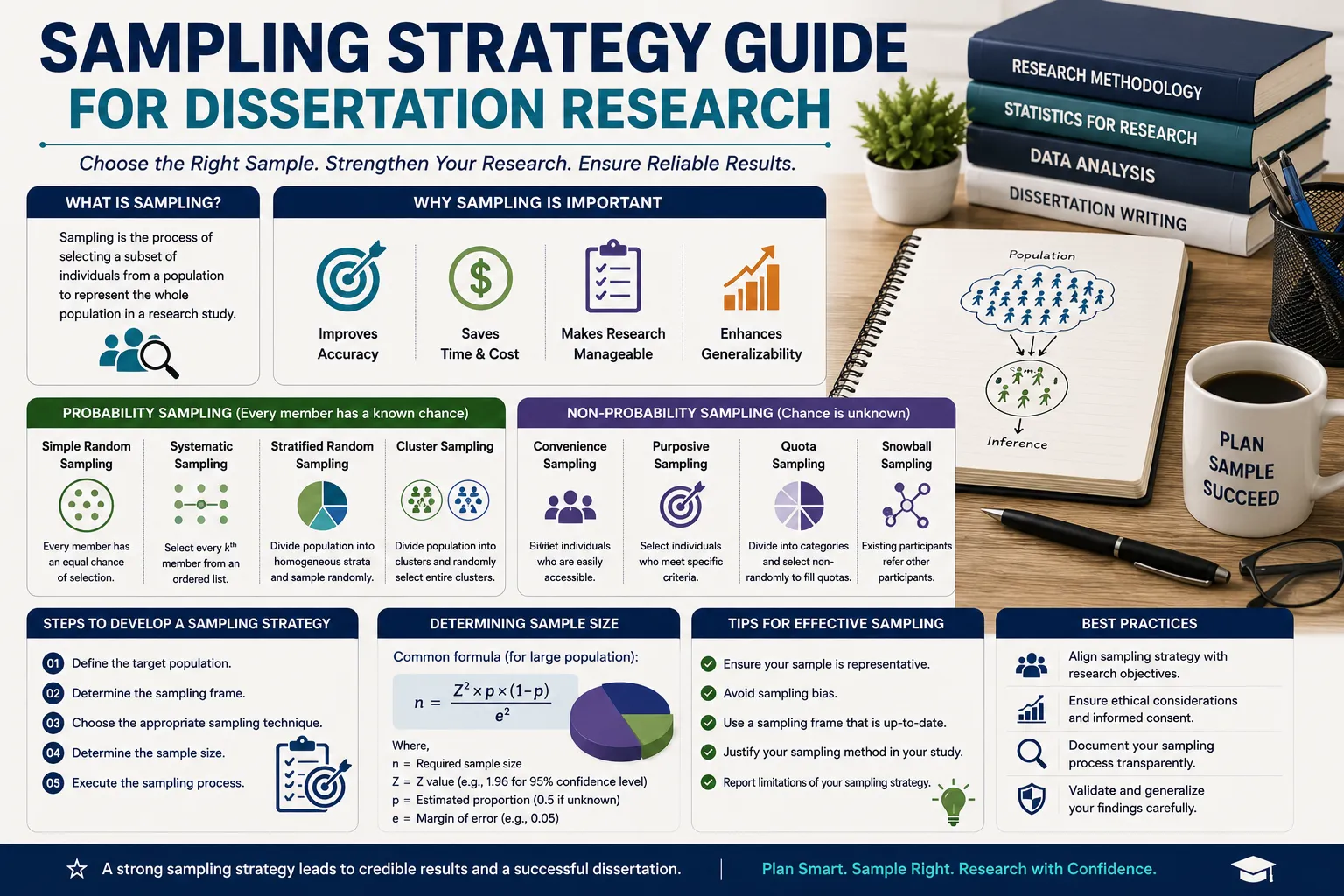
Somewhere in Chapter Three, most dissertation scholars hit a question that feels deceptively simple: who exactly am I going to study, and how am I going to choose them? It sounds like a logistics detail, but a poorly reasoned sampling strategy is one of the most common reasons a methodology chapter gets sent back — not because the sample was wrong, exactly, but because the choice wasn't defended.
This guide walks through a sampling strategy guide for dissertation research the way an experienced research supervisor would — practically, without assuming you already know the difference between a sampling frame and a population. If you're a first-time dissertation writer without a strong research background, this is written specifically for you.
At ThesisLikho, our PhD-qualified mentors have guided more than 10,000 scholars through sampling design, data collection planning, and methodology chapters across disciplines. What follows draws on that mentoring experience, checked against established sampling methodology guidance and PRISMA's standards for transparent, reproducible study selection.
1. Getting the Basic Vocabulary Right First
Before choosing a sampling technique, get precise about three related but distinct terms — confusing them is one of the most common errors in a methodology chapter, and examiners notice it immediately.
Your population (or target population) is the entire set of units your conclusions are meant to apply to — for example, "all full-time MBA students at Indian business schools in 2026." Your sampling frame is the actual, practical list or source from which you'll draw your sample — which is almost never identical to your full population, since a complete list of "all MBA students in India" doesn't realistically exist for you to sample from. Your sample is the specific subset of units you actually study, drawn from your sampling frame using a chosen technique.
Getting this distinction right matters because your sampling frame's limitations become your study's limitations — if your sampling frame is "MBA students at three Delhi NCR business schools," your findings technically generalize to that frame, not to "all MBA students in India," and your methodology chapter should say so explicitly rather than overstating your study's reach.
It's also worth being clear early on about what you mean by a "unit" of sampling, since it isn't always an individual person. Depending on your research question, your unit could be an individual, an organization, a document, a specific event, or even a time period — a dissertation studying organizational culture might sample companies rather than individual employees, while one studying media coverage might sample specific articles or broadcast segments. Naming your unit of analysis precisely, alongside your population and sampling frame, is a small step that prevents a surprising amount of downstream confusion when you get to writing your results chapter.
2. Probability Sampling: What It Is and When to Use It
Probability sampling means every unit in your population has a known, non-zero chance of being selected — the randomization involved reduces selection bias and makes your sample more likely to genuinely represent the broader population, which is what allows you to generalize your findings and estimate sampling error with a stated level of confidence.
Common probability sampling techniques include:
- Simple random sampling — every unit has an equal chance of selection, typically done via a random number generator applied to a complete sampling frame.
- Systematic sampling — selecting every nth unit from an ordered sampling frame, a practical alternative when a full random draw isn't feasible.
- Stratified sampling — dividing your population into meaningful subgroups (strata) — by department, seniority level, region, or another relevant variable — then randomly sampling within each stratum, ensuring your sample reflects important population subgroups proportionally.
- Cluster sampling — dividing your population into naturally occurring clusters (e.g., specific organizations or geographic units), then randomly selecting entire clusters to study, useful when a full individual-level sampling frame isn't practically available.
Probability sampling is the right choice when your research design is quantitative, your study aims to generalize findings to a broader population, and you have — or can reasonably construct — a genuine sampling frame. Its main drawback is practicality: it tends to be considerably more time- and resource-intensive than non-probability alternatives, particularly for large or geographically scattered populations, which is exactly why so many real dissertations end up using non-probability methods instead, even when probability sampling would theoretically be preferable.
3. Non-Probability Sampling: What It Is and When to Use It
In non-probability sampling, selection is based on convenience, judgment, or accessibility rather than random chance — the probability of any given unit being selected is unknown, and statistical generalization to the broader population isn't valid in the way it is with probability sampling.
Common non-probability techniques include:
- Convenience sampling — selecting whoever is easiest to access (respondents at a specific location, an available email list); the weakest technique for generalizability, but sometimes the only realistic option under severe time or access constraints.
- Purposive (judgmental) sampling — deliberately selecting units based on specific characteristics relevant to your research question (e.g., only IT managers with at least five years of experience); the most commonly used non-probability technique in qualitative dissertation research, since it directly targets people who can actually speak to your research question.
- Quota sampling — setting target numbers for specific subgroups (similar in spirit to stratified sampling, but without random selection within each group).
- Snowball sampling — asking initial participants to refer additional participants, particularly useful for hard-to-reach or hidden populations where no accessible sampling frame exists at all.
Non-probability sampling is entirely appropriate and widely accepted in dissertation research, especially for qualitative or exploratory studies, or when no genuine sampling frame exists for your population. The key requirement is that you justify your choice clearly, explicitly acknowledge that findings can't be statistically generalized in the way probability-sampled findings can, and avoid running inferential statistics that assume random selection when your data wasn't actually randomly selected.
4. How Your Research Design Should Drive Your Sampling Choice
Your sampling strategy shouldn't be chosen in isolation — it should flow logically from your broader research paradigm, design, and methods, which is one of the most common alignment checks an examiner will make while reading your methodology chapter.
As a general (not absolute) pattern: dissertations using a post-positivist paradigm, a quantitative design, and a structured questionnaire as the primary instrument tend toward probability sampling techniques, since the goal is typically statistical generalization. Dissertations using a constructivist paradigm, a qualitative design (such as a case study approach), and semi-structured or unstructured interviews tend toward non-probability techniques like purposive sampling, since the goal is typically depth of understanding within a specific, deliberately chosen context rather than population-wide generalization.
This is a theoretical ideal, not a rigid rule — in practice, practical constraints (covered in Section 8) often determine your actual choice as much as, or more than, these theoretical preferences do. What matters for your methodology chapter is that your final choice is at least broadly consistent with your stated research paradigm and design, and where it isn't, that you explain why.
5. Determining Your Sample Size
Sample size determination differs sharply between quantitative and qualitative research, and using the wrong logic for your specific design is a common, easily avoidable error.
For quantitative research, sample size is typically calculated using statistical formulas that account for your population size, desired confidence level, acceptable margin of error, and, for more advanced designs, statistical power and expected effect size. Tools like GPower are commonly used for power-analysis-based sample size calculations, particularly for studies planning to run specific inferential tests (regression, ANOVA, structural equation modeling) where the required sample size varies by test type and model complexity — SEM-based studies, for instance, often require considerably larger samples than a simple comparison-of-means study. Whatever method you use, state it explicitly in your methodology chapter — "a sample size of 150 was determined using GPower for a medium effect size at 80% power" is a defensible statement; "150 respondents were surveyed" with no stated rationale is not.
For qualitative research, sample size isn't calculated through a formula at all — instead, researchers typically aim for data saturation, the point at which additional interviews or cases stop producing meaningfully new themes or insights. This is covered in more depth in the next section, but the key takeaway here is: don't try to justify a qualitative sample size using quantitative logic (power analysis, margin of error), and don't treat a small qualitative sample as a weakness that needs apologizing for — it's the appropriate standard for that research design, provided it's justified on its own terms.
6. Sampling for Qualitative Research: Saturation, Not Statistics
Qualitative sampling operates on a fundamentally different logic than quantitative sampling, and this is worth stating explicitly and confidently in your methodology chapter rather than treating it as a lesser version of quantitative rigor.
Rather than calculating a sample size in advance, qualitative researchers typically continue data collection until reaching saturation — the point where new interviews or cases stop revealing new themes, patterns, or insights relevant to the research question. In practice, this means your stated sample size in a qualitative dissertation is often an outcome you report ("saturation was reached after twelve interviews, with no new themes emerging in the final two") rather than a number you commit to and justify upfront.
A few practical points for building this into your methodology chapter: state explicitly that you're using saturation as your stopping criterion, rather than a predetermined number; describe concretely how you assessed saturation (a common approach is tracking whether new interviews continue to add previously uncoded themes); and be honest if your fieldwork was ultimately constrained by practical factors (a fixed number of available participants, a hard deadline) rather than purely by reaching saturation — acknowledging this limitation directly is more defensible than implying a saturation point you didn't actually reach.
7. Systematic Reviews and PRISMA: Sampling the Literature Itself
If your dissertation includes a systematic literature review as a standalone method (rather than a conventional narrative literature review chapter), "sampling" takes on a different meaning entirely: you're not sampling participants, you're sampling the existing body of literature itself, and this process needs its own transparent, reproducible methodology.
The PRISMA (Preferred Reporting Items for Systematic Reviews and Meta-Analyses) statement is the internationally recognized standard for this, originally developed in medical research but now widely adopted across disciplines. PRISMA structures the literature "sampling" process into clearly defined stages: identification (running your search across specified databases with a documented search string), screening (removing duplicates and excluding irrelevant records by title and abstract against stated criteria), eligibility assessment (full-text review against your inclusion/exclusion criteria), and inclusion (the final set of studies that make it into your review).
If your dissertation methodology involves this kind of systematic literature sampling, following PRISMA's guidance and including a PRISMA flow diagram — showing exactly how many records were identified, screened, excluded (with stated reasons), and ultimately included — considerably strengthens the transparency and reproducibility of your review, and is increasingly expected by examiners even outside medical and health sciences disciplines where PRISMA originated.
8. Practical Constraints That Shape Real-World Sampling Decisions
Theoretical ideals aside, real dissertation sampling decisions are shaped heavily by practical factors — and acknowledging this honestly in your methodology chapter, rather than pretending your choice was purely theory-driven, actually strengthens your credibility with an examiner:
- Time available for fieldwork. A probability sample requiring a full sampling frame and randomized recruitment across a large population may simply not be achievable within your dissertation timeline.
- Access to your population. Whether you can realistically reach your intended participants — through an organization, a professional network, or an existing dataset — often determines your sampling technique as much as theoretical preference does.
- Cost and resource constraints, including survey distribution costs, incentive budgets, or travel for in-person interviews.
- Ethical considerations, particularly for vulnerable or hard-to-reach populations, where snowball or purposive sampling may be the only ethically and practically viable approach.
- Existing relationships or gatekeeper access — many dissertation scholars sample through an organization they already have access to (an employer, an alumni network, a placement company), which is a legitimate and common practical strategy, provided it's disclosed and its limitations acknowledged.
None of this means practical constraints should simply override methodological reasoning — the goal is a sampling strategy that's both defensible in theory and achievable in practice, and when the two pull in different directions, the honest move is to document the trade-off rather than silently picking the more convenient option and describing it as though it were the theoretically ideal choice all along.
9. How to Justify Your Sampling Strategy in Your Methodology Chapter
A strong sampling strategy section doesn't just name your chosen technique — it builds a clear, logical case for it. A few practical steps:
- State your population and sampling frame explicitly, and acknowledge any gap between the two.
- Name your specific sampling technique and explain why it fits your research paradigm, design, and practical constraints — not just one of these in isolation.
- State and justify your sample size, using the appropriate logic for your research design (statistical calculation for quantitative, saturation-based reasoning for qualitative).
- Acknowledge the limitations of your chosen approach honestly — if you used non-probability sampling, state plainly that findings can't be statistically generalized beyond your specific sample, rather than implying broader generalizability your method doesn't support.
- Connect your sampling strategy back to your research question, showing that your specific chosen units are actually capable of answering what you're asking.
For a fuller walkthrough of structuring this and adjacent methodology sections, see How to Write the Methodology Chapter of a Thesis.
10. Common Mistakes First-Time Dissertation Writers Make
- Confusing population, sampling frame, and sample, or using the terms inconsistently across the methodology chapter — this is flagged as one of the single most common and immediately noticeable errors in student methodology chapters.
- Using convenience sampling without naming it or justifying it — many dissertations effectively use convenience sampling but describe it using more formal-sounding language, which examiners tend to see through quickly.
- Overstating generalizability from a non-probability sample, implying population-wide conclusions that the sampling method can't actually support.
- Calculating a qualitative sample size using quantitative logic (or vice versa — treating a quantitative sample size as flexible and saturation-based when statistical validity actually requires a calculated number).
- Failing to justify sample size at all, stating a number without any rationale, whether statistical or saturation-based.
- Ignoring practical constraints in the write-up, presenting a sampling choice as purely theory-driven when access or time constraints clearly played a real role — a methodology chapter that acknowledges practical reality directly is more credible, not less.
- Skipping a PRISMA-style flow diagram for a systematic literature review component, missing an easy opportunity to demonstrate transparency and rigor.
11. Two Realistic Case Studies
Case Study 1 — Choosing Stratified Sampling for a Generalizable Quantitative Study
A dissertation scholar studying employee engagement across a large multinational organization initially planned simple random sampling from the full employee list. Recognizing that engagement likely varied meaningfully by department and seniority level, and that a purely random sample risked underrepresenting smaller but important subgroups, the scholar switched to stratified random sampling — dividing the population by department and seniority, then randomly sampling proportionally within each stratum. This produced a sample that better reflected the organization's actual structure, strengthening the study's claim to genuinely represent the target population rather than just an average across it.
Case Study 2 — Justifying Purposive Sampling and Saturation for a Qualitative Study
A first-time dissertation writer studying decision-making among small business owners during a specific regulatory transition initially worried that a sample of only nine interview participants would seem too small. Rather than padding the sample defensively, the scholar explicitly framed the methodology chapter around purposive sampling — deliberately selecting business owners who had directly navigated the regulatory change — and reported that saturation was reached after the eighth interview, with the ninth confirming no new themes emerged. Framing the sample size around saturation, rather than apologizing for its smallness relative to quantitative norms, gave the methodology chapter a confident, well-justified logic the committee didn't challenge.
If you're navigating your own sampling decision, our Dissertation Writing service can help you match your sampling strategy to your research question and defend it clearly in your methodology chapter.
FAQs
What is a sampling strategy guide for dissertation research?
It's a structured approach to deciding who or what you'll study and how you'll select them — covering the choice between probability and non-probability sampling, sample size determination for quantitative versus qualitative designs, and, where relevant, PRISMA-based sampling of literature for systematic reviews.
Why does sampling strategy matter for dissertation research?
Because your sampling choice directly determines what your findings can and can't claim — an unjustified or misaligned sampling strategy is one of the most common reasons a methodology chapter draws committee revision requests, regardless of how interesting the underlying research question is.
How does sampling strategy affect a dissertation in practice?
Scholars who choose and clearly justify a sampling technique aligned with their research paradigm, design, and practical constraints typically face fewer committee objections and produce a results chapter whose claims are properly scoped to what their data can actually support.
How long does it take to complete a dissertation using this approach?
Timelines vary, but a well-justified sampling strategy — particularly one that realistically accounts for access and time constraints from the outset — meaningfully reduces the risk of a stalled or redesigned data collection phase partway through the dissertation.
Is professional help available for sampling strategy guide for dissertation research?
Yes — support with choosing and justifying a sampling technique appropriate to your specific research question and constraints is available through services such as Dissertation Writing.
Ready to build a sampling strategy your committee will approve with confidence? Get Dissertation Help Now from ThesisLikho's PhD-qualified mentors.