
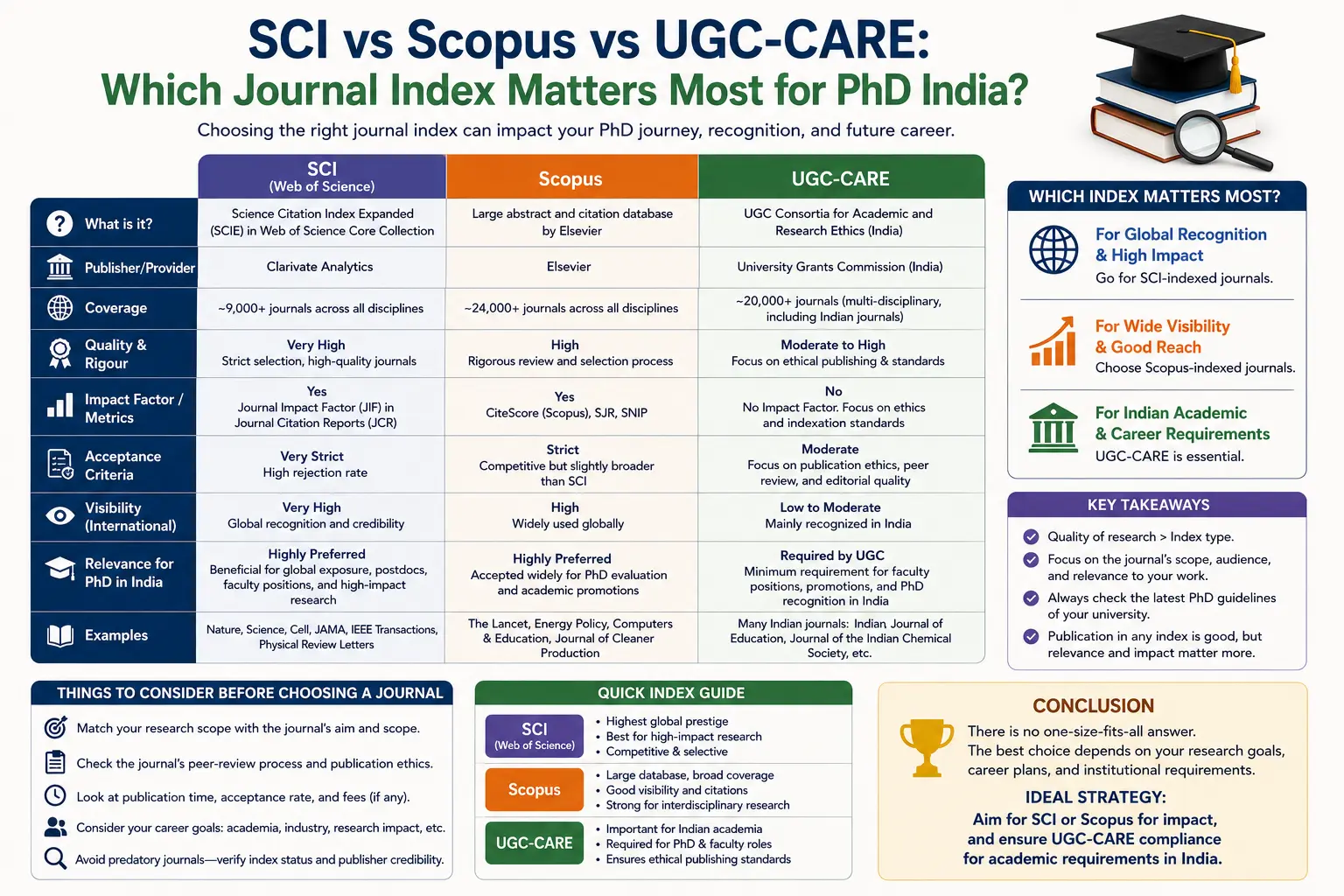
Introduction
One of the most common questions among PhD scholars, research students, faculty members, and academic professionals in India is:
"Should I publish in an SCI journal, a Scopus-indexed journal, or a UGC-CARE journal?"
With increasing competition in academia and stricter publication requirements for PhD completion, faculty promotions, research funding, and university rankings, selecting the right journal index has become more important than ever.
Many researchers mistakenly assume that SCI, Scopus, and UGC-CARE are the same. In reality, they serve different purposes and have different levels of recognition within the academic community.
Understanding the differences between these journal indexing systems can help researchers make better publication decisions and avoid wasting time, money, and effort on journals that may not meet institutional requirements.
This comprehensive guide explains SCI, Scopus, and UGC-CARE journals, compares their advantages and limitations, and helps Indian scholars determine which index matters most for PhD research in 2026.
What Is Journal Indexing?
Before comparing SCI, Scopus, and UGC-CARE, it is important to understand journal indexing.
Journal indexing is the process of including academic journals in recognized databases that evaluate publication quality, citation performance, editorial standards, and research impact.
Indexing helps researchers:
- Identify credible journals
- Improve research visibility
- Track citations
- Enhance academic recognition
- Meet university publication requirements
A journal's indexing status often reflects its reputation and influence within the research community.
Understanding SCI (Science Citation Index)
What Is SCI?
SCI stands for Science Citation Index.
It is one of the most prestigious journal indexing systems in the world.
SCI is maintained through the Web of Science platform and includes high-quality journals that meet strict evaluation criteria.
Originally developed by:
Eugene Garfield
SCI journals are widely recognized for publishing influential scientific research.
Fields Covered by SCI
SCI primarily focuses on:
- Engineering
- Physics
- Chemistry
- Biology
- Medicine
- Environmental Sciences
- Computer Science
- Agricultural Sciences
Characteristics of SCI Journals
SCI journals typically have:
- Rigorous peer review
- High citation impact
- Strong editorial standards
- International readership
- Established academic reputation
Many SCI journals also possess official Impact Factors.
Advantages of SCI Journals
High Academic Prestige
SCI journals are considered among the most respected journals globally.
Better Citation Visibility
Research published in SCI journals often receives greater exposure.
Strong International Recognition
Universities and funding agencies highly value SCI publications.
Career Advancement
SCI publications can strengthen:
- Academic promotions
- Faculty recruitment
- Research grant applications
Challenges of SCI Journals
- Highly competitive acceptance rates
- Longer review processes
- Strict quality expectations
Publishing in SCI journals can be challenging, particularly for early-career researchers.
Understanding Scopus
What Is Scopus?
Scopus is one of the world's largest abstract and citation databases for academic literature.
It is managed by:
Elsevier
Scopus indexes thousands of journals across multiple disciplines.
Fields Covered by Scopus
Scopus covers:
- Science
- Technology
- Engineering
- Medicine
- Social Sciences
- Arts
- Humanities
- Business
- Management
Its disciplinary coverage is broader than SCI.
Characteristics of Scopus Journals
Scopus-indexed journals typically feature:
- Peer review
- Editorial oversight
- Citation tracking
- International accessibility
However, quality levels vary significantly among journals.
Advantages of Scopus Journals
Broad Coverage
Scopus includes a large number of journals across disciplines.
Widely Accepted in India
Many universities recognize Scopus publications for:
- PhD requirements
- Promotions
- Academic assessments
Citation Metrics
Researchers can monitor:
- CiteScore
- h-index
- Citation counts
Easier Access for Researchers
Compared to SCI journals, some Scopus journals may offer more attainable acceptance opportunities.
Challenges of Scopus Journals
- Quality varies across journals
- Not all Scopus journals have Impact Factors
- Some journals may have lower citation influence
Researchers should evaluate individual journals carefully.
Understanding UGC-CARE
What Is UGC-CARE?
UGC-CARE stands for:
University Grants Commission – Consortium for Academic and Research Ethics
It was established to help Indian researchers identify credible journals and avoid predatory publications.
UGC-CARE was introduced after concerns regarding fake and low-quality journals.
Purpose of UGC-CARE
The primary objectives include:
- Promoting research quality
- Preventing publication in predatory journals
- Supporting academic integrity
- Guiding Indian scholars toward trustworthy journals
Fields Covered by UGC-CARE
UGC-CARE includes journals from:
- Sciences
- Engineering
- Social Sciences
- Humanities
- Education
- Commerce
- Arts
Advantages of UGC-CARE Journals
Recognition Within India
Many Indian institutions recognize UGC-CARE-listed journals.
Protection Against Predatory Journals
Researchers can identify more credible publication venues.
Useful for Academic Evaluations
Certain institutions still consider UGC-CARE publications during assessments.
Challenges of UGC-CARE Journals
Limited International Recognition
Outside India, UGC-CARE status often carries less significance than Scopus or SCI indexing.
Variable Journal Quality
Not all UGC-CARE journals have high citation impact.
Reduced Importance in Recent Years
Many universities increasingly prioritize Scopus and Web of Science indexing.
Which Index Is Better for PhD Scholars in India?
The answer depends on your academic goals.
If You Want Maximum Academic Prestige
Choose:
SCI Journals
Benefits include:
- Strong international recognition
- High citation potential
- Better research visibility
Ideal for:
- STEM researchers
- Future academics
- International collaborations
If You Want Broad Recognition and Flexibility
Choose:
Scopus Journals
Benefits include:
- Wide subject coverage
- Good institutional acceptance
- Strong citation tracking
Ideal for:
- PhD scholars
- Faculty members
- Early-career researchers
If Your Institution Specifically Requires It
Choose:
UGC-CARE Journals
Benefits include:
- Indian institutional recognition
- Easier accessibility in some disciplines
Ideal for:
- Certain university requirements
- Humanities and regional research topics
What Do Indian Universities Prefer in 2026?
The trend across Indian higher education institutions increasingly favors:
First Preference
- SCI journals
- Web of Science journals
Second Preference
- Scopus-indexed journals
Third Preference
- UGC-CARE-listed journals
Many universities now emphasize international indexing rather than relying solely on national journal lists.
Researchers should always check their institution's latest regulations.
SCI, SCIE, SSCI, and ESCI: Understanding the Difference
Many researchers confuse these terms.
SCI
Science Citation Index
SCIE
Science Citation Index Expanded
A broader version of SCI.
SSCI
Social Sciences Citation Index
For social science disciplines.
ESCI
Emerging Sources Citation Index
Includes developing journals that may later qualify for higher indexes.
Understanding these distinctions helps researchers evaluate journal quality more effectively.
Can a Journal Be Both SCI and Scopus Indexed?
Yes.
Many prestigious journals are indexed in both:
- Web of Science (SCI/SCIE)
- Scopus
These journals often enjoy:
- Higher visibility
- Greater credibility
- Increased citation potential
Such journals are frequently preferred by experienced researchers.
How to Verify Journal Indexing
Before submission, always verify indexing independently.
For SCI Journals
Check:
- Web of Science Master Journal List
For Scopus Journals
Check:
- Official Scopus Sources database
For UGC-CARE Journals
Check:
- Official UGC-CARE resources or university notifications
Never rely solely on claims made by journal websites.
Avoiding Predatory Journals
Many predatory journals falsely claim:
- SCI indexing
- Scopus indexing
- Impact Factors
Warning signs include:
Unrealistic Publication Promises
"Publish within 48 hours"
Aggressive Email Invitations
Frequent unsolicited publication offers.
Fake Metrics
Unknown impact indicators.
Poor Editorial Standards
Weak peer review and unprofessional websites.
Always verify indexing through official databases.
Best Publication Strategy for Indian PhD Scholars
A practical publication strategy may include:
Option 1: Target SCI Journals
For maximum prestige and long-term academic value.
Option 2: Publish in Quality Scopus Journals
If SCI acceptance proves difficult.
Option 3: Use UGC-CARE Only When Necessary
Particularly when institutional requirements specifically mention it.
The emphasis should always be on journal quality rather than merely satisfying minimum publication criteria.
Future of Research Publishing in India
Academic publishing is evolving rapidly.
Key trends include:
Greater Focus on Quality
Institutions increasingly evaluate research impact rather than publication quantity.
Increased International Collaboration
Researchers are encouraged to publish in globally recognized journals.
AI-Assisted Editorial Screening
Publishers increasingly use artificial intelligence for manuscript assessment.
Open Access Growth
Open-access publishing continues to expand worldwide.
As these trends continue, internationally indexed journals are likely to become even more important.
Conclusion
SCI, Scopus, and UGC-CARE each play important roles in academic publishing, but they differ significantly in prestige, visibility, and international recognition.
For Indian PhD scholars in 2026:
- SCI journals generally offer the highest academic prestige and citation potential.
- Scopus-indexed journals provide excellent visibility and broad acceptance across disciplines.
- UGC-CARE journals remain useful for specific institutional requirements but often carry less international influence.
When selecting a journal, researchers should prioritize quality, relevance, indexing status, and academic impact rather than focusing solely on publication requirements.
Ultimately, publishing in a reputable journal that aligns with your research area will contribute more to your academic career than simply choosing a journal based on a particular index.
Frequently Asked Questions (FAQs)
1. Which is better: SCI or Scopus?
SCI journals generally have higher prestige and stricter selection standards, while Scopus offers broader coverage across disciplines.
2. Is Scopus accepted for PhD in India?
Yes. Many Indian universities recognize Scopus-indexed journals for PhD requirements and academic evaluations.
3. Are UGC-CARE journals still important in 2026?
They remain relevant for some institutions, but many universities increasingly prioritize Scopus and Web of Science indexing.
4. Can a journal be both SCI and Scopus indexed?
Yes. Many high-quality international journals are indexed in both databases.
5. How do I check if a journal is SCI indexed?
Verify through the official Web of Science Master Journal List.
6. Does every Scopus journal have an Impact Factor?
No. Impact Factor is provided through Web of Science journals, not all Scopus-indexed journals.
7. Which journal index is best for academic promotions?
SCI and high-quality Scopus-indexed journals are generally preferred for promotions and research assessments.
8. Should I publish only based on indexing?
No. Researchers should also consider journal scope, audience, review quality, citation impact, and publication ethics before submission.
Contact ThesisLikho Today
Call / WhatsApp: +91 96438 02216
Visit: ThesisLikho.com