
Introduction
Writing a thesis involves much more than collecting data and analyzing results. One of the most important yet often misunderstood sections of a research study is the Scope and Limitations of the Study. Whether you are pursuing a PhD, MPhil, MBA, or Master's degree, clearly defining the scope and limitations of your research helps readers understand the boundaries, focus, and potential constraints of your study.
Many research scholars struggle with this section because they either provide insufficient details or confuse scope with limitations. However, a well-written scope and limitations section demonstrates academic maturity, transparency, and methodological rigor. It shows that the researcher understands what the study covers, what it does not cover, and the factors that may influence the findings.
Supervisors and thesis examiners pay close attention to this section because it helps them evaluate the relevance, validity, and applicability of the research outcomes. It also guides future researchers by identifying areas that require further investigation.
In this comprehensive guide, we will explain what scope and limitations mean, why they are important, how to write them effectively, common mistakes to avoid, and practical examples that can help PhD scholars prepare a strong thesis.
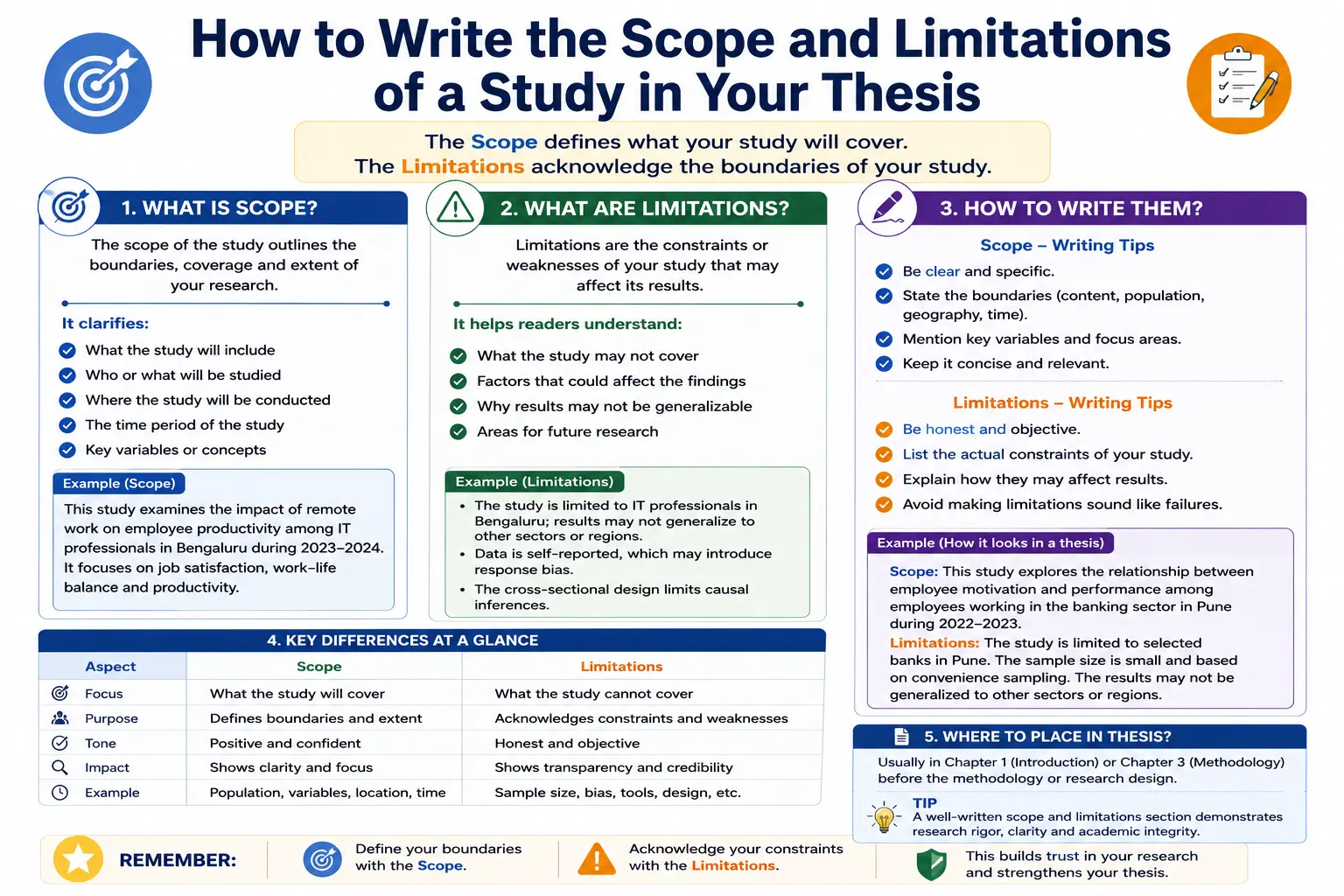
What Is the Scope of a Study?
The scope of a study defines the boundaries and extent of the research. It specifies what the study will cover and what aspects will be included in the investigation.
In simple terms, the scope tells readers:
- What the research focuses on
- Who or what is being studied
- Where the study is conducted
- When the study takes place
- Which variables are examined
- What research objectives are addressed
The scope helps narrow down a broad research topic into a manageable and focused study.
Example of Scope
Research Topic
Impact of Remote Work on Employee Productivity
Scope Statement
"This study examines the impact of remote work arrangements on employee productivity among IT professionals working in private technology companies in Bengaluru, India. The research focuses on employees who have been working remotely for at least six months during the period from 2024 to 2026."
This statement clearly defines:
- Population: IT professionals
- Location: Bengaluru
- Industry: Private technology companies
- Time period: 2024–2026
- Variable: Employee productivity
What Are the Limitations of a Study?
Limitations refer to factors beyond the researcher's control that may affect the study's findings, validity, or generalizability.
Every research study has limitations. Identifying them does not weaken the research; instead, it demonstrates honesty and transparency.
Limitations may arise from:
- Time constraints
- Budget restrictions
- Sample size limitations
- Geographic boundaries
- Data availability
- Research design choices
- Participant responses
Acknowledging limitations helps readers interpret findings appropriately.
Example of Limitations
"This study focuses only on IT professionals in Bengaluru; therefore, findings may not be generalizable to employees in other industries or regions. Additionally, the research relies on self-reported survey responses, which may be subject to response bias."
Why Are Scope and Limitations Important?
Many students underestimate the significance of this section. However, it serves several critical purposes.
Establishes Research Boundaries
The scope defines what is included and excluded from the study.
Improves Research Focus
Clear boundaries help researchers avoid unnecessary expansion of the study.
Enhances Transparency
Limitations demonstrate honesty about research constraints.
Supports Interpretation of Findings
Readers can better understand the applicability and relevance of results.
Guides Future Research
Limitations often highlight areas for future investigation.
Elements of the Scope of a Study
A comprehensive scope statement typically includes several key components.
1. Research Topic
Clearly state the subject under investigation.
Example:
"The study investigates factors affecting employee engagement."
2. Population
Identify who or what is being studied.
Examples:
- Employees
- Students
- Consumers
- Organizations
3. Geographic Area
Specify the location of the study.
Examples:
- India
- Delhi NCR
- Mumbai
- South India
4. Time Frame
Define the period covered by the research.
Example:
"The study focuses on data collected between January 2025 and December 2025."
5. Variables
Specify the key variables examined.
Example:
- Leadership style
- Employee engagement
- Job satisfaction
6. Research Objectives
Mention the objectives addressed within the study boundaries.
Types of Research Limitations
Understanding different types of limitations helps scholars identify and discuss them effectively.
Methodological Limitations
Arise from research design choices.
Examples:
- Cross-sectional design
- Qualitative approach
- Limited variables
Sample Limitations
Related to participant selection.
Examples:
- Small sample size
- Non-random sampling
- Limited demographic diversity
Geographic Limitations
Research conducted in a specific location.
Example:
A study limited to organizations in Mumbai.
Time Limitations
Research conducted within a restricted timeframe.
Example:
Data collected over six months.
Data Limitations
Challenges related to data availability or quality.
Examples:
- Missing records
- Limited access to confidential information
Resource Limitations
Constraints involving:
- Funding
- Personnel
- Technology
- Research support
How to Write the Scope of a Study
Follow these steps to develop a clear scope statement.
Step 1: Define the Research Problem
Begin with a concise explanation of the problem being investigated.
Example:
"This research explores factors influencing employee retention."
Step 2: Identify the Target Population
Specify who will participate.
Example:
"The study focuses on employees working in Indian IT companies."
Step 3: Define Geographic Boundaries
Specify where the research will occur.
Example:
"The study is limited to organizations located in Hyderabad."
Step 4: Specify the Time Period
Example:
"The research examines data collected during 2025."
Step 5: Mention Variables
Example:
"The study analyzes employee engagement, job satisfaction, and organizational commitment."
Example Scope Statement
"This study investigates the relationship between employee engagement and job performance among IT professionals employed in private technology companies in Hyderabad, India. Data will be collected during 2025 using structured questionnaires. The study focuses specifically on full-time employees and excludes contractual workers."
How to Write the Limitations of a Study
Step 1: Identify Constraints
Consider factors that may influence findings.
Examples:
- Time
- Budget
- Access
- Methodology
Step 2: Be Honest
Do not hide weaknesses.
Examiners appreciate transparency.
Step 3: Explain Impact
Describe how limitations affect findings.
Step 4: Avoid Overemphasizing Weaknesses
Acknowledge limitations without undermining the study.
Example Limitation Statement
"The study is limited to private technology companies in Hyderabad, which may restrict the generalizability of findings to other sectors. Additionally, reliance on self-reported questionnaires may introduce response bias."
Sample Scope and Limitations Section
Research Topic
Impact of Digital Marketing on Consumer Purchase Decisions
Scope of the Study
This study examines the influence of digital marketing strategies on consumer purchase decisions among online shoppers in Delhi NCR. The research focuses on social media marketing, influencer marketing, and email marketing campaigns. Data will be collected from consumers aged 18–45 years who regularly engage in online shopping. The study covers the period from January 2025 to December 2025.
Limitations of the Study
The study is geographically limited to Delhi NCR and may not represent consumer behavior in other regions. The findings are based on self-reported survey responses, which may be affected by participant bias. Time constraints restrict the study to a one-year period, limiting the assessment of long-term behavioral changes.
Common Mistakes to Avoid
Confusing Scope with Objectives
Scope defines boundaries, while objectives describe goals.
Writing Very Broad Scope Statements
Broad scope leads to unfocused research.
Poor Example:
"This study examines digital marketing worldwide."
Better Example:
"This study examines digital marketing practices among e-commerce consumers in Delhi NCR."
Hiding Limitations
Every study has limitations.
Failing to acknowledge them may reduce credibility.
Listing Too Many Limitations
Focus on significant limitations that genuinely affect the study.
Using Negative Language
Avoid language that undermines research quality.
Instead of:
"This study suffers from major weaknesses."
Write:
"This study is subject to certain limitations that should be considered when interpreting the findings."
Scope and Limitations in Different Research Approaches
Quantitative Research
Scope often focuses on:
- Population
- Variables
- Sample
- Statistical analysis
Limitations may include:
- Sampling bias
- Measurement errors
Qualitative Research
Scope often includes:
- Context
- Participants
- Phenomenon studied
Limitations may include:
- Subjectivity
- Smaller sample sizes
Mixed-Methods Research
Requires explanation of both quantitative and qualitative boundaries and constraints.
Expert Tips for PhD Scholars
Keep the Scope Realistic
Avoid attempting to study too many variables or populations.
Align Scope with Objectives
Ensure consistency throughout the thesis.
Acknowledge Limitations Professionally
Limitations do not reduce the value of research when addressed transparently.
Revise After Data Collection
Some limitations become apparent during the research process.
Seek Supervisor Feedback
Experienced supervisors can help refine scope and limitations effectively.
Checklist for Writing Scope and Limitations
Before finalizing, ask yourself:
Scope Checklist
- Have I defined the research topic clearly?
- Is the population specified?
- Is the geographic area identified?
- Is the timeframe mentioned?
- Are variables clearly stated?
- Is the scope aligned with research objectives?
Limitations Checklist
- Have I identified major constraints?
- Am I being transparent?
- Have I explained potential impacts?
- Have I avoided exaggerating weaknesses?
- Are limitations relevant to the study?
Conclusion
The scope and limitations section is an essential part of any thesis or dissertation. While the scope defines the boundaries of the research, the limitations acknowledge the factors that may influence findings. Together, they provide readers with a realistic understanding of what the study covers and the conditions under which the results should be interpreted.
For PhD scholars, writing a clear and balanced scope and limitations section demonstrates methodological rigor, transparency, and academic professionalism. By carefully defining the study boundaries and honestly addressing potential constraints, researchers can strengthen the credibility of their work and help readers evaluate the significance of their findings.
Remember that every research project has limitations. What matters is not the absence of limitations but the ability to recognize, explain, and manage them effectively. A well-written scope and limitations section will enhance the overall quality of your thesis and contribute to a stronger, more defensible research study.
Contact ThesisLikho Today
Call / WhatsApp: +91 96438 02216
Visit: ThesisLikho.com