
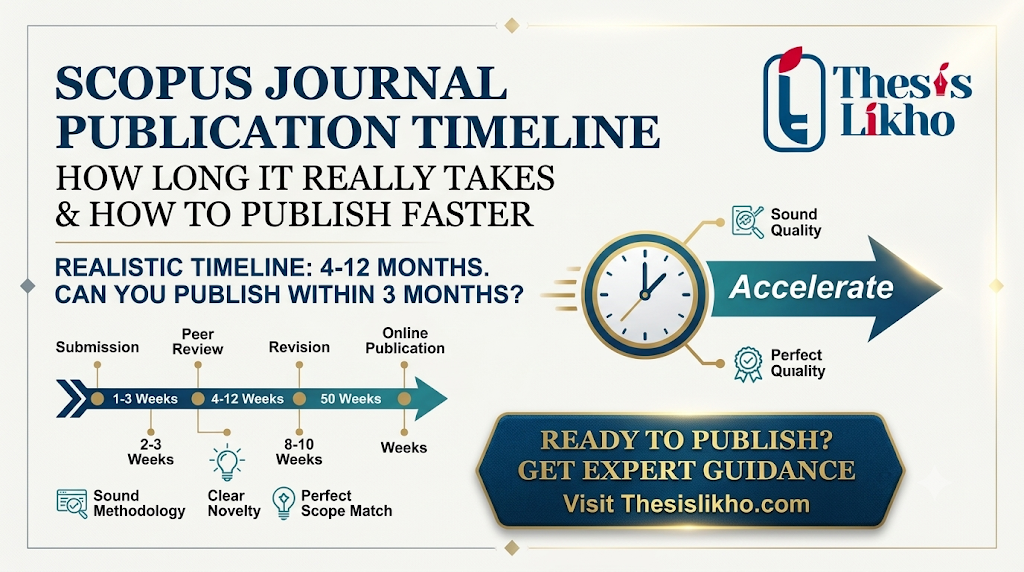
For every PhD scholar and early-career researcher, publishing in a Scopus indexed journal is a milestone. Many universities require at least one or two Scopus publications before thesis submission, and faculty promotions and grant applications increasingly depend on them. Naturally, the first question researchers ask is: "How long will it take for my paper to get published?"
The honest answer is that it depends — on the journal, the field, the quality of your manuscript and how quickly you respond to reviewers. In this guide, we explain the realistic timeline for Scopus publication, what reputable Scopus journals actually look for, the specific conditions under which a paper can be published within three months, and how Thesislikho.com supports researchers throughout this journey.
1. The Actual Timeline for Scopus Journal Publication
Even when your research is of high quality, publication involves several stages that you cannot skip. Each stage takes time because it involves editors and independent peer reviewers, most of whom are working academics reviewing papers voluntarily.
| Stage | What Happens | Typical Duration |
|---|---|---|
| Manuscript preparation | Writing, formatting to journal guidelines, plagiarism check, language editing | 2–6 weeks |
| Initial editorial screening | Editor checks scope, novelty, formatting and similarity; decides on desk rejection or sending for review | 1–3 weeks |
| Peer review (first round) | Usually 2–3 independent experts evaluate the paper | 4–12 weeks |
| Revision by author | Addressing reviewer comments, adding analysis, rewriting sections | 2–6 weeks |
| Second review / final decision | Reviewers or editor verify revisions | 2–6 weeks |
| Production & proofs | Copyediting, typesetting, author proof approval, DOI assignment | 2–4 weeks |
| Online publication & Scopus indexing | Article goes online; appears in Scopus database | 1–8 weeks after publication |
Realistic total: For most reputable Scopus indexed journals, the time from first submission to online publication ranges from 4 to 12 months. Journals in Q1 and Q2 quartiles, particularly in medicine, social sciences and pure sciences, may take 6 to 18 months. Engineering and computer science journals, and many open access journals, often move faster — sometimes 3 to 6 months.
2. What a Good Scopus Indexed Journal Is Looking For
Editors of reputable Scopus journals receive hundreds of submissions and reject a large share of them — often before review. Understanding what they want dramatically improves your chances.
a) Clear novelty and contribution
The editor's first question is: "What is new here?" Your paper must clearly state the research gap and explain how your work fills it. A paper that simply repeats existing methods on a slightly different dataset, without new insight, is unlikely to succeed.
b) Fit with the journal's aims and scope
Scope mismatch is one of the most common reasons for desk rejection. Read the journal's aims and scope, and look at articles it has published in the last two years. If your topic does not appear there, the journal may not be the right home.
c) Sound methodology
Reviewers check whether your research design, sampling, data collection, experiments and statistical analysis are appropriate and reproducible. Clearly describe datasets, parameters, tools and validation methods so another researcher could repeat your work.
d) Strong and current literature review
Good journals expect you to engage with recent literature — ideally including work from the last three to five years and from the target journal itself. An outdated or superficial review signals that the author is not aware of the current state of the field.
e) Meaningful results and discussion
It is not enough to present tables and graphs. You must interpret your results, compare them with previous studies, explain limitations honestly and discuss practical or theoretical implications.
f) Originality and research ethics
Journals run similarity checks (commonly through iThenticate). Most accept an overall similarity of roughly 10–15%, with no large copied blocks. Ethical approvals, informed consent, data availability statements and conflict-of-interest declarations are mandatory where relevant. Authorship must reflect real contributions.
g) Professional language and formatting
A well-written, grammatically correct manuscript formatted exactly as per author guidelines — reference style, word limit, figure resolution, structured abstract — creates a positive first impression and reduces delays.
3. Conditions That Enable Early Publication Within 3 Months
Publication within three months is possible, but only when several favourable conditions come together. No legitimate journal can guarantee acceptance — anyone who promises guaranteed Scopus publication for a fee should be treated with caution. However, the following conditions significantly increase the chance of a fast outcome.
- Choosing journals with fast review cycles. Many publishers display "time to first decision" and "submission to acceptance" statistics on journal homepages. Journals reporting a first decision in 2–4 weeks are good candidates for quick publication.
- Open access journals with rapid publication models. Many reputable open access journals publish articles online immediately after acceptance (continuous publication), instead of waiting for a print issue. This removes weeks or months of waiting.
- A submission-ready, high-quality manuscript. A paper that needs only minor revisions after the first review can be accepted in a single round. Major revisions add one or two extra cycles.
- Perfect scope match. When the paper fits the journal well, editors find suitable reviewers faster and desk rejection is avoided.
- Fast author response. Submitting revisions within one to two weeks, with a clear point-by-point response letter, keeps your paper moving. Many delays are actually caused by authors.
- Special issues and conference-linked journals. Special issues often have defined timelines and dedicated guest editors, which can speed up review. Some conferences publish selected papers in Scopus indexed proceedings or partner journals within a defined schedule.
- Suggesting qualified reviewers (where permitted). Some journals allow authors to suggest independent experts. This can reduce the time an editor spends searching for reviewers — but suggestions must have no conflict of interest.
- Complete documentation at submission. Including the cover letter, ethics approval, data availability statement, high-resolution figures, ORCID IDs and declarations avoids technical returns from the editorial office.
4. Common Mistakes That Delay Publication
- Submitting to a journal outside your research scope.
- Ignoring the author guidelines on formatting, word count and referencing style.
- High similarity index due to poor paraphrasing or reuse of thesis text without proper citation.
- Weak abstract and title that fail to communicate the contribution.
- Defensive or incomplete responses to reviewer comments.
- Falling for predatory or cloned journals, leading to wasted time, money and credibility.
5. How Thesislikho.com Helps in Research and Publication
Thesislikho.com supports PhD scholars, M.Tech and postgraduate students and faculty members in turning their research into well-presented, publication-ready work. The focus is on guidance, editing and mentoring — the research and the intellectual contribution remain the scholar's own.
Research guidance and topic refinement
Our mentors help you identify a relevant research gap, refine your topic and objectives, and structure your research plan so that the outcome is publishable from the beginning.
Journal selection
We help you shortlist suitable Scopus indexed journals based on your subject area, quartile, publication fees, review speed and scope — and verify their current indexing status, so you avoid predatory and discontinued journals.
Manuscript structuring and editing
Our experts review your draft for logical flow, clarity and academic tone, and provide language editing and proofreading. We help you strengthen your introduction, literature review, methodology description and discussion.
Formatting as per journal guidelines
We format your manuscript to the target journal's template — references (APA, IEEE, Harvard, Vancouver, etc.), figures, tables and abstract structure — so it passes technical screening without delay.
Plagiarism checking and originality support
We run similarity checks and guide you on proper paraphrasing and citation so your paper meets journal originality standards.
Data analysis support
Our analysts can guide you in choosing appropriate statistical or computational methods and help you interpret and present results using tools such as SPSS, R, Python and MATLAB.
Reviewer response assistance
Revisions are where many papers stall. We help you understand reviewer comments, plan revisions and draft clear, professional point-by-point response letters.
Thesis and synopsis support
Beyond papers, Thesislikho.com assists with synopsis preparation, thesis structuring, chapter editing, formatting according to university guidelines, and presentation preparation for progress seminars and viva.
Conclusion
Publishing in a Scopus indexed journal typically takes 4 to 12 months, and longer for top-tier journals. Publication within three months is achievable when a high-quality, well-formatted manuscript is sent to the right fast-review journal and the author responds promptly to reviewers. The key factors are novelty, sound methodology, scope fit, originality and professional presentation.
Plan your publication strategy early, verify journals carefully, and get expert feedback before you submit. A little preparation at the start can save months of rejections and resubmissions.
Ready to make your research publication-ready?
Get expert guidance on journal selection, manuscript editing, formatting and reviewer responses.
Visit Thesislikho.com