
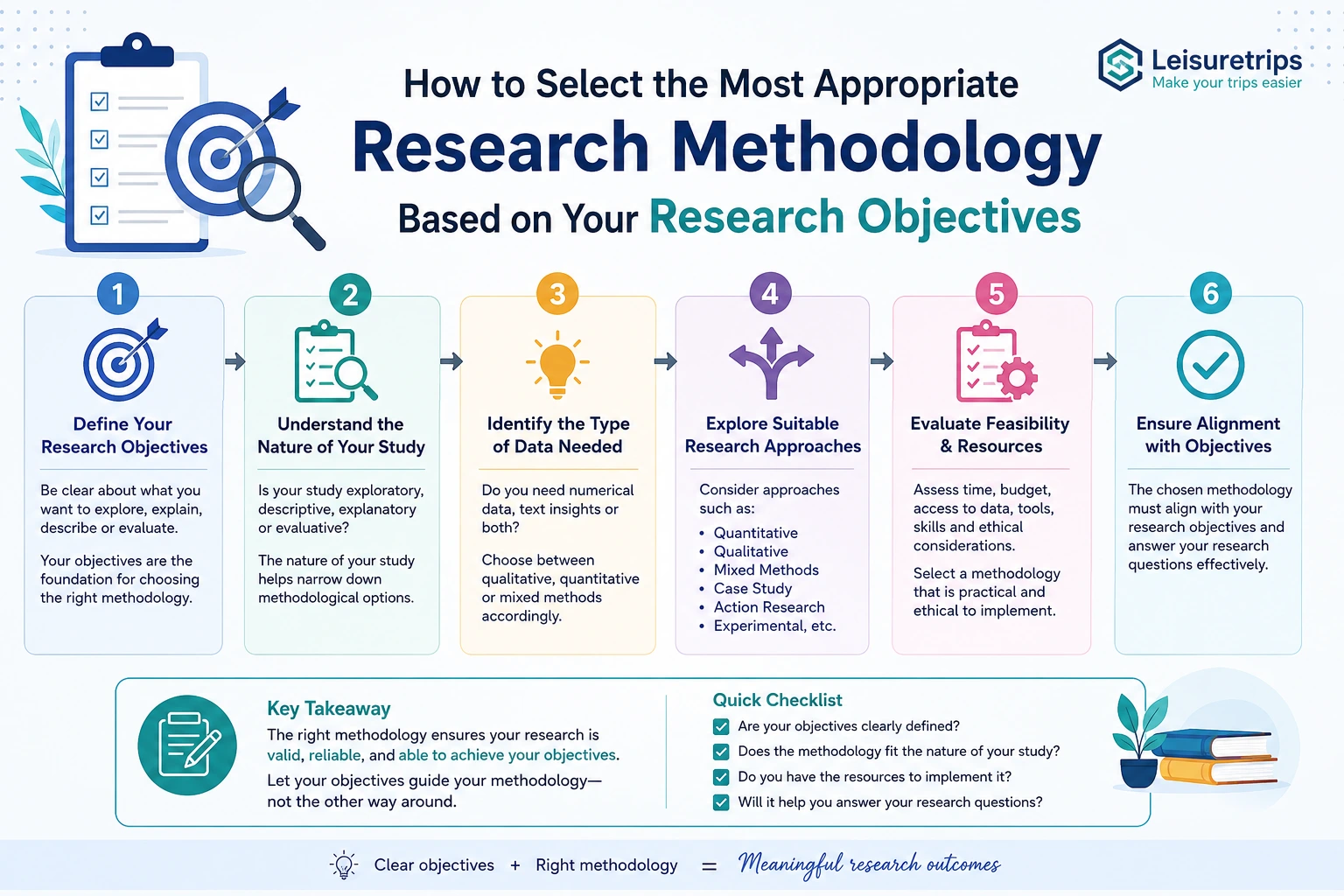
Selecting the right research methodology is one of the most critical decisions you will make during your PhD journey. Even if you have an excellent research topic, a clearly defined research problem, and well-written objectives, choosing an inappropriate methodology can undermine the quality, validity, and credibility of your research.
Many PhD scholars in India struggle with questions such as:
- Should I use quantitative or qualitative research?
- Is a mixed-methods approach better?
- Which sampling technique should I choose?
- What data collection method fits my objectives?
- Which statistical analysis should I use?
These are important questions because your research methodology determines how data will be collected, analyzed, interpreted, and presented. It also influences whether your research objectives can be achieved effectively.
The good news is that selecting a methodology does not have to be confusing. Once you understand how research objectives relate to different research approaches, the decision becomes much easier.
In this comprehensive guide, you will learn how to select the most appropriate research methodology based on your research objectives, along with practical examples, common mistakes, and expert tips specifically designed for Indian PhD scholars.
What Is Research Methodology?
Research methodology is the overall strategy and systematic process used to conduct research. It explains how the study will be carried out and why specific methods have been selected.
A research methodology includes:
- Research philosophy
- Research approach
- Research design
- Sampling method
- Data collection techniques
- Data analysis methods
- Ethical considerations
- Validity and reliability measures
It serves as the blueprint for your entire research project.
Why Is Choosing the Right Research Methodology Important?
Your methodology should align with your research objectives. If there is a mismatch, your findings may not adequately answer your research questions.
Selecting the right methodology helps you:
- Collect relevant data.
- Improve research validity.
- Enhance reliability.
- Reduce bias.
- Justify methodological decisions.
- Produce meaningful findings.
- Increase the acceptance of your thesis or journal article.
A well-justified methodology also demonstrates your understanding of research design to supervisors and examiners.
Understanding the Relationship Between Research Objectives and Methodology
Research objectives define what you want to achieve.
Research methodology explains how you will achieve it.
For example:
Research Objective
To examine the relationship between employee engagement and job performance.
Suitable Methodology
Quantitative research using surveys and statistical analysis.
Another example:
Research Objective
To explore teachers' experiences with online learning.
Suitable Methodology
Qualitative research using interviews or focus groups.
Always allow your objectives—not personal preference—to guide your methodological choices.
Step 1: Clearly Define Your Research Objectives
Before selecting a methodology, ensure your objectives are:
- Specific
- Measurable
- Achievable
- Relevant
- Time-bound (where applicable)
Examples:
- To identify factors influencing digital banking adoption.
- To examine customer satisfaction levels.
- To explore leadership challenges in start-up companies.
- To compare academic performance before and after online learning.
- To develop a framework for AI implementation.
Clear objectives make methodological decisions much easier.
Step 2: Identify the Nature of Your Research
Ask yourself:
Are you trying to measure something?
If yes, quantitative research is likely appropriate.
Example:
- Customer satisfaction
- Employee engagement
- Sales performance
- Income levels
Are you trying to understand experiences or opinions?
If yes, qualitative research may be more suitable.
Example:
- Employee perceptions
- Patient experiences
- Leadership challenges
- Consumer attitudes
Do you need both measurement and explanation?
If yes, consider a mixed-methods approach.
Example:
First, survey customers to measure satisfaction, then interview selected participants to understand the reasons behind their responses.
Step 3: Understand the Main Research Methodologies
Quantitative Research
Quantitative research focuses on numerical data and statistical analysis.
It is suitable when your objective is to:
- Measure variables.
- Test hypotheses.
- Compare groups.
- Examine relationships.
- Predict outcomes.
Common Data Collection Methods
- Surveys
- Structured questionnaires
- Experiments
- Existing datasets
Common Analysis Techniques
- Descriptive statistics
- Correlation analysis
- Regression analysis
- ANOVA
- Chi-square tests
- Structural Equation Modelling (SEM)
Example
Objective:
To examine the impact of employee training on productivity.
Methodology:
Survey 500 employees and analyze the data using regression analysis.
Qualitative Research
Qualitative research explores meanings, experiences, behaviors, and perspectives.
It is suitable when your objective is to:
- Explore opinions.
- Understand experiences.
- Develop theories.
- Investigate complex social phenomena.
Common Data Collection Methods
- Interviews
- Focus groups
- Observations
- Document analysis
Common Analysis Techniques
- Thematic analysis
- Content analysis
- Narrative analysis
- Grounded theory
- Phenomenological analysis
Example
Objective:
To explore the experiences of women entrepreneurs in rural India.
Methodology:
Conduct semi-structured interviews with 30 entrepreneurs and analyze themes.
Mixed Methods Research
Mixed methods combine quantitative and qualitative approaches.
It is suitable when you want to:
- Validate findings.
- Explain quantitative results.
- Gain a more comprehensive understanding.
- Address complex research questions.
Example
Objective:
To evaluate digital learning among university students.
Methodology:
- Survey 600 students.
- Interview 25 students.
- Compare and integrate findings.
Mixed methods provide both breadth and depth.
Step 4: Select an Appropriate Research Design
Research design determines the structure of your study.
Descriptive Research
Describes characteristics or situations.
Example:
Customer satisfaction surveys.
Exploratory Research
Explores new or poorly understood topics.
Example:
Adoption of Generative AI in higher education.
Explanatory Research
Explains cause-and-effect relationships.
Example:
Impact of leadership on employee performance.
Experimental Research
Examines causal relationships through controlled experiments.
Common in:
- Psychology
- Medicine
- Engineering
Case Study Research
Provides an in-depth examination of a specific organization, event, or community.
Step 5: Choose the Right Sampling Technique
Your methodology also depends on who you will study.
Probability Sampling
Suitable for quantitative studies.
Examples:
- Simple random sampling
- Stratified sampling
- Systematic sampling
- Cluster sampling
Non-Probability Sampling
Often used in qualitative research.
Examples:
- Purposive sampling
- Convenience sampling
- Snowball sampling
- Quota sampling
Choose a sampling method that reflects your research objectives and target population.
Step 6: Select Data Collection Methods
Different objectives require different methods.
Questionnaires
Best for:
- Large samples
- Quantitative analysis
Interviews
Best for:
- In-depth insights
- Qualitative research
Focus Groups
Useful for:
- Group discussions
- Consumer research
- Policy evaluation
Observations
Suitable for:
- Behavioral studies
- Educational research
- Healthcare settings
Secondary Data
Ideal for:
- Economic studies
- Government reports
- Financial analysis
Step 7: Plan Your Data Analysis
Your methodology should include a clear analysis plan.
Quantitative Analysis
Common software:
- SPSS
- R
- Python
- Stata
- SAS
Common analyses:
- Regression
- Factor analysis
- SEM
- Correlation
- t-tests
- ANOVA
Qualitative Analysis
Common software:
- NVivo
- ATLAS.ti
- MAXQDA
Common analyses:
- Coding
- Theme development
- Content analysis
- Narrative analysis
Consider Validity and Reliability
A strong methodology explains how you will ensure the quality of your research.
Validity
Does the study measure what it intends to measure?
Types include:
- Content validity
- Construct validity
- Internal validity
- External validity
Reliability
Will the study produce consistent results if repeated?
Methods include:
- Pilot testing
- Cronbach's Alpha
- Test-retest reliability
- Inter-rater reliability
Ethical Considerations
Every research methodology should address ethics.
Include:
- Informed consent.
- Confidentiality.
- Voluntary participation.
- Data protection.
- Ethical approval (if required).
Ethical practices are essential for maintaining research integrity.
Practical Examples
Example 1: Management Research
Objective
To examine the relationship between transformational leadership and employee engagement.
Methodology
- Quantitative
- Survey
- Random sampling
- Regression analysis
Example 2: Education Research
Objective
To explore teachers' experiences with online teaching.
Methodology
- Qualitative
- Semi-structured interviews
- Thematic analysis
Example 3: Healthcare Research
Objective
To evaluate patient satisfaction with telemedicine services.
Methodology
- Mixed methods
- Survey + interviews
- Statistical and thematic analysis
Example 4: Engineering Research
Objective
To compare the performance of two machine learning algorithms for defect detection.
Methodology
- Experimental research
- Quantitative analysis
- Performance metrics comparison
Common Mistakes to Avoid
Many PhD scholars make methodological mistakes that weaken their research.
Avoid:
- Choosing a methodology before defining objectives.
- Selecting methods because they are popular rather than appropriate.
- Using sample sizes that are too small for the chosen analysis.
- Failing to justify methodological decisions.
- Mixing qualitative and quantitative methods without a clear integration strategy.
- Ignoring validity, reliability, or ethical considerations.
- Selecting statistical techniques that do not match the research questions.
A well-reasoned justification is as important as the methodology itself.
Best Software for Research Methodology
The following tools can support different stages of your research.
SPSS
Ideal for descriptive and inferential statistical analysis.
R
Powerful open-source software for advanced statistical modeling.
Python
Useful for data analysis, machine learning, and visualization.
Stata
Popular in economics, public health, and social sciences.
NVivo
Designed for qualitative coding and thematic analysis.
MAXQDA
Supports mixed-methods and qualitative research.
ATLAS.ti
Useful for analyzing interviews, documents, and multimedia data.
Tips for Indian PhD Scholars
If you are pursuing a PhD in India, consider these recommendations:
- Review your university's research methodology guidelines before finalizing your design.
- Align your methodology with your research objectives—not with the software you are familiar with.
- Discuss your methodological choices with your supervisor early to avoid major revisions later.
- Conduct a pilot study if you are using questionnaires or interview schedules.
- Ensure that your sample size is appropriate for the analytical techniques you intend to use.
- Clearly explain why alternative methodologies were not selected.
Frequently Asked Questions (FAQs)
How do I choose the right research methodology?
Start by clearly defining your research objectives. If your study aims to measure variables or test hypotheses, quantitative methods are usually appropriate. If it seeks to explore experiences or perceptions, qualitative methods may be better. Mixed methods are suitable when both numerical data and in-depth insights are needed.
Can I use both qualitative and quantitative methods in one study?
Yes. Mixed-methods research combines quantitative and qualitative approaches to provide a more comprehensive understanding of complex research questions.
Is quantitative research better than qualitative research?
Neither is inherently better. The most appropriate methodology depends on your research objectives, questions, and the type of evidence needed to answer them.
How important is sampling in research methodology?
Sampling is critical because it influences the reliability, validity, and generalizability of your findings. Your sampling technique should align with your research design and target population.
Should I justify my choice of methodology in my thesis?
Absolutely. Examiners expect you to explain why your chosen methodology is the most suitable for addressing your research objectives and why alternative approaches were not selected.
Conclusion
Choosing the most appropriate research methodology is one of the most important decisions in any PhD project. Your methodology shapes how data are collected, analyzed, interpreted, and presented, ultimately determining whether your research objectives can be achieved successfully. Rather than selecting methods based on familiarity or convenience, allow your research objectives and questions to guide every methodological decision.
Whether your study requires a quantitative, qualitative, or mixed-methods approach, ensure that your research design, sampling strategy, data collection techniques, and analytical methods work together to answer your research problem effectively. A carefully justified methodology not only strengthens the credibility of your thesis but also demonstrates your competence as a researcher.
For Indian PhD scholars, investing time in understanding methodological options, consulting with supervisors, conducting pilot studies, and following university guidelines will lead to more rigorous, reliable, and impactful research. By aligning your methodology with your objectives from the outset, you create a strong foundation for a thesis that is academically sound, logically structured, and capable of making a meaningful contribution to your field of study.
Call / WhatsApp: +91 96438 02216
Website:www.ThesisLikho.com