
Introduction
When researchers hear the word plagiarism, they usually think about copying someone else's work without proper acknowledgment. However, there is another form of academic misconduct
that many students, researchers, and even experienced academics overlook—self-plagiarism.
At first glance, the concept may seem confusing. After all, how can someone steal their own work? If you wrote the original content, shouldn't you be free to use it again whenever you want?
In academic research, the answer is not always yes.
Universities, research institutions, and academic journals expect every thesis, dissertation, conference paper, and journal article to represent original scholarly work. Reusing your previously published text, data, or findings without proper disclosure can violate academic integrity policies and lead to serious consequences.
With plagiarism detection software becoming more sophisticated in 2026, self-plagiarism is being identified more frequently than ever before. Researchers who unknowingly recycle their own content may face manuscript rejection, thesis revision requests, damaged credibility, or disciplinary action.
This guide explains what self-plagiarism is, why it matters, common examples, consequences, and practical strategies to avoid it while conducting ethical research.
What Is Self-Plagiarism?
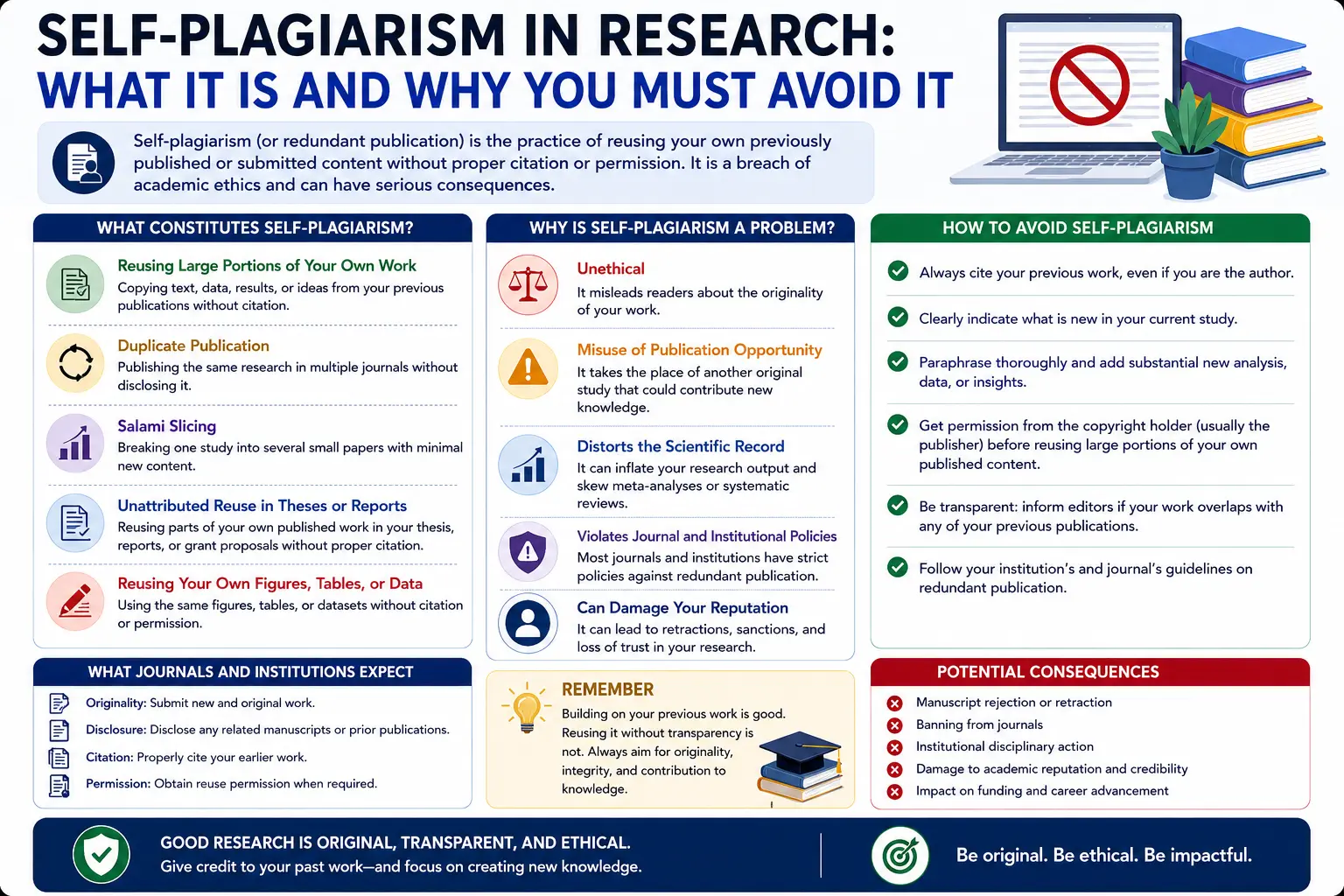
Self-plagiarism occurs when an author reuses substantial portions of their previously published or submitted work without proper citation, acknowledgment, or permission.
Although the content originally belongs to the author, presenting old work as new and original can mislead readers, reviewers, editors, and academic institutions.
In simple terms, self-plagiarism happens when you recycle your own academic writing without informing the audience that the material has appeared elsewhere.
Definition
Self-plagiarism is the practice of reusing one's previously disseminated content, ideas, data, or text in a new work without appropriate attribution.
The key issue is not ownership but transparency.
Academic readers expect to know whether content is:
- Completely original
- Previously published
- Adapted from earlier work
- Based on earlier findings
Why Is Self-Plagiarism Considered a Problem?
Many students ask:
"If I wrote it myself, why can't I use it again?"
The answer lies in academic honesty.
Research publications, dissertations, and journal articles are expected to contribute new knowledge. When authors reuse old material without disclosure, it creates a false impression of originality.
It Misleads Readers
Readers assume the work is new unless stated otherwise.
It Inflates Research Output
Publishing the same findings multiple times may artificially increase publication counts.
It Distorts Academic Records
Duplicate publications can affect literature reviews, meta-analyses, and research evaluations.
It Violates Publication Ethics
Many journals require submissions to be original and unpublished.
Reusing previously published content may breach these agreements.
Types of Self-Plagiarism in Research
Self-plagiarism can occur in several forms.
Understanding these categories helps researchers avoid unintentional mistakes.
1. Text Recycling
Text recycling is the most common form of self-plagiarism.
It occurs when researchers copy sections from their previous publications and insert them into a new manuscript without citation.
Example
A researcher publishes a journal article in 2024 and copies entire paragraphs from the introduction into another article submitted in 2026.
Even though the author wrote both papers, failing to acknowledge the earlier publication constitutes self-plagiarism.
2. Duplicate Publication
Duplicate publication occurs when essentially the same research is published more than once.
Example
A researcher submits identical findings to two different journals under different titles.
This practice is considered highly unethical.
It wastes editorial resources and can distort scientific evidence.
3. Salami Slicing
Salami slicing refers to dividing one research project into multiple publications with minimal differences.
Example
A PhD scholar conducts one large study and publishes several papers containing overlapping data without proper disclosure.
Although each paper may contain some unique information, excessive overlap can raise ethical concerns.
4. Data Reuse Without Disclosure
Researchers may reuse datasets from previous studies without informing readers.
Example
Using the same survey data in multiple publications while presenting each article as an entirely new study.
Transparency is essential when reanalyzing existing datasets.
5. Thesis and Publication Overlap
Many PhD scholars publish journal articles based on thesis chapters.
This is generally acceptable when:
- University policies allow it.
- Journals are informed.
- Proper citations are included.
Problems arise when previously published material is copied directly into the thesis or vice versa without acknowledgment.
Common Examples of Self-Plagiarism
Example 1: Reusing Literature Review Sections
A researcher copies several pages from an earlier conference paper into a new journal article.
Example 2: Submitting the Same Paper to Multiple Journals
The same manuscript is sent simultaneously to multiple publishers.
Example 3: Copying Methodology Sections
Researchers often believe methodology sections can be reused because the procedures remain unchanged.
However, many journals still require proper citation of earlier descriptions.
Example 4: Republishing Existing Data
Publishing identical results under different article titles without disclosure.
Example 5: Reusing Published Figures and Tables
Including previously published graphs or tables without citing the original publication.
Is Self-Plagiarism Always Wrong?
Not necessarily.
Some reuse of previous work is acceptable under certain circumstances.
Acceptable Situations
Thesis-Based Journal Articles
Many PhD students publish research derived from their dissertation.
This is widely accepted when disclosed appropriately.
Methodology Descriptions
If the same methodology is used across multiple studies, limited reuse may be acceptable with citation.
Conference Papers to Journal Articles
Expanding a conference paper into a full journal article is generally allowed if the journal permits it and the earlier version is cited.
The key requirement is transparency.
How Universities View Self-Plagiarism
Universities worldwide increasingly recognize self-plagiarism as an academic integrity issue.
Many institutions include self-plagiarism policies covering:
- Thesis writing
- Dissertation submissions
- Coursework
- Research publications
In India, universities following UGC guidelines often use plagiarism detection software that can identify overlap with previously submitted work.
Consequences vary depending on severity.
How Journals Detect Self-Plagiarism
Academic publishers use sophisticated similarity-checking tools.
Popular systems include:
- Turnitin
- iThenticate
- Crossref Similarity Check
These tools compare submitted manuscripts against:
- Published articles
- Conference papers
- Dissertations
- Institutional repositories
- Online academic databases
Editors can quickly identify overlapping content.
Consequences of Self-Plagiarism
Many researchers underestimate the seriousness of self-plagiarism.
Potential consequences include:
Manuscript Rejection
Journals may reject submissions with excessive overlap.
Retraction of Published Articles
Published papers may be withdrawn if undisclosed duplication is discovered.
Damage to Academic Reputation
Research credibility can suffer significantly.
Funding Risks
Funding agencies may investigate ethical concerns.
Degree Delays
PhD theses flagged for substantial overlap may require revisions before approval.
Institutional Disciplinary Action
Repeated violations may lead to formal penalties.
The Role of Plagiarism Detection Software
Modern plagiarism checkers are increasingly effective at identifying self-plagiarism.
What They Detect
- Exact text matches
- Similar sentence structures
- Previously published content
- Overlapping sections
What They Do Not Decide
Software does not determine misconduct.
Human reviewers interpret the results and assess context.
How to Avoid Self-Plagiarism in Research
Cite Your Previous Work
Whenever reusing ideas, text, or findings from earlier publications, cite the original source.
This is the most important preventive measure.
Rewrite Rather Than Copy
Instead of copying paragraphs, paraphrase them appropriately while citing the original work.
Inform Editors
If a manuscript overlaps with earlier publications, disclose this during submission.
Editors appreciate transparency.
Keep Detailed Records
Maintain a list of:
- Published papers
- Conference proceedings
- Thesis chapters
- Submitted manuscripts
This helps track content reuse.
Understand Journal Policies
Always review author guidelines before submission.
Different journals have different expectations regarding overlap.
Best Practices for PhD Scholars
Create Original Literature Reviews
Avoid copying previous review sections.
Update and Expand Earlier Work
If building upon previous research, clearly indicate what is new.
Maintain Research Integrity
Focus on contributing fresh insights rather than maximizing publication numbers.
Seek Supervisor Guidance
Consult supervisors when uncertain about content reuse.
Use Similarity Reports
Review plagiarism reports before final submission.
Self-Plagiarism in the Age of AI
The rise of AI-assisted writing introduces new challenges.
Researchers may unknowingly generate content similar to their previous work.
To stay compliant:
- Review AI-generated text carefully.
- Cite earlier publications when relevant.
- Avoid reusing large sections without attribution.
- Maintain transparency regarding AI usage.
Academic integrity remains essential regardless of writing tools.
Practical Checklist Before Thesis or Journal Submission
Ask yourself:
- Have I reused any previously published text?
- Have I cited all earlier publications?
- Have I disclosed overlapping studies?
- Is this work substantially original?
- Are reused figures properly referenced?
- Have I checked similarity reports?
If any answer is "no," revisions may be necessary.
Future Trends in Academic Publishing
By 2026 and beyond, publishers are increasingly focusing on:
Greater Transparency
Authors may need detailed disclosures regarding previous publications.
Enhanced Similarity Detection
AI-powered systems are improving overlap identification.
Stronger Ethical Standards
Research institutions continue strengthening academic integrity policies.
Publication History Tracking
Cross-platform databases make duplicate content easier to detect.
Researchers must adapt to these evolving expectations.
Conclusion
Self-plagiarism is often misunderstood because it involves reusing one's own work. However, academic research is built on honesty, transparency, and originality. When authors recycle previous content without proper acknowledgment, they create a misleading impression that the work is entirely new.
For PhD scholars, researchers, and academics, understanding self-plagiarism is essential in today's publishing environment. Whether writing a thesis, conference paper, dissertation, or journal article, researchers must ensure that reused material is clearly cited and appropriately disclosed.
The goal is not to avoid building upon previous work—it is to do so ethically. By maintaining transparency, citing earlier publications, and focusing on genuine scholarly contributions, researchers can protect their credibility and uphold the highest standards of academic integrity.
Frequently Asked Questions (FAQs)
Can I reuse content from my own published paper in my thesis?
Yes, in many cases, but you should cite the original publication and follow university guidelines.
Is self-plagiarism considered academic misconduct?
Many universities and journals consider undisclosed self-plagiarism a form of academic misconduct.
Can Turnitin detect self-plagiarism?
Yes. Turnitin and similar tools can identify overlap with your previously submitted or published work.
What is salami slicing in research?
It is the practice of dividing one research project into multiple publications with significant overlap.
Can I use the same methodology description in different papers?
Limited reuse may be acceptable if properly cited and permitted by journal policies.
How can I avoid self-plagiarism?
Cite previous work, rewrite reused content, disclose overlap, and follow journal and university guidelines carefully.
Contact ThesisLikho Today
Call / WhatsApp: +91 96438 02216
Visit: ThesisLikho.com