
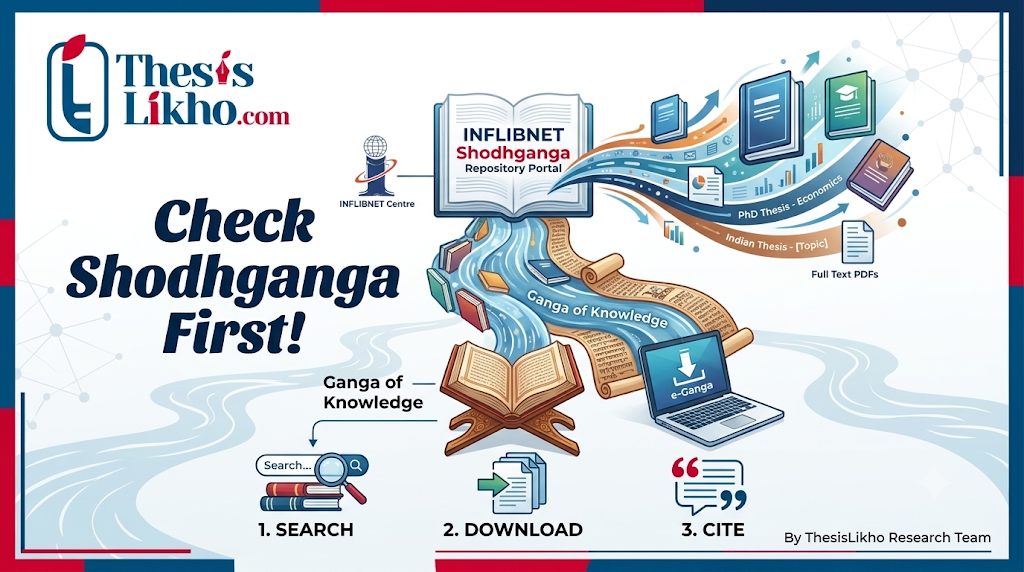
Every PhD scholar in India hears the same advice from a supervisor in the first semester: "Check Shodhganga first." It is good advice. Shodhganga is the largest open collection of Indian doctoral theses, it costs nothing, and it shows you exactly what has already been done in your area. This guide explains how the Shodhganga thesis repository works, how to search and download from it, and how its sister platforms (ShodhGangotri, e-ShodhSindhu, ShodhShuddhi and Shodh Chakra) fit into your research journey.
What is Shodhganga?
Shodhganga is a national digital repository of theses and dissertations submitted to Indian universities. It is hosted and maintained by the INFLIBNET Centre in Gandhinagar, Gujarat, an Inter-University Centre of the University Grants Commission (UGC). The name joins two words: Shodh, Sanskrit for research and discovery, and Ganga, the river. The tagline says it plainly: "a reservoir of Indian theses."
The repository grew out of UGC regulations issued in 2009, which asked universities to deposit electronic copies of PhD theses and MPhil dissertations with INFLIBNET. Universities join by signing a Memorandum of Understanding with the Centre. By mid-2026 the collection had crossed 6.7 lakh full-text theses from more than 870 universities, which makes it one of the largest national thesis collections in the world.
Everything on Shodhganga is open access. You do not need a login, a university ID or a subscription. A scholar in a small college in Jhajjar has the same access as one at an IIT.
Why Shodhganga matters for research scholars
- Finding a research gap. Before your synopsis is approved, you need to show that your topic has not been done already. A search across Indian theses is the quickest way to prove it.
- Building a literature review. A thesis is a far richer source than a journal paper. Chapter 2 of a good thesis in your field gives you a curated reading list of 150 to 300 references.
- Learning thesis structure. You can see how awarded scholars in your own university arranged chapters, framed objectives and hypotheses, and presented results.
- Studying methodology. Questionnaires, sampling designs, datasets and statistical tests are described in far more detail in a thesis than in any published paper.
- Regional and Indian-language research. The repository supports Hindi, Tamil, Gujarati and other Indian languages, so work that never reached an international journal is still discoverable.
- Visibility for your own work. Once your thesis is uploaded, it is indexed by search engines and can be cited by scholars anywhere.
How to search and download a thesis on Shodhganga
- Open the portal. Go to shodhganga.inflibnet.ac.in.
- Start with a simple search. Type two or three core keywords, for example "depression detection deep learning", not a full sentence.
- Narrow the results. Use the filters or advanced search to restrict by university, department, researcher, guide, keyword or year of completion.
- Browse by university. If you want to see what your own department has produced, open the university list, choose your university and then the department.
- Open the thesis record. The record shows the title, researcher, guide, abstract, keywords, completion date and a permanent handle link that you can use in your citation.
- Download the files. Theses are stored chapter by chapter as PDF files: title page, certificate, contents, each chapter, bibliography and annexures. Download only what you need.
Beyond Shodhganga: the other Shodh tools from INFLIBNET
Shodhganga is one part of a family of five platforms. Each one serves a different stage of your PhD.
| Platform | What it holds or does | When to use it |
|---|---|---|
| Shodhganga | Full-text awarded PhD theses and dissertations | Literature review, gap analysis, structure and methodology reference |
| ShodhGangotri | Approved synopses and research in progress | Topic selection and synopsis writing |
| e-ShodhSindhu | Consortium access to paid journals and databases | Reading subscription journals through your institution |
| ShodhShuddhi | Plagiarism detection software for universities | Similarity check before submission |
| Shodh Chakra | Research lifecycle management workspace | Organising references, progress and guide interaction |
ShodhGangotri: research in progress
If Shodhganga is the river, ShodhGangotri is its source. It hosts the approved synopses that scholars submit when they register for a PhD, and it has expanded to cover major and minor research projects, post-doctoral fellowships and emeritus fellowships. For a new scholar it answers a question Shodhganga cannot: what are people working on right now? Checking it before you finalise a title helps you avoid duplicating a study that is already under way. When the final thesis is awarded, the synopsis is meant to be linked to the full text on Shodhganga.
e-ShodhSindhu: access to journals and databases
e-ShodhSindhu is the consortium for higher education e-resources. It gives member universities and colleges access to peer-reviewed journals, bibliographic databases and factual databases at negotiated rates, instead of each institution paying publishers separately. Since 2025 a large share of journal access for public institutions is delivered through the Government of India's One Nation One Subscription (ONOS) scheme, so ask your university library which route applies to you. In either case, access is institutional: you log in through your campus network or library credentials.
ShodhShuddhi: plagiarism detection
ShodhShuddhi is a Ministry of Education programme, started on 1 September 2019, that provides plagiarism detection software to universities and institutions. Faculty and scholars get accounts through the university coordinator, usually the librarian. It matters because the UGC's 2018 regulations on academic integrity fix similarity levels: up to 10% attracts no penalty, while higher bands can lead to resubmission, a bar on submission or cancellation of registration. Your university will not accept a thesis without a similarity report.
Shodh Chakra: managing the research lifecycle
Shodh Chakra is a workspace for the scholar, the supervisor and the university. Scholars can collect and organise references, store notes and track progress; supervisors can monitor the work of their students; the university gets a view of research activity across departments. It is useful if your department has adopted it, especially for keeping six-monthly progress records in one place.
How to use Shodhganga properly in your own thesis
Shodhganga is a library, not a source of ready-made chapters. Scholars who treat it as a copy bank get caught, because every thesis on it is also in the comparison database of similarity software. Use it this way instead:
- Read, then write in your own words. Take notes on findings and arguments, close the PDF, and write from your notes.
- Cite the thesis. A thesis is a legitimate source. Cite the author, year, title, university and the Shodhganga handle URL in the style your university prescribes (APA, IEEE, MLA or Harvard).
- Go to the primary source. If a thesis quotes a journal paper you need, find and read that paper. Do not cite something you have not read.
- Judge quality. Not every thesis is equally rigorous. Check the methodology and sample before relying on the results.
- Mind the date. In fast-moving fields such as computer science, a 2014 thesis shows you history, not the state of the art. Combine it with recent journal literature.
How your thesis reaches Shodhganga
You do not upload a thesis to Shodhganga yourself. After the viva and award, you give the final soft copy to your university, usually to the central library or research cell, along with any declaration form it requires. The university's designated coordinator uploads the files and metadata. Make sure the soft copy matches the approved hard copy, that chapters are in separate, searchable PDF files, and that your name, guide's name, title and keywords are entered correctly, because that metadata decides whether other scholars will ever find your work.
How ThesisLikho helps alongside these tools
INFLIBNET's platforms give you material. They do not sit with you and turn 40 downloaded theses into a focused chapter, choose a statistical test, or fix formatting the night before submission. That is the gap ThesisLikho fills. Based in Gurugram and working with scholars across India since 2015, the team offers guidance at each stage where the Shodh tools leave off.
| Research stage | INFLIBNET tool | ThesisLikho support |
|---|---|---|
| Admission and topic selection | ShodhGangotri | PhD admission guidance, entrance exam help, top universities list |
| Literature review | Shodhganga, e-ShodhSindhu | Literature review and analysis |
| Research design | Shodhganga (methodology chapters) | Methodology assistance |
| Data and results | Shodh Chakra | PhD data analysis (SPSS, R, Python, MATLAB, AMOS, NVivo) |
| Thesis drafting | Shodhganga (structure reference) | Thesis writing support |
| Publication | e-ShodhSindhu | Research article writing for Scopus, SCI and UGC-CARE journals |
| Pre-submission checks | ShodhShuddhi | Plagiarism check and proofreading and formatting |
A practical example: a scholar finds 25 relevant theses on Shodhganga but cannot see the pattern in them. A literature review mentor helps group the studies by theme, method and finding, and the research gap becomes visible. Later, the university's ShodhShuddhi report comes back above the permitted limit; the editing team helps the scholar rewrite and cite the flagged passages properly, so the next report is clean. The research stays the scholar's own. The support makes it stronger and faster.
You can also join the ThesisLikho research community to discuss topics with other scholars, read what past clients say on the testimonials page, and check plans on the pricing page before you commit.
Stuck between downloading theses and writing your own?
Talk to a research mentor about your topic, synopsis or chapter. The first consultation is free.
Get Free Thesis Consultation WhatsApp +91 92890 68414Key ThesisLikho links for researchers
- ThesisLikho home
- Thesis writing
- Literature review and analysis
- Methodology assist
- PhD data analysis
- Research article writing
- Plagiarism checker
- Proofreading and formatting
- PhD admission
- PhD entrance exam
- Top universities in India
- Research community
- Pricing
- Testimonials
- FAQs
- More research blogs
- About us
- Contact us
Frequently asked questions
Is Shodhganga free to use?
Yes. Shodhganga is an open-access repository. Anyone can search, read and download theses without paying a fee or creating an account.
How do I download a full thesis from Shodhganga?
Open the thesis record and download the PDF files listed at the bottom of the page. Theses are stored chapter by chapter, so you download the title page, each chapter and the bibliography as separate files.
What is the difference between Shodhganga and ShodhGangotri?
Shodhganga holds completed, awarded theses in full text. ShodhGangotri holds approved synopses and research proposals of work that is still in progress.
Can I copy content from a Shodhganga thesis?
No. You can read, cite and build on a thesis, but copying text without citation is plagiarism and will be detected by the similarity software universities use.
Is it compulsory to upload my PhD thesis on Shodhganga?
UGC regulations require universities to submit an electronic copy of every awarded PhD thesis to INFLIBNET for hosting on Shodhganga. Your university library or research cell normally handles the upload.
Final word
Shodhganga and its sister platforms have removed the biggest barrier Indian scholars once faced: access. The theses, the synopses, the journals and the plagiarism software are all within reach. What remains is the hard part, which is reading critically, finding your own question and writing it up well. Start with a search on Shodhganga today, and when you need a second pair of expert eyes on your review, methodology or draft, reach out to ThesisLikho or write to support@thesislikho.com.