
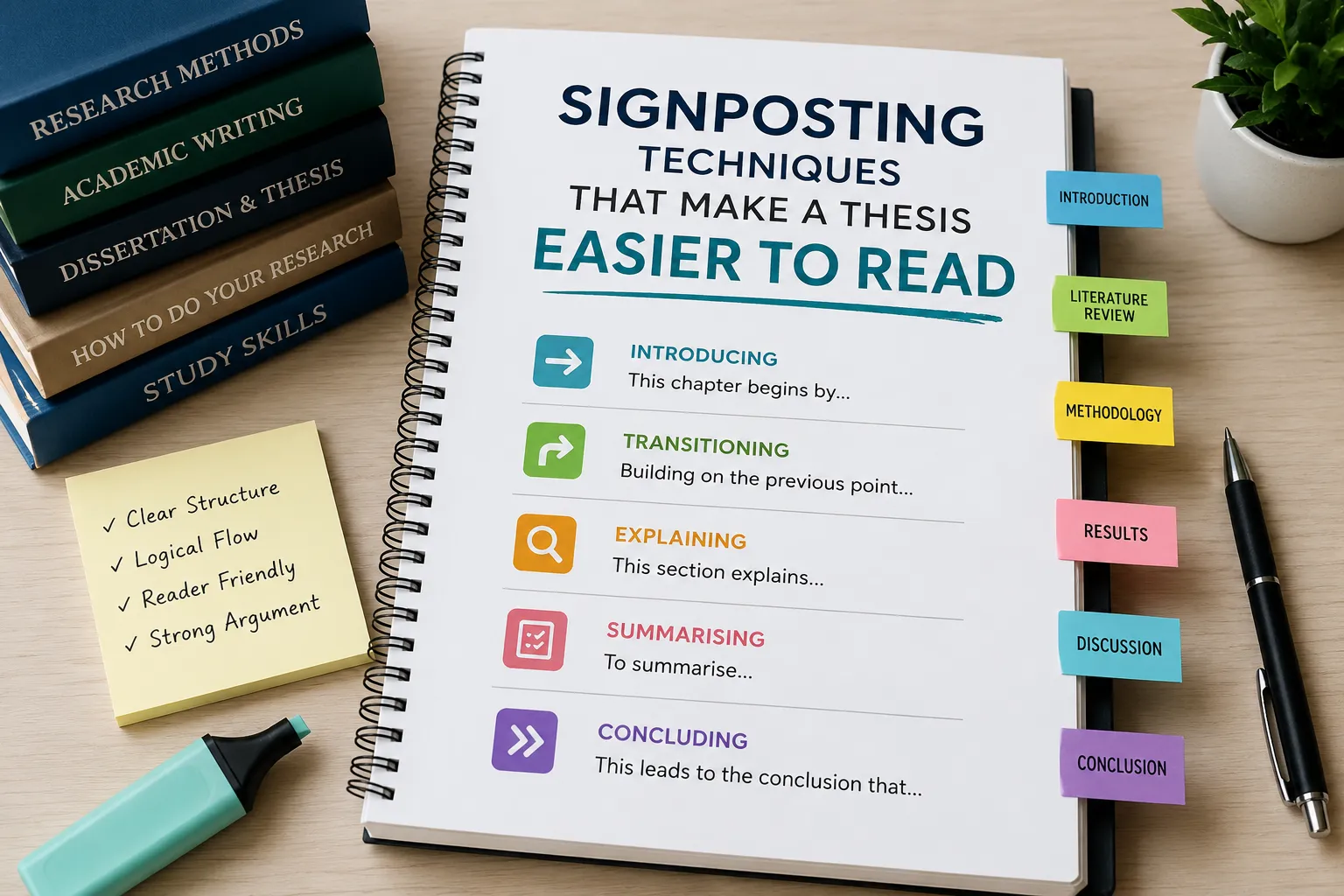
If your supervisor has ever written "where is this going?" or "how does this connect to your argument?" in the margins of an otherwise solid chapter, the issue often isn't your actual content — it's that your reader can't see the structure holding it together. Signposting techniques that make a thesis easier to read are exactly what solves this, and they're genuinely learnable, concrete tools, not a vague matter of "writing more clearly."
This guide walks through what signposting actually is, why theses specifically need far more of it than other academic writing, and the exact techniques — at both the whole-thesis and sentence level — that make a long, complex document navigable for an examiner who won't read it start to finish in one sitting.
What Signposting Actually Is
Signposting is meta-commentary on your document's structure. When you write "this section examines three implications," you're not making an argument — you're telling your reader how the next part of your document is organized. That distinction, between meta-level structural commentary and your actual argument, is exactly what separates signposting from other kinds of writing.
Think of it the way the name suggests: just as road signs show you where a street or highway is heading, signposting phrases show your reader the route your thesis will take, remind them of key points already covered, and flag upcoming changes in direction. Done well, signposting is nearly invisible in the sense that it doesn't call attention to itself — but its absence is immediately, frustratingly obvious to a reader who's lost track of where a chapter is going or why a particular section exists.
ThesisLikho's PhD-qualified mentors, who've guided over 10,000 scholars through thesis writing, consistently see the same feedback pattern from supervisors: comments like "unclear structure" or "hard to follow the argument here" often point not to a genuine problem with the underlying research, but to missing or vague signposting that leaves an otherwise sound argument feeling disorganized on the page. This is genuinely good news for scholars receiving this kind of feedback, since it usually means the fix is a structural writing pass rather than reworking the actual research or analysis underneath it.
Why Theses Need More Signposting Than Almost Any Other Document
This is worth understanding clearly, because it explains why signposting that would feel over-explained in a short essay is often genuinely necessary in a thesis. Readers of a thesis rarely read it linearly, start to finish, the way you might read a novel. Examiners jump directly to specific sections flagged by other reviewers. Committee members skip straight to your methodology or results chapters to evaluate rigor before reading your full argument. A reader scanning for a specific claim relies on explicit structural cues to find it quickly, rather than re-reading your prose in sequence to locate it.
Individual thesis chapters commonly run 40 to 80 pages — far beyond what any reader can hold in working memory or navigate confidently without explicit signposting cues throughout. This is precisely why dissertations and theses require the heaviest signposting density of any common academic document type: light signposting suffices for a short essay, research articles get much of their navigational structure for free from standard IMRaD section headings, but a thesis's length and internal complexity genuinely demand more deliberate, explicit guidance than either of these shorter formats.
Macro Signposting: The Whole-Thesis Level
Macro signposting (sometimes called major or overview signposting) outlines your overall structure and roadmap, typically appearing in your introduction, your conclusion, and at the start of each new chapter as your argument moves into its next stage. This is where you tell your reader, explicitly and directly, what your thesis argues and how you'll develop that argument across your chapters.
A strong introduction typically states your core argument directly — "the core argument of this thesis is..." or "the key proposition this thesis advances is..." — and then bundles this with an explicit chapter-by-chapter overview: "I develop this argument across five chapters. Chapter 2 reviews the existing literature on X, identifying a specific gap in Y. Chapter 3 details my methodology for addressing this gap. Chapters 4 and 5 present and interpret my findings, and Chapter 6 discusses their broader implications." Being this direct isn't a sign of unsophisticated writing — it's specifically what helps an examiner confirm, efficiently, that you're addressing every element they're evaluating your thesis against, without leaving them to reconstruct your structure themselves.
The Chapter-Level Pattern: Roadmap Paragraphs and Recap Paragraphs
This is the specific structural pattern worth adopting deliberately throughout your thesis: each chapter should open with a roadmap paragraph previewing that specific chapter's internal structure, and close with a recap paragraph summarizing what the chapter actually accomplished. Your introduction chapter signposts the thesis as a whole, using the macro-signposting approach covered above. Your concluding chapter should explicitly circle back and refer to the structure your introduction established, closing the loop for your reader rather than simply ending with new, unconnected summary content.
Applied practically, a chapter's opening roadmap paragraph might read: "This chapter reviews existing literature on employee engagement and remote work, organized around three themes: measurement approaches, contextual moderators, and identified gaps. It concludes by positioning this thesis's specific contribution within the third theme." And that same chapter's closing recap paragraph might read: "This chapter has shown that while employee engagement measurement is well established, contextual moderators specific to hybrid work arrangements remain underexplored — the gap this thesis addresses in the chapters that follow." Notice how the recap doesn't just summarize; it explicitly connects forward to what comes next, maintaining the reader's sense of the thesis's overall argument even as they move between chapters, potentially with weeks between reading sessions.
This pattern matters more than it might initially seem, precisely because of how theses are actually read in practice. An examiner working through your thesis across several sittings, or a committee member returning to a specific chapter weeks after their last read, benefits enormously from being able to open any given chapter and immediately reorient themselves — both to that chapter's specific content and to where it sits within your thesis's overall argument. A chapter that simply begins with content, with no roadmap paragraph establishing its purpose and structure first, forces this reorientation work onto the reader instead, which is exactly the kind of friction well-executed signposting is designed to remove.
Micro Signposting: The Sentence and Paragraph Level
Micro signposting (also called minor or linking signposting) works at a much smaller scale, connecting ideas at the sentence or paragraph level rather than orienting a reader to your whole chapter or thesis structure. These are the transition words and phrases signaling relationships between ideas — addition, contrast, cause and effect, sequence — that keep your prose flowing logically from one point to the next.
Examples include phrases like "having discussed the theoretical framework, the analysis now turns to its practical implications," "in contrast to previous studies, this analysis focuses on...," and "given the challenges identified above, this study adopts a mixed-method design specifically to address them." These micro-level signposts do real work distinct from macro signposting: where macro signposting orients a reader to your overall structure, micro signposting keeps them oriented as they move through the connective tissue between your specific points, sentence by sentence and paragraph by paragraph.
Signposting vs. a Thesis Statement: Two Different Things
This distinction is genuinely worth stating clearly, since these two concepts are commonly confused despite being fundamentally different. Your thesis statement expresses your core argument or claim — the actual substantive position your research advances. Signposting, by contrast, concerns the flow and structure of your writing — how your ideas connect, and in what order you present them to build your case.
A strong introduction needs both, working together but doing genuinely different jobs: a clear, direct thesis statement establishing exactly what you're arguing, and macro-signposting establishing exactly how you'll develop and support that argument across your subsequent chapters. Neither one substitutes for the other — a thesis statement without signposting leaves a reader unsure how your argument will unfold; signposting without a clear thesis statement leaves a reader following a structure that isn't actually anchored to a clear central claim.
Vague Signposting vs. Specific Signposting
This is consistently identified as the most common signposting mistake, and it's worth internalizing the distinction clearly. Vague signposting technically signals structure but tells the reader almost nothing useful — a sentence like "this section will discuss the issue" is technically a signpost, since it's meta-commentary about what's coming, but it gives a reader no genuine sense of what "the issue" actually is or why this particular section matters to your broader argument.
Specific signposting, by contrast, genuinely orients: naming exactly what will be covered, in what order, and connecting it explicitly to your broader argument. Compare "this section will discuss the issue" against "this section examines three specific challenges to implementing competency-based assessment: teacher training gaps, infrastructure limitations, and assessment design complexity" — the second version tells a reader precisely what to expect and gives them a concrete framework for following the section that follows. Vague signposting wastes the reader's attention on structural commentary that doesn't actually help them; specific signposting earns its place by genuinely orienting them.
The Opposite Risk: Over-Signposting
Signposting has a genuine opposite failure mode worth guarding against: adding an explicit structural marker or transition to every single sentence, which interrupts your writing's natural flow and can feel mechanical or even patronizing to a sophisticated reader capable of following reasonably connected prose without constant explicit narration of every micro-transition.
The goal isn't maximizing signposting density throughout your entire thesis — it's using signposting deliberately at the specific points where a reader genuinely needs orientation: chapter openings and closings, major shifts in argument direction, and points where your structure might not otherwise be obvious. Between these points, well-constructed prose with natural, varied transitions does the connective work without needing every single sentence explicitly flagged as a structural marker.
If you're also working on tightening prose that might be running long due to unnecessary repetition, our sibling guide on [Link: How to Avoid Repetition and Filler Words in Academic Writing] covers that closely related concern. And if you're synthesizing multiple sources within a signposted section, our related guide on [Link: How to Paraphrase Research Sources Without Losing Meaning] is worth reading alongside this one.
A Practical Phrase Bank by Function
Organizing useful signposting phrases by the specific function they serve makes them easier to apply deliberately rather than reaching for the same one or two transitions repeatedly throughout a long thesis. For introducing your overall structure: "this thesis begins by...," "it goes on to...," "finally, it considers...," "I develop this argument across the following chapters." For chapter or section transitions: "having established X, this chapter now turns to Y," "building on the previous chapter's findings," "this section extends the discussion by considering." For signaling contrast or divergence from prior work: "in contrast to previous studies," "unlike earlier research, which focused on X, this study examines Y," "while X has been well documented, less attention has been paid to Y." For emphasis, drawing attention to a particularly important point: "it is crucial to note that," "of particular significance here is," "this finding is especially notable because." And for closing a chapter or section with a clear summary that also points forward: "this chapter has demonstrated that," "taken together, these findings suggest," "the following chapter builds on this foundation by."
Varying your specific phrasing within each function category, rather than relying on the identical transition repeatedly, keeps your prose feeling natural rather than formulaic, even while maintaining consistent, deliberate signposting throughout.
A Realistic Before-and-After Example
A results chapter's early draft might move directly from one finding to the next with no signposting at all: "Regression analysis showed flexible work policy predicted retention intention (β = .31, p < .01). Organizational trust showed a mediating effect. The interaction between policy access and trust was also significant." Each sentence is individually clear, but a reader has no sense of how these three findings relate to each other or to the chapter's overall argument — they read as a disconnected list rather than a building case.
A revised version adds both macro and micro signposting: "This chapter presents three key findings, addressing each of this study's three research questions in turn. First, regression analysis showed that flexible work policy significantly predicted retention intention (β = .31, p < .01), directly supporting the first hypothesis. Building on this result, mediation analysis then examined whether organizational trust helps explain this relationship, finding a significant mediating effect. Finally, testing for an interaction effect revealed that policy access and trust combine to predict retention even more strongly together than either does alone — a finding discussed in more depth in the following chapter." The underlying statistical findings are identical, but the added roadmap opening and connective micro-signposting between findings transform a disconnected list into a coherent, easy-to-follow argument.
How Signposting Density Should Change by Section
Signposting needs genuinely vary across your thesis's different chapters and sections, and matching density to context matters as much as using signposting techniques correctly in the first place. Your introduction and conclusion chapters need the heaviest macro-signposting, since these are specifically where you're orienting readers to your entire thesis's structure and argument. Literature review chapters benefit from clear thematic signposting, explicitly naming each theme as you move between them, since readers need to track which body of literature you're synthesizing at any given point. Methodology chapters typically need less signposting relative to their length, since their internal logic (design, then sampling, then data collection, then analysis) is often self-evident from standard section headings alone. Results and discussion chapters benefit from the kind of finding-by-finding signposting shown in the example above, particularly when presenting multiple related findings that build toward a cumulative argument.
This variation isn't arbitrary — it tracks how self-evident each chapter's internal organization already is without added commentary. A methodology chapter following a standard, expected sequence (design, sample, instruments, procedure, analysis) needs relatively little explicit signposting because an experienced reader already anticipates this structure and can navigate it using section headings alone. A results chapter presenting several related but distinct findings, by contrast, has no equivalently predictable default structure, meaning the reader genuinely benefits from explicit signposting connecting each finding to the last and to the chapter's overall shape. The general principle worth carrying forward: add signposting where your document's structure isn't otherwise obvious, and rely on standard conventions and clear headings where it already is.
Common Mistakes With Signposting
- Using vague signposting phrases ("this section will discuss the issue") that technically flag structure without genuinely orienting the reader to specific content
- Over-signposting every single sentence, producing mechanical, repetitive prose that interrupts natural flow
- Confusing signposting with your actual thesis statement, treating structural commentary as a substitute for stating your core argument clearly
- Skipping chapter-opening roadmap paragraphs or closing recap paragraphs, leaving readers to reconstruct each chapter's internal logic themselves
- Relying on the same one or two transition phrases repeatedly throughout a long thesis, producing formulaic-feeling prose
- Failing to have your conclusion chapter explicitly circle back to the structure your introduction established, leaving the thesis feeling structurally unresolved
Signposting Checklist
Before finalizing your thesis, confirm the following:
- Your introduction includes both a clear thesis statement and explicit macro-signposting previewing your chapter-by-chapter structure
- Each chapter opens with a roadmap paragraph previewing that chapter's specific internal structure
- Each chapter closes with a recap paragraph summarizing what it accomplished and connecting forward to what follows
- Your conclusion chapter explicitly refers back to the structure your introduction established
- Micro-level transitions between paragraphs and sections use varied, specific phrasing rather than repeating the same transition throughout
- Your signposting is specific (naming exactly what's coming and why it matters) rather than vague ("this section discusses the issue")
- Signposting density is calibrated to each section's actual needs, heavier in introduction, conclusion, and literature review, lighter where structure is otherwise self-evident
How Long Does This Take to Add to an Existing Draft?
Adding proper signposting to an already-drafted thesis typically takes one to two weeks, done most efficiently as its own dedicated editing pass separate from content or tone revision. This involves reading through chapter by chapter, checking for missing opening roadmap paragraphs and closing recap paragraphs, and reviewing transitions between major sections for vagueness or absence. Building strong signposting habits into your writing from the start — rather than retrofitting it onto a completed draft — is somewhat more efficient overall, though a dedicated signposting pass on existing content is a genuinely manageable, high-value use of editing time even late in your writing process.
If you'd like expert feedback on your thesis's structure and signposting, or help revising a completed draft for clearer navigation, you can explore our Thesis Writing service, where our PhD-qualified mentors help scholars make long, complex documents genuinely easier for examiners to follow.
FAQs
What are signposting techniques that make a thesis easier to read?
Signposting techniques include macro-level structural guidance (chapter roadmap and recap paragraphs, whole-thesis overviews in your introduction and conclusion) and micro-level transitions connecting ideas at the sentence and paragraph level. Together, they help readers navigate a long, complex document without needing to read it linearly start to finish.
Why do signposting techniques that make a thesis easier to read matter?
Theses are rarely read linearly — examiners jump to specific sections, committee members skip to methodology or results, and readers scan for specific claims. Without explicit structural cues, even strong research can read as disorganized or hard to follow, undermining how convincingly your argument comes across.
When should you use signposting techniques in a thesis?
Throughout, but with density calibrated to context — heaviest in your introduction, conclusion, and literature review, present at the opening and close of every chapter, and used more lightly in sections like methodology where structure is often already clear from standard headings.
How long does it take to complete a thesis using this approach?
Adding proper signposting to an already-completed draft typically takes one to two weeks as a dedicated editing pass. Building strong signposting habits into your writing from the start is more efficient but takes ongoing practice across several chapters to become natural.
Is professional help available for signposting techniques that make a thesis easier to read?
Yes. Many scholars work with experienced thesis mentors to review their draft's structure and add or strengthen signposting throughout — this is exactly the kind of support ThesisLikho's PhD-qualified mentors provide.
Talk to a Thesis Expert: If your thesis feels harder to follow than your research deserves, ThesisLikho's PhD-qualified mentors can help you add clear, effective signposting throughout. Explore our Thesis Writing Service →
Website: www.thesislikho.com
Call / WhatsApp:+91 96438 02216