
Introduction
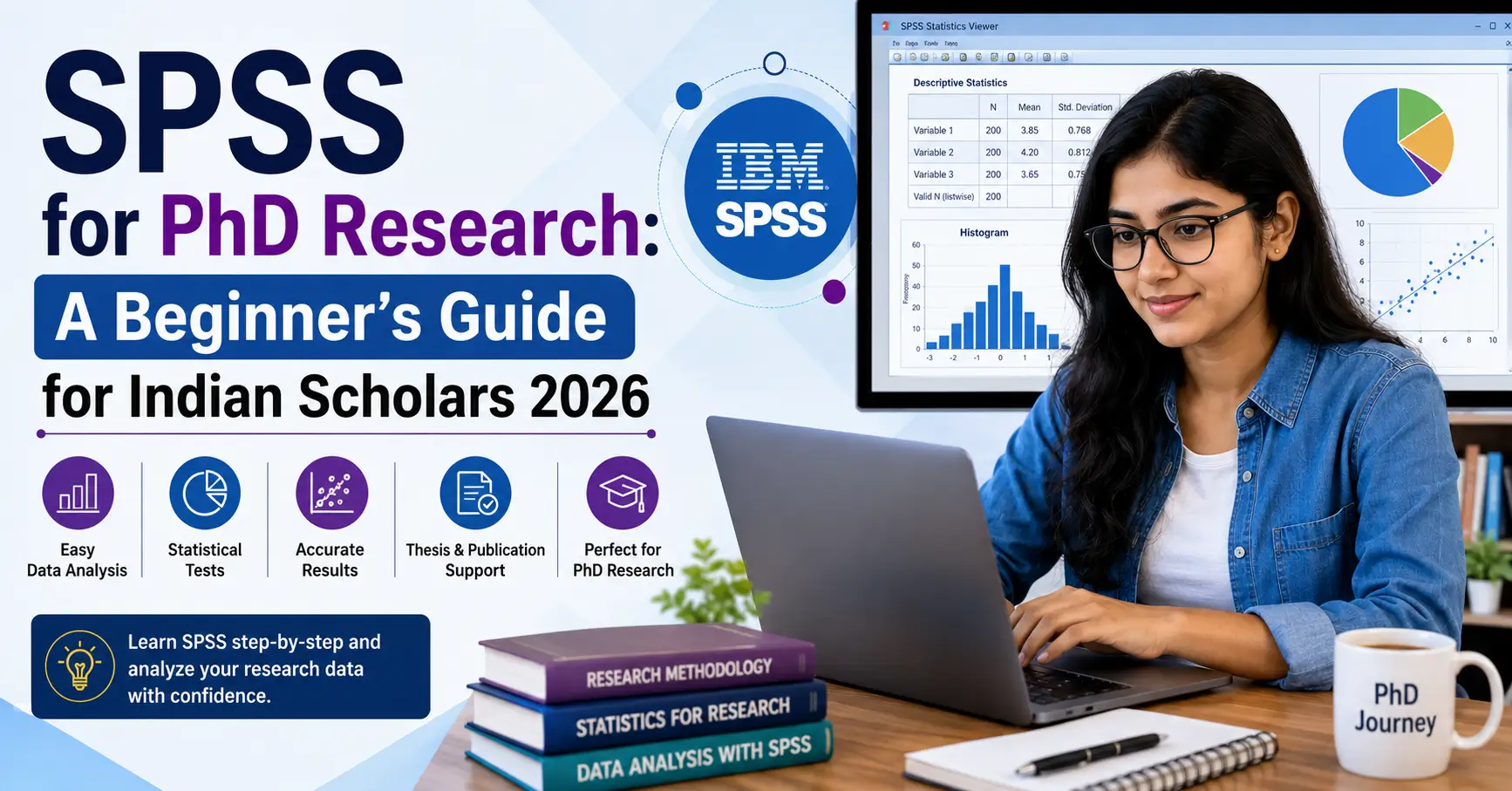
For many PhD scholars, data analysis is one of the most challenging stages of the research journey. After months of literature review, questionnaire design, data collection, and fieldwork, researchers must transform raw data into meaningful findings. This is where SPSS for PhD research becomes an essential tool.
Whether you belong to management, education, psychology, social sciences, healthcare, economics, or commerce, SPSS can help simplify complex statistical analysis. However, many Indian scholars entering doctoral research in 2026 are unfamiliar with statistical software and often feel overwhelmed by terms such as regression analysis, ANOVA, reliability testing, and hypothesis testing.
The good news is that SPSS is designed for researchers, not programmers. You do not need advanced coding skills to analyze your data effectively.
This beginner-friendly guide explains everything Indian PhD scholars need to know about SPSS, including its importance, features, applications, statistical tests, and practical tips for thesis data analysis.
What Is SPSS?
SPSS stands for Statistical Package for the Social Sciences. It is one of the most widely used statistical software packages for academic and professional research worldwide.
Originally developed for social science research, SPSS is now extensively used across various disciplines, including:
- Management Research
- Education Studies
- Psychology
- Sociology
- Public Health
- Nursing
- Economics
- Commerce
- Human Resource Management
- Marketing Research
SPSS allows researchers to organize, manage, analyze, and visualize data without requiring programming knowledge.
For doctoral scholars, it serves as a powerful tool for converting survey responses and research data into meaningful insights.
Why Is SPSS Important for PhD Research?
Research today is increasingly data-driven. Universities and journals expect researchers to support their findings with robust statistical evidence.
Using SPSS helps scholars:
- Analyze large datasets efficiently
- Test research hypotheses
- Validate questionnaires
- Improve research accuracy
- Generate publication-quality outputs
- Save time during thesis preparation
Most importantly, SPSS provides credibility to research findings by applying scientifically accepted statistical methods.
Why Indian PhD Scholars Prefer SPSS in 2026
In India, SPSS continues to remain one of the most preferred data analysis tools for doctoral research.
Several reasons contribute to its popularity:
Easy Learning Curve
Unlike programming-based tools, SPSS offers a user-friendly graphical interface.
University Acceptance
Most Indian universities accept SPSS-generated statistical analysis in PhD theses and dissertations.
Suitable for Survey-Based Research
A large percentage of doctoral research in India relies on questionnaires and survey data, making SPSS highly relevant.
Research Publication Support
Many Scopus-indexed and UGC CARE-listed journals accept studies conducted using SPSS.
Strong Documentation
SPSS offers extensive tutorials, training materials, and research support resources.
Key Features of SPSS for PhD Research
Understanding the core features of SPSS helps scholars use it more effectively.
1. Data Management
SPSS allows researchers to:
- Enter survey responses
- Clean datasets
- Handle missing values
- Code variables
- Transform data
Efficient data management ensures reliable research outcomes.
2. Descriptive Statistics
Descriptive analysis helps summarize collected data.
Examples include:
- Mean
- Median
- Mode
- Standard deviation
- Frequency distribution
These statistics provide an overview of participant responses.
3. Reliability Testing
Before hypothesis testing, researchers often check questionnaire reliability using:
- Cronbach's Alpha
A reliability score above acceptable thresholds indicates consistent measurement.
4. Correlation Analysis
Correlation determines relationships between variables.
Examples:
- Study habits and academic performance
- Employee satisfaction and productivity
- Customer experience and loyalty
5. Regression Analysis
Regression helps identify the influence of independent variables on dependent variables.
It is among the most frequently used statistical techniques in doctoral research.
6. Data Visualization
SPSS generates:
- Bar charts
- Pie charts
- Histograms
- Scatter plots
- Line graphs
These visuals improve data interpretation and presentation.
How SPSS Is Used in a PhD Thesis
SPSS plays a critical role in multiple stages of thesis development.
Stage 1: Data Entry
Researchers enter:
- Survey responses
- Interview coding results
- Experimental observations
Each response becomes a variable within the SPSS dataset.
Stage 2: Data Cleaning
Before analysis, scholars check for:
- Missing values
- Duplicate entries
- Coding errors
- Outliers
Proper cleaning enhances result accuracy.
Stage 3: Reliability Analysis
Researchers verify the consistency of measurement instruments.
Reliable data improves research validity.
Stage 4: Statistical Testing
Depending on research objectives, scholars perform:
- Correlation analysis
- Regression analysis
- T-tests
- ANOVA
- Factor analysis
Stage 5: Interpretation
The final stage involves converting statistical outputs into meaningful research findings.
This interpretation forms the foundation of thesis chapters.
Common Statistical Tests Used in SPSS for PhD Research
Choosing the correct statistical test is crucial.
Descriptive Statistics
Used when:
- Summarizing participant demographics
- Reporting survey responses
T-Test
Used to compare means between two groups.
Example:
Comparing academic performance between male and female students.
ANOVA
Used when comparing more than two groups.
Example:
Comparing satisfaction levels among employees from multiple departments.
Correlation Analysis
Used to measure relationships between variables.
Example:
Relationship between stress levels and work productivity.
Regression Analysis
Used to predict outcomes.
Example:
Impact of training programs on employee performance.
Factor Analysis
Used to identify hidden dimensions within large datasets.
Commonly used in questionnaire development and validation.
SPSS vs Excel for PhD Research
Many scholars ask whether Excel is sufficient for doctoral research.
The answer depends on research complexity.
FeatureExcelSPSSData EntryYesYesBasic StatisticsYesYesAdvanced AnalysisLimitedExtensiveReliability TestingNoYesRegression AnalysisBasicAdvancedPublication SupportLimitedStrongResearch AcceptanceModerateHigh
For serious doctoral research, SPSS offers significantly greater analytical capabilities.
Step-by-Step Process to Learn SPSS as a Beginner
Learning SPSS becomes easier when approached systematically.
Step 1: Understand Research Methodology
Before learning software, understand:
- Research objectives
- Variables
- Hypotheses
- Sampling techniques
Step 2: Learn Data Coding
Assign numerical values to survey responses.
Example:
- Strongly Agree = 5
- Agree = 4
- Neutral = 3
- Disagree = 2
- Strongly Disagree = 1
Step 3: Practice Data Entry
Create small datasets and practice entering responses.
Step 4: Perform Basic Statistics
Start with:
- Frequencies
- Means
- Standard deviations
Step 5: Learn Hypothesis Testing
Gradually move toward:
- T-tests
- Correlation
- Regression
Step 6: Interpret Outputs
Statistical results are useful only when interpreted correctly.
Focus on understanding:
- P-values
- Significance levels
- Coefficients
- Model fit indicators
Common Challenges Faced by Indian PhD Scholars
Despite its simplicity, many scholars encounter difficulties.
Understanding Statistical Concepts
The challenge is often statistics, not the software itself.
Selecting Appropriate Tests
Many researchers struggle to identify suitable statistical methods.
Data Cleaning Issues
Poor-quality data can produce misleading results.
Interpretation Errors
Misinterpreting outputs can weaken thesis quality.
Time Constraints
Learning statistics while conducting research can be demanding.
Best Practices for Using SPSS in Doctoral Research
To improve research quality:
- Plan analysis before data collection.
- Use properly designed questionnaires.
- Maintain clean datasets.
- Verify assumptions before statistical testing.
- Document every analytical step.
- Save backup copies regularly.
- Interpret results within theoretical context.
- Seek expert guidance when necessary.
Following these practices increases the reliability and credibility of your research.
Future of SPSS in Academic Research
As research becomes increasingly evidence-based, statistical analysis will continue to play a vital role.
Although newer tools such as R and Python are gaining popularity, SPSS remains highly relevant because of its:
- User-friendly interface
- Academic acceptance
- Strong statistical capabilities
- Wide adoption among researchers
For Indian scholars entering doctoral programs in 2026, SPSS remains one of the most practical tools for thesis data analysis.
Conclusion
SPSS has become an indispensable tool for modern doctoral research. From data management and descriptive statistics to regression analysis and hypothesis testing, it simplifies complex analytical processes and helps scholars produce reliable findings.
For beginners, learning SPSS may initially seem intimidating. However, with a structured approach and consistent practice, researchers can quickly develop confidence in handling statistical analysis. Understanding how to use SPSS effectively not only strengthens a PhD thesis but also improves publication opportunities and academic credibility.
As research standards continue to evolve in India, mastering SPSS will remain a valuable skill for doctoral scholars across disciplines.
Frequently Asked Questions (FAQs)
Is SPSS necessary for PhD research?
Not always, but it is highly recommended for quantitative research involving surveys, statistical testing, and hypothesis analysis.
Can beginners learn SPSS easily?
Yes. SPSS is designed for researchers and provides a user-friendly interface that requires no programming knowledge.
Which subjects commonly use SPSS?
Management, education, psychology, sociology, healthcare, commerce, economics, and social sciences frequently use SPSS.
How long does it take to learn SPSS?
Most beginners can learn basic SPSS operations within a few weeks, while advanced statistical analysis may require additional practice.
Is SPSS accepted in Indian universities?
Yes. SPSS is widely accepted for thesis, dissertation, and doctoral research across Indian universities.
What statistical tests can be performed in SPSS?
Researchers can perform descriptive statistics, t-tests, ANOVA, correlation analysis, regression analysis, factor analysis, and reliability testing.
Need Expert SPSS Help for Your PhD Thesis?
Struggling with questionnaire analysis, hypothesis testing, regression models, ANOVA, reliability testing, or thesis data interpretation? Our experienced research experts provide end-to-end SPSS assistance for PhD scholars across India. From data coding and statistical analysis to result interpretation and thesis chapter writing, we help you complete your research with accuracy and confidence.
Get professional SPSS support today and transform your raw research data into meaningful findings that strengthen your thesis, improve publication potential, and accelerate your PhD journey.
Website: www.thesisLikho.com
Call/WhatsApp: +91 96438 02216