
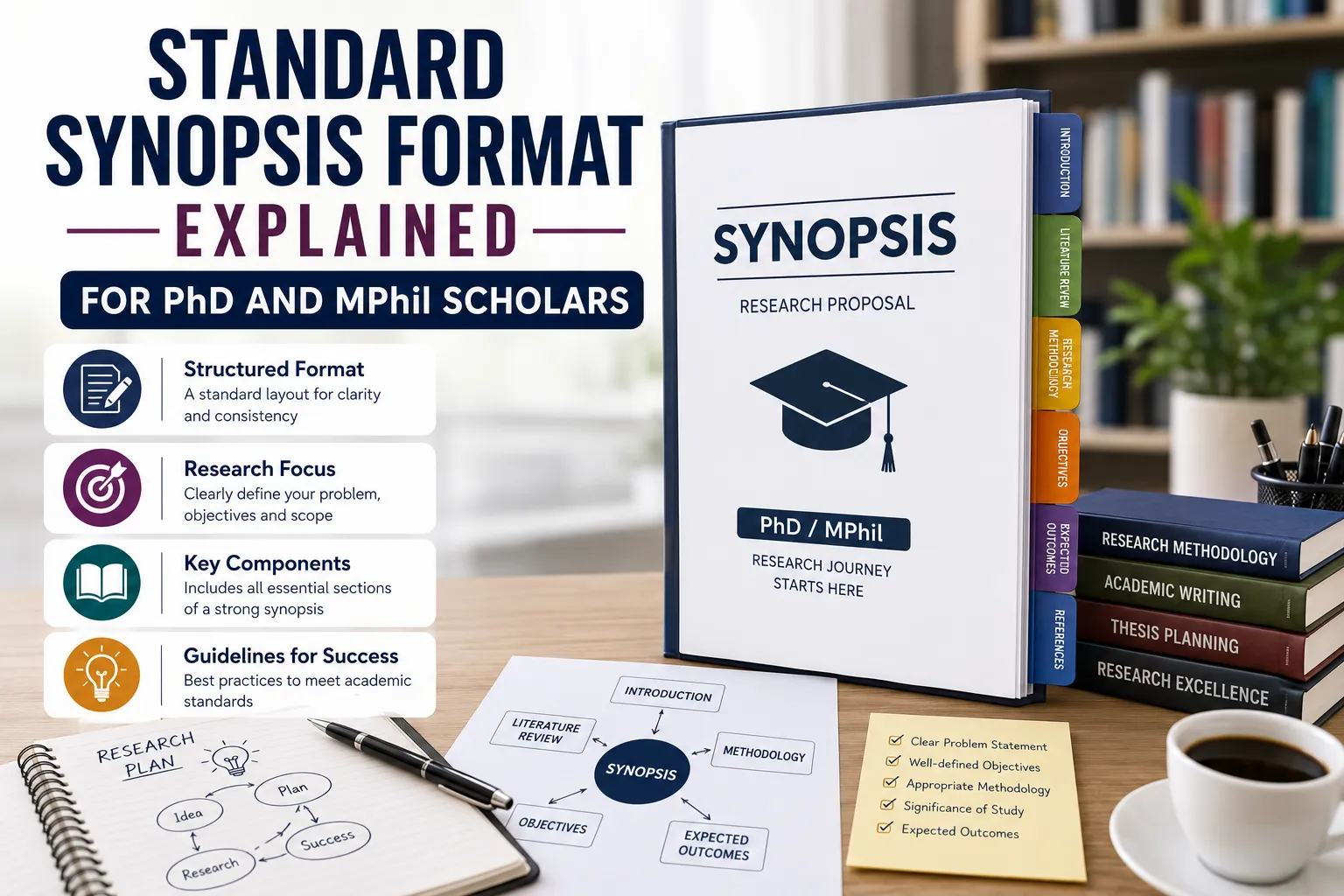
If you are staring at a blank document wondering exactly what goes where, you are not alone. Nearly every doctoral scholar hits this exact wall before their Doctoral Research Committee (DRC) presentation. Understanding the standard synopsis format explained for PhD and MPhil scholars is the single most practical thing you can do before you start writing, because it tells you precisely what your committee expects to see — and in what order.
A synopsis is not a rough outline. It is a structured, defensible academic document — typically 2,000 to 5,000 words — that summarises your research topic, problem, objectives, literature background, and methodology so a committee can evaluate whether your proposed study deserves formal approval. Get the structure right, and the rest of your PhD journey becomes considerably smoother.
A quick but important note on terminology: under the UGC (Minimum Standards and Procedure for Award of Ph.D. Degree) Regulations, 2022, the M.Phil programme has been discontinued at UGC-recognised institutions in India. If you are enrolled in a legacy M.Phil programme, a state or private university that still runs one, or an international institution, the core synopsis format below still applies with minor adjustments, which we've noted throughout.
Why the Synopsis Format Matters So Much
Your synopsis is evaluated by a Doctoral Research Committee on specific criteria: whether the research problem is clearly defined and original, whether the proposed methodology genuinely matches the objectives, whether the study is feasible within a typical PhD timeframe, and whether you demonstrate adequate familiarity with existing literature. A synopsis that skips sections, buries the research gap, or presents an unclear chapter scheme gives your committee reasons to send it back for revision — costing you weeks or months.
The Standard Synopsis Format Explained: Core Sections
Most Indian universities converge on a broadly similar structure, even though individual institutional ordinances add their own specific requirements. Below is the standard synopsis format explained section-by-section, based on commonly used university formats.
1. Title Page
Includes the research title, scholar's name, supervisor's name, department, university, and year. Keep the title itself under 15–20 words while making the population, variable, and methodological approach clear at a glance.
2. Abstract
A standalone summary of 200–300 words covering the research purpose, methodology, and expected outcomes. It must be readable independently, without requiring the reader to consult the rest of the synopsis .
3. Introduction and Background
Typically 200–400 words. Start broad with the field, narrow toward your specific problem, and end with a roadmap sentence describing what the following sections will cover.
4. Statement of the Problem
A precise articulation of the specific issue your research addresses — not a general topic, but a defensible, narrow problem statement.
5. Review of Literature
Usually 500–1,000 words depending on discipline and scope. Organise sources by theme rather than chronology, cover both foundational and recent (2025–2026) works, and synthesise findings across studies rather than summarising them one at a time.
6. Research Gap
State explicitly what remains unanswered in existing literature and why your proposed study is positioned to address it. DRCs specifically look for originality here — a vague "more research is needed" statement rarely survives committee scrutiny.
7. Objectives of the Study
Generally 2–4 clear, specific, and measurable objectives, each explained in one to two sentences.
8. Hypotheses or Research Questions
Written as testable predictions, often in both null (H0) and alternative (H1) forms for quantitative studies, or as clearly framed research questions for qualitative work.
9. Research Methodology
Usually 300–500 words, covering research design, sample or participant selection, data collection instruments, and analysis procedures.
10. Proposed Chapter Scheme
A brief outline of the full thesis structure — most DRCs expect this because it demonstrates you already have a coherent vision of the complete study, not just the
proposal stage.
11. Significance of the Study
Explains the academic, practical, or societal contribution the research is expected to make.
12. Anticipated Challenges and Timeframe
Some universities require scholars to acknowledge feasibility constraints and propose a realistic completion timeline.
13. References/Bibliography
A complete, consistently formatted list of every source cited, following your discipline's required citation style.
Synopsis Requirements by Discipline
The expectations for a research synopsis vary across academic disciplines. Understanding what review committees prioritize can help you prepare a stronger and more convincing proposal.
Sciences & Engineering: Committees primarily evaluate the research methodology and experimental design. The proposal is closely examined for a clear hypothesis, appropriate instrumentation, and a well-defined data collection protocol.
Social Sciences & Humanities: The main focus is the theoretical framework and research positioning. Reviewers look for strong conceptual grounding, reflexivity, and a clear connection to an established theoretical tradition.
Management & Business Studies: Committees emphasize the practical and academic relevance of the research. They carefully assess the managerial implications, research significance, and whether the researcher has confirmed access to industry or organizational data for the study.
Practical Checklist: Is Your Synopsis Format-Ready?
- Title page includes all required institutional details
- Abstract stands alone and stays within 200–300 words
- Introduction moves from broad field to specific, narrow problem
- Literature review is organised thematically, not chronologically
- Research gap is stated explicitly, not implied
- Objectives are specific, measurable, and limited to 2–4 items
- Hypotheses or research questions are clearly testable
- Methodology matches the stated objectives
- Chapter scheme is included and logically sequenced
- Formatting (font, margins, spacing) matches your specific university's ordinance
- References follow a consistent citation style throughout
Two Practical Scenarios
Scenario 1 — Sciences Scholar Revising for Methodology Gaps A scholar in biotechnology submitted a synopsis with a strong literature review but a thin, two-paragraph methodology section. The DRC returned it, noting that Sciences and Engineering committees scrutinise experimental design most heavily . After expanding the section to cover instrumentation, sample size justification, and statistical analysis techniques in detail, the revised synopsis was approved within one review cycle.
Scenario 2 — Management Scholar Missing Industry Access Confirmation A scholar proposing a study on SME digital adoption had a well-constructed theoretical framework but no confirmed access to the industry data required for primary collection. Because Management and Business Studies committees expect confirmed industry access before approval, the synopsis was held pending a letter of cooperation from the participating firms. Securing this documentation before resubmission avoided a second rejection.
Common Mistakes First-Time Synopsis Writers Make
- Treating the abstract as an afterthought rather than a standalone 200–300 word summary that could be read in isolation.
- Burying the research gap inside the literature review instead of stating it as a distinct, clearly labelled point.
- Listing too many objectives — committees generally prefer 2–4 focused, achievable objectives over six or seven vague ones.
- Skipping the chapter scheme, which signals to the DRC that the full thesis structure hasn't been thought through yet.
- Copying a format from an unrelated university without checking your own institution's specific ordinance on margins, word limits, and required sections.
Frequently Asked Questions
What is the standard synopsis format explained for PhD and MPhil scholars?
It is a structured sequence of sections — title page, abstract, introduction, literature review, research gap, objectives, hypotheses, methodology, chapter scheme, significance, and references — that together form a defensible academic proposal evaluated by a Doctoral Research Committee before formal registration.
Why does standard synopsis format matter for PhD and MPhil scholars?
A clear, complete format signals to your committee that your research problem is well-defined, your methodology is feasible, and you understand the existing literature — all of which directly affect whether your synopsis is approved on the first review.
How does standard synopsis format affect a synopsis's approval chances?
Missing or underdeveloped sections (particularly methodology and research gap) are among the most common reasons DRCs send synopses back for revision, so following the complete structure reduces avoidable delays.
How long does it take to complete a synopsis using this approach?
Most scholars who follow a clear section-by-section structure from the outset complete a first full draft within a few weeks, though timelines vary by discipline and how much literature review work is already done.
Is professional help available for standard synopsis format for PhD and MPhil scholars?
Yes. ThesisLikho's PhD-qualified experts have guided 10,000+ scholars through synopsis structuring, chapter scheme planning, and DRC-ready formatting tailored to individual university requirements.
Get Expert Guidance on Your Synopsis
Formatting a synopsis correctly the first time saves months of committee back-and-forth. If you want a second set of expert eyes on your structure, objectives, or chapter scheme before submission, ThesisLikho's PhD-qualified mentors offer research methodology support, synopsis structuring, and full thesis writing assistance grounded in current university standards. If you need expert guidance with your synopsis structure, research methodology, or DRC presentation preparation, you can explore our Synopsis Writing Assistance service.
Get Synopsis Help Now → https://thesislikho.com/writing-services/synopsis-writing