
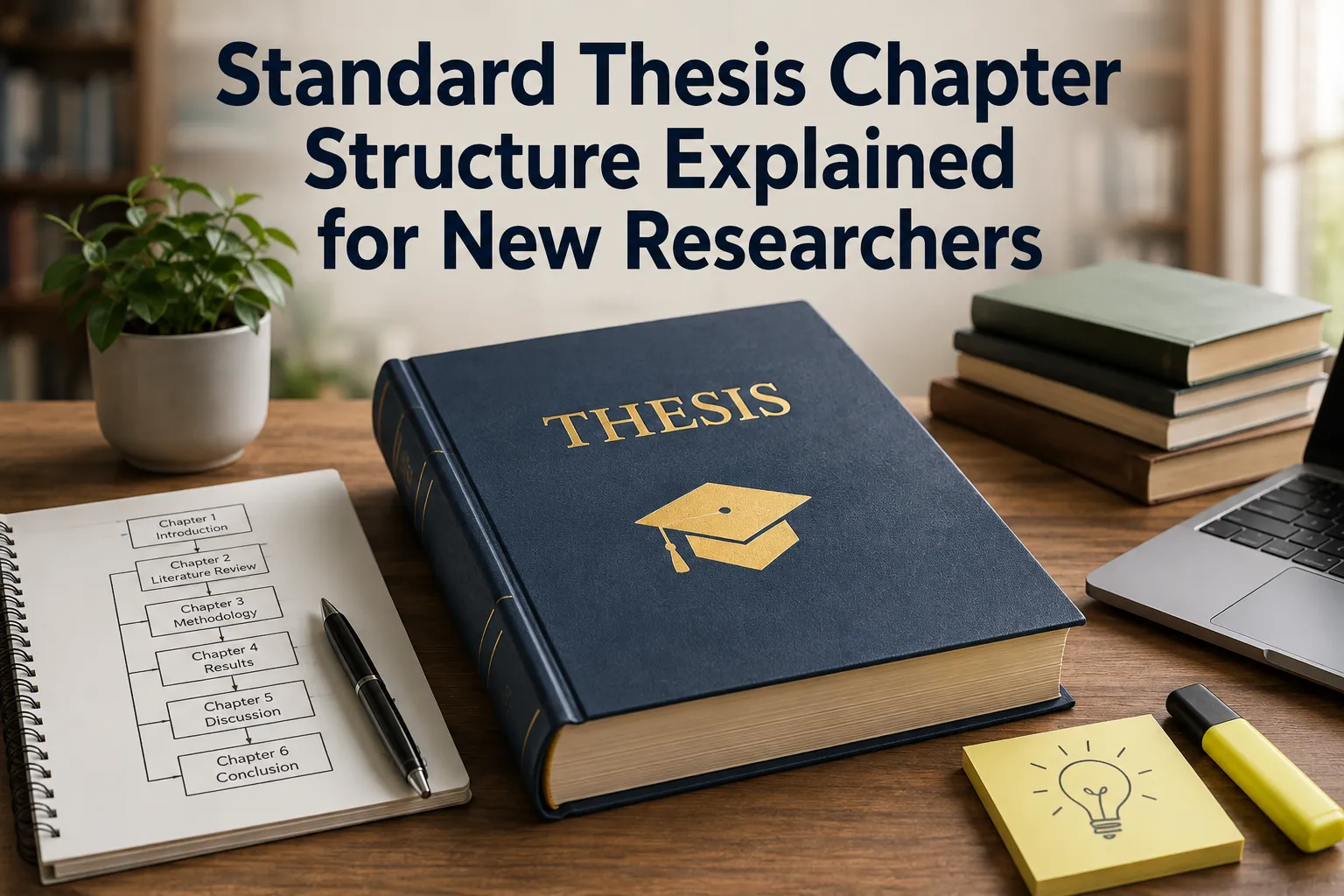
Staring at a blank document titled "Chapter 1" is one of the more paralyzing moments in academic writing — not because you don't know your topic, but because you're not entirely sure what actually belongs in each chapter, or how many chapters your thesis even needs. This guide walks through the standard thesis chapter structure explained clearly for new researchers, covering what goes where, how chapter count varies by degree level and discipline, and how to avoid the most common structural mistakes.
The Five-Chapter Model: Your Starting Foundation
The standard five-chapter model — Introduction, Literature Review, Methodology, Results, and Discussion/Conclusion — is the most widely accepted thesis structure across disciplines worldwide. Even where your specific university allows variations, understanding this core model gives you a reliable foundation to build your own thesis structure from.
This model is commonly referred to by the acronym IMRaD (Introduction, Methodology, Results, and Discussion), with the literature review functioning as a distinct standalone chapter in most social science and humanities theses — producing the canonical five-chapter spine that most supervisors and examiners expect to see.
Understanding the Three Parts of a Complete Thesis
A complete thesis document has three distinct parts, not just the numbered chapters themselves:
- Front matter — title page, abstract, acknowledgements, and table of contents, appearing before Chapter 1
- Main body — the numbered chapters carrying your actual argument and research
- Back matter — references and appendices, appearing after your final chapter
Front matter uses lowercase Roman numeral page numbering (i, ii, iii...), while normal Arabic numbering restarts at 1 on the first page of Chapter 1. This convention is standard across most universities, though always confirm your specific institution's formatting requirements.
Chapter Count Varies Genuinely by Degree Level
Chapter count isn't fixed — it scales meaningfully with degree level:
- Bachelor's theses commonly use 4–5 chapters
- Master's theses typically use 5–6 chapters
- PhD theses typically use 5–8 chapters, sometimes extending to 9, shaped by discipline, research design, and institutional requirements
If you're a first-time thesis writer feeling uncertain about how many chapters your specific project needs, this variation is completely normal — the right number depends on your degree level and discipline, not a single universal rule.
Chapter-by-Chapter: What Actually Belongs Where
Chapter 1: Introduction
Your introduction chapter typically includes: background providing context for your research topic, a clearly defined research problem, stated research questions or hypotheses, and your outlined research objectives. This chapter's job is to orient your reader — by the end of it, they should understand what you're studying, why it matters, and what you intend to find out.
Chapter 2: Literature Review
Your literature review should include critical analysis — identifying and discussing the strengths and limitations of existing research, not simply summarizing it. It needs a clear identification of your research gap, explaining precisely what's missing from existing literature and how your thesis addresses it. Where applicable to your discipline, this chapter should also include a theoretical framework, describing the theoretical lens or model underpinning your study.
Chapter 3: Methodology
Your methodology chapter explains how you conducted your research, giving your reader enough detail to evaluate the rigor of your approach and, in principle, to replicate your study. Every methodological choice you made should be explained and justified — not just described. This includes your research design (whether qualitative, quantitative, or mixed methods, and why that approach suits your specific research question) and your data collection methods (surveys, interviews, experiments, archival research, or whatever combination applies to your work).
Chapter 4: Results/Findings
Your results chapter presents what you actually found, organized clearly around your research questions or hypotheses (for quantitative work) or around emergent themes (for qualitative work). This chapter reports objectively — it describes what your data showed, without yet interpreting what that means for your broader argument.
Chapter 5: Discussion and Conclusion
Your discussion chapter is where you interpret your results, connect them back to your literature review, and explain what your findings actually mean for your field. Some theses split this into two separate chapters — a standalone Discussion followed by a standalone Conclusion — while others combine them into one. Either structure is common; check your specific department's convention.
Chapter Length Isn't Uniform — And That's Expected
As a general guide, the introduction and methodology chapters tend to be shorter, while the literature review, results, and discussion chapters are typically the longest sections of the document. If your methodology chapter feels noticeably shorter than your literature review, that's not necessarily a problem — it often reflects the natural proportions of a well-structured thesis, not an imbalance you need to correct.
Important Structural Variations by Discipline
The five-chapter model isn't followed identically everywhere. Meaningful variations exist:
- Sciences and STEM theses may include a separate "Materials and Methods" chapter, or combine Discussion and Conclusion into a single chapter
- Humanities theses may use a thematic structure with multiple analytical chapters instead of a single "Results" chapter, since qualitative, interpretive work often doesn't separate as cleanly into "results" and "discussion"
- Social sciences generally follow the standard five-chapter model most closely among the major discipline groups
Whether your literature review is a standalone chapter or embedded within your introduction also depends heavily on discipline. In many STEM PhD theses, the literature review is embedded within the Introduction chapter, giving a four-chapter IMRaD structure rather than five. In most social science and humanities dissertations, it remains a standalone chapter. Your specific departmental handbook is the definitive source for confirming which convention applies to you — don't assume based on general guidance alone.
How PhD Structures Can Extend Further
A PhD thesis specifically may extend to 7–9 chapters, sometimes adding a standalone theoretical framework chapter — particularly common in business, management, and social sciences, but genuinely rare in science and engineering, where theory is typically woven directly into the introduction and literature review instead. The exact number of chapters matters less than whether each one has a clear, distinct purpose that advances your overall argument. Padding your thesis with unnecessary chapters, purely to reach a number that feels more substantial, is actively discouraged — every chapter should earn its place.
Step-by-Step: Confirming Your Own Thesis's Structure
- Check your department's specific handbook or guidelines for the expected chapter structure at your degree level
- Confirm whether your literature review should be a standalone chapter or embedded within your introduction, based on your specific discipline's convention
- Confirm whether your discipline expects Discussion and Conclusion combined or separated
- If your field is STEM-oriented, check whether a "Materials and Methods" chapter is expected instead of a standard "Methodology" chapter
- If your work is humanities-based, consider whether a thematic chapter structure fits your research better than a single Results chapter
- Draft a chapter outline early, confirming each planned chapter has a clear, distinct purpose before you begin writing
- Revisit your outline periodically as your research develops, since your structure may need minor adjustment as your argument takes shape
Practical Checklist: Is Your Thesis Structure Sound?
- Chapter count matches typical expectations for your specific degree level (bachelor's, master's, or PhD)
- Front matter, main body, and back matter are all correctly organized with appropriate page numbering
- Introduction includes background, research problem, research questions/hypotheses, and objectives
- Literature review includes critical analysis, explicit gap identification, and a theoretical framework where applicable
- Methodology explains and justifies every methodological choice, not just describes it
- Results are reported objectively, without interpretation that belongs in the discussion
- Discussion and conclusion structure (combined or separate) matches your department's convention
- Discipline-specific variations (STEM, humanities, social sciences) have been checked against your department's specific guidance
- Every chapter has a clear, distinct purpose — no chapter exists purely to pad the overall length
Two Practical Scenarios
Scenario 1 — Confirming Whether the Literature Review Should Stand Alone A first-time PhD student in a STEM department drafted their thesis with a standalone literature review chapter, following the general five-chapter model without checking their specific department's convention. After reviewing their department's handbook, they discovered STEM theses in their program typically embed the literature review within the introduction, producing a four-chapter structure. Restructuring accordingly — merging the literature review content into an expanded introduction chapter — better matched what their committee actually expected to see.
Scenario 2 — Deciding Whether to Split Discussion and Conclusion A master's student in social sciences was uncertain whether to combine their discussion and conclusion into one chapter or split them into two. After confirming that their department's social science theses generally follow the standard five-chapter model closely, and that a combined Discussion/Conclusion chapter was the norm within their specific program, the student combined the two — avoiding an unnecessary sixth chapter that wouldn't have matched departmental convention.
Common Mistakes New Researchers Make With Thesis Structure
- Assuming one universal chapter structure applies everywhere, without checking discipline-specific and departmental variations.
- Treating the results chapter as a place for interpretation, when objective reporting belongs there and interpretation belongs in the discussion.
- Adding extra chapters to make the thesis feel more substantial, rather than ensuring each chapter has a genuinely distinct purpose.
- Not confirming early whether the literature review should be standalone or embedded, leading to restructuring later in the writing process.
- Ignoring the natural difference in chapter length, assuming a shorter methodology chapter signals a weakness rather than a normal structural proportion.
Frequently Asked Questions
What is the standard thesis chapter structure for new researchers?
The most widely used model is five chapters — Introduction, Literature Review, Methodology, Results, and Discussion/Conclusion — often called IMRaD, though the exact chapter count and structure vary by degree level (bachelor's, master's, PhD) and by discipline.
Why does understanding standard thesis chapter structure matter for new researchers?
Knowing the expected structure early prevents wasted effort restructuring later, and signals to supervisors and examiners that you understand the conventions of academic writing appropriate to your specific discipline and degree level.
How does thesis chapter structure affect a thesis's overall clarity?
A well-structured thesis, with each chapter serving a clear and distinct purpose, makes it significantly easier for examiners to follow your argument from research problem through to original contribution — a poorly structured thesis can obscure even strong underlying research.
How long does it take to complete a thesis using this approach?
Confirming your expected chapter structure early, before drafting begins, typically saves time overall by avoiding the need for significant restructuring partway through the writing process.
Is professional help available for understanding standard thesis chapter structure?
Yes. ThesisLikho's PhD-qualified mentors have guided 10,000+ scholars through thesis structuring, chapter planning, and complete thesis writing assistance tailored to individual degree levels and disciplines.
Get Expert Guidance on Your Thesis Structure
Confirming the right chapter structure for your specific degree level and discipline early in your thesis journey saves considerable time and effort later. If you'd like expert input on planning your thesis structure or confirming discipline-specific conventions, ThesisLikho's PhD-qualified team offers thesis structuring support, chapter planning guidance, and complete thesis writing assistance. If you need expert guidance with your thesis structure, chapter planning, or overall writing process, you can explore our Thesis Writing Assistance service.
Talk to a Thesis Expert → https://thesislikho.com/writing-services/thesis-writing