
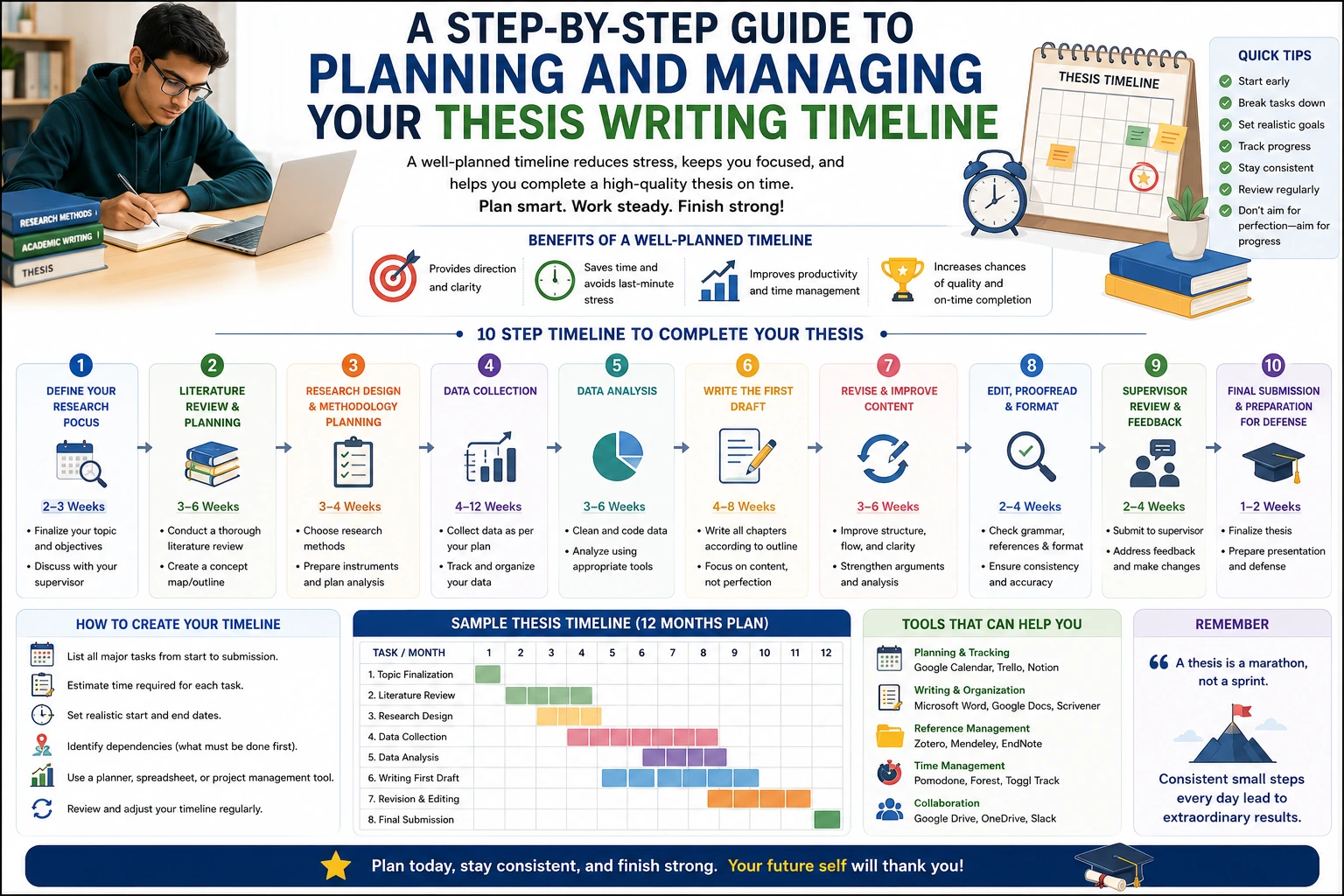
SEO Meta Information
Meta Title (60 characters):
How to Plan and Manage Your Thesis Writing Timeline Effectively
Meta Description (155 characters):
Learn how to plan and manage your thesis writing timeline with this step-by-step guide. Discover practical strategies, timelines, and productivity tips for PhD and Master's students.
URL Slug:
step-by-step-guide-to-planning-and-managing-your-thesis-writing-timeline
A Step-by-Step Guide to Planning and Managing Your Thesis Writing Timeline
Writing a thesis is one of the most demanding academic projects you'll undertake. Whether you're pursuing a PhD, Master's, MPhil, or professional research degree, completing a thesis requires months—or even years—of planning, reading, data collection, analysis, writing, and revision. While many students focus on selecting the perfect research topic or methodology, they often overlook one of the most important factors influencing success: effective time management.
A well-planned thesis writing timeline can make the difference between a smooth, stress-free research journey and a last-minute scramble filled with missed deadlines and unnecessary pressure. Without a realistic schedule, even highly motivated students can fall behind due to unexpected challenges such as literature review delays, slow participant recruitment, supervisor revisions, or data analysis issues.
The good news is that thesis writing is a project that can be successfully managed with proper planning. By breaking the process into manageable stages, setting achievable milestones, and tracking your progress consistently, you can stay organised, reduce stress, and produce a high-quality thesis on time.
In this comprehensive guide, you'll learn how to create an effective thesis writing timeline, manage every stage of your research efficiently, avoid common time-management mistakes, and use practical tools that help you stay productive from proposal approval to final submission.
Why a Thesis Writing Timeline Is Essential
Many students underestimate how long research activities actually take. A literature review that seems like a two-week task may require two months. Ethical approval, survey responses, or statistical analysis often take longer than expected.
Creating a structured timeline helps you:
- Stay focused on long-term goals.
- Meet university deadlines.
- Avoid last-minute writing.
- Track research progress.
- Reduce academic stress.
- Improve communication with your supervisor.
- Produce higher-quality work through multiple revisions.
A timeline transforms a large, intimidating project into a series of manageable tasks.
Benefits of Planning Your Thesis Early
Planning your thesis before you begin writing provides several advantages.
A structured plan allows you to:
- Allocate sufficient time to each research stage.
- Anticipate potential delays.
- Balance academic work with personal commitments.
- Maintain consistent writing habits.
- Identify priority tasks.
- Build flexibility into your schedule.
Students who begin planning early are generally better prepared to handle unexpected challenges.
Understanding the Typical Thesis Writing Process
Although every university has different requirements, most thesis projects follow a similar sequence.
The major stages include:
- Topic Selection
- Proposal Writing
- Literature Review
- Research Design
- Ethical Approval (if required)
- Data Collection
- Data Analysis
- Thesis Writing
- Editing and Proofreading
- Supervisor Review
- Final Submission
- Viva Voce or Thesis Defense
Each stage requires dedicated time and should be included in your overall timeline.
Step 1: Understand Your University's Deadlines
Before creating your personal schedule, review your university's academic calendar.
Pay attention to:
- Proposal submission deadlines.
- Ethics committee deadlines.
- Progress report dates.
- Draft submission deadlines.
- Final thesis submission.
- Viva or defense schedule.
Work backwards from your final submission date to determine how much time is available for each task.
Always include extra time for unexpected delays.
Step 2: Break the Thesis into Smaller Milestones
Instead of viewing your thesis as one enormous project, divide it into smaller tasks.
For example:
Research Planning
- Choose research topic.
- Meet supervisor.
- Finalise research problem.
- Prepare proposal.
Literature Review
- Search academic databases.
- Read journal articles.
- Organise references.
- Write literature review.
Methodology
- Select research design.
- Develop research instrument.
- Conduct pilot study.
- Obtain ethical approval.
Data Collection
- Recruit participants.
- Distribute surveys.
- Conduct interviews.
- Organise collected data.
Analysis
- Clean data.
- Perform statistical analysis.
- Interpret findings.
Writing
- Introduction.
- Literature Review.
- Methodology.
- Results.
- Discussion.
- Conclusion.
Breaking large tasks into smaller milestones makes progress easier to measure.
Step 3: Estimate Time for Each Stage
Many students underestimate the time required for research activities.
The table below provides a general guideline for a one-year Master's thesis. PhD timelines are usually longer.
Research Stage
Suggested Duration
Topic Selection
2 Weeks
Proposal Development
3 Weeks
Literature Review
6–8 Weeks
Research Design
2 Weeks
Ethical Approval
2–6 Weeks
Data Collection
6–8 Weeks
Data Analysis
4 Weeks
Chapter Writing
8–10 Weeks
Editing and Proofreading
3 Weeks
Final Revisions
2 Weeks
Adjust these estimates based on your research complexity and institutional requirements.
Step 4: Set SMART Goals
Your milestones should follow the SMART framework.
Each goal should be:
- Specific – Clearly define the task.
- Measurable – Track completion.
- Achievable – Be realistic.
- Relevant – Support your thesis.
- Time-bound – Include a deadline.
Instead of writing:
Work on literature review.
Write:
Read and summarise five journal articles by Friday.
Small, measurable goals improve motivation and accountability.
Step 5: Create a Weekly Writing Schedule
Consistency is more effective than occasional long writing sessions.
Example weekly plan:
Day
Task
Monday
Read journal articles
Tuesday
Write literature review
Wednesday
Meet supervisor / revise draft
Thursday
Analyse data
Friday
Write methodology chapter
Saturday
Edit previous work
Sunday
Review progress and plan next week
Aim for steady progress rather than perfection.
Step 6: Prioritise High-Impact Tasks
Not all thesis activities have equal importance.
Prioritise tasks that directly contribute to your research objectives.
High-priority tasks include:
- Literature review.
- Data collection.
- Chapter writing.
- Supervisor revisions.
- Final editing.
Administrative tasks should not consume most of your productive time.
Step 7: Build Buffer Time into Your Timeline
Unexpected delays are common during research.
Possible setbacks include:
- Supervisor availability.
- Low survey response rates.
- Technical issues.
- Software problems.
- Ethical approval delays.
- Illness or personal commitments.
Add one to two weeks of buffer time after major milestones whenever possible.
This flexibility reduces stress if your schedule changes.
Step 8: Use Productivity Techniques
Several proven productivity methods can improve thesis writing.
Time Blocking
Reserve dedicated hours each day for research.
Example:
9:00–11:00 AM
Literature Review
2:00–4:00 PM
Chapter Writing
Treat these appointments as non-negotiable.
Pomodoro Technique
Work for:
25 minutes
Followed by:
5-minute break
After four sessions, take a longer break.
This technique improves concentration and reduces fatigue.
Two-Minute Rule
If a task takes less than two minutes—such as replying to your supervisor or organising references—complete it immediately.
Step 9: Manage Your Literature Efficiently
Literature reviews often consume more time than expected.
Stay organised by:
- Creating thematic folders.
- Highlighting key findings.
- Recording summaries.
- Tracking citations.
- Using reference management software.
Popular tools include:
- Zotero
- Mendeley
- EndNote
Organised references save significant time during writing.
Step 10: Schedule Regular Meetings with Your Supervisor
Supervisor feedback keeps your research on track.
Plan meetings at regular intervals.
Before each meeting:
- Send your draft in advance.
- Prepare specific questions.
- Note areas requiring clarification.
After the meeting:
- Record agreed actions.
- Update your timeline accordingly.
Frequent communication reduces major revisions later.
Step 11: Track Your Progress
Monitoring progress helps maintain motivation.
Track:
- Chapters completed.
- Articles reviewed.
- Data collected.
- Analysis completed.
- Revision status.
- Upcoming deadlines.
Simple spreadsheets, planners, or project management tools can help visualise progress.
Celebrating small achievements keeps momentum high.
Step 12: Avoid Procrastination
Procrastination is one of the biggest threats to thesis completion.
Common causes include:
- Fear of failure.
- Perfectionism.
- Lack of structure.
- Overwhelming workload.
Strategies to overcome procrastination:
- Break tasks into smaller steps.
- Set daily writing goals.
- Remove distractions.
- Reward completed milestones.
- Focus on progress rather than perfection.
Writing one page today is more productive than planning ten pages tomorrow.
Sample 12-Month Thesis Writing Timeline
Below is an example schedule for a one-year Master's thesis.
Month Major Activities
Month 1 Topic selection, supervisor meetings
Month 2 Proposal writing
Month 3 Proposal approval
Months 4–5 Literature review
Month 6 Methodology development
Months 7–8 Data collection
Month 9 Data analysis
Months 10–11 Thesis writing
Month 12 Editing, submission, viva preparation
PhD students can adapt this timeline across multiple years by expanding each stage.
Digital Tools for Managing Your Thesis Timeline
Technology can simplify project management.
Useful tools include:
Project Planning
- Trello
- Notion
- Asana
- ClickUp
Calendar Management
- Google Calendar
- Microsoft Outlook
Writing
- Microsoft Word
- Google Docs
Reference Management
- Zotero
- Mendeley
- EndNote
Data Analysis
- SPSS
- R
- Python
- NVivo
- MAXQDA
Choose tools that fit your workflow rather than using too many platforms simultaneously.
Common Thesis Timeline Mistakes
Avoid these frequent errors.
Starting Too Late
Research almost always takes longer than expected.
Begin planning as early as possible.
Ignoring Revision Time
Editing often requires multiple rounds.
Always reserve sufficient time for proofreading and supervisor feedback.
Setting Unrealistic Goals
Writing an entire chapter in one day is rarely sustainable.
Focus on achievable daily targets.
Neglecting Personal Well-Being
Burnout reduces productivity.
Include time for:
- Sleep.
- Exercise.
- Family.
- Recreation.
Balanced schedules improve long-term performance.
Failing to Track Progress
Without monitoring milestones, delays accumulate unnoticed.
Review your timeline weekly.
Tips for Staying Motivated Throughout Your Thesis
Maintaining motivation over several months can be challenging.
Try these strategies:
- Establish a consistent writing routine.
- Join research or writing groups for accountability.
- Celebrate completed milestones.
- Visualise your submission and graduation goals.
- Keep a record of your daily progress.
- Break large chapters into manageable sections.
- Take regular breaks to avoid burnout.
Remember that consistent effort, even in small amounts, leads to substantial progress over time.
Tips for PhD and Master's Students in India
If you're completing your thesis at an Indian university, planning becomes even more important due to institutional deadlines and administrative requirements.
Keep these points in mind:
- Familiarise yourself with your university's thesis submission calendar.
- Allocate extra time for proposal approval, ethics clearance, and supervisor revisions.
- Plan around semester examinations, conferences, or teaching responsibilities if applicable.
- Use your institution's thesis formatting guidelines from the beginning to avoid extensive formatting work later.
- Begin preparing for plagiarism checks and final documentation well before the submission deadline.
A proactive approach can prevent unnecessary delays during the final stages of your research.
Frequently Asked Questions (FAQs)
How long should it take to write a thesis?
The duration depends on the degree programme and research scope. A Master's thesis often takes 6–12 months, while a PhD thesis may require several years of research and writing.
How many hours should I write each day?
Consistency is more important than long sessions. Writing for two to four focused hours daily is often more productive than occasional marathon sessions.
What is the biggest mistake students make when planning a thesis?
One of the most common mistakes is underestimating the time required for literature review, data collection, revisions, and supervisor feedback.
Should I write chapters while collecting data?
Yes. Many students write sections such as the introduction, literature review, and methodology while data collection is ongoing. This approach helps distribute the workload more evenly.
How often should I meet my supervisor?
The ideal frequency depends on your programme and supervisor's preferences, but meeting every two to four weeks during active research helps maintain progress and resolve issues promptly.
Conclusion
Planning and managing your thesis writing timeline is just as important as selecting the right research topic or methodology. A realistic schedule provides structure, keeps your research moving forward, and helps you avoid the stress of last-minute deadlines. By breaking the project into manageable milestones, setting SMART goals, building buffer time for unexpected challenges, and reviewing your progress regularly, you can maintain steady momentum throughout your research journey.
Remember that thesis writing is a marathon, not a sprint. Consistent daily progress, thoughtful planning, and regular communication with your supervisor are far more effective than relying on bursts of last-minute productivity. Flexibility is equally important—unexpected delays are a normal part of research, and adapting your timeline when necessary is a sign of good project management, not failure.
Whether you're preparing a Master's dissertation or a PhD thesis, investing time in creating and following a well-structured writing timeline will improve your productivity, reduce stress, and increase the quality of your final submission. With discipline, organisation, and the right planning strategies, you can successfully navigate every stage of the thesis process and reach your submission deadline with confidence.
Contact ThesisLikho
Call / WhatsApp: +91 96438 02216
Website:www.ThesisLikho.com