
Introduction
Writing a PhD thesis, MPhil dissertation, or a postgraduate research project is one of the most laborious things that a scholar can undertake. Researchers find conducting research, collecting data, and analyzing data not too demanding and challenging. Researchers usually find that writing the thesis is the most challenging and difficult part of the scholarly journey. One of the most common challenges that scholars at all levels and in all disciplines face is thesis writer's block.
Writers' block happens when a researcher is unable to start writing and organize their thoughts. Some of the factors that can lead to this block can include inadequate knowledge and research material. Writer's block can affect a researcher at any level of thesis writing, from drafting the literature review to writing the conclusions.
For many Indian researchers, the thesis writer's block can be more difficult and challenging because of added stresses like publication pressure, fellowship deadlines, expectations of research supervisors, teaching related pressures, and family pressures. Thesis writer's block can adversely affect the thesis writer's block.
The good thing about writer's block is that it is never a permanent condition. With the right tools, researchers are able to remove the mental barriers and are able to restore writing momentum. This guide explains techniques that Indian researchers can use to overcome writer's block and complete their academic writing.
What is Thesis Writer's Block?
Thesis writer's block is a temporary condition where a researcher is unable to undertake a scholarly act of writing.
It's natural to experience some of the following symptoms if you're having trouble writing:
- you can't get a chapter started
- you keep postponing writing tasks
- you constantly feel mentally stuck
- you edit rather than write
- you fear that you will write something awful
- you have no will to write
Many researchers tend to think that having a writer's block is the same as being incompetent, while it is, in fact, a fairly common phenomenon even among seasoned researchers, published authors, and professors.
The first step of overcoming the writer's block is recognizing that it is a common occurrence.
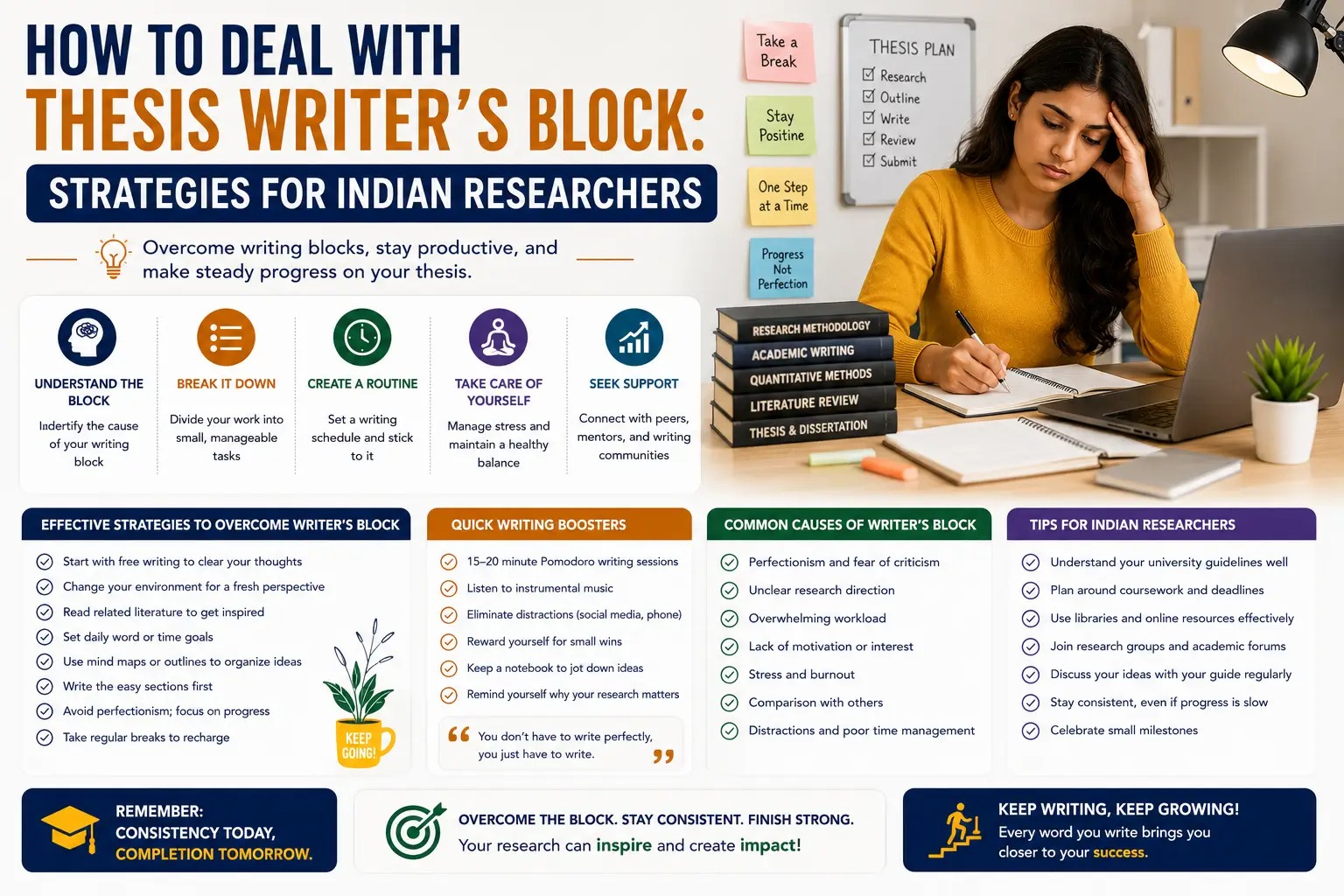
The following are the most common causes of writer's block during thesis writing
The first step in combating writer's block is recognizing the cause of it.
Perfectionism
Many researchers are under the impression that in order to move on to the next sentence, the previous one has to be written flawlessly.
This leads to:
- unnecessary edits
- constant rewrites
- lack of progress
Perfectionism can prevent writing from ever being started.
Fear of Criticism
Often academic researchers are highly concerned with:
- feedback from their supervisors or examiners
- critique from peers
- judgments from the academic community
Fear of criticism often leads to anxiety which ultimately prevents all writing.
Information Overload
When research was done the old-fashioned way, researchers had a limited number of resources to rely on compared to the thousands of journals, books, and online resources available to today's researchers.
Often, researchers feel that the perfect paper will help them write and continue to read for months without writing.
Too much information often causes confusion and slows down the ability to critically think.
Burnout and Mental Fatigue
Doctoral research is often highly demanding, labor intensive, and time consuming.
Some of the many symptoms of burnout and mental fatigue include:
- loss of concentration
- lack of creativity
- emotional fatigue
- low productivity
Burnout and mental fatigue are among the highest contributors of writer's block in doctoral candidates.
Lack of Structure
Writing a thesis looks like an enormous task to many students, and students often get overwhelmed.
Writing seems impossible without a clear structure.
Work is easier to manage when broken into smaller sections.
Why Indian Researchers Often Experience Writer's Block
Although writer's block is a phenomenon that many people experience worldwide, Indian researchers have specific difficulties.
This includes:
- The need to publish research papers
- Limited research funding
- Administrative work
- The need to renew fellowships
- Teaching
- Family pressures
- A cutthroat academic environment
Some researchers may be first-generation researchers, meaning they have no family system to support them, and are likely also lacking a strong academic support system.
Knowing and understanding these difficulties normalizes the experience and provides a basis for implementing solutions.
Strategy 1: Stop Waiting for Inspiration
One of the biggest myths about writing is that inspiration comes before the act of writing.
Professional writers and researchers know that often, writing begets inspiration.
This means instead of waiting for the right moment to start, do it immediately.
Don't lose the opportunity to improve work because it is in draft form.
You can't improve what isn't there.
Strategy 2: Break the Thesis Into Manageable Tasks
A thesis that encompasses 200 pages is, without a doubt, a daunting idea.
Instead of thinking about the final document in its entirety, break it into smaller parts.
Consider the following:
- Literature Review
- Research gap
- Theoretical framework
- Previous studies
- Methodology
- Research design
- Sampling
- Data collection
- Results
- Tables
- Figures
- Interpretation
Breaking the work into smaller sections yields a manageable design and creates a sense of momentum, and therefore, reduces anxiety.
Strategy 3: Setting Realistic Daily Writing Goals
Most researchers prefer to focus on the completion of each chapter, but a better approach is to focus on setting writing goals for yourself.
These goals could take different forms. You could decide to write:
- 300 words each day
- 1 page a day
- For 30 minutes each day
The accumulation of writing day to day is more effective than fewer, longer writing sessions.
Strategy 4: Write First, Edit Later
Writing and editing at the same time is one of the fastest ways to develop writer's block.
While writing your first draft:
- Don't edit grammar
- Don't worry about the format
- Think about the ideas
Writing and editing need to stay in their own separate stages.
When writing the first draft, progress is the goal and editing is not necessary.
This technique will improve your writing and help grow your ideas.
Strategy 5: Writing at the Same Time Each Day
The brain loves routine.
Research writing at the same time each day helps and becomes easier. You could try to write at each of the following times:
- Early in the morning
- During the quiet parts of the day
- At night
The more consistent you are and the more routines you have writing will feel like a habit instead of a struggle.
Strategy 6: Eliminating Technology
Writing in the modern world is impossible without some form of distraction. Distractions include:
- Social Media
- Messaging apps
- Email notifications
- Streaming Services
During each writing session make sure you:
- Turn Notifications off
- Block distracting websites
- Place your phone somewhere not on your desk
- Work in a quiet place
Work with purpose. Your writing will be better and more effective without distractions.
Strategy 7: Start With the Easiest Section
Most starting scholars try to tackle the introduction first.
The introduction is not only the first section, but also one of the hardest to write.
To avoid this challenge, tackle the sections you are the most confident in first.
These might be:
- Methods
- Analysis
- Results
- Findings
These sections are easier to write and help you build the confidence and momentum to carry you through the document.
Strategy 8: Use Free Writing Techniques
The basis of free writing is to write continuously without much thought to the quality.
This is one of the easiest techniques to get over the initial fear of starting.
Use a timer to practice free writing in increments of:
- 10 minutes
- 15 minutes
- 20 minutes
The only thing you need to focus on is what you want to say most about your research.
This technique breaks the barrier most people have about writing. You may even discover new thoughts and ideas for your research.
Strategy 9: Discuss Your Research With Others
Sometimes, writing block is the mentality of having your ideas "trapped" in your mind.
Talking about your thoughts can help you clear your mental block.
You can tell many people about your research, some of them are:
- Supervisors
- Fellow researchers
- Friends
- Academic mentors
Most of the time, you cannot write what you cannot say, but saying it comes first.
Strategy 10: Create an Imperfect First Draft
Most scholars have a fear of writing incorrect things.
Rough drafts are part of the process.
Things to be prepared for are:
- Weak sentences, arguments, and sections
- Necessary edits to sections and arguments
- Necessary improvements to the draft
The only progress you can achieve with a blank page is to slowly start writing. But drafts can be improved.
Strategy 11: Read Strategically, Not Endlessly
Reading is important to your research, but taking a lot of time to read can be a form of procrastination.
Do you really want to know what the best verse in your favorite book is? Or are you just reading because you are scared of the blank paper?
Set these types of limits for yourself.
- Read for ONE hour
- Write for TWO hours
You should strive for balance between content creation and research. Remember that it is the premise and content of the thesis that people will be concerned with, not the amount of research that you have accumulated on the topic.
Strategy 12: Join a Writing Group
Writing can be a lonely task.
Research writing groups provide:
- Monitoring
- Support
- Constructive critiques
Most of India's universities have new research communities that help associates with a place to discuss their progress and obstacles.
Being part of a positive community helps with writer's block.
Strategy 13: Remember Your Research Purpose
When you begin to feel writer's block, remember what you were trying to do with your research.
Ask:
- Why did I select this topic?
- What issue am I trying to help?
- Who are the possible beneficiaries of my research?
A clear purpose can help you overcome temporary block.
---
# When to Seek Professional Help
If writer's block is ongoing for a few months and you feel:
- Anxiety
- Depression
- Stress
- Lack of motivation
Consider going to:
- University therapist
- Mental health practitioners
- Academic advisers
There is no shame in seeking help.
Having your emotional needs met can help your productivity with research and improve your mental well being.
Conclusion
Thesis Writer's block is one of the most common challenges encountered by Indian researchers. Fortunately, overcoming this is not an impossible task.Writer's block typically is temporary, and with the proper method, it can be caused by perfectionism, the fear of criticism, burnout, or a lack of structure.
Gradually, you can begin to rebuild momentum and confidence by breaking your thesis down to small, manageable tasks, creating a writing routine, and focusing on progress instead of perfection, while also maintaining a strong work / life balance.
Every completed thesis is the result of a collection of drafts. Therefore, the aim is to continue writing, rather than to write the perfect draft on the first attempt.
Theses are not expected to be written in one day. That's impossible. However, they can be written through a single draft to write a single paragraph, a single page, or a single chapter through repetition and in a reasonable amount of time. Combining Intent and effort will allow completed researchers to overcome writer's block.
ThesisLikho supports scholars throughout the dissertation process helping them turn research ideas into quality academic contributions that meet university and publication standards.
Contact ThesisLikho
Website: www.ThesisLikho.com
Call/WhatsApp: +91 96438 02216