
Introduction
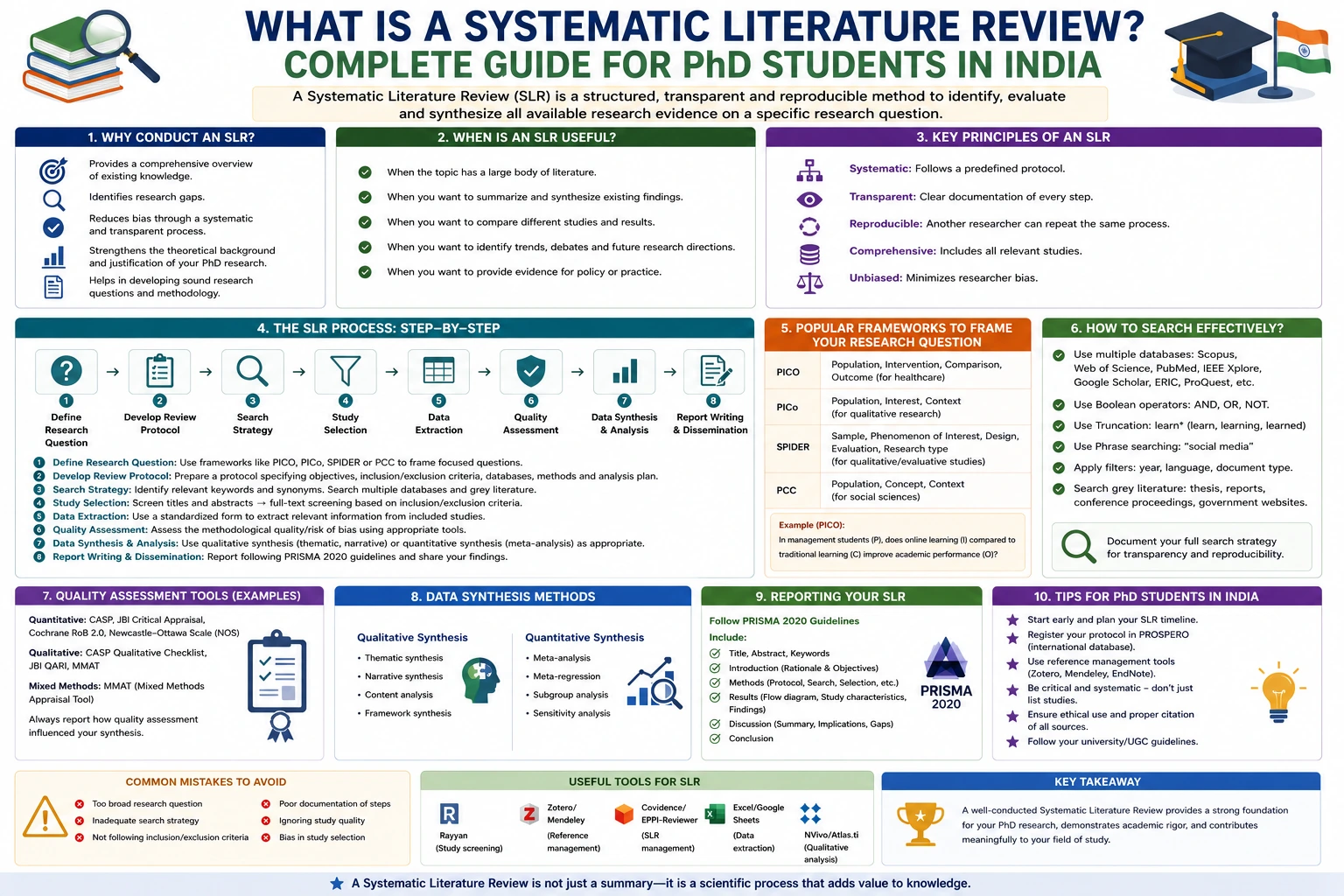
A Systematic Literature Review (SLR) is one of the most rigorous and reliable methods of reviewing existing research. Unlike a traditional literature review, a systematic literature review follows a predefined, transparent, and reproducible process to identify, evaluate, and synthesize all relevant studies related to a specific research question.
For PhD scholars in India, conducting a systematic literature review helps establish a strong research foundation, identify knowledge gaps, avoid duplication, and support evidence-based conclusions. It is widely used in medicine, engineering, management, education, nursing, social sciences, psychology, computer science, and many other disciplines.
This guide explains what a systematic literature review is, why it is important, its key characteristics, the complete process, common challenges, and best practices for PhD research.
What Is a Systematic Literature Review?
A Systematic Literature Review (SLR) is a structured method of collecting, selecting, critically evaluating, and synthesizing research evidence to answer a clearly defined research question.
Unlike conventional reviews, an SLR follows a documented methodology that minimizes bias and ensures transparency throughout the review process. Every step—from searching databases to selecting studies and reporting findings—is planned in advance and can be replicated by other researchers.
The primary objective of a systematic literature review is to provide a comprehensive and unbiased summary of the available evidence.
Why Is a Systematic Literature Review Important?
A systematic literature review plays a vital role in academic research by providing a reliable overview of existing knowledge.
Its importance includes:
- Identifies research gaps.
- Reduces selection bias.
- Supports evidence-based research.
- Improves research quality.
- Prevents duplication of previous studies.
- Helps formulate research questions.
- Strengthens theoretical foundations.
- Enhances the credibility of research findings.
- Supports publication in high-quality journals.
For PhD students, a systematic review also demonstrates a deep understanding of the research area before conducting primary research.
Key Characteristics of a Systematic Literature Review
A systematic literature review has several distinguishing features.
Clearly Defined Research Question
The review begins with a focused research question that guides every stage of the study.
Comprehensive Search Strategy
Researchers search multiple academic databases using predefined keywords and search strings.
Predefined Inclusion and Exclusion Criteria
Studies are selected based on established eligibility criteria rather than personal preference.
Transparent Selection Process
Each stage of study selection is documented and reported.
Critical Appraisal
The quality of included studies is evaluated using appropriate appraisal tools.
Evidence Synthesis
The findings from selected studies are combined systematically through narrative synthesis or meta-analysis.
Reproducibility
Another researcher following the same process should obtain similar results.
When Should You Conduct a Systematic Literature Review?
A systematic literature review is appropriate when:
- You need to summarize all available evidence.
- Your research addresses a focused question.
- You are identifying research gaps.
- You are preparing a doctoral thesis.
- You plan to publish a review article.
- Evidence-based decision-making is required.
Types of Systematic Literature Reviews
Qualitative Systematic Review
Synthesizes findings from qualitative studies to understand experiences, perceptions, or behaviors.
Quantitative Systematic Review
Summarizes quantitative research and statistical findings.
Mixed-Methods Systematic Review
Combines qualitative and quantitative evidence.
Systematic Review with Meta-Analysis
Uses statistical techniques to combine results from multiple quantitative studies.
Rapid Systematic Review
Uses streamlined methods to produce evidence in a shorter timeframe.
Step-by-Step Process of Conducting a Systematic Literature Review
Step 1: Define the Research Question
The first step is to formulate a clear and focused research question.
Frameworks commonly used include:
- PICO
- PICo
- SPIDER
A well-defined question determines the scope of the review.
Step 2: Develop a Review Protocol
A review protocol outlines the methodology before the review begins.
It typically includes:
- Research objectives
- Search strategy
- Databases
- Eligibility criteria
- Data extraction method
- Quality assessment approach
- Data synthesis plan
Preparing a protocol reduces bias and improves consistency.
Step 3: Identify Relevant Databases
Researchers search multiple academic databases relevant to their discipline.
Common databases include:
- Scopus
- Web of Science
- PubMed
- ScienceDirect
- IEEE Xplore
- SpringerLink
- JSTOR
- Google Scholar
Searching multiple databases ensures broader coverage of relevant studies.
Step 4: Develop Search Strings
Keywords are combined using Boolean operators.
Examples include:
- AND
- OR
- NOT
Search strings should include synonyms, alternative spellings, and related terms to maximize retrieval of relevant studies.
Step 5: Apply Inclusion and Exclusion Criteria
Eligibility criteria help determine which studies should be included.
Examples include:
Inclusion Criteria
- Peer-reviewed articles
- English-language publications
- Relevant study designs
- Specified publication years
Exclusion Criteria
- Conference abstracts
- Editorials
- Duplicate studies
- Irrelevant populations
- Non-peer-reviewed sources
Applying criteria consistently reduces selection bias.
Step 6: Screen Studies
Screening generally occurs in two stages.
Title and Abstract Screening
Researchers eliminate studies that clearly do not meet the eligibility criteria.
Full-Text Screening
Remaining articles are reviewed in full to determine final eligibility.
Reasons for exclusion should be documented.
Step 7: Extract Data
Relevant information is systematically collected from each included study.
Typical data include:
- Author
- Year
- Country
- Research objective
- Methodology
- Sample size
- Variables
- Key findings
- Limitations
Using a standardized extraction form improves consistency.
Step 8: Assess Study Quality
Quality assessment determines the reliability of included studies.
Common appraisal tools include:
- CASP Checklists
- JBI Critical Appraisal Tools
- Cochrane Risk of Bias Tool
- MMAT
- Newcastle-Ottawa Scale
Evaluating methodological quality strengthens the credibility of the review.
Step 9: Synthesize the Evidence
Evidence synthesis involves combining findings from individual studies.
Common approaches include:
Narrative Synthesis
Describes and compares findings without statistical analysis.
Meta-Analysis
Combines numerical results using statistical techniques when studies are sufficiently similar.
Step 10: Report the Review
The final review should present the methodology and findings clearly.
Reporting commonly includes:
- Search strategy
- Screening process
- Study characteristics
- Quality assessment
- Results
- Discussion
- Limitations
- Conclusions
Many researchers use the PRISMA 2020 reporting guidelines to ensure transparent reporting.
Challenges in Conducting a Systematic Literature Review
Researchers may encounter several challenges during the review process.
Common challenges include:
- Large number of search results.
- Duplicate records.
- Limited access to full-text articles.
- Inconsistent reporting across studies.
- Time-intensive screening.
- Complex quality assessment.
- Managing extensive references.
- Synthesizing conflicting evidence.
Careful planning and documentation help overcome these challenges.
Best Practices for Writing a Systematic Literature Review
To produce a high-quality systematic review:
- Define a focused research question.
- Search multiple databases.
- Document every step of the process.
- Use consistent eligibility criteria.
- Maintain accurate records of screening decisions.
- Evaluate the quality of included studies.
- Present findings objectively.
- Follow established reporting guidelines.
- Use reference management software.
- Proofread the final manuscript thoroughly.
These practices improve transparency, reliability, and academic quality.
Common Mistakes to Avoid
Many researchers make avoidable mistakes that reduce the quality of their review.
These include:
- Using only one database.
- Developing an unclear research question.
- Applying inconsistent eligibility criteria.
- Ignoring duplicate studies.
- Omitting quality assessment.
- Failing to document the search strategy.
- Including low-quality evidence without appraisal.
- Drawing conclusions unsupported by the evidence.
Avoiding these mistakes strengthens the overall review.
Tips for PhD Students in India
PhD scholars in India can improve the quality of their systematic literature reviews by following these recommendations:
- Select databases relevant to your discipline.
- Maintain detailed records of search strategies.
- Save database search results for future reference.
- Use reference management software to organize citations.
- Follow your university's research guidelines.
- Seek regular feedback from your research supervisor.
- Update your search before final submission if necessary.
These practices support transparency and ensure a comprehensive review.
Frequently Asked Questions (FAQs)
What is a systematic literature review?
A systematic literature review is a structured and transparent method of identifying, evaluating, and synthesizing all relevant research to answer a specific research question.
Why is a systematic literature review important for a PhD?
It helps identify research gaps, establishes the theoretical foundation, reduces bias, and improves the credibility of doctoral research.
What is the difference between a systematic review and a traditional literature review?
A systematic review follows a predefined methodology with comprehensive searching and quality assessment, whereas a traditional literature review is generally more flexible and narrative in nature.
Is PRISMA required for a systematic literature review?
PRISMA 2020 is a reporting guideline commonly used to improve transparency when reporting systematic reviews.
Which databases are commonly used for systematic literature reviews?
Researchers frequently search Scopus, Web of Science, PubMed, ScienceDirect, IEEE Xplore, SpringerLink, JSTOR, and Google Scholar.
How long does it take to complete a systematic literature review?
The duration depends on the scope and complexity of the topic. Comprehensive reviews often require several months to complete.
Conclusion
A Systematic Literature Review is one of the most reliable methods for summarizing existing research and building a strong foundation for doctoral studies. By following a structured methodology, researchers can minimize bias, identify knowledge gaps, critically evaluate evidence, and produce transparent, reproducible findings.
For PhD students in India, mastering the systematic literature review process is an essential research skill that strengthens thesis quality and increases the potential for publication in reputable academic journals. Careful planning, comprehensive database searching, systematic screening, rigorous quality assessment, and clear reporting are the key elements of a successful systematic literature review.
Website: www.thesislikho.com
Call/WhatsApp: +91 96438 02216