
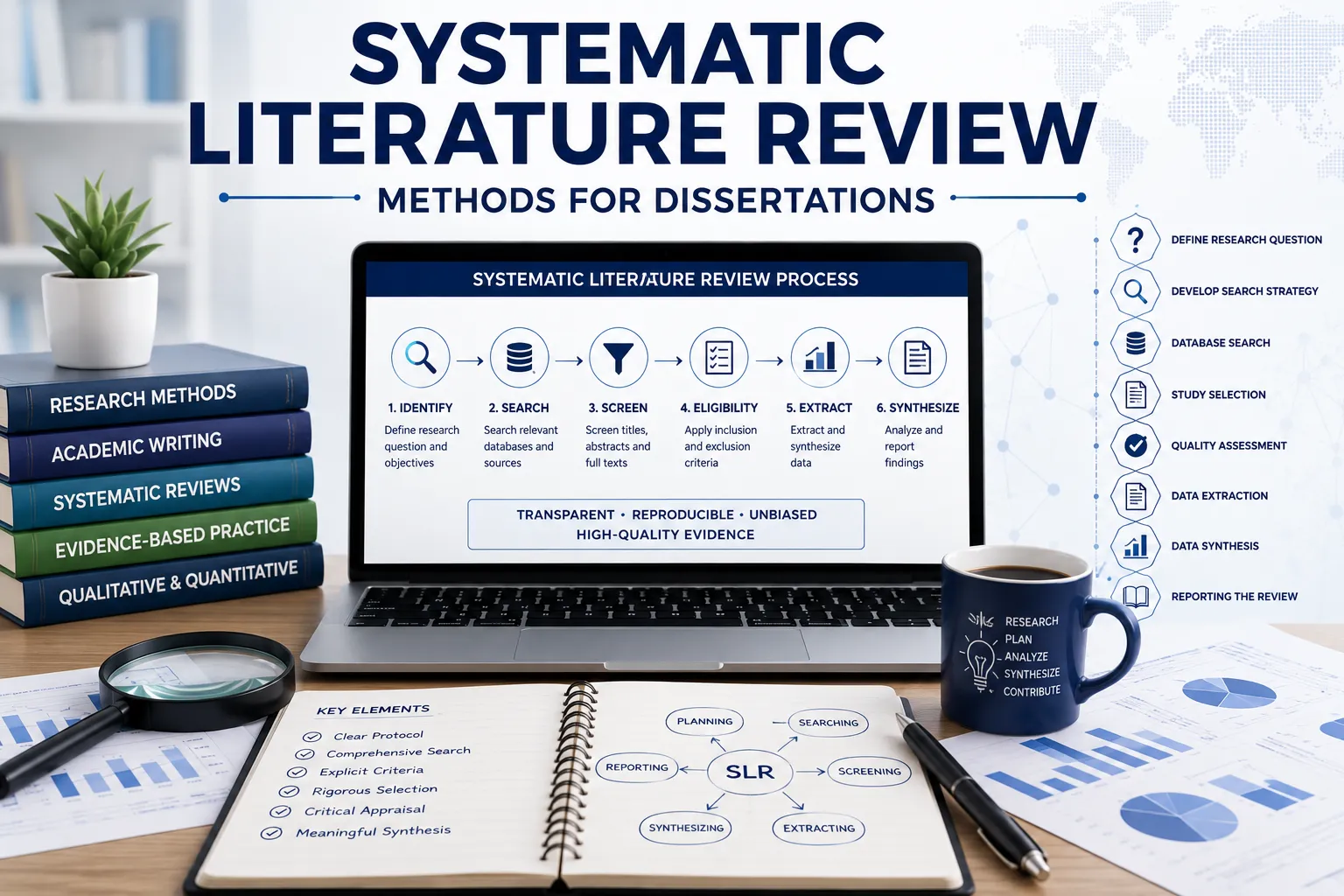
Not every literature review needs to be systematic — but if yours does, doing it properly means more than reading widely and organizing what you find by theme. A genuine systematic literature review follows a transparent, reproducible, and internationally recognized methodology, and increasingly, dissertation committees expect to see that methodology named and followed explicitly. This guide walks through systematic literature review methods for dissertations, centered on the PRISMA framework that has become the standard across disciplines.
Why "Systematic" Is a Specific Methodological Claim, Not a Description
PRISMA (Preferred Reporting Items for Systematic Reviews and Meta-Analyses) exists to solve a specific problem: incomplete reporting makes a systematic review impossible to properly appraise. A reader can't judge whether a review's conclusions are trustworthy without knowing how comprehensive the search was, how many studies were excluded and why, how risk of bias was assessed, and whether the synthesis method actually matched the underlying data.
This matters more than it might seem. Before structured reporting standards existed, reviews that called themselves "systematic" often weren't meaningfully distinguishable from narrative literature reviews with a more authoritative-sounding label attached. If your dissertation claims to conduct a systematic review, your committee will expect the actual methodology behind that claim — not just the word "systematic" in your chapter title.
Understanding the PRISMA Framework
PRISMA 2020, the current standard, updated the checklist to reflect advances in how reviews identify, select, appraise, and synthesise studies, with search reporting, risk-of-bias assessment, and certainty-of-evidence rating as central additions over earlier versions. The core checklist contains 27 items covering title, objectives, eligibility criteria, search strategy, risk of bias, and synthesis methods, among other elements. Each item should be addressed with a specific page or section reference in your completed review, since many institutions and journals require this as a supplementary table alongside the main text.
Choosing the Right PRISMA Extension
PRISMA isn't a single checklist — it's a family of extensions, each a distinct reporting standard rather than an optional add-on. The two most relevant for dissertation work are:
- PRISMA-P (2015) — for review protocols, containing 17 items, used if you're registering or documenting your review plan before conducting the search
- PRISMA-ScR (2018) — for scoping reviews, containing 20 essential items plus 2 optional items, used when your review is broader and more exploratory than a traditional systematic review, but still more structured than a narrative review
Selecting the correct extension for your specific review type matters — using the base checklist for what's actually a scoping review, or vice versa, signals a methodological mismatch to anyone evaluating your work closely.
The Four-Phase PRISMA Workflow
The standard PRISMA process follows four distinct phases, typically visualized in a PRISMA flow diagram that tracks how your initial search narrows down to your final included studies:
- Identification — your initial database search results, including duplicate records before removal
- Screening — title and abstract review to exclude records that are clearly irrelevant to your research question
- Eligibility — full-text review of remaining records against your explicit inclusion and exclusion criteria
- Inclusion — the final set of studies that pass all screening stages and form the basis of your review
Each phase's record count should be tracked and reported explicitly. This isn't just documentation for its own sake — the count at each stage is what allows your committee to judge how rigorous and reproducible your search actually was.
A Real Example of the Scale Involved
Published systematic reviews illustrate just how dramatically the initial search pool narrows through this process. One recent systematic review began with 673 candidate articles identified through database search, removed 36 duplicates (leaving 637), excluded 602 after title/abstract screening, and excluded a further 9 after full-text evaluation — arriving at a final included set of just 26 articles. This kind of narrowing is completely normal and expected; a systematic review with a small final count isn't a weak review, provided each stage of exclusion was conducted transparently and the reasoning is documented.
Step-by-Step: Conducting Your Systematic Literature Review
Step 1: Confirm a Systematic Review Actually Fits Your Question
Use PRISMA if your literature review aims to systematically map all relevant empirical studies on a well-defined research question. A traditional narrative review remains more appropriate when your field is too nascent for systematic coverage, or when your goal is a broad theoretical overview rather than exhaustive evidence synthesis. Not every dissertation literature review needs to be systematic — confirm this fits your actual purpose before committing to the additional rigor it requires.
Step 2: Register or Draft Your Protocol
If your review will be substantial, consider drafting a protocol following PRISMA-P before beginning your search. This documents your planned research questions, search strategy, and eligibility criteria in advance, which strengthens the credibility of your eventual review by making clear that your criteria weren't adjusted after seeing which studies they would include or exclude.
Step 3: Select Your Databases Deliberately
Common databases used for systematic literature searches include Scopus, Google Scholar, IEEE Xplore, Semantic Scholar, and DBLP, often used in combination since each database indexes different publishers and complements the others' coverage. A search restricted to a single database is generally considered a methodological weakness unless you can specifically justify why that one database provides sufficient coverage for your field. A practical selection approach: choose databases that provide comprehensive coverage of peer-reviewed journals in your specific field, ensure inclusion of high-quality academic publications, and are verifiably accessible through your institutional credentials.
Step 4: Write and Document Your Exact Search String
Report the precise search string you used, along with any date range or filter restrictions applied. This level of specificity is what makes your search reproducible — another researcher should be able to run your exact search string and arrive at a comparable initial result set.
Step 5: Set Explicit Inclusion and Exclusion Criteria Before Screening
Define your criteria clearly before you begin screening, not as you go. Criteria typically address publication date range, study type, language, population or context, and methodological requirements relevant to your research question.
Step 6: Screen in Two Stages
First, screen by title and abstract to remove clearly irrelevant records efficiently. Then conduct full-text review of the remaining records against your full eligibility criteria. Beyond the base PRISMA checklist, additional best practices for manual filtering are worth following — including tracking category-level details relevant to your specific research questions as you screen, and, if working with co-researchers, establishing clear shared guidelines for how manual screening decisions should be made.
Step 7: Assess Risk of Bias in Included Studies
For each study that makes it into your final included set, assess and report its risk of bias using an established tool appropriate to the study design. This step is central to PRISMA 2020's emphasis on reporting not just what studies were included, but how trustworthy their individual findings are.
Step 8: Synthesize, Don't Just Summarize
Once your final set of studies is confirmed, synthesize their findings — organized thematically, methodologically, or by outcome — rather than summarizing each study individually in sequence. This is where your systematic review moves from a documented search process into an actual scholarly contribution.
Step 9: Build and Include Your PRISMA Flow Diagram
Generate a PRISMA flow diagram showing the record counts at each of the four phases (identification, screening, eligibility, inclusion), and place it prominently in your literature review chapter. This diagram is often one of the first things a committee member familiar with systematic review methodology will look for.
Why a Systematic Review Strengthens a Dissertation
A systematic review offers a transparent, reproducible way to synthesize existing research, and for a dissertation specifically it does three things a narrative review typically can't do as convincingly: it demonstrates scholarly rigour by following an internationally recognised standard, it identifies genuine research gaps through structured, exhaustive search rather than selective reading, and it builds a solid theoretical foundation that anchors your own contribution in a comprehensive evidence base rather than a curated sample of literature.
Practical Checklist: Is Your Systematic Literature Review PRISMA-Ready?
- Confirmed a systematic review (rather than narrative or scoping review) genuinely fits your research question
- Correct PRISMA extension (base checklist, PRISMA-P, or PRISMA-ScR) identified for your specific review type
- Protocol drafted or registered before beginning the search, if applicable
- Multiple relevant databases selected and justified, not a single database
- Exact search strings documented for reproducibility
- Inclusion and exclusion criteria set explicitly before screening begins
- Two-stage screening (title/abstract, then full-text) conducted and documented
- Risk of bias assessed for included studies
- Findings synthesized thematically or methodologically, not just summarized study-by-study
- PRISMA flow diagram built and included, showing record counts at each phase
- All 27 PRISMA checklist items addressed with page/section references
Two Practical Scenarios
Scenario 1 — Choosing the Right Extension for a Scoping Question A scholar initially planned a full systematic review on a topic still too broad and underdeveloped in the literature to support a well-defined, narrow research question — a hallmark sign that a systematic review wasn't the right fit. After reviewing PRISMA-ScR's guidance for scoping reviews, the scholar shifted to a scoping review methodology instead, using the 20-item PRISMA-ScR checklist rather than forcing an ill-fitting systematic review structure onto an exploratory research question — a change that better matched both the maturity of the field and the scholar's actual research goals.
Scenario 2 — Justifying a Multi-Database Search Strategy A scholar initially searched only Google Scholar for a computer science-adjacent dissertation topic. A committee member flagged this as insufficient coverage. The scholar added IEEE Xplore and Scopus to the search strategy, since these databases specifically index major technical publishers not comprehensively covered by Google Scholar alone, and documented the exact search strings used across all three databases — strengthening the review's reproducibility and addressing the committee's original concern directly.
Common Mistakes Dissertation Writers Make With Systematic Reviews
- Calling a review "systematic" without following an actual documented methodology like PRISMA, using the label without the underlying rigor.
- Searching only a single database, missing coverage that a second or third database would have caught.
- Setting inclusion and exclusion criteria after screening has already begun, rather than defining them explicitly in advance.
- Skipping the PRISMA flow diagram, leaving reviewers to guess how the search process actually narrowed to the final included studies.
- Summarizing included studies one by one instead of synthesizing findings thematically across the full set.
Frequently Asked Questions
What are systematic literature review methods for dissertations?
They are structured, transparent, and reproducible approaches to literature review — most commonly following the PRISMA framework — involving explicit search strategies across multiple databases, defined inclusion and exclusion criteria, staged screening, risk-of-bias assessment, and thematic synthesis of the final included studies.
Why do systematic literature review methods matter for a dissertation?
A properly conducted systematic review demonstrates scholarly rigour through an internationally recognised standard, reveals genuine research gaps through exhaustive rather than selective search, and gives your own research contribution a comprehensive evidence base to build on.
How does systematic review methodology affect a dissertation's credibility?
Committees and examiners can verify a systematic review's reproducibility and thoroughness through its documented search strings, PRISMA flow diagram, and explicit criteria — a review lacking this documentation is difficult to distinguish methodologically from a narrative review, regardless of how it's labeled.
How long does it take to complete a dissertation using this approach?
A full systematic review typically takes longer than a narrative review due to the multi-database search, staged screening, and risk-of-bias assessment involved, but this investment often pays off in a stronger, more defensible literature review chapter.
Is professional help available for systematic literature review methods for dissertations?
Yes. ThesisLikho's PhD-qualified mentors have guided 10,000+ scholars through systematic review methodology, PRISMA-compliant literature searches, and complete dissertation writing assistance tailored to individual research questions.
Get Expert Guidance on Your Systematic Literature Review
Conducting a genuinely PRISMA-compliant systematic review takes careful planning across database selection, screening criteria, and synthesis structure — details that are easy to underestimate but heavily weighted by committees familiar with the methodology. If you'd like expert input on structuring your systematic review or verifying PRISMA compliance, ThesisLikho's PhD-qualified team offers systematic review methodology support, search strategy guidance, and complete dissertation writing assistance. If you need expert guidance with your literature review, search methodology, or overall dissertation structure, you can explore our Dissertation Writing Assistance service.
Get Dissertation Help Now → https://thesislikho.com/writing-services/dissertation-writing